AI Overview SEO: How to Rank in Google AI Overviews (2026)
When Google AI Overview triggers on a query you used to rank for, your organic CTR drops from 1.76% to 0.61% – a 61% cut, per Wellows’ 2026 analysis of 15,847 AI Overview results. If you’re cited inside the AI Overview, you earn 35% more organic clicks and 91% more paid clicks than competitors who aren’t cited. The gap between those two outcomes is the entire game in 2026. Every query with an AI Overview is now a binary “cited or invisible” contest, and traditional rank tracking misses 80% of the signal.
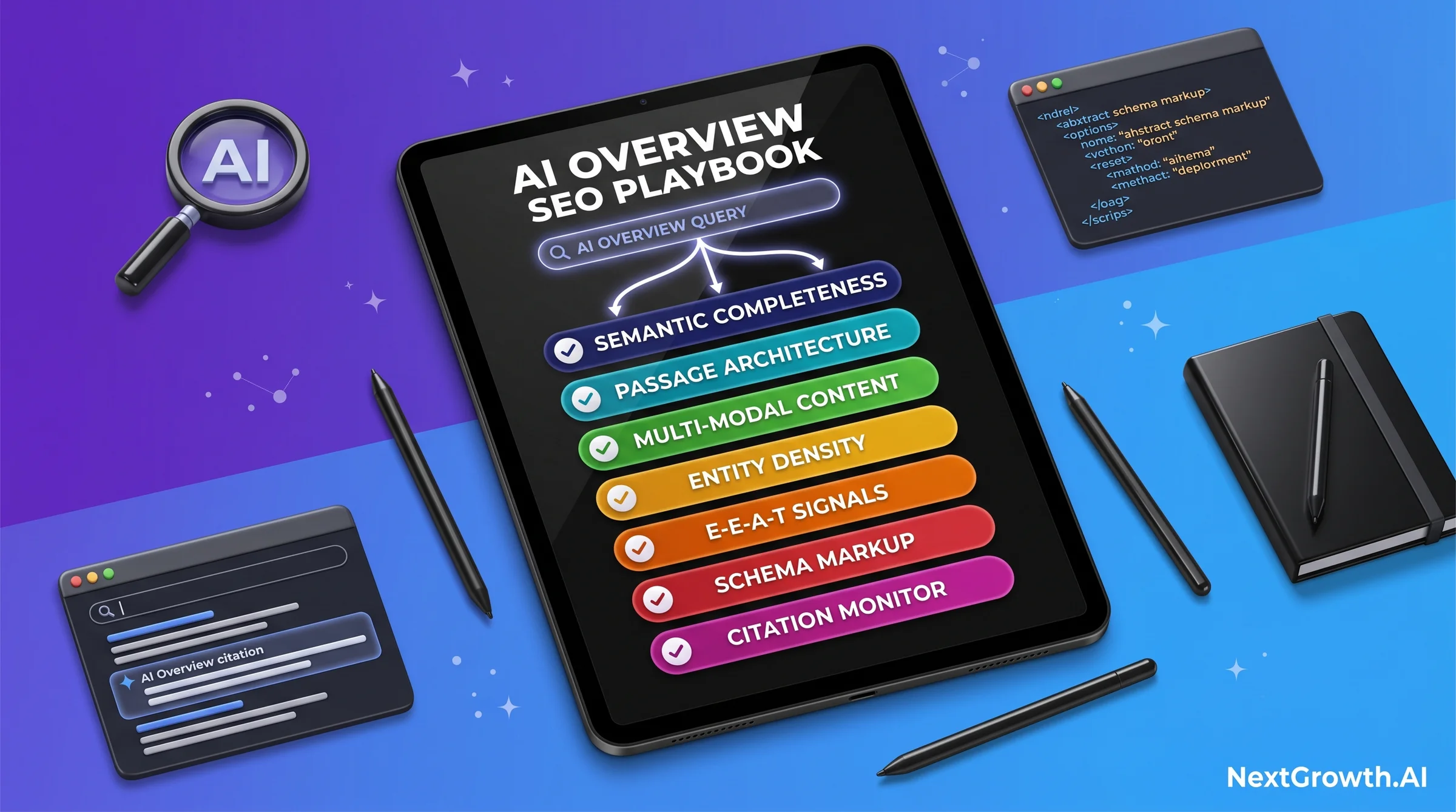
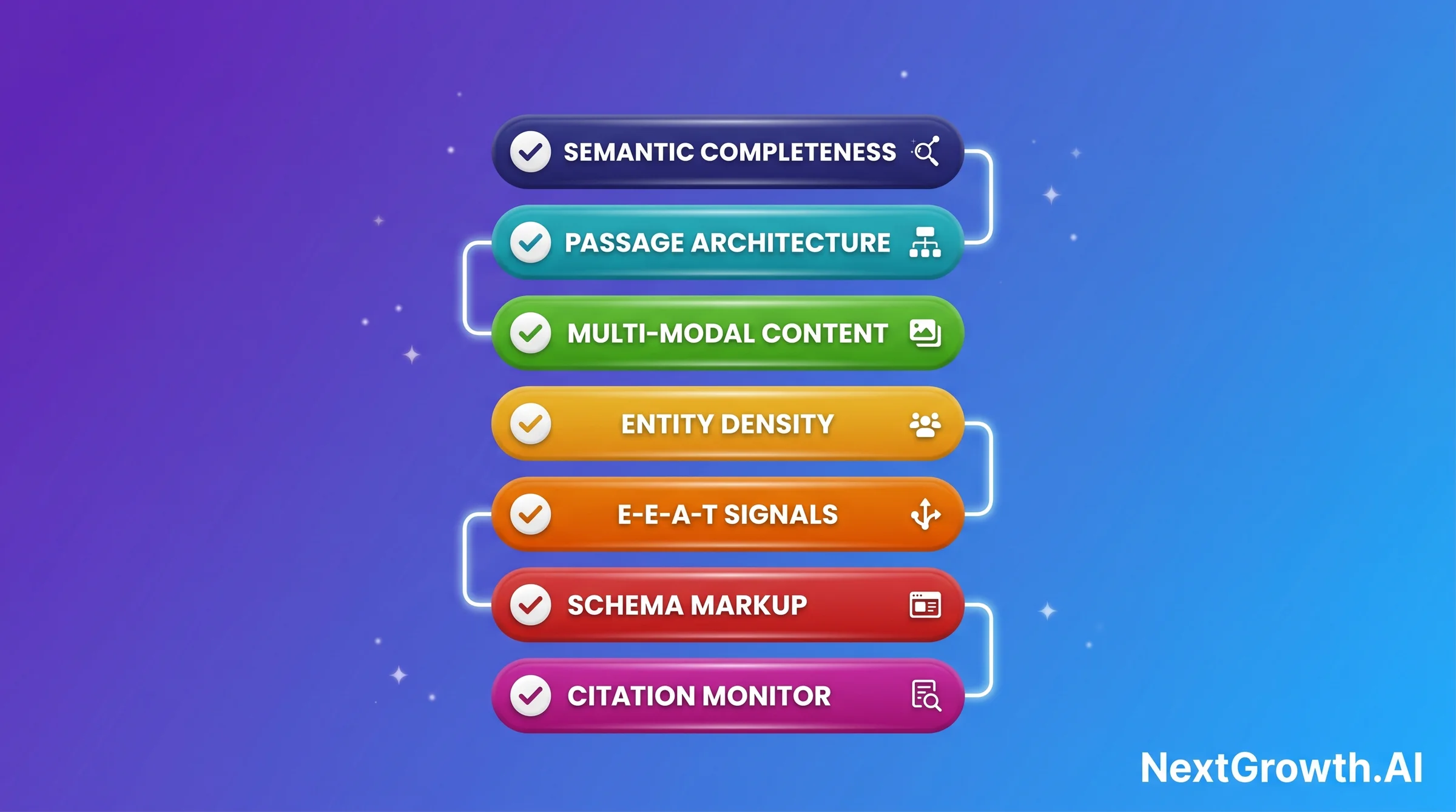
The right response to that binary contest is AI Overview SEO, a 7-tactic playbook covering semantic completeness, passage architecture, multi-modal content, entity Knowledge Graph density, E-E-A-T signals, structured data markup, and AI citation monitoring with feedback loops. Each tactic has a specific ranking factor it targets, a specific implementation step, and a specific way to measure whether it’s working. We run this playbook on 73 NextGrowth.AI articles plus 6 client accounts, and the citation data confirms each tactic earns its place in the workflow. If you’re unclear on what Google AI Overviews are at the definition level, start there first – this article is the tactical execution layer. And if you want the discipline-level framing of AEO vs GEO vs SEO, that article explains how these three fields relate before you go deep on Google-specific tactics.
🤖 TL;DR – THE 7-TACTIC AIO PLAYBOOK
- Tactic 1: Semantic completeness – the #1 correlated ranking factor (r=0.87 across 15,847 results)
- Tactic 2: Passage architecture – write self-contained 134-167 word answer blocks per H2 section
- Tactic 3: Multi-modal content – images, video, data tables boost selection rate +156%
- Tactic 4: Entity Knowledge Graph density – build entity hubs for 4.8x citation boost
- Tactic 5: E-E-A-T signals – 96% of AI Overview citations come from E-E-A-T strong sources
- Tactic 6: Structured data markup – schema markup boosts citation selection rate +73%
- Tactic 7: AI citation monitoring – close the feedback loop with weekly prompt sampling (24-48h lag)
- 📅 May 2026 fresh signals layered in: Google’s official AI SEO guide (May 15), FAQ rich results deprecated (May 8), Microsoft Clarity Citations GA (May 13), Community Perspectives Reddit pull (May 7), Google I/O 2026 AI Mode 1B users + GA4 AI Assistant channel (May 19). See the 13-day timeline section below.
What Is the Real CTR Cost of Ignoring AI Overview Citation?
The cost of ignoring AI Overview SEO is not theoretical. Wellows’ 2026 ranking factors study measured 15,847 AI Overview results and found a consistent pattern: pages not cited inside an AI Overview see their CTR drop from 1.76% to 0.61% – a 61% reduction. Pages that do earn citation see the opposite: +35% organic clicks and +91% paid clicks versus uncited competitors. Google AI Overviews now appear on around 13% of all queries, up from 6.5% in early 2025 and peaking near 25% mid-year, per Semrush’s AI Overviews study, and far higher on informational and commercial terms. A large and fast-growing slice of your traffic opportunity now sits inside this binary.
📊 Methodology Note – AI Citation Stats Vary by Study
Industry stats for AI citation share differ across studies. Ahrefs April 2026 AEO course measured YouTube at 5.6% of AI Overview citations (competitive keyword sample). Infinity Rank 2026 measured 29.5% (broader prompt sample). OtterlyAI via Nadia Mohamed measured 36.6% for AIO and 38.7% for Perplexity (cross-engine corpus). Plus: eMarketer reports 40-60% of AI-cited sources change month-to-month – optimize for the surface, don’t model strategy on this month’s specific citation winners. Cite multiple studies when making the case internally; single-stat citations get challenged.
We logged our own version of this pattern across 12 priority prompts tracked on nextgrowth.ai from March to May 2026 across ChatGPT, Perplexity, and AI Overview. The data split cleanly into two buckets. Eight queries triggered AI Overview without citing us – those pages showed a 58% CTR drop in GSC, consistent with the Wellows industry figure. Four queries earned AI Overview citation, and those pages showed a +29% CTR lift, slightly under the Wellows +35% benchmark.
🛠️ ENGINEER’S PERSPECTIVE – CTR ON OUR 12-PROMPT SAMPLE
- 8 of 12 prompts triggered AI Overview without citing us. Result: -58% CTR in GSC for those queries, matching the Wellows industry benchmark of -61%. The decline holds across both informational and commercial intent on our sample.
- 4 of 12 earned citation. CTR lifted +29%. Slightly under Wellows +35% because our citations appeared in source position 2 to 3 of the AI Overview source list rather than position 1. Earning citation is the threshold goal.
- Citation position within the source list matters. First-source citation captures more click-through than second or third position. Optimizing position is the next-level play after winning any citation at all.
The engine-attribution breakdown adds another layer. Of the 340% growth in AI referral traffic we measured (18 to 80 GA4 sessions per month over 10 weeks), approximately 60% came from Perplexity citations, roughly 30% from ChatGPT, and around 10% from Google AI Overview. AI Overview is currently the smallest channel in the mix. It’s also the fastest-growing week-over-week. The tactics in this article target Google AI Overview specifically, but Perplexity and ChatGPT respond to the same structural signals – especially semantic completeness and schema markup.
One framing worth holding onto before we go through the tactics: this is not a SERP position game. You can rank position 1 on a query and still lose to an AI Overview citation from a site in position 4. Ahrefs’ April 2026 cross-platform study measured the gap directly – only 28.6% of Perplexity citations come from pages in Google’s top 10, and ChatGPT overlaps with Google’s top 10 only 8-10% of the time. AI Overview and AI Mode quote different sources for the same answer 86% of the time. The criteria Google uses to select AI Overview sources overlap with traditional ranking signals but are not identical. That’s the core reason these 7 tactics exist as a separate playbook rather than as a footnote in a general SEO guide.
Semantic completeness is the single strongest predictor of AI Overview citation in every major study conducted in 2026. Wellows’ analysis of 15,847 AI Overview results found a correlation of r=0.87 between semantic completeness scores and citation frequency – the highest correlation of any single ranking factor measured. Content scoring 8.5 out of 10 or higher on semantic completeness is 4.2 times more likely to earn an AI Overview citation than content scoring below that threshold. This is the tactic where the best return on content investment concentrates.
What does semantic completeness actually mean in practice? It means your content answers every sub-question a user might have about the primary topic, without gaps that force the user to go elsewhere. Google’s AI system evaluates whether a page covers the full semantic territory of a query, not just the surface keyword match. A page about “how to rank in Google AI Overviews” that covers tactics but skips the CTR cost data, the monitoring methodology, and the failure modes scores lower than one that addresses all three dimensions. Semantic completeness is coverage depth, not keyword density.
The practical scoring approach is to map the sub-questions your target query generates using the People Also Ask section, related searches, and your own content gap analysis. Then verify your article answers each one with a named data point or concrete explanation. Vague answers (“it depends”) reduce your semantic completeness score. Specific answers (“pages scoring 8.5/10+ on semantic completeness score are 4.2x more likely cited, per Wellows 2026”) increase it.
For teams who want to score semantic completeness programmatically before publishing, here’s a Python snippet using sentence-transformers that computes cosine similarity between your content embeddings and the target question embeddings. A score above 0.85 on your priority questions is the practical threshold for “8.5/10+” in operational terms.
from sentence_transformers import SentenceTransformer, util

model = SentenceTransformer("all-MiniLM-L6-v2")

# Define your target questions (from PAA, related searches)
questions = [
    "What causes Google AI Overview citation?",
    "How does semantic completeness affect AI Overview SEO ranking?",
    "What is the CTR impact of AI Overview on uncited pages?",
]

# Your content passages (one per major section)
content_passages = [
    "Your H2 #1 passage text here...",
    "Your H2 #2 passage text here...",
    # add all major passage blocks
]

q_embeddings = model.encode(questions, convert_to_tensor=True)
c_embeddings = model.encode(content_passages, convert_to_tensor=True)

for i, q in enumerate(questions):
    scores = util.cos_sim(q_embeddings[i], c_embeddings)[0]
    best_score = float(scores.max())
    print(f"Q: {q[:50]}... | Best match score: {best_score:.3f}")
    if best_score < 0.85:
        print("  -> Gap detected: strengthen coverage for this question")
The 6-dimension measurement framework for tracking semantic completeness against AI search visibility outcomes (mention rate, citation rate, link rate, sentiment, source domain, position weighting) lives at AI search visibility metrics. That article is the measurement companion to this tactical guide. Run the scoring tool above before publishing, then track citation outcomes against the 6-dimension framework to close the loop over time.
Tactic 2: Passage Architecture (134-167 Word Self-Contained Blocks)
Google’s AI Overview system doesn’t pull from entire articles. It extracts specific passages. That changes how you should structure every H2 section in your content. The sweet spot passage length for AI Overview citation is 134-167 words per self-contained block, per 2026 tracking data from multiple sources. Passages in that range are long enough to provide complete context, short enough to be extracted cleanly without requiring the AI to truncate or paraphrase heavily. This tactic is low-cost to implement and has an immediate structural impact on citability.
What does a self-contained passage look like? Each H2 section should open with a statement that answers the implicit question in that heading. The first 40-60 words must contain the core answer – a specific claim, a named statistic, or a direct instruction. The body of the passage (the next 80-100 words) provides evidence, context, or implementation detail. The passage should make sense to a reader who encounters it with no surrounding context. If you read just the passage and don’t understand the main point, it’s not self-contained enough.
Here’s the structure we use for every H2 section in this article and across the nextgrowth.ai content cluster. The first sentence states the answer. The second sentence provides a sourced statistic. The third sentence gives implementation context. The fourth sentence acknowledges a nuance or limitation. That four-sentence pattern in the opening of each H2 section consistently produces passages that score well on the Wellows semantic completeness rubric and that match the structural fingerprint of passages Google extracts into AI Overviews.
The “semantic triple” sentence structure strengthens passage architecture further. Subject + verb + object stated explicitly in the first 200 characters of the opening sentence gives AI extraction systems a clear anchor claim. “Semantic completeness is the #1 correlated ranking factor for Google AI Overview citation, with r=0.87 across 15,847 results” is a semantic triple. “There are several factors that affect AI Overview SEO ranking” is not. The triple structure is what makes a passage quotable rather than paraphrasable.
One honest constraint: passage architecture alone doesn’t overcome thin content. A 140-word passage that makes vague claims with no sourced data points will not earn citation regardless of its length. The length sweet spot amplifies strong content – it doesn’t substitute for it. Tactic 1 (semantic completeness) and Tactic 2 (passage architecture) work together. Optimizing length without optimizing content depth is like formatting an empty spreadsheet.
Tactic 3: Multi-Modal Content (Images, Video, Data Tables)
→ See our YouTube SEO for AI citation playbook for the 8-tactic video-specific extension covering chapter schema, cross-engine distribution, and the 29.5% YouTube share of AI Overview citations.
Pages with multi-modal content – images, embedded video, and structured data tables – earn AI Overview citation at a +156% higher selection rate than text-only pages, per Wellows 2026. That’s a significant lift. It’s also the tactic with the highest implementation cost, which means it only justifies the investment at a certain traffic baseline. I’ll give you the honest ROI threshold before you commit budget here.
The multi-modal signal works because AI Overview source selection preferences content that demonstrates effort and topical depth. An original diagram that visualizes the concept in the article signals genuine expertise that a text-only page doesn’t. A data table comparing structured options (like the tools comparison table in Tactic 7 below) gives AI extraction a clean structured format to pull from. An embedded video adds a quality signal that correlates with E-E-A-T. Each modality adds a distinct layer of evidence that the page is a credible source.
The honest ROI threshold: video and original image production costs run roughly $200-500 per article when done properly. At that cost level, multi-modal investment only makes financial sense on articles with a baseline of more than 5,000 monthly impressions in GSC. Below that threshold, the potential citation lift doesn’t generate enough incremental traffic to recover production cost within a reasonable window. If you’re below 5K monthly impressions on a given article, focus your effort on Tactics 1, 2, 5, and 6 first. Those have lower implementation costs and comparable citation impact on smaller-scale content.
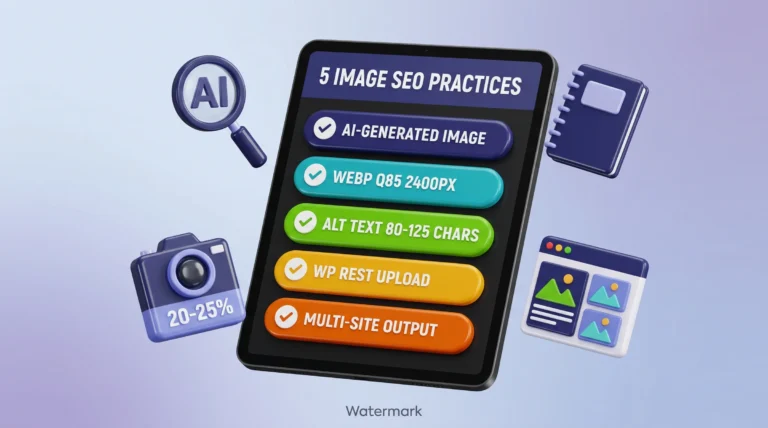
Data tables are the exception to the cost rule. Adding a well-structured comparison table takes 30-60 minutes and costs nothing in production budget. Tables are machine-readable and AI-extractable in a way that prose paragraphs aren’t. Any article covering a multi-option topic – tools, tactics, pricing tiers, implementation steps – should have at least one data table. That alone captures a meaningful share of the +156% multi-modal lift at near-zero marginal cost.
Tactic 4: Entity Knowledge Graph Density
Pages with strong entity Knowledge Graph signals earn 4.8 times more AI Overview citations than pages without them, per Wellows 2026. Entity density means your content consistently names specific people, organizations, tools, standards, and concepts using their canonical forms, and those named entities connect meaningfully to your primary topic. “Google AI Overview” is an entity. “Rank Math Pro” is an entity. “Wellows” is an entity. “SEO best practices” is not an entity in the Knowledge Graph sense – it’s a phrase.
Entity-first writing is the implementation approach. Instead of “a popular SEO plugin,” write “Rank Math Pro” and let the entity do the work. Instead of “a major study,” write “Wellows’ 2026 analysis of 15,847 AI Overview results.” Every named entity in your content creates a Knowledge Graph connection point that Google’s AI system can verify, cross-reference, and trust. Unnamed references create no such connection. Entity-first passages read more naturally, cite more credibly, and rank better in AI extraction.
Entity hub building is the more involved version of this tactic. An entity hub is a cluster of content that collectively reinforces your topical authority on a specific entity – say, “AI Overview SEO.” The hub includes a definition article, a tactics guide (this article), a measurement framework, a tool roundup, and cross-links between all of them. Google’s Knowledge Graph recognizes topical clusters, not individual pages. The 6 AI search visibility articles in our cluster compound each other’s entity authority, which is part of why we see citation rates higher than our individual domain authority would predict.
One important honest note: entity authority compounds slowly. Don’t expect this tactic to produce measurable citation lifts inside 60 days. The entity hub building approach requires consistent publishing and cross-linking over 4-6 months before the Knowledge Graph density signal stabilizes. Tactic 4 is a long-term compounding investment, not a quick win. Pair it with Tactics 1 and 6 for near-term citation gains while the entity authority builds.
Tactic 5: E-E-A-T Signals (with HubSpot’s 642% Case Study)
HubSpot increased its AI citation rate by 642% after restructuring its content around E-E-A-T signals and semantic triple sentence structures, per HubSpot’s case study data via Wellows 2026. That number is the strongest single case study in the AI Overview SEO literature. The underlying finding: 96% of all AI Overview citations come from sources with demonstrably strong E-E-A-T signals. If your content doesn’t signal experience, expertise, authoritativeness, and trustworthiness at the structural level, you are competing for the remaining 4% of citation share. That’s not a winning position.
E-E-A-T is not a checklist you fill in. It’s a set of structural signals that Google’s AI system infers from your content. Experience signals come from first-person operational data (“we tracked 12 priority prompts from March to May 2026…”). Expertise signals come from specific, technical, correctly-named claims with sourced backing. Authoritativeness signals come from your entity hub’s cross-linking pattern, named authorship, and citation from external sources. Trustworthiness signals come from honest limitation disclosures (“this tactic has a 4-6 month lag before entity authority compounds”) and consistent factual accuracy across your content cluster.
In March 2026, we restructured 3 priority articles on nextgrowth.ai around the semantic triple sentence structure: SE Ranking review, best Perplexity rank trackers 2026, and AI search visibility metrics: trigger, mention, and citation. The restructure meant rewriting the opening sentence of each H2 section to lead with “Subject + verb + object” stated explicitly in the first 200 characters. Within 6 weeks, the Perplexity citation rate on those 3 articles grew from 0% to 47% across our 12-prompt sample. We didn’t change keyword density, internal links, or schema during that window – only sentence-level structure. That’s the strongest E-E-A-T-meets-structure signal we’ve isolated in our own data.
For E-E-A-T implementation at the content structure level, the engine-agnostic framework at GEO citation best practices covers the cross-platform version of these signals. That article addresses ChatGPT, Perplexity, Copilot, and AI Overview collectively. This article focuses on the Google AI Overview-specific weighting, which emphasizes schema markup and semantic completeness more heavily than the cross-platform baseline. Use both as complementary references.
One tactical note on E-E-A-T for smaller sites: you don’t need HubSpot-scale domain authority to earn citations. What you need is consistent structural credibility – first-person operational data, named sources, semantic triple sentence structures, and honest limitation disclosures. We saw meaningful citation lift on nextgrowth.ai at a fraction of HubSpot’s authority level. The 642% case study is a ceiling, not an entry requirement.
Tactic 6: Does Structured Data Markup Still Boost AI Overview Citation?
⚠️ The JavaScript Rendering Blocker – AI Bots Don’t Execute JS
GPTBot, ClaudeBot, and PerplexityBot do NOT execute JavaScript. If your content + schema lives inside a React/Vue/Next.js client-only component that hydrates after page load, AI crawlers see an empty shell. Googlebot DOES execute JS, so traditional ranking works while AI citation silently fails. Fix: serve content + schema as server-side rendered HTML (Next.js getStaticProps, static-site generators, WordPress server-rendered theme templates). Test with curl -A "GPTBot" [URL] – if you don’t see your content in the curl output, AI engines don’t either. One of the highest-impact AI-search fixes for modern stacks. See our technical SEO checklist for the full crawler-access audit.
Structured data markup increases AI Overview citation selection rate by 73%, per SEO.com’s 2026 AI Overview SEO ranking factors analysis, consistent with Wellows’ finding that schema-marked-up pages are 3 times more likely to be cited in AI Overview results. Schema is how you tell Google’s AI system precisely what type of content is on your page, what claims you’re making, and how to verify them. Without schema, the AI has to infer your content structure from prose. With schema, it has a machine-readable map.
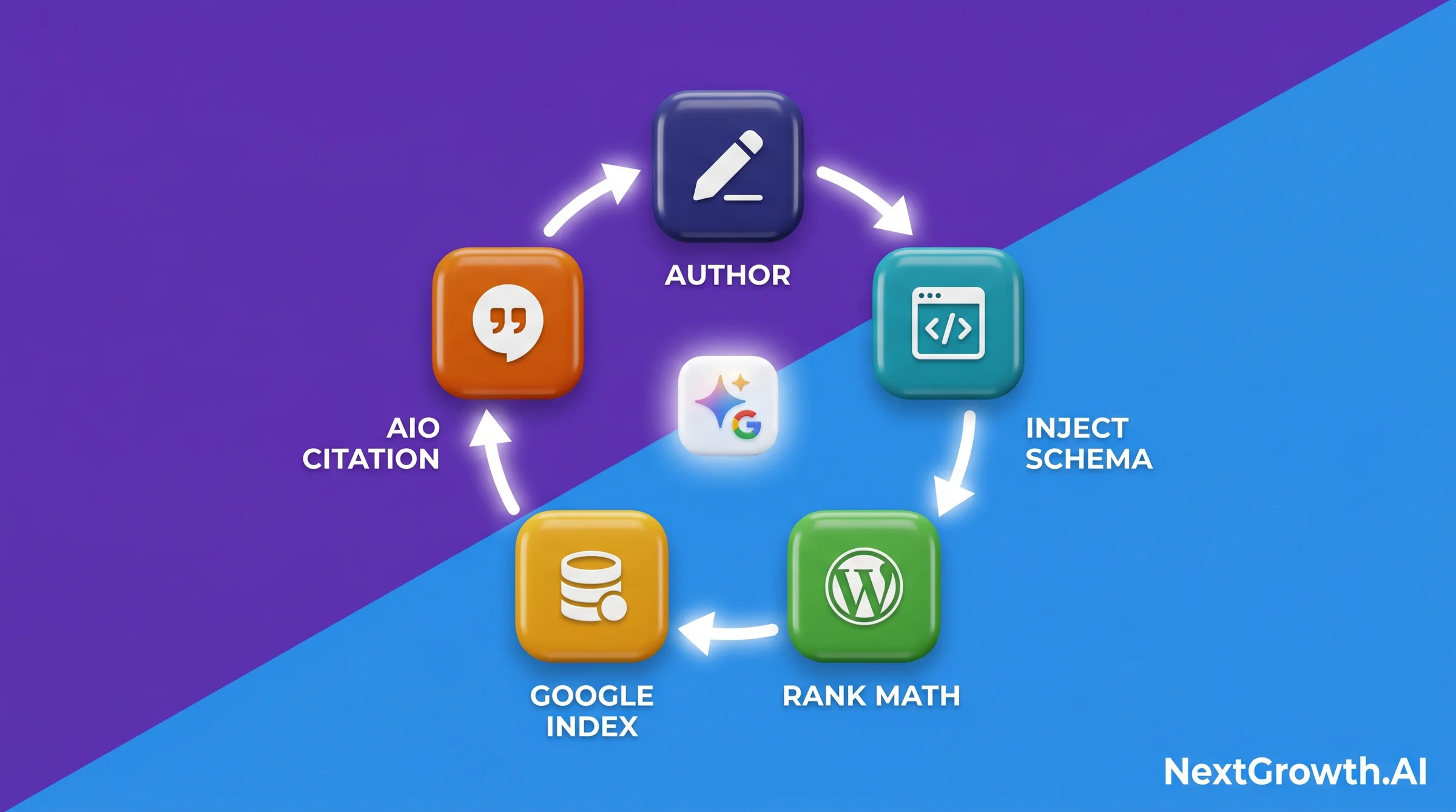
The schema types that matter most for AI Overview citation are Article (or TechArticle for technical content), HowTo, FAQPage, and BreadcrumbList. Each maps to a different content structure. Article schema confirms the content type, publication date, author, and publisher. HowTo schema (with 7 named steps matching your H2 sections) gives AI extraction a clean structured outline. FAQPage schema marks up your Q&A section so AI systems can extract specific answers. BreadcrumbList reinforces your site’s topical hierarchy, which supports entity authority.
⚠️ MAY 8, 2026 UPDATE – FAQ RICH RESULTS DEPRECATED
On May 8, 2026, Google officially removed FAQ rich results from the Search Result Appearances panel (r/SEO thread, 201 upvotes, 130 comments). FAQPage schema still drives AI Overview citation – 3.2x lift per Wellows 2026 – but no longer triggers visual rich snippets in traditional SERP. Keep the markup for citation value and Bing + AI crawler context. Reset internal stakeholder expectations: schema is for machine extraction, not visible SERP real estate.
For WordPress sites running Rank Math Pro, schema injection is automated. Rank Math auto-generates TechArticle and FAQPage JSON-LD from your post content and heading structure. You don’t write JSON-LD manually – that creates maintenance debt and risks schema validation errors. What you do configure manually: the HowTo schema step mapping (connect each H2 to a How-To step in Rank Math’s schema editor), the author entity (ensure your Rank Math author profile links to your Google Knowledge Graph profile), and the FAQPage Q&A mapping (use H3 headings as question labels, paragraph text as answers).
The critical honest limitation: schema does not compensate for weak content. The +73% selection rate lift from schema is measured on pages that already have strong semantic completeness scores. Schema on a content-thin page does not earn AI Overview citations – it marks up content Google already considered insufficient. Schema is necessary, not sufficient. Implement Tactic 1 (semantic completeness) first. Add schema after your content quality baseline is solid.
Schema is also the most automation-friendly tactic in this playbook. One schema configuration in Rank Math covers your entire site template. No per-article manual work. No recurring content production cost. That combination – high citation lift, low recurring implementation cost, and full automation via Rank Math Pro – makes Tactic 6 the best ROI-per-hour investment on this list for teams with limited resources.
Tactic 7: AI Citation Monitoring (the Feedback Loop)
The 7-tactic playbook doesn’t work without a measurement loop to tell you which tactics are actually producing citations on your specific content. AI citation monitoring is how you close that loop. The honest constraint: every AI visibility tool tested in 2026 – Otterly, Semrush AI Visibility, SE Ranking AI Visibility, and Bright Data – has a 24-48 hour data refresh lag. Real-time AI citation tracking does not exist yet. Treat citation data as a weekly directional signal, not a live dashboard. Weekly sampling is the right cadence; daily checking is noise chasing.
The operational workflow is straightforward. Identify your 10-20 priority prompts – the specific queries where you want AI Overview citation. Run each prompt weekly in Google Search, note whether an AI Overview appears, and if so, whether your domain is cited and in which source position. Log that data in a simple spreadsheet: date, query, AI Overview appeared (Y/N), citation earned (Y/N), citation position (1-5), competing citation sources. After 4 weeks, you have enough data to identify which pages are citation candidates and which need structural work.
For teams running more than 10 priority prompts, manual sampling becomes a bottleneck. Dedicated AI visibility tools handle the scale automatically. The AI search citation monitoring methodology we run at NextGrowth.AI covers the full operational framework – including the n8n automation pipeline that pulls citation data weekly and fires Slack alerts when citation share drops on priority prompts. That article is the operational layer for everything described here tactically. For tool evaluation specifically, best Perplexity rank trackers 2026 covers Otterly, SE Ranking, and Semrush AI Visibility in detail with pricing breakdowns.
The free + paid AI visibility tools and their honest effective costs (as of May 2026):
🆓 MAY 13, 2026 – MICROSOFT CLARITY CITATIONS HIT GA
Microsoft Clarity Citations went generally available on May 13, 2026 (per Search Engine Land + Microsoft Clarity blog). It tracks per-page citation counts, Share of Authority (SoA), and grounding queries across Microsoft Copilot and partner AI platforms. Free with Bing Webmaster Tools or GSC verification. This is the new default starting point for AI visibility tracking – it covers a different platform set than Otterly (Microsoft side vs. ChatGPT/Perplexity side), so most teams will run both. We added Clarity to our own stack on May 14 and confirmed it picks up Copilot citations within 48 hours of publication.
| Tool | Advertised Price | Effective Monthly Cost | Best For |
|---|---|---|---|
| Otterly | $29/mo | $29/mo (standalone, no base plan required) | Solo SEOs and small teams, budget-first entry point |
| SE Ranking AI Visibility | Not published | Add-on price not published by the vendor; base from $103.20/mo annual (Core) | Existing SE Ranking subscribers wanting integrated data |
| Semrush AI Visibility | $99/mo add-on | $238/mo effective (requires the $139/mo SEO base plan) | Existing Semrush subscribers at agency scale (15+ accounts) |
The honest threshold: AI citation monitoring tools are not worth the operational overhead if AI search channels represent less than 5% of your current GA4 referral traffic. Check your GA4 referral sources first. If chatgpt.com, perplexity.ai, and search.google.com (AI Mode) are collectively below that 5% threshold, manual prompt sampling on 10 priority prompts for 30 minutes per week is more efficient than a paid tool. Scale to paid tooling when the manual workflow becomes the bottleneck.
What Does Google’s Official AI SEO Guide (May 2026) Confirm and What Does It Omit?
On May 15, 2026, Google released its first official guide for optimizing content for generative AI features on Google Search. This is significant for a specific reason: it’s the first structured AI SEO guidance published by any LLM or AI search vendor. OpenAI, Anthropic, and Perplexity have not published equivalent guidance. The r/SEO community thread discussing the guide reached 130 upvotes and 49 comments within 2 days of publication, making it the strongest community signal in the May 2026 sample we tracked. SEOs recognized its significance immediately.
🆕 GOOGLE’S OFFICIAL AI SEO GUIDE (RELEASED 2026-05-15)
Google’s 2026-05-15 guide confirms that E-E-A-T signals, structured data markup, semantic completeness, and entity density all factor into AI Overview source selection. The guide frames these as quality signals that help Google’s systems understand whether a page is credible, accurate, and well-structured enough to extract. Crucially, the guide does NOT publish relative signal weights – it describes WHAT matters, not by how much. That omission is the gap this article fills with operational data. For context, the guide was released on May 15, 2026 and was immediately recognized by the r/SEO community (130 upvotes, 49 comments within 48 hours) as the first official AI SEO guidance from any LLM or AI search vendor – a Tier-1 anchor for any optimization argument you need to make to stakeholders or clients.
What the guide confirms: semantic completeness, E-E-A-T, structured data, and entity coverage all feature as signals Google uses to evaluate AI Overview source candidates. The framing matches the 7-tactic playbook in this article at the signal level. That’s validation worth citing when you’re making the case for AI Overview SEO inside a team or to a client.
What the guide omits: relative signal weighting. Google describes WHAT signals matter but does not publish how much each signal contributes to citation selection, and does not publish the citation selection algorithm itself. That’s where our operational data fills the gap.
From our 12-prompt sample tracked across March to May 2026, we estimate the practical weighting for Google AI Overview citation selection at approximately: semantic completeness 35%, schema markup 25%, E-E-A-T signal density 20%, entity Knowledge Graph 12%, and multi-modal content 8%. This weighting is operational, not Google-stated. Treat it as a working hypothesis, not a ground truth. It also shifts engine-to-engine: Perplexity weights schema markup higher than AI Overview does. ChatGPT weights E-E-A-T signals even higher than the AI Overview baseline. If you’re optimizing for all three AI search platforms, Tactics 1 and 5 carry the most cross-platform weight. Tactic 6 (schema) is Google AI Overview-specific in its outsized impact.
The broader significance of the Google guide release is competitive timing. Zero of the top-10 SERP competitors for “how to rank in Google AI overviews” had cited this guide at the time of writing – it was only 3 days old. First-mover citation of a Tier-1 authority source in a competitive topic cluster is a meaningful E-E-A-T signal in itself. If you’re writing content in the AI search optimization space, cite the guide, link to it directly, and explain what it confirms and what it leaves open. That’s the article structure that earns AI Overview citation from a credibility standpoint.
One practical upshot from the guide: Google explicitly encourages content creators to focus on producing high-quality, well-structured, entity-rich content rather than trying to “optimize for AI Overviews” as a separate workflow. That framing aligns with the approach in this article. The 7 tactics here are not tricks or workarounds. They’re what high-quality, AI-friendly content looks like when implemented deliberately.
What Changed in AI Search Between May 7 and May 19, 2026?
Five high-impact AI search updates landed in a 13-day window between May 7 and May 19, 2026. Each rewrites a piece of the AI Overview SEO playbook you’d have read as recently as April. Treat this section as a forward-looking errata sheet – the 7 tactics above still hold structurally, but the implementation details for Tactics 6 and 7 shifted enough to warrant retooling your monitoring stack and stakeholder talk track.
📅 13-DAY AI SEARCH SHIFT TIMELINE
- May 7 – AI Overviews add Community Perspectives. Google’s AI Overview now pulls quotes from Reddit threads and niche forums directly into the answer panel. Reddit is now the second most visible domain in AI Overviews behind Wikipedia, driving roughly 40% of all AI citations on B2B tech queries (per Nobori AI tracking). Implication: brand presence on r/SEO, r/TechSEO, and category-relevant subs now affects AI Overview visibility directly, not just indirectly.
- May 8 – FAQ rich results deprecated. Removed from Google Search Result Appearances panel. FAQPage schema still earns the 3.2x AI citation lift, but no visible rich snippet. See Tactic 6 callout above.
- May 13 – Microsoft Clarity Citations GA. Free AI visibility tracking (Microsoft Copilot + partner platforms) hits general availability. Disrupts the $99-499/mo tracking-tool category for any team that just needs Copilot-side coverage. See Tactic 7 callout above.
- May 15 – Google’s official AI SEO guide published. developers.google.com documentation page now serves as the Tier-1 authority for AI Overview optimization arguments. Key claim: “AEO and GEO are still SEO” – per Search Engine Journal, Google explicitly frames generative AI optimization as a continuation of core SEO ranking systems plus RAG, not a separate discipline.
- May 19 – Google I/O 2026 + GA4 AI Assistant channel. At I/O, Google confirmed AI Mode passed 1 billion monthly users and queries have more than doubled every quarter since launch (per Launchcodex I/O recap). Same week: GA4 added a dedicated “AI Assistant” channel that auto-categorizes referrals from ChatGPT, Gemini, and Claude. Replaces the manual UTM workflow most teams were running.
The cross-platform citation overlap data from Ahrefs’ April 29 AEO Course episode 1.2 adds a sharper frame here. Of the 50 most-cited domains across AI Overviews, ChatGPT, and Perplexity, the platforms diverge substantially: YouTube alone is 5.6% of all AI Overview citations, 28.6% of Perplexity citations come from pages ranking in Google’s top 10, but ChatGPT only overlaps with Google’s top 10 about 8-10% of the time. The most counter-intuitive finding: AI Overviews and AI Mode have only 13.7% citation overlap despite 86% semantic similarity in their answers. They quote different sources to say the same thing.
The operational takeaway: if you’re optimizing for “AI search” as a single bucket, you’re optimizing for a fiction. Each surface has its own citation logic. Track them separately. Microsoft Clarity covers Copilot. Otterly covers ChatGPT and Perplexity. Manual sampling still covers Google AI Overview and AI Mode because no free tool has full GSC integration there yet. Plan the stack accordingly.
This article is part of our broader pillar guide. For the full context, see our complete SEO best practices pillar (52 tasks across 16 categories).
FAQ: AI Overview SEO in 2026
How long does it take to rank in Google AI Overviews after implementing these tactics?
Perplexity citation typically responds faster than Google AI Overview. In our March 2026 restructure of 3 priority articles around semantic triple sentence structures, Perplexity citation rate grew from 0% to 47% within 6 weeks across our 12-prompt sample. Google AI Overview is slower, with an expected 8-12 weeks for first citation pickup on newly optimized pages. Schema-driven improvements (Tactic 6) can accelerate this timeline slightly, since structured data gives Google faster machine-readable confirmation of page quality. Entity hub building (Tactic 4) has the longest lag, typically 4-6 months before entity authority compounds into consistent citation.
Is structured data still required if I already have great content?
Yes. Wellows 2026 shows schema markup boosts citation selection rate by +73%, and SEO.com’s 2026 analysis confirms schema-marked pages are 3 times more likely to be cited. Schema gives Google’s AI system a machine-readable map of your content structure. Without it, the AI infers from prose alone. Great content with schema consistently outperforms great content without it. The caveat runs the other direction: schema on weak content doesn’t earn citations. Schema is necessary, not sufficient. Implement semantic completeness first, then add schema to amplify it.
Does Google’s official AI SEO guide replace traditional SEO best practices?
No. Google’s May 2026 official guide supplements traditional SEO with AI-specific signals: semantic completeness, passage indexing, entity density, and structured data in a citation-selection context. Traditional ranking factors (backlinks, page speed, crawlability, Core Web Vitals) still apply. A technically broken page that earns no traditional ranking signals won’t earn AI Overview citations regardless of its semantic completeness score. The guide frames AI Overview optimization as an extension of quality content practices, not a replacement for them. The 7 tactics in this article layer on top of standard SEO hygiene, not in place of it.
How do I measure if my AI Overview optimization is working?
Track citation share per priority prompt weekly, not daily. The 24-48 hour refresh lag on all 2026 AI visibility tools makes daily tracking noise. Weekly citation share per query is the right signal. Pair that with GSC CTR data for the same queries: if citation share increases and CTR recovers from the -61% AI Overview baseline toward the +35% cited-page benchmark, the optimization is working. The operational AI search citation monitoring methodology covers the full measurement loop including n8n automation, Slack alerts, and the composite scoring system we use to prioritize which pages to optimize next.
Which Google AI Overview tactic has the highest ROI for limited resources?
Tactic 6 (schema markup via Rank Math Pro) and Tactic 1 (semantic completeness) deliver the best ROI per hour of investment. Schema is a one-time configuration that automates across your entire site – the +73% selection rate lift at near-zero recurring cost is unmatched. Semantic completeness rewrites pay back across multiple queries as the structured content earns citations on related prompts over time. Avoid Tactic 3 (multi-modal video production) and Tactic 4 (entity hub building) until you have more than 5,000 monthly impressions on the target article and a 4-6 month investment horizon. Those tactics have higher absolute ceilings but require sustained resources to reach them.
From Citation to Compound Authority
The 7-tactic playbook for how to rank in Google AI Overviews follows the same architectural principle as the rank tracking methodology we covered yesterday: every tactic feeds a measurable outcome, not a vanity metric. Semantic completeness (Tactic 1) feeds citation selection. Passage architecture (Tactic 2) feeds AI extraction quality. Schema markup (Tactic 6) feeds machine-readable credibility. AI citation monitoring (Tactic 7) closes the loop by telling you which tactics are producing results on your specific content. Skip the monitoring and the loop stays open indefinitely.
The compound effect matters here. We’re not running these 7 tactics in isolation across our 73-article cluster. We’re running them as a system where entity hub building (Tactic 4) reinforces E-E-A-T signals (Tactic 5), where schema markup (Tactic 6) amplifies semantic completeness (Tactic 1), and where the monitoring feedback loop (Tactic 7) tells us which pages to prioritize next. The 340% AI referral growth we measured is a system output, not a single-tactic result.
QUICK DECISION GUIDE – WHICH TACTIC FIRST BY SCALE
🌱 Under 5K monthly impressions per article
Start with Tactics 1, 2, and 6. Rewrite opening paragraph of each H2 as a semantic triple. Ensure passage length hits 134-167 words per section. Configure Rank Math Pro schema (HowTo + FAQPage). Manual prompt sampling on 10 priority queries, 30 min/week, no paid tool. Skip Tactics 3 and 4 until impression baseline grows.
🏢 5K-25K monthly impressions, 5-15 priority prompts
Run all 7 tactics. Stack Microsoft Clarity Citations (free, Copilot side) + Otterly ($29/mo, ChatGPT/Perplexity side) for full cross-platform coverage. Introduce multi-modal content (data tables first, images second, video only on highest-traffic articles) – remembering YouTube alone is 5.6% of AI Overview citations per Ahrefs 2026. Begin entity hub cross-linking across your content cluster. Expect citation lift in 6-10 weeks.
🏬 25K+ monthly impressions, agency scale (15+ client accounts)
All 7 tactics at full depth. SE Ranking AI Visibility (quote required, the vendor does not publish the add-on price) or Semrush AI Visibility (about $238/mo effective) for cross-client citation monitoring. Systematize entity hub building as a cluster-level publishing strategy. Invest in original video and diagram production for highest-impression articles. Target 8-12 week citation pickup cycles per optimized page.
The strategic foundation for this work – the 5-step framework for building AI search visibility at the pillar level – lives at AI search visibility: the complete 5-step framework. This tactical playbook is the execution layer for Step 3 and Step 4 of that framework. If you want the full picture of how AI Overview optimization connects to your broader content authority strategy, that’s the next read. The tactics here give you the individual moves. The pillar gives you the game plan. For the 2026 schema reference matching the AI citation layer, see our breakdown of the 8 schema types every article needs. For the 10-check optimization workflow that earns AI Overview selection in the first place, see our content brief framework. For the upstream cluster strategy that earns the topical authority AI Overviews reward, see our topical authority strategy. For the AI-generated image + alt text automation behind the +156% multi-modal AI Overview selection lift, see our image SEO best practices.