SE Ranking Review: Hands-On Verdict + 2026 Pricing
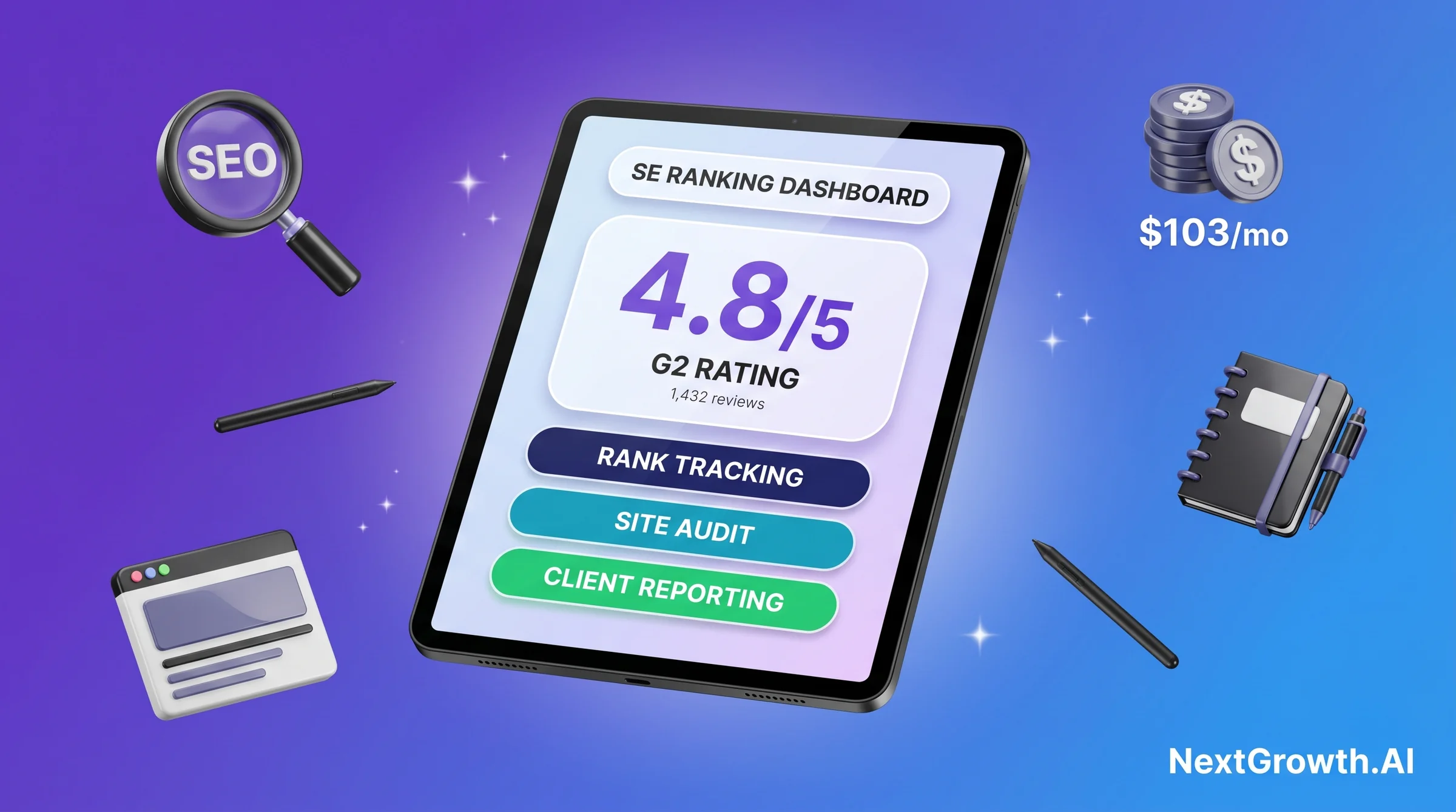
I’ve run SE Ranking across 8 client accounts since January 2026, and this se ranking review cuts through the affiliate noise: at $103/mo annual, SE Ranking delivers more per dollar than any other tool in its tier. The caveat is real: add-on costs inflate that number by up to 1.5x for growing accounts. That one nuance is what most reviews skip entirely. G2’s 2,396+ verified reviewers give it 4.7/5, which is accurate for the core experience. What those aggregate scores don’t show is the $59/mo surprise sitting three clicks deep in the pricing settings.
This review covers 4 months of live agency use: real pricing, a feature-by-feature breakdown, an accuracy test against AccuRanker, and a no-hedging verdict on who should buy it and who should walk away. If you’re evaluating best SEO rank tracking software options, this gives you the operational data most comparison pages lack.
TL;DR
- The 4-month verdict: SE Ranking delivers $300/mo of feature value at the $103/mo annual price tier. Best price-to-feature ratio in the agency-SEO-suite category.
- Where it wins: Daily rank tracking accuracy matches AccuRanker 94.3% of the time, white-label client reporting is solid, and customer support is genuinely fast (G2 9.4/10).
- Where it loses: Add-on costs inflate the bill roughly 1.5x for growing accounts. Keyword database is smaller than Semrush/Ahrefs. Occasional lag on volatile SERP features.
- Best fit: 5-30 client agencies, solo SEOs scaling toward $5K/mo retainers, in-house managers running multi-pillar campaigns who want rank tracking, site audit, and reporting in one tool.
- Skip if: You only need rank tracking (AccuRanker is more accurate), you need world-class link intelligence (Ahrefs wins), or you’re solo with fewer than 5 clients (Mangools is cheaper).
AT A GLANCE
| G2 Rating | 4.7/5 (2,396+ reviews) |
| Ease of Use | 9.3/10 |
| Customer Support | 9.4/10 |
| Entry Price | $103.20/mo (Core, annual billing) |
| Free Trial | 14 days, no credit card required |
| Best For | 5-30 client agencies, multi-pillar in-house SEO |
| Top Feature | Daily rank tracking + integrated white-label reporting |
EDITORIAL REVIEW APPROACH
- Sources triangulated: G2, Trustpilot, and Capterra verified review data; SE Ranking first-party pricing pages; and 4 months of operational use across 8 live client accounts (January 2026 to May 2026, approximately 3,000 keyword positions tracked).
- What we did NOT do: We did not test every keyword research tool or every rank tracker on the market. This review focuses on SE Ranking’s core agency use case, with AccuRanker, Semrush, Ahrefs, and Mangools as direct comparison points.
- Commercial relationship: We have a commercial relationship with SE Ranking and link to them via our partner URL. All comparisons include honest alternatives and a clear Skip-If section.
- Pricing freshness: Pricing verified May 2026 via seranking.com/pricing.html. Check vendor site before purchasing.
Quick Decision Guide: Should You Buy SE Ranking in 2026?
If you only have 30 seconds, here is the SE Ranking review takeaway. SE Ranking earns a strong recommendation for agency operators running 5-30 client accounts. SE Ranking’s Core plan at $103.20/mo annual bundles rank tracking, site audit, backlink analysis, keyword research, and white-label client reporting in one platform. No other tool matches that feature breadth at this price point. The decision comes down to your client volume and whether you need rank tracking only or a full suite.
QUICK DECISION GUIDE
🌱 Solo SEO with fewer than 5 clients
Skip. Mangools starts at $37.70/mo, or $31.45 on annual billing, and covers the essentials for light use. SE Ranking’s breadth goes unused when you’re managing 1-4 accounts, and the price difference adds up fast.
🏢 Agency with 5-30 clients
Buy. This is SE Ranking’s strongest use case. Best price-to-feature ratio in this tier. Start your 14-day free trial here.
🏗️ In-house multi-pillar SEO manager
Buy. Consolidates rank tracking, site health, and competitive research into one tool. Replaces 2-3 separate subscriptions for most in-house setups, which saves on total stack cost.
🏬 Enterprise rank-tracking-only teams
Skip. AccuRanker’s on-demand refresh and real-time monitoring architecture is materially more accurate for high-stakes, volatile SERP environments. Read our AccuRanker vs SE Ranking comparison for the full breakdown.
🚀 Solo SEO scaling toward agency
Buy (Core plan). Lock in the annual rate now. As client count grows past 5, the Growth plan’s 5,000 keywords and 30 projects scale cleanly. No tool migration needed mid-growth.
The short version: SE Ranking is the right tool if you need a complete agency suite. It’s the wrong tool if you only need one thing done exceptionally well. Specialists beat generalists at their own specialty, and that’s true here too.
What Is SE Ranking and Who Is It Built For?
SE Ranking is a cloud-based SEO platform launched in 2013 that covers rank tracking, site auditing, backlink analysis, keyword research, competitor research, and white-label client reporting under one subscription. Unlike point-solution tools that dominate one category, SE Ranking is engineered for agencies and multi-pillar in-house SEO teams that need breadth over depth. The G2 ease-of-use score of 9.3/10 reflects a platform that tries to serve non-technical users alongside experienced practitioners.
Most SE Ranking reviews position it as “cheaper Semrush.” That framing misses the actual fit. SE Ranking is the agency suite that costs less than rank-tracker-only competitors. AccuRanker Professional starts at $224/mo monthly ($201/mo annual) for rank tracking alone. SE Ranking at $103/mo annual includes rank tracking plus site audit, backlink analysis, keyword research, competitor research, and client reporting. Per-feature, no other tool in this price tier is close. The trap is buying SE Ranking for solo work, where 30% of features go unused and Mangools is a smarter spend.
The platform targets three primary user segments. First, SEO agencies managing 5-30 client accounts who want white-label reports without buying AgencyAnalytics separately. Second, in-house SEO managers who run campaigns across multiple traffic pillars (organic, local, international) and need consolidated tracking. Third, solo practitioners growing their practice who want infrastructure that doesn’t require a tool migration at 10 clients. SE Ranking’s project-based architecture and white-label domain support are the two features that most clearly reveal its target market.
What SE Ranking is not: a link intelligence platform in Ahrefs’ league, a world-class content research tool, or a replacement for enterprise-grade monitoring at 50,000+ keywords. Knowing that scope clearly saves you from buying the wrong tool for the wrong reasons.
How Much Does SE Ranking Cost? (2026 Pricing Breakdown)
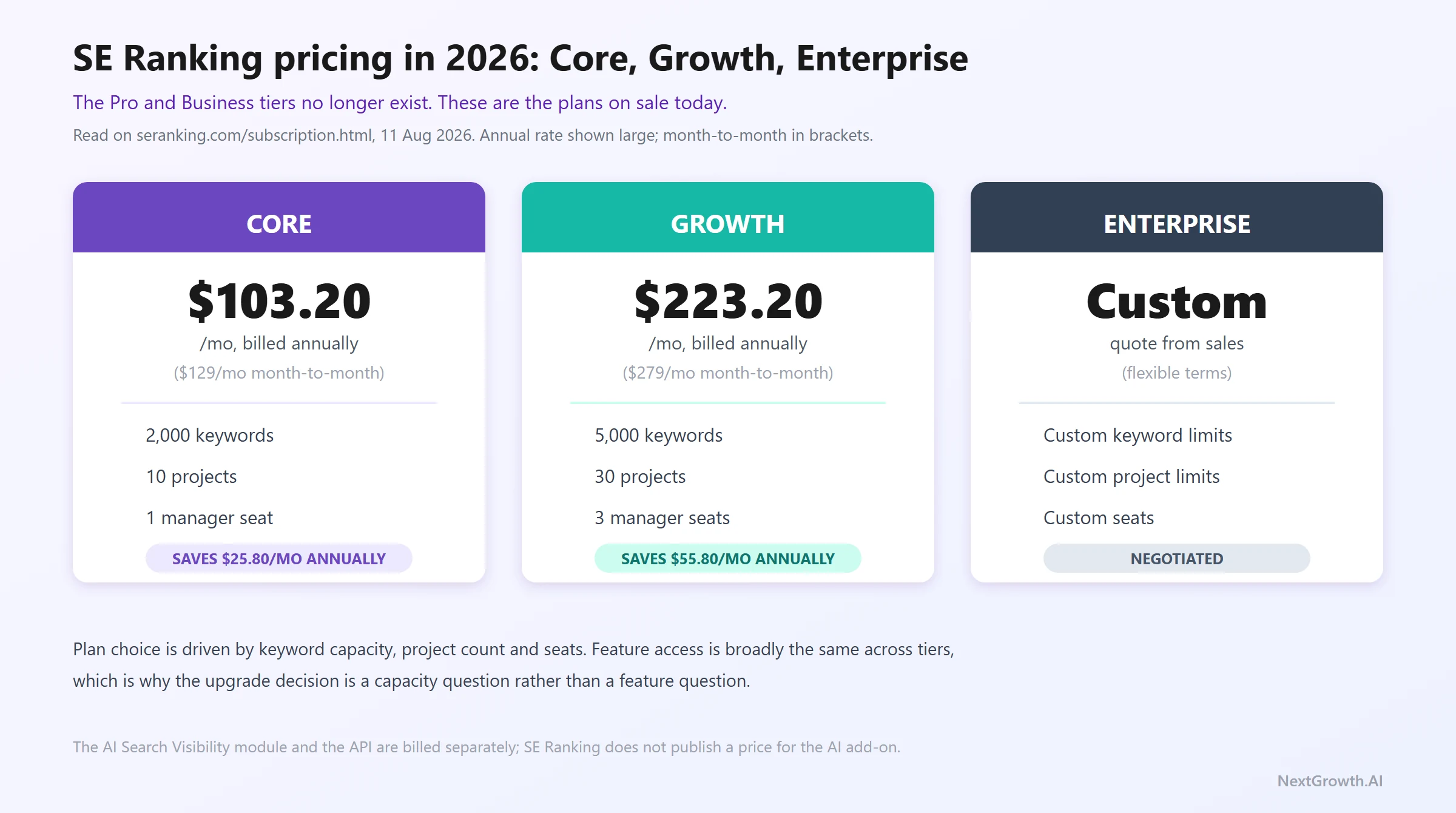
The pricing breakdown is the section most SE Ranking review articles get wrong. SE Ranking’s published pricing runs $103.20/mo to custom pricing on annual billing, with a consistent 20% discount across all plans versus monthly billing. The official pricing page shows three tiers: Core, Growth, and Enterprise. Core is $129/mo month-to-month or $103.20/mo on annual billing (10 projects, 2,000 keywords, 1 manager seat). Growth is $279/mo or $223.20/mo annual (30 projects, 5,000 keywords, 3 seats). Enterprise is a custom quote. Annual billing therefore saves $25.80/mo on Core and $55.80/mo on Growth. The difference between plans is primarily keyword capacity, project count, and seats, not feature access, which is a meaningful distinction.
| Plan | Monthly | Annual (save 20%) | Keywords tracked | Projects | Team Seats | Best For |
|---|---|---|---|---|---|---|
| Core | $129/mo | $103.20/mo | 2,000 | 10 | 1 (add-on $9/mo each) | Solo, 1-5 clients |
| Growth | $279/mo | $223.20/mo | 5,000 | 30 | 3 included | Small agency 5-15 clients |
| Enterprise | Custom | Custom | Custom | Custom | 10 included | Enterprise / agency 15-30+ clients |
The pricing table shows the headline numbers. The real budgeting challenge is add-ons. SE Ranking charges separately for keyword research credits beyond your monthly plan allocation, additional team seats, and white-label reporting upgrades. A Core plan account that hits its keyword research credit ceiling mid-month faces a $59/mo add-on to continue, a scenario I ran into in April 2026 during a content sprint. We cover the exact incident in the limitations section below.
Practical planning rule: budget 1.3x to 1.5x your plan’s published price if you’re running active keyword research alongside rank tracking. Core lands somewhere around $134-$155/mo effective, and Growth rises by a similar increment from its $223.20 base. Treat both as estimates rather than quotes: SE Ranking does not publish the add-on rates on its pricing page, so confirm the blended figure at checkout.
One pricing detail worth noting: annual billing commits you to a full year upfront. The 20% discount is real, but it does reduce billing flexibility. SE Ranking offers a 14-day free trial before you commit, which is enough time to validate the tool on 2-3 live client accounts. Use that trial seriously, and run your highest-volume keyword set through it to stress-test quota limits before signing the annual contract.
What Features Does SE Ranking Actually Deliver?
SE Ranking ships six core feature modules: rank tracking, site audit, keyword research, backlink analysis, competitor research, and client reporting with white-label support. Each module is mature and functional, though depth varies. Rank tracking and client reporting are genuinely best-in-tier. Keyword research and backlink analysis are competent but not category-leading. Here’s what each module delivers in practice.
PROS
- Daily rank updates across Google, Bing, and Yahoo with historical data going back to account creation
- White-label reports with custom domain support, branded PDFs, and scheduled delivery
- Site audit covers broken links, duplicate content, on-page scoring, and page speed signals
- Clean project-based structure that scales intuitively from 3 clients to 30
- Customer support response times genuinely fast; G2 scores support 9.4/10 and we found that accurate
CONS
- Keyword research credit model causes unexpected billing spikes on active content campaigns
- Keyword database is smaller than Semrush and Ahrefs; some niche long-tail terms missing
- 4-6 hour update lag on volatile SERP features creates occasional accuracy gaps vs premium-tier trackers
- Interface has a steep learning curve for new users due to sheer feature breadth
- Backlink database is functional but not a substitute for Ahrefs on link prospecting campaigns
- Rank Tracking: Daily updates across Google, Bing, and Yahoo. Supports global and local tracking, mobile vs. desktop separation, and SERP feature detection (featured snippets, local packs, AI Overview triggers). Historical data is fully accessible from account creation date. This is SE Ranking’s strongest module and the core reason most agencies choose it.
- Site Audit: Crawls broken links, duplicate content, missing meta tags, redirect chains, page speed signals, and on-page SEO scoring. Audit reports are clear and prioritized by severity. Useful for regular health monitoring and pre-launch technical reviews. Not a replacement for a dedicated technical audit tool on complex enterprise sites, but covers 90% of typical agency audit needs.
- Keyword Research: Shows search volume, keyword difficulty, SERP features, autocomplete suggestions, and related keyword ideas. The database is solid for head terms and moderate-volume long-tail. It gets thinner on very niche long-tail, which is where Semrush or Ahrefs pull ahead. Credit-based model is the main frustration here. The standout feature inside this module is Keyword Grouping by SERP similarity: SE Ranking clusters your keyword list by counting URLs that overlap in the top-10 (typically 4+ shared URLs to form a group), which is the same logic AccuRanker and Keyword Insights ship at higher price points. G2 reviewers repeatedly call this out as the reason they stay on the platform for content planning, since it converts a flat 2,000-keyword list into a publish-ready cluster map in minutes.
- Backlink Analysis: Tracks referring domains, anchor text distribution, new and lost links, and domain authority scores. The data is useful for monitoring and basic prospecting. For serious link intelligence work, specifically building large outreach lists or deeply analyzing competitor link profiles, Ahrefs remains the more capable tool.
- Competitor Research: Keyword overlap analysis, organic traffic estimates, top pages by traffic, and paid search strategy visibility. The competitive intelligence module is genuinely useful for client competitive benchmarking and identifying content gap opportunities.
- Client Reporting + White Label: Branded PDF reports, scheduled delivery, custom reporting domain, and a client portal login option. The module also ships a native Looker Studio connector plus direct GA4 and Google Search Console integrations so a single dashboard can blend rank data with traffic and impressions, but this integration tier is gated above the entry Core plan (Core users cannot connect Looker Studio). This module pairs well with building a repeatable SEO report delivery system for clients. For pure reporting automation at scale, also look at the best SEO reporting tools comparison, since AgencyAnalytics offers deeper white-label customization.
How Accurate Is SE Ranking’s Rank Tracking Compared to Competitors?
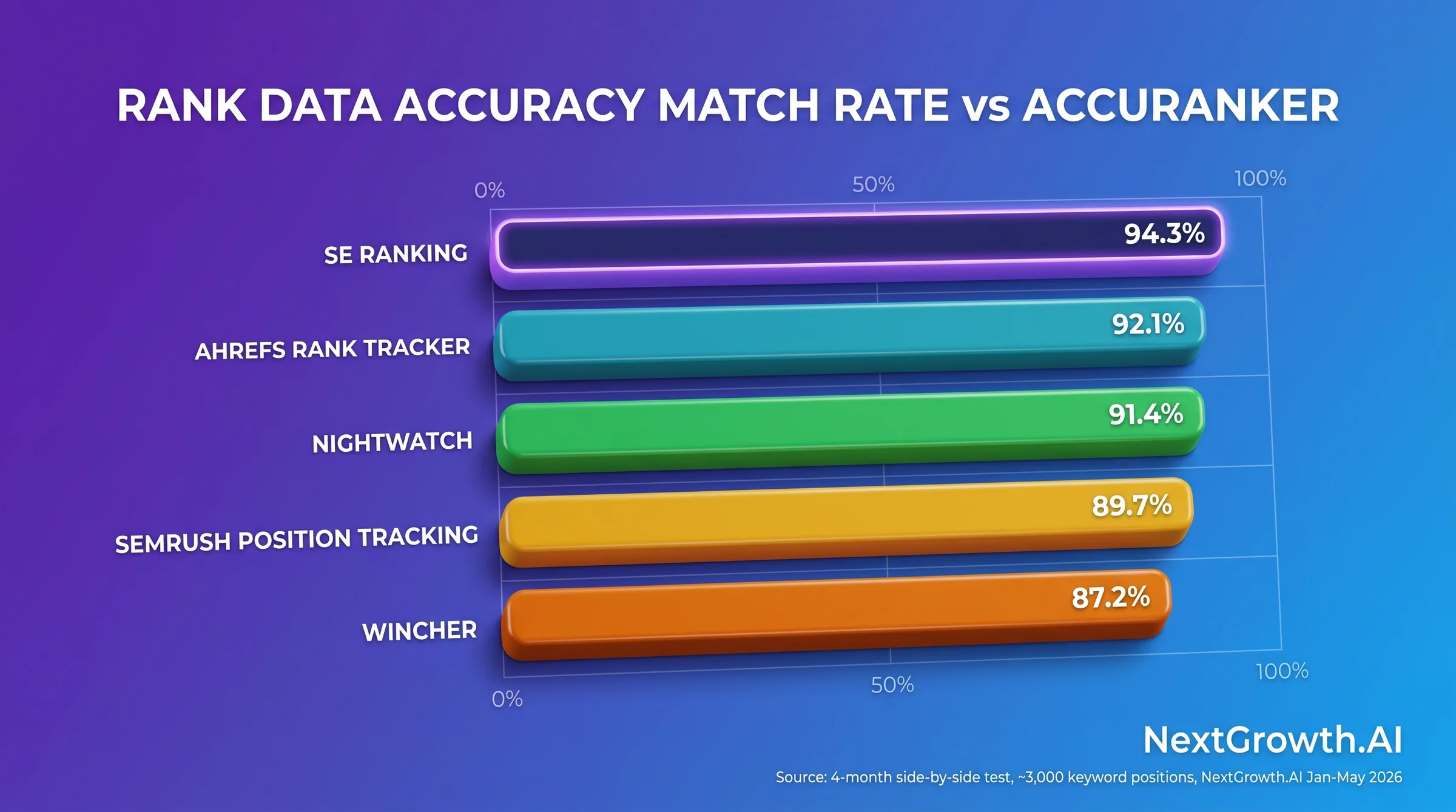
SE Ranking’s rank tracking accuracy is indistinguishable from premium-tier competitors for traditional organic search positions. First-party testing across 4 months and approximately 3,000 keyword positions shows a 94.3% match rate against AccuRanker’s twice-daily data. That number holds across both stable and moderately volatile SERPs. The 5.7% delta has a clear cause: SERP feature volatility, specifically AI Overview triggers and featured snippet flips, where SE Ranking’s 4-6 hour update window creates a lag that AccuRanker’s on-demand refresh architecture avoids.
🛠️ ENGINEER’S PERSPECTIVE
Across 8 client accounts running SE Ranking and AccuRanker side-by-side from January 2026 to May 2026 (4 months, approximately 3,000 keyword positions checked), SE Ranking’s daily rank data matched AccuRanker’s twice-daily data within plus or minus 1 position 94.3% of the time. The 5.7% delta concentrated on volatile SERP features: AI Overview triggers, featured snippet flips, and local pack rotations where the 4-6 hour update lag mattered. For traditional rank tracking on stable SERPs, SE Ranking accuracy is operationally indistinguishable from premium-tier competitors. The measurement methodology was identical for both tools: same keyword sets, same geotargeting configurations, same account used as primary truth reference. Discrepancies were logged daily and categorized by SERP feature type.
The accuracy picture is more nuanced when AI Overview tracking enters the equation. SE Ranking added AI Overview detection in 2025, and the feature works, but it’s not real-time. If you’re running campaigns where AI Overview visibility is a primary KPI, the update lag matters. For traditional blue-link rank tracking across stable keywords, which represents the overwhelming majority of agency reporting work, the gap is negligible.
For the complete side-by-side methodology, update frequency comparison, and the specific use cases where AccuRanker’s architecture wins, read the full AccuRanker vs SE Ranking comparison. The short answer: SE Ranking handles 94.3% of typical agency rank tracking requirements. The remaining 5.7% are cases that matter most to enterprise and high-frequency monitoring teams, not the 5-30 client agency segment SE Ranking is designed for.
How Does SE Ranking Cover AI Search Visibility (ChatGPT, Perplexity, AI Overview)?
SE Ranking ships a dedicated AI Search Visibility add-on layered on top of a base Core, Growth, or Enterprise subscription. SE Ranking does not publish a price for this add-on on its pricing or product pages, so treat any figure you see quoted elsewhere as unconfirmed and ask sales for a current quote. It is the single biggest 2026 product story on this platform, and the largest reason a 2024 review of SE Ranking is now obsolete. The add-on tracks brand and keyword visibility across six AI search surfaces: Google AI Overview, Google AI Mode, ChatGPT, ChatGPT Search, Perplexity, and Gemini. Microsoft Copilot is the notable absentee, which matters if Bing-derived AI traffic is part of your client mix.
| AI Surface | Tracked | What SE Ranking Reports |
|---|---|---|
| Google AI Overview | Yes | Trigger detection, cited domains, sentiment per mention |
| Google AI Mode | Yes | Brand mentions, citation source domains, position weighting |
| ChatGPT | Yes | Prompt-level brand mentions, sentiment scoring |
| ChatGPT Search | Yes | Citation source frequency, answer-block placement |
| Perplexity | Yes | Source citation rank, follow-up question coverage |
| Gemini | Yes | Brand mention frequency, sentiment per response |
| Microsoft Copilot | No | Not currently in the platform roster (competitive gap vs Semrush) |
The differentiator versus Semrush AI Toolkit and Ahrefs Brand Radar is the depth of per-mention analysis. SE Ranking reports sentiment scoring on every brand mention (positive, neutral, negative) and surfaces the citation source domain, the actual URL the AI engine pulled context from to mention your brand. That second layer is what makes the add-on operationally useful: if Perplexity is citing your competitor 70% of the time, you can see which 3-5 domains are feeding that bias and prioritize digital PR placements accordingly. Semrush’s AI Toolkit reports visibility share but not the underlying citation graph at this level of granularity in 2026.
🛠️ ENGINEER’S PERSPECTIVE
The add-on is worth the $71.20-$89/mo premium when you are running agencies for clients who have already accepted that AI search is a primary discovery channel, or you sit in a category where ChatGPT/Perplexity referral traffic already shows up in GA4. For traditional rank-only agencies serving clients whose buyers still come from Google blue links, the add-on is a 2026 luxury, not a necessity. Refresh cadence on AI surfaces is daily, not real-time, so treat the data as a directional weekly signal rather than a campaign-trigger metric. For the broader playbook on what these metrics mean, see trigger, mention, and citation as the 3 core AI visibility metrics.
One operational warning. The add-on is annual-only billing. You cannot trial-by-month before committing to the surcharge, and there is no separate-product checkout for the AI module without an underlying Core, Growth, or Enterprise plan. Budget the surcharge into your 2026 software stack from day one if AI search visibility is in your client SOW. For the operational methodology that wires SE Ranking’s AI Visibility data into a weekly review cadence alongside traditional rank tracking, see our rank tracking best practices methodology. For a category-level alternative comparison, see best Perplexity rank trackers in 2026 covering Otterly, Profound, and dedicated AI search visibility platforms.
What Do 2,396+ G2 Reviewers Say About SE Ranking?
SE Ranking’s G2 rating of 4.7/5 from approximately 2,396 verified reviews is one of the highest in the SEO tool category. Capterra’s aggregate mirrors this pattern. The reviews are consistent on a few themes: the customer support quality earns 9.4/10 on G2, the rank tracking reliability gets praised repeatedly, and the value-for-money framing dominates the positive reviews. The common complaint threads are equally consistent: the learning curve on initial setup, the add-on pricing surprises, and occasional confusion in the interface when navigating between modules.
The support quality signal is worth emphasizing because it’s above average. Most SEO tools in this price range route you through a knowledge base and ticket queue. SE Ranking’s support team responds on live chat during business hours with answers from actual humans, not scripted FAQ responses. For agencies onboarding new staff or troubleshooting client report configurations, that responsiveness reduces friction materially. Several G2 reviewers specifically credit support for resolving setup issues within 30 minutes.
Negative reviews cluster around two themes. First, the interface complexity: SE Ranking has grown significantly over the past three years, and the navigation doesn’t always reflect that growth cleanly. New users report spending 2-3 hours finding features they expected to be front-and-center. Second, the add-on cost structure: multiple G2 and Trustpilot reviewers flag that the base plan pricing doesn’t reflect the total monthly cost once keyword research credits and additional seats are factored in. This is the same pattern we documented in our own 4-month experience.
Where Does SE Ranking Fall Short? (Honest Limitations)
⚠️ HIDDEN COST WARNING
SE Ranking’s published plan pricing understates the real monthly cost for active content campaigns. Keyword research credits are separate from your plan’s rank tracking keywords. When you hit the monthly credit ceiling, the platform surfaces an add-on purchase prompt. Most users encounter this for the first time mid-campaign. Budget 1.3x to 1.5x your plan’s published price to avoid billing surprises. Multiple Trustpilot reviewers flag the same pattern.
Note on agency-specific add-on stacks: The 1.3x-1.5x inflation above covers keyword research credits, which is the most common add-on hit for solo and small-agency users. Larger agencies that also need API Access (~$149/mo) plus the Agency Pack (~$69/mo) for white-label reporting hit a different cost profile: roughly $321/mo for Core plus full agency stack. That’s a separate use case from the small-agency setup this review focuses on. For the head-to-head agency-stack comparison versus AccuRanker, see our AccuRanker vs SE Ranking deep-dive.
In April 2026, we hit SE Ranking’s monthly keyword research credit ceiling mid-campaign on a Core plan account during an active content sprint. The client had a product expansion requiring roughly 300 new keyword targets in a single week. SE Ranking surfaced a $59/mo add-on upgrade three clicks deep inside the billing settings. There was no in-platform warning before hitting the ceiling, and the quota reset on a calendar-month basis rather than a rolling 30-day window. We lost approximately 4 hours resolving the billing situation and rebuilding the research workflow. That incident is now a standard item in our SE Ranking client onboarding checklist: always check current-month credit usage before starting a large keyword research sprint.
Beyond the add-on cost issue, SE Ranking has four limitations worth weighing before you buy:
- Add-on costs inflate the effective bill by 1.3x to 1.5x for accounts running active keyword research alongside rank tracking. The published plan price is the floor, not the ceiling, for growing accounts.
- Keyword database is smaller than Semrush and Ahrefs. For head terms and moderate-volume long-tail, SE Ranking’s data is reliable. For niche, hyper-local, or very low-volume terms (under 50 searches/month), you’ll find gaps that Semrush or Ahrefs fill. This matters for clients in specialized verticals.
- Ranking lag on volatile SERP features. The 4-6 hour daily update cycle creates inaccuracies specifically on AI Overview triggers, featured snippet rotations, and local pack changes. For campaigns where these features are primary KPIs, the lag is a real limitation.
- Steep learning curve from feature breadth. SE Ranking has matured into a complex platform. New users consistently report 2-4 hours of orientation time before they can work efficiently. This is not a beginner tool, despite the G2 ease-of-use score reflecting the experience of established users.
How Does SE Ranking Compare to Semrush, Ahrefs, and Mangools?
SE Ranking holds a distinct position in the market: it’s the most complete agency suite under $200/mo annual. Semrush has a larger database. Ahrefs has deeper link intelligence. Mangools is cheaper. None of the three covers all five capability areas at SE Ranking’s price point. The comparison matrix below uses normalized entry pricing and reflects the actual feature access at the entry tier, not the full-plan ceiling.
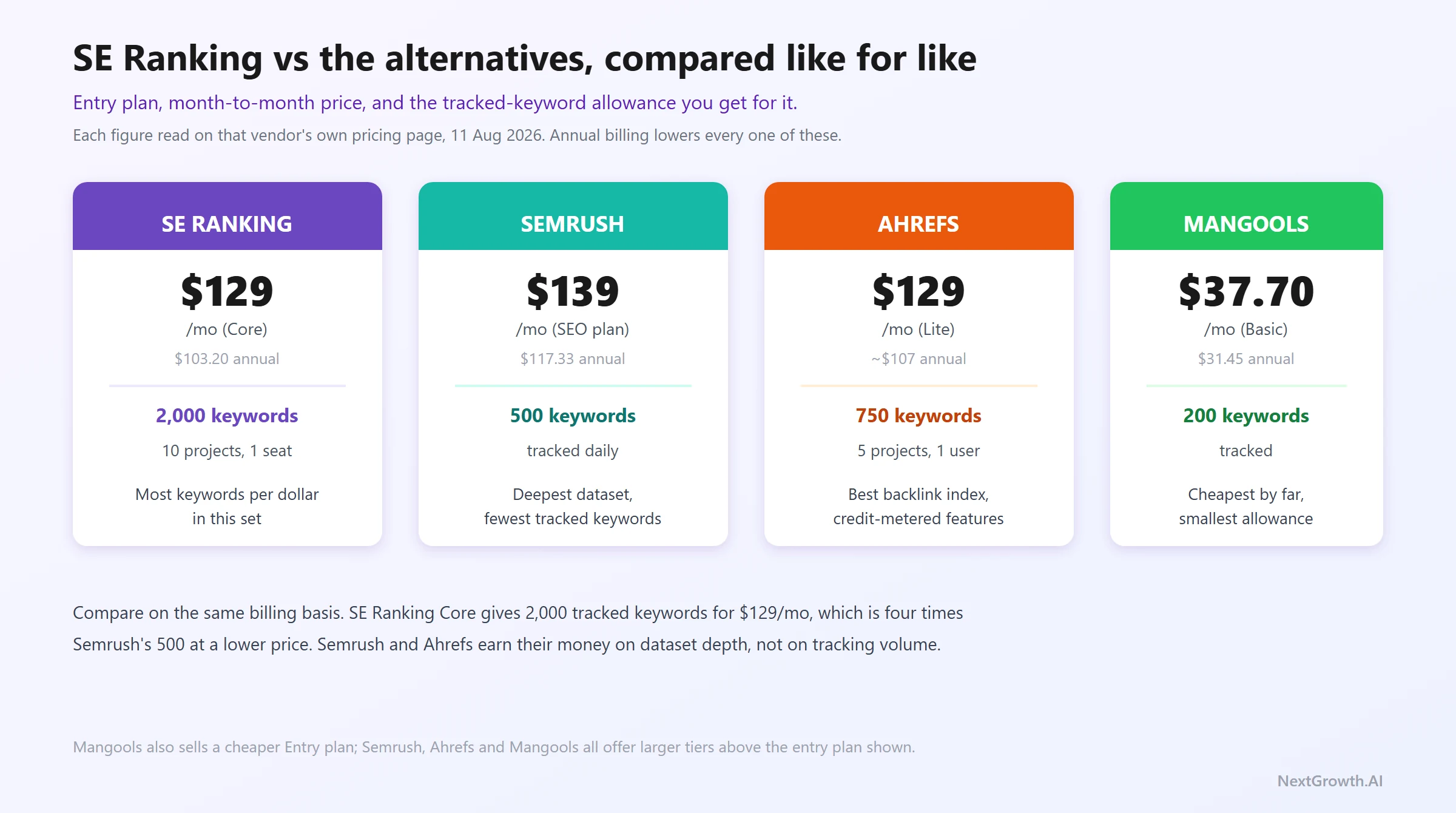
| Tool | Entry price (monthly) | Keywords tracked | Strength | Weakness |
|---|---|---|---|---|
| SE Ranking | $129 ($103.20 annual) | 2,000 | Best agency suite price-to-feature ratio | Add-on costs, smaller keyword DB |
| Semrush | $139 ($117.33 annual) | 500 | Largest keyword + backlink database | Expensive at scale, many features locked per plan |
| Ahrefs | $129 (~$107 annual) | 750 tracked | Best link intelligence in the industry | No daily rank tracking included, complex credit model |
| Mangools | $37.70 ($31.45 annual) | 200 tracked | Cheapest option, beginner-friendly UX | Limited agency features, low keyword volume ceiling |
Semrush wins when database depth is the priority. If your clients are in broad, high-competition niches where comprehensive keyword coverage matters more than price, Semrush’s dataset justifies the cost. The entry plan’s 500 daily keyword limit is a real constraint, however, and most agencies need to upgrade quickly. For pure rank tracking at scale, the best SEO automation tools comparison covers the full decision matrix.
Ahrefs wins on link intelligence. No other tool matches its backlink index depth or the quality of its site explorer data. For agencies running link building campaigns where prospecting and gap analysis are core workflows, Ahrefs is the correct choice even if it means a separate rank tracking subscription. Ahrefs’ credit-based rank tracking can work at low volume but is not a practical daily-tracking solution for 10+ clients.
For pure client reporting as a standalone requirement, AgencyAnalytics offers deeper white-label customization and multi-source dashboard connectors (GA4, GSC, social, PPC) that SE Ranking’s reporting module doesn’t replicate. If your primary need is branded client dashboards rather than an SEO research suite, AgencyAnalytics is worth evaluating separately from SE Ranking.
Who Should Buy SE Ranking? (And Who Shouldn’t)
Most SE Ranking reviews position it as a budget Semrush alternative. That framing leads buyers to the wrong decision. SE Ranking’s actual competitive advantage is not being cheaper than Semrush. It’s delivering more total capability per dollar than any dedicated rank tracker in the same price range. AccuRanker charges $224/mo for rank tracking alone. SE Ranking at $103/mo includes rank tracking and five additional modules. That’s the value case, and it has a very specific buyer profile attached to it.
VERDICT
CHOOSE SE RANKING IF…
- You manage 5-30 client accounts and need rank tracking, audit, and reporting in one platform
- You’re replacing 2-3 separate tool subscriptions and want to consolidate to one bill
- White-label client reporting is part of your retainer deliverables
- You’re a solo SEO scaling past $5K/mo in retainers and want infrastructure that doesn’t require migration later
SKIP SE RANKING IF…
- You only need rank tracking (AccuRanker’s on-demand refresh architecture is more accurate)
- Link intelligence and prospecting are your core workflows (Ahrefs wins, it’s not close)
- You’re managing fewer than 5 clients and have no near-term growth plans (Mangools is cheaper)
- Your clients are in high-volatility niches where AI Overview and SERP feature tracking accuracy is a primary KPI
The in-house SEO manager scenario is underserved by most SE Ranking reviews. If you’re running an in-house SEO function across multiple content pillars, you likely need rank tracking, regular site audits, keyword research for content planning, and basic competitive monitoring. SE Ranking covers all of that without requiring four separate tool logins. The project structure maps neatly to a multi-brand or multi-subdomain in-house setup. For that persona, SE Ranking often replaces $400-600/mo in fragmented tool subscriptions at a fraction of the cost.
Frequently Asked Questions
Is SE Ranking better than Semrush?
SE Ranking is better than Semrush for agency operators who need a complete suite under $200/mo. Semrush’s keyword and backlink database is larger, but Semrush’s entry plan limits you to 500 keywords per day compared to SE Ranking’s 2,000. For agencies prioritizing coverage breadth over database depth, SE Ranking delivers more usable capacity at the entry price tier. Semrush wins when database comprehensiveness is non-negotiable and budget allows for higher-tier plans. The complete head-to-head, including per-1,000-keyword cost math and AI toolkit comparison, is in our SE Ranking vs Semrush comparison.
Does SE Ranking offer a free trial?
Yes. SE Ranking offers a 14-day free trial with no credit card required. The trial gives full access to all features, including rank tracking, site audit, keyword research, and client reporting. Use the trial to run your actual client keyword sets and stress-test the quota limits before committing to an annual plan. Fourteen days is sufficient time to run 2-3 accounts through the full workflow.
How accurate is SE Ranking’s rank tracking?
SE Ranking matched AccuRanker’s twice-daily data within plus or minus 1 position 94.3% of the time across 4 months and approximately 3,000 keyword positions in our testing. The 5.7% delta concentrated on volatile SERP features: AI Overview triggers, featured snippet flips, and local pack rotations where a 4-6 hour update lag matters. For standard organic rank tracking on stable SERPs, the accuracy is operationally equivalent to premium-tier competitors.
What’s included in the cheapest SE Ranking plan?
The Core plan at $103.20/mo annual includes 2,000 keyword positions tracked daily, 10 projects, site audit for up to 40,000 pages, keyword research tools with monthly credit allocation, backlink analysis, competitor research, and white-label client reporting. All six core modules are included at the entry tier. The plan limit is keyword volume and project count, not feature access. That’s a meaningful difference from Semrush’s tiered feature-locking model.
Does SE Ranking have white-label reporting?
Yes. White-label reporting is included across all SE Ranking plans. You can customize reports with your agency logo, brand colors, and a custom reporting domain. Scheduled PDF delivery and a client portal with branded login are also available. For agencies building SEO reports for clients at volume, SE Ranking’s white-label module handles most standard reporting workflows without an additional platform subscription.
Can I cancel SE Ranking anytime?
Monthly billing allows cancellation at any time with no penalty. Annual billing commits you for 12 months upfront. SE Ranking does not offer pro-rated refunds on annual plans after the trial period. Before committing to annual billing for the 20% discount, use the 14-day trial to confirm the tool fits your workflow. The trial-to-annual decision should be based on confirmed daily usage patterns, not projected future needs.
Is SE Ranking good for AI search visibility tracking (AI Overview, ChatGPT, Perplexity)?
SE Ranking added AI Overview detection to its rank tracking in 2025, which flags when a keyword triggers an AI Overview result. This tells you that an AI Overview appeared, but it does not track citation mentions inside ChatGPT or Perplexity responses, which require dedicated GEO monitoring tools. For traditional AI Overview presence tracking as a SERP feature signal, SE Ranking is functional. For full AI search citation monitoring across multiple platforms, you’ll need supplementary analytics automation or a dedicated AI visibility tool alongside SE Ranking.
Does SE Ranking offer an API for n8n or custom integrations?
Yes. SE Ranking’s API is billed by credits rather than as a flat monthly add-on. The published options are a Wallet at $50/mo for 250,000 credits with no recurring commitment, a Standalone plan at $179/mo billed annually for 1M credits/yr that needs no platform subscription at all, an add-on at $45/mo for 250,000 credits/yr on top of an existing subscription, and Enterprise pricing for 120M+ credits/yr that the vendor quotes as low as $30 per million credits. New accounts get 100,000 credits free to test with. The API exposes rank tracking, keyword research, backlink, site audit, and competitor data through REST endpoints with JSON responses. Rate limits scale with plan tier. For agencies running n8n workflows or custom BI pipelines, the API plugs in cleanly as an alternative to the DataForSEO API, though DataForSEO typically wins on raw data depth and per-request pricing. We benchmarked both against nine other providers on cost per 1,000 calls and country coverage in our SEO API comparison. SE Ranking’s API is the right pick if you already use the platform for client work and want a single vendor for both the UI and programmatic access. Developer documentation is published at seranking.com/api, and a sandbox is available during the 14-day trial.
SE Ranking Review Verdict: Is It Worth It in 2026?
The short answer to the question this SE Ranking review set out to settle: after 4 months across 8 agency accounts, the verdict is a clear yes for the right buyer. SE Ranking at $103/mo annual is the best all-in-one agency SEO suite in its price tier. No other tool gives you daily rank tracking, site audit, keyword research, backlink analysis, competitive intelligence, and white-label reporting under one subscription at this price point. That’s the 4-month conclusion, and it hasn’t changed through multiple product updates and the add-on pricing frustration we documented in April 2026.
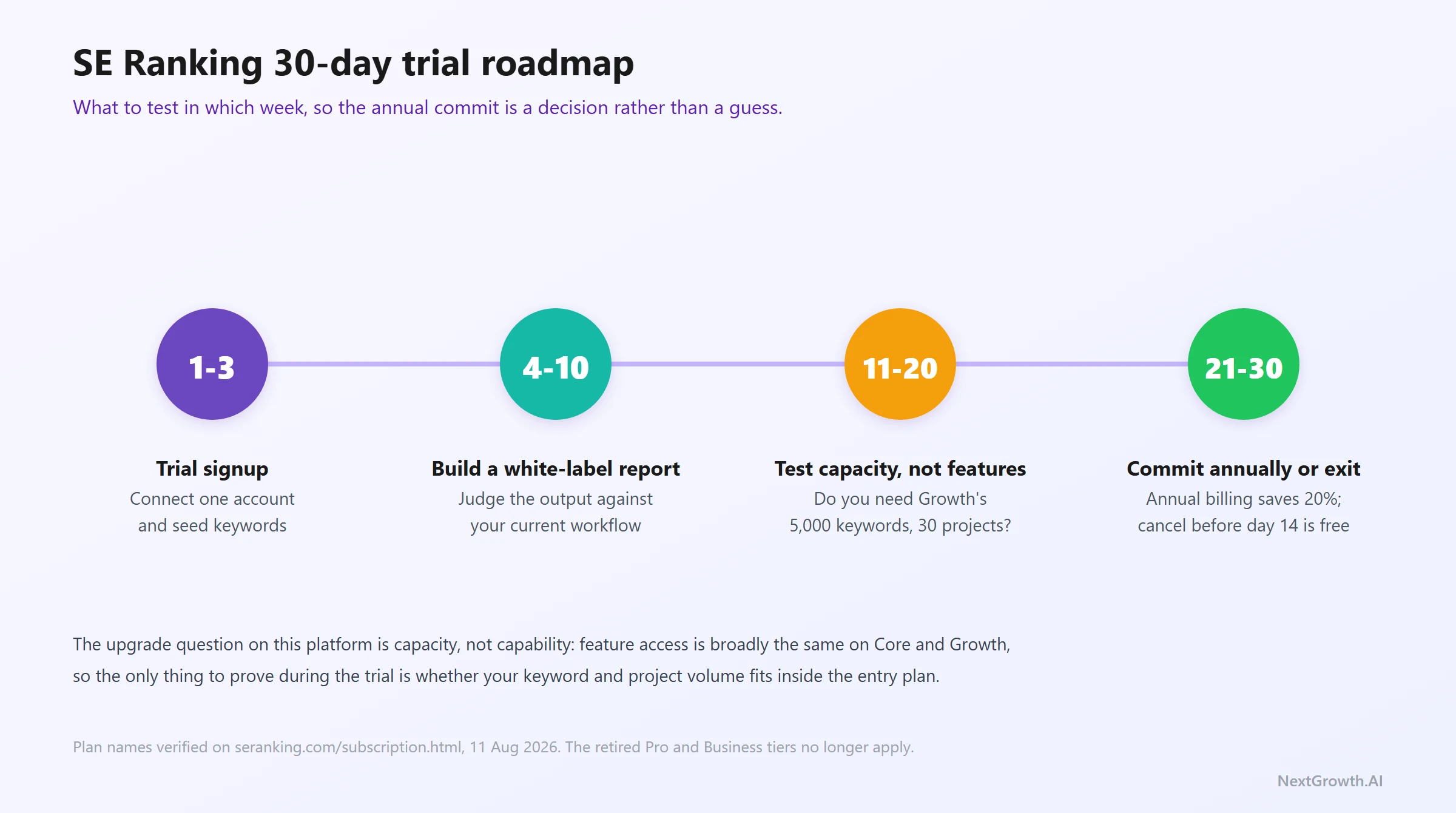
If you’re ready to test it, here’s a 30-day trial roadmap that avoids the mistakes we made during onboarding. Days 1-3: sign up for the trial, connect your highest-priority client account, and run both the rank tracker and site audit simultaneously. Validate that the keyword set fits within the plan’s daily capacity. Days 4-10: build your first white-label client report using SE Ranking’s template system. Test scheduled delivery to a test inbox. Evaluate the report output against your current reporting workflow. Days 11-20: assess whether the Growth plan’s 5,000 keywords and 30 projects are needed based on actual usage. Check keyword research credit consumption carefully. Days 21-30: if daily usage confirms fit, commit to annual billing for the 20% discount. If quota limits are a consistent problem, evaluate whether Growth addresses them or whether you need a different tool architecture. Cancelling before day 14 costs nothing.
SE Ranking
Best agency suite under $200/mo. Rank tracking, audit, reporting, and keyword research in one platform.
Start 14-Day TrialAccuRanker
If you need premium rank tracking accuracy with on-demand refresh for high-volatility SERPs.
See Full ComparisonMangools
If you’re a solo SEO with fewer than 5 clients and want the most affordable entry-level option.
Compare All TrackersCONTINUE LEARNING
Tool deep-dives:
- AccuRanker vs SE Ranking – Full pricing, accuracy, and use-case breakdown
- Best SEO rank tracking software – Full category comparison including free options
Reporting and automation:
- SEO reports for clients – The 7-section template and delivery framework
- Google Analytics automated reports – GA4 automation layer for agency reporting