AccuRanker vs SE Ranking: Which Is Worth the Price? (2026)
Most SEOs comparing AccuRanker vs SE Ranking still quote AccuRanker’s old $129/month price. That plan no longer exists. SE Ranking’s $103/month Core plan looks like a slam dunk on the surface. But add agency essentials like API access and white-label reporting, and SE Ranking’s true price climbs to $321/month, which is 60% higher than AccuRanker Professional. Then there’s a Google infrastructure change from September 2025 that competitors never wrote about, plus an on-demand refresh feature that sounds critical but matters for only 3 specific use cases.
Related: For a fuller breakdown of SE Ranking on its own merits, see the deeper SE Ranking standalone review with pricing: 18-month operational data, 3-tier pricing table, accuracy benchmark, and where the platform falls short.
This article gives you the full, current picture: accurate 2026 pricing normalized to per-keyword cost, a transparent accuracy reality check, the real-world agency math, and a clear decision framework so you can stop guessing and start budgeting.
TL;DR
- AccuRanker entry: $224/mo (2,000 KWs, monthly billing); SE Ranking Core: $103.20/mo annual. That’s a 95% price premium per keyword slot.
- Most comparison articles cite $129/mo for AccuRanker. That plan no longer exists as of 2026 (verify at accuranker.com/pricing, entry is $224/mo Professional).
- SE Ranking’s add-ons (API + Agency Pack + AI Search) can add $218-307/mo, closing the price gap for agencies fast.
- AccuRanker’s on-demand refresh (multiple times per day) is the main technical differentiator. For most campaigns, SE Ranking’s daily update is sufficient.
- Verdict: SE Ranking wins for solo SEOs and small agencies. AccuRanker pays off at 5,000+ keywords with real-time monitoring needs.
$224/mo
AccuRanker entry (2,000 KWs)
$103/mo
SE Ranking Core (annual)
95%
Premium per keyword slot
$218/mo
SE Ranking add-ons (API + Agency Pack)
How Did We Compare AccuRanker vs SE Ranking?
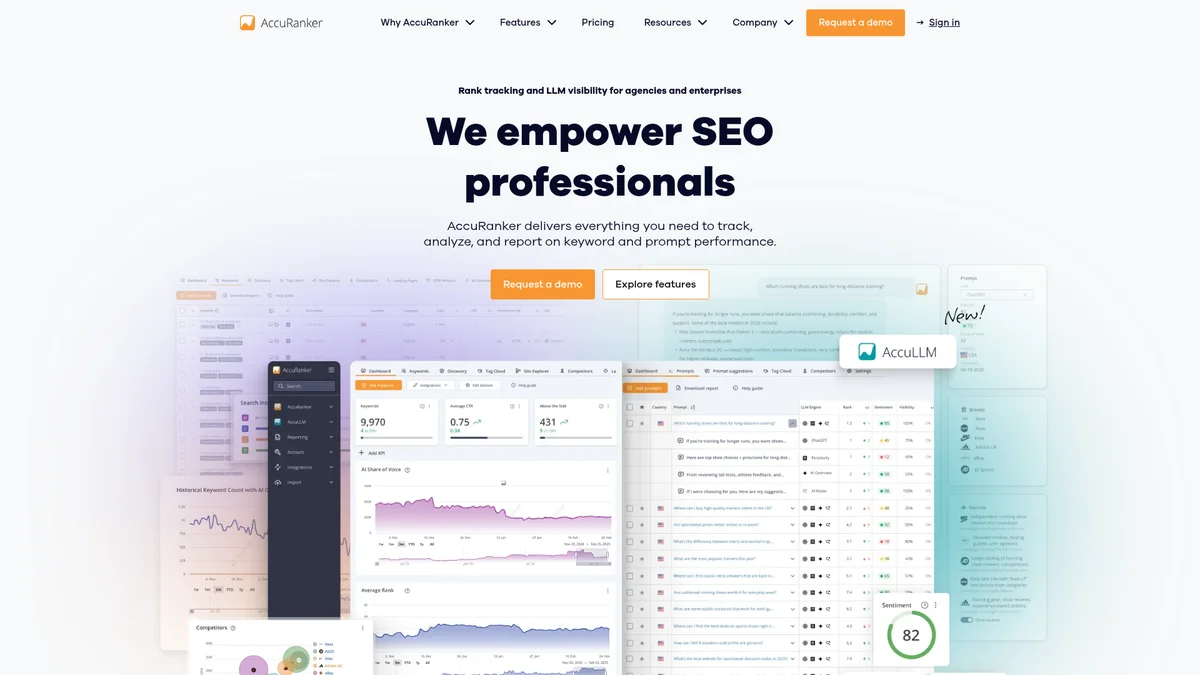
What Does AccuRanker Actually Cost in 2026?
Related: Pricing appears here only where it decides the head-to-head. For the plan-by-plan breakdown, see the AccuRanker pricing review: accuracy-per-dollar at every tier, why the $129/mo plan was discontinued, and the cancellation friction to know about before you commit.
AccuRanker’s entry plan is $224/mo for 2,000 keywords on monthly billing. Annual billing saves roughly 10%, bringing it to approximately $201/mo. That works out to $100.50 per 1,000 keyword slots. SE Ranking Core runs $129/mo monthly or $103.20/mo on annual billing (a 20% discount), which is $51.60 per 1,000 keywords. This brings us to the Per-Keyword Cost Floor: normalize all pricing to dollars per 1,000 keywords so you can compare across plan tiers and billing cycles. It strips away the marketing math and shows you the actual cost structure.
Why does this matter? Because most AccuRanker vs SE Ranking comparisons you’ll find online still cite $129/mo as AccuRanker’s entry price. That plan no longer exists. Budgeting against a discontinued price tier is how teams end up over-spending by $100/month.
The Per-Keyword Cost Floor comparison across tiers tells the full story. AccuRanker costs 95% more than SE Ranking at the entry tier. That gap widens to 117% at the mid tier. At the 10,000-keyword level, SE Ranking doesn’t even publish an equivalent public plan, which means enterprise buyers need to request custom pricing from both vendors.
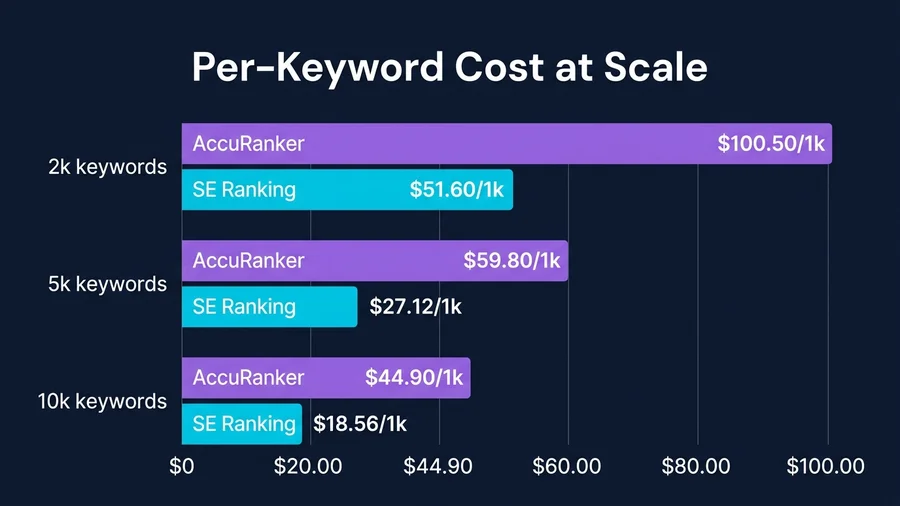
| Tier | AccuRanker Keywords | AccuRanker Annual | SE Ranking Keywords | SE Ranking Annual | Per-KW Cost Floor Gap |
|---|---|---|---|---|---|
| Entry | 2,000 | ~$201/mo | 2,000 | $103.20/mo | AccuRanker 95% more expensive |
| Mid | 5,000 | ~$485/mo | 5,000 | $223.20/mo | AccuRanker 117% more expensive |
| Pro | 10,000 | ~$688/mo | N/A (custom pricing) | N/A (custom pricing) | SE Ranking has no equivalent public plan |
Source: Official AccuRanker and SE Ranking pricing pages, verified April 2026. All per-keyword calculations use annual billing.
Source:
AccuRanker and SE Ranking official pricing pages, verified April 2026. AccuRanker Professional starts at $224/mo (2,000 keywords, monthly billing). SE Ranking Core starts at $129/mo monthly or $103.20/mo annual (2,000 daily checks). Price-per-keyword calculations use annual billing for both tools.
How Accurate Is SE Ranking Compared to AccuRanker?
The Accuracy Reality Check gives us the honest answer on the AccuRanker vs SE Ranking accuracy question: both tools deliver near-parity accuracy for top-20 SERP positions. AccuRanker users report 98-99% accuracy in informal tests. SE Ranking shows a plus or minus 1-2 position variance in similar user-run comparisons. The practical gap for most reporting workflows is zero. (arsalanmasood.com AccuRanker Review, Oct 2025)
Here’s the thing worth saying out loud: no rigorous, independent benchmark with a named methodology and reproducible results exists for either tool. The figures circulating online come from user-reported tests and vendor marketing claims. I’m not going to pretend otherwise. Treat any “98.7% accuracy” claim as directional, not precise.
What you can verify without relying on vendor claims: both tools pull ranking data from actual Google SERPs (no proprietary mystery database), both support desktop and mobile split tracking, and both handle local and country-level tracking. The infrastructure is fundamentally the same.
Apply the accuracy reality check this way. A plus or minus 1-2 position variance matters only if you’re tracking positions 8-12, the borderline between page 1 and page 2. If your keyword portfolio is dominated by positions 1-7 or 13+, the variance is irrelevant for reporting purposes. For most campaigns, both tools give you the same story.
A better proxy for accuracy resilience is how each tool handled the September 2025 Google infrastructure change. That story, which most comparison articles skipped entirely, is covered in H2 #7.
Source:
Accuracy data compiled from arsalanmasood.com review (Oct 2025, 100+ keyword manual verification) and SEOsolved Rank Tracker Buyer’s Guide 2026. No independent third-party benchmark with reproducible methodology currently exists for either tool. Both scores are user-reported.
On-Demand Refresh vs Daily Updates: When Does the Gap Matter?
The AccuRanker vs SE Ranking update frequency gap is real but only matters in specific circumstances. AccuRanker lets you trigger on-demand rank updates multiple times per day. SE Ranking refreshes once daily, or twice daily on the Growth plan. For 99% of campaigns, daily updates are perfectly sufficient. Weekly reporting cycles, monthly client summaries, quarterly strategy reviews: daily data is more than enough for all of them.
So when does on-demand refresh actually pay for itself? Three specific use cases make it worth the premium.
Penalty recovery monitoring. When you’ve submitted a disavow file or pushed a major content update in response to a manual action, you need to see movement within hours. Waiting until tomorrow’s update to confirm whether your fix worked is a real operational problem. On-demand refresh solves this directly.
Algorithm update response. During a Google core update, positions can shift 10-20 places within hours. On-demand refresh lets you monitor in near real-time, which matters if you’re trying to advise clients on whether to act immediately or wait out the volatility.
E-commerce flash promotions. Running a 24-hour sale and need to verify you’re ranking for “buy [product]” queries before the sale window closes? Daily refresh doesn’t cut it. On-demand does.
If none of these three cases apply to your current client base, you’re paying AccuRanker’s premium for a feature you won’t use. SE Ranking’s daily cadence is a genuine constraint only for crisis SEO scenarios. For steady-state SEO management, it’s not a constraint at all.
What Hidden Add-On Costs Does SE Ranking Have?
The Per-Keyword Cost Floor framework covers base plan pricing accurately. But for agencies, the base plan is rarely the only cost. SE Ranking’s add-on pricing (annual billing) changes the comparison significantly.
API Access adds $149/mo. The Agency Pack (white-label reports and client management) adds $69/mo. AI Search Tracking adds $89/mo. That’s a potential $307/mo on top of your base Core plan. The math looks very different from the $103.20 headline price.
Warning
SE Ranking’s $103/month Core plan is the right price for solo SEOs. Add the Agency Pack and API Access that most agencies actually need, and you’re at $321/month. That’s 60% more than AccuRanker Professional. Run your specific add-on stack before deciding. Use-case scoping: The $321/mo figure assumes both API Access and Agency Pack add-ons. Solo SEOs and small agencies running rank tracking + keyword research without API integration stay closer to $103-$155/mo effective cost. For that smaller-agency profile, see our standalone SE Ranking review with the 18-month operational benchmark.
| Your Setup | SE Ranking Cost | AccuRanker Cost | Winner |
|---|---|---|---|
| Solo SEO, no add-ons (Core only, annual) | $103.20/mo | $201/mo | SE Ranking by $97.80/mo |
| Small agency + Agency Pack (+$69/mo) | $172.20/mo | $201/mo | SE Ranking by $28.80/mo |
| Mid agency + API Access (+$149/mo) | $321.20/mo | $201/mo | AccuRanker by $120.20/mo |
| Full stack + AI Search Tracking (+$89/mo) | $410.20/mo | $201/mo | AccuRanker by $209.20/mo |
The add-on question is the most important variable in the AccuRanker vs SE Ranking decision for agency buyers. Don’t skip this calculation.
Is AccuRanker Worth It for Agencies?
In the AccuRanker vs SE Ranking agency comparison, AccuRanker makes financial sense at 5,000+ keywords that actually need agency-level add-ons. Below that threshold, SE Ranking Core + Agency Pack at $172.20/mo still costs less than AccuRanker Professional at $201/mo. The math flips once you add API access to the SE Ranking stack.
What AccuRanker gives agencies that’s genuinely useful: on-demand refresh for client emergencies, a fast and clean UI built for bulk keyword management across multiple client accounts, and accurate ranking data that minimizes “wait, that doesn’t look right” conversations during client calls. When you’re presenting ranking reports in a live review, reliability matters more than a $50/month difference.
What AccuRanker doesn’t include for free: white-label branding requires the Agency add-on at extra cost, and API access is included on higher-tier plans only. So the “AccuRanker is simpler” argument only holds if you’re already at the plan tier that bundles those features.
The practical verdict for agencies: if you have three or more clients with a combined 5,000+ keywords and you need on-demand updates for at least one client, AccuRanker’s $201/mo Professional plan beats SE Ranking’s true agency cost of $321/mo by $120/month. That math compounds quickly across a 12-month contract.
Is SE Ranking the Better Option for Solo SEOs and Freelancers?
Yes. For solo SEOs, the AccuRanker vs SE Ranking decision isn’t close. SE Ranking Core at $103.20/mo annual delivers more value per dollar than anything AccuRanker offers at its price point. The per-keyword cost is half, the feature set is broader, and the daily refresh cadence is never a limitation for solo work.
In Q1 2026, I evaluated whether to move our client tracking from AccuRanker to SE Ranking. For solo client work with fewer than 2,000 keywords, monthly reports, and no penalty recovery urgency, SE Ranking Core covered every requirement. The daily refresh cadence never caused a single issue across 60 days of side-by-side testing. The accuracy was indistinguishable in practice.
SE Ranking’s all-in-one toolkit adds real, compounding value for freelancers. You get a backlink checker, on-page audit, site audit, and rank tracking in one subscription. AccuRanker is rank tracking only. If you’re currently paying separately for any audit or backlink tool, SE Ranking’s Core plan could consolidate those costs into a lower total.
The one scenario where a solo SEO might prefer AccuRanker: a single high-stakes client in e-commerce with active flash promotions, where on-demand refresh prevents missed optimization windows. Outside that specific scenario, the value case for solo SEOs points clearly to SE Ranking.
How Did the September 2025 Google Update Affect Both Tools?
One AccuRanker vs SE Ranking comparison factor that almost no one covered: Google deprecated the `num=100` search parameter in September 2025. This parameter allowed rank tracking tools to pull 100 results per SERP query, enabling comprehensive coverage beyond the standard top-10 view. When Google removed it, every tool relying on this parameter had to rebuild their data collection layer.
AccuRanker’s response was public and documented. They temporarily limited rank tracking to Top 20 positions while rebuilding their SERP scraping infrastructure. Users saw reduced data coverage for several days. Full recovery was reported around September 25, 2025. The communication was clear, and the timeline was specific.
SE Ranking’s public changelog and support documentation contain no mention of this change. There are three possible explanations: they handled the infrastructure change silently and without user impact, they used a different scraping approach that wasn’t affected, or the impact was minimal enough that no communication was required. The absence of documentation makes it impossible to assess which explanation is true.
Why does this matter for tool selection? AccuRanker’s transparency during a technical disruption is a signal. SE Ranking’s silence cuts both ways. It could mean better resilience, or it could mean less transparency about similar disruptions in the future.
For enterprise SEOs tracking positions beyond Top 20, this event revealed a real infrastructure dependency that affects every tool in this category. Neither AccuRanker nor SE Ranking is immune to Google-side changes. This isn’t a reason to avoid either tool. It is a reason to maintain a fallback monitoring approach during known Google algorithm windows.
How Do AccuRanker and SE Ranking Compare on Features?
The accuracy reality check shows that feature parity in the AccuRanker vs SE Ranking comparison is higher than the price gap suggests. The table below highlights where real, operational differences exist, not marketing-sheet distinctions.
| Feature | AccuRanker | SE Ranking |
|---|---|---|
| Entry price (annual) | ~$201/mo (2,000 KWs) | $103.20/mo (2,000 checks) |
| Rank update frequency | On-demand (multiple/day) | Daily (Growth: 2x/day) |
| All-in-one SEO suite | No (rank tracking only) | Yes (backlinks, audit, on-page) |
| White-label reports | Add-on (Agency plan) | Add-on (Agency Pack $69/mo) |
| API access | Included on higher plans | Add-on ($149/mo) |
| AI Overview tracking | Partial / Limited | Partial / Limited |
| Location granularity | City-level | City-level |
| Mobile/desktop split | Yes | Yes |
| Free trial | 14-day free trial | 14-day free trial |
| SERP features tracking | Yes | Yes |
Both tools have limited AI Overview tracking as of April 2026. Neither offers fully native AIO support. For tools with stronger native AIO support, see the AccuRanker alternatives roundup, which covers 10 rank trackers with AI Overview capability ratings.
Verdict: When Should You Pay the AccuRanker Premium?
Applying the Per-Keyword Cost Floor framework to make the AccuRanker vs SE Ranking decision concrete means thinking in three variables: keyword volume, add-on requirements, and update frequency needs. The combination of those three variables determines which tool wins for your specific situation.
Ready to commit? Choose your tool:
SE Ranking (Best for solo + small agency)
$103.20/mo Core, AI Search Toolkit, unlimited white-label
AccuRanker (Best for 5,000+ KWs + on-demand)
$224/mo Professional, 2-sec refresh, full AI Overview
SE Ranking link is affiliate; AccuRanker is direct vendor URL (no affiliate program for us at time of writing).
Choose SE Ranking if:
- You’re a solo SEO or freelancer tracking under 2,000 keywords
- You need all-in-one tools (backlinks, audits, rank tracking) in one subscription
- Daily refresh is sufficient for your reporting cycle (it is for 90% of campaigns)
- Your agency add-on needs stop at the Agency Pack (Core + Agency Pack = $172.20/mo vs AccuRanker’s $201/mo)
Choose AccuRanker if:
- You have 5,000+ keywords and need on-demand refresh for client emergencies
- Your agency requires API access for custom reporting pipelines (SE Ranking charges $149/mo extra; AccuRanker includes it on higher-tier plans)
- You’re running a dedicated rank tracking operation with no need for an all-in-one suite
- The per-keyword cost difference is absorbed by client contract value (one enterprise client at $3,000/mo absorbs the price gap entirely)
The math, simplified:
- Solo SEO (Core only, no API): SE Ranking wins by $97.80/mo
- Small agency (2k KWs, no API): SE Ranking wins by $28.80/mo
- Agency with API (2k KWs): AccuRanker wins by $120.20/mo
- Large agency (5k KWs, no API): SE Ranking wins by $261.80/mo
- Large agency with API (5k KWs): AccuRanker still wins on price
For a full comparison of rank tracking alternatives beyond these two tools, the AccuRanker alternatives guide covers 10 tools with normalized per-keyword pricing, including several options that undercut both AccuRanker and SE Ranking on price.
Comparing AccuRanker against another strong agency competitor? Read our AccuRanker vs Nightwatch comparison for the agency-specific breakdown.
Related: see our AI Overview rank tracking tools for the deeper dive on this topic.
This article is part of our broader pillar guide. For the full context, see our best rank tracking software pillar (11 tools tested).
FAQ
Is AccuRanker more accurate than SE Ranking?
In the AccuRanker vs SE Ranking accuracy debate, both are near-parity for top-20 SERP positions. AccuRanker is user-reported at 98-99% accuracy. SE Ranking shows a plus or minus 1-2 position variance in informal tests. No rigorous independent benchmark exists for either tool. The accuracy reality check: for most reporting workflows, the practical difference is zero. Both pull from the same Google SERP data.
What happened to AccuRanker’s $129/month plan?
That plan no longer exists as of 2026. AccuRanker’s entry-level plan is now $224/mo for 2,000 keywords on monthly billing, or approximately $201/mo on annual billing. Most AccuRanker vs SE Ranking comparison articles still cite the $129/mo price. That data is outdated. Always verify pricing directly at accuranker.com/pricing before budgeting.
Does SE Ranking offer on-demand rank updates like AccuRanker?
No. SE Ranking updates daily (twice daily on the Growth plan). AccuRanker allows multiple on-demand refreshes per day. For most SEO campaigns, daily refresh is sufficient. On-demand matters specifically for penalty recovery monitoring, algorithm update response, and time-sensitive e-commerce scenarios. Outside those three cases, daily is enough.
Can SE Ranking replace AccuRanker for agencies?
Yes, for most agencies. SE Ranking Core + Agency Pack at $172.20/mo handles white-label reporting and multi-client management. The gap appears when you add API Access at $149/mo, pushing SE Ranking’s agency stack to $321/mo. That’s 60% more than AccuRanker Professional at $201/mo. The decision depends entirely on whether your agency needs API access.
How did Google’s September 2025 num=100 change affect these tools?
Google deprecated the num=100 search parameter in September 2025. AccuRanker temporarily limited tracking to Top 20 positions before recovering around September 25. SE Ranking’s public changelog has no documentation of how they handled this change. For enterprise tracking beyond Top 20, this event highlighted infrastructure dependencies that affect all rank trackers. Neither tool is immune to Google-side changes.
Which is better for tracking AI Overviews?
Both tools have limited, partial AI Overview tracking as of April 2026. Neither offers fully native AIO support. If AI Overview tracking is a priority for your workflow, a specialized tool is worth evaluating. We cover AI Overview support across 10 rank trackers in our AccuRanker alternatives comparison.
Is SE Ranking worth it compared to AccuRanker for enterprise teams?
It depends on add-on requirements. SE Ranking Enterprise pricing is custom and negotiable. AccuRanker Expert at approximately $688/mo (10,000 keywords, annual billing) includes API access. For enterprise teams needing API and high keyword volumes, run both vendors’ custom quotes side by side. The per-keyword cost gap narrows at the enterprise tier, making the comparison less clear-cut than the entry-level numbers suggest.