About NextGrowth.ai: n8n SEO Automation by The Nguyen
n8n SEO Automation on Demand
At NextGrowth.ai, I believe that powerful automation and AI shouldn’t be reserved for big enterprises. Small businesses and individuals deserve the same ability to save time, scale faster, and compete more effectively.
Yet, many find themselves stuck with automation that is brittle, hard to scale, and impossible to monitor. As a Senior DevOps & Cloud Engineer, I approach this problem differently.
The mission of NextGrowth.ai is to provide the guides and frameworks for engineering your automations—making them as reliable and powerful as the enterprise systems you’re competing against.
My Story: Bridging DevOps and SEO
Hi, I’m The Nguyen.
I have been building and ranking English-language content sites since 2014. Between 2016 and 2022 I grew several of them to page-one positions in competitive US niches, with a small team of writers, editors and designers behind them. I thought I had found a formula that repeated.
Google’s Helpful Content Update landed in September 2023 and took roughly 30% of my impressions within weeks. The March 2024 Core Update finished it. Traffic went to zero, the team came apart, and I went back to DevOps full time.
That part is usually missing from SEO blogs, and it is the reason this one exists. I had been publishing exactly the kind of content the industry still sells: broad roundups, figures I had not opened the source for, verdicts carried by adjectives rather than measurements. It ranked until it did not.
The other half of the story is the day job. Enterprise CI/CD pipelines, Kubernetes clusters, and infrastructure that has to stay reliable and observable under load. When I came back to publishing in 2025 I came back as an engineer: build the system first, then the content. Monitor it. Check every number at its source. Say plainly when a tool is the wrong buy.
When I started working with n8n, I saw its incredible potential to bring this level of automation to everyone. But I also saw a gap between the potential of the tool and how it was often implemented. I realized I could apply the principles from my DevOps work to help anyone build more robust solutions.
This blog is where I document that process: applying a battle-tested DevOps mindset to build truly production-grade n8n and AI systems, accessible to all.
My profiles: LinkedIn, GitHub, YouTube, Reddit
Contact me at contact@nextgrowth.ai
Based in Vietnam. Available for remote consulting worldwide.

What You Will Find on This Blog
This is a practitioner’s blog. Expect clear, step-by-step guides and deep dives into two core areas:
Pillar 1: Production-Grade n8n Infrastructure
This is the bedrock of reliable automation. Here, I cover the essential engineering practices for running n8n in a serious, real-world environment. You’ll find actionable playbooks on:
- Deployment: Step-by-step guides for deploying n8n in single and queue mode with Docker, Traefik, PostgreSQL, and Redis.
- Management & Scaling: Best practices for managing complex workflows and scaling your infrastructure for a heavy workload.
- Monitoring: Deep dives into building and configuring a full Prometheus & Grafana observability stack for your n8n instance.
Pillar 2: Autonomous SEO & Content Systems
This is where I apply my own n8n infrastructure to solve high-value marketing problems. For the past decade, I’ve built and scaled my own content sites—from affiliate sites to blogs in competitive niches like dog care and health care—with a focus on ranking well on Google and social platforms.
This has given me deep, hands-on experience across the entire content lifecycle: from initial topic ideation and validation, through keyword research, competitor analysis, and content brief creation, to on-page optimization, backlink strategies, performance tracking, and content refresh cycles.
I realized this entire process was a perfect candidate for production-grade automation. That’s why I created the SEVOsmith™ ecosystem.
In this pillar, I share my playbook for building this system. It’s a five-stage autonomous framework designed to handle the entire content lifecycle from discovery to performance analysis. I will cover how to:
- Autonomous Keyword Research: Build an engine to discover and validate keyword opportunities at scale.
- Deepen Strategic Analysis: Go beyond keywords with autonomous Competitor, SEO, and Business Analysis to identify the perfect winning angle.
- Forge AI-Citable Content: Execute an autonomous n8n system that transforms a strategic blueprint into a final, publication-ready article.
- Amplify Across Platforms: Automatically create a campaign of multi-platform assets from a single article.
- Track Performance: Close the loop with an automated system for Tracking Website Rankings to measure real-world impact.
Career Timeline: From DevOps to Automation
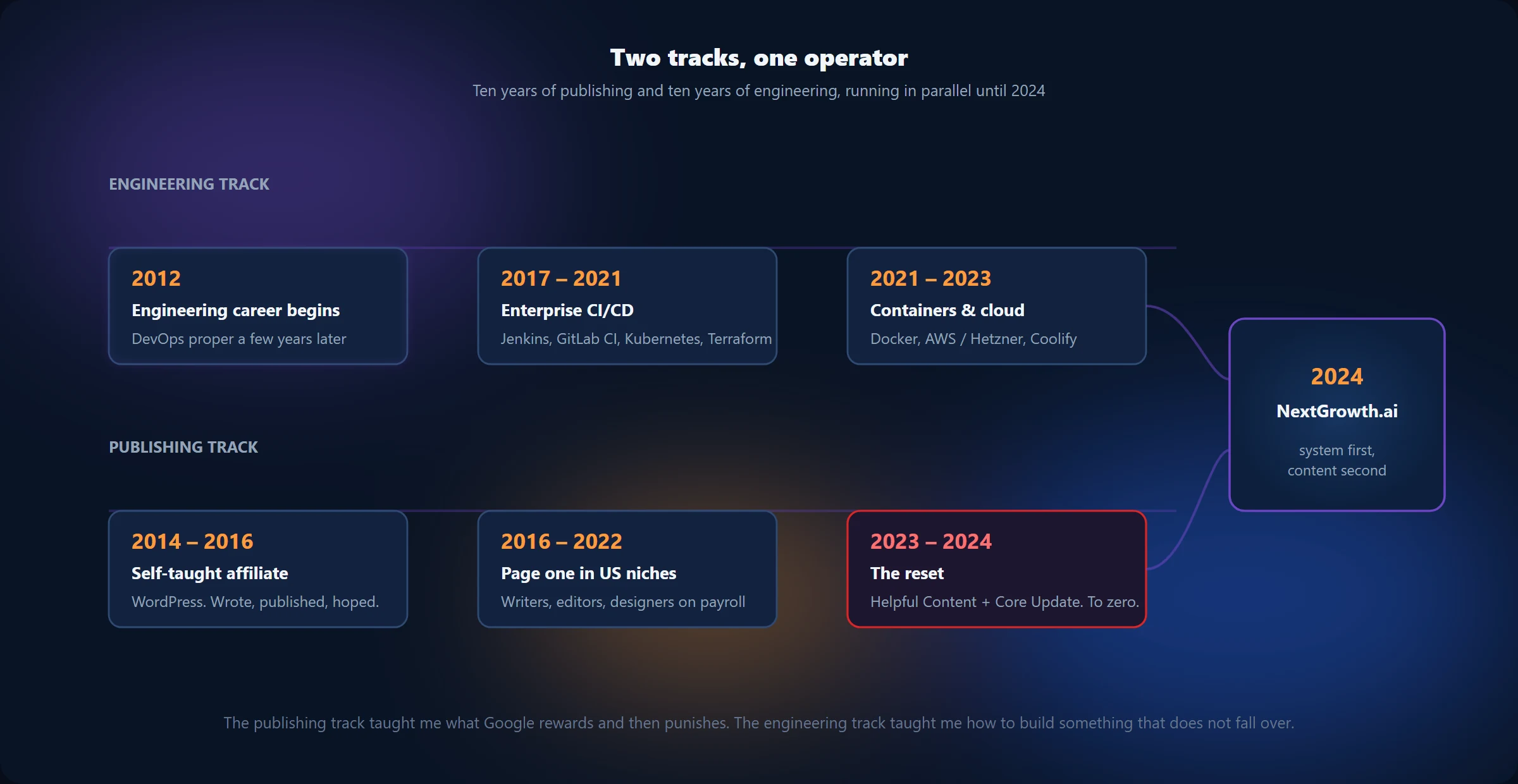
Two tracks run through this timeline and they only converge at the end: ten years of publishing and ranking content sites, and ten years of DevOps inside an engineering career that began in 2012. The first taught me what Google rewards and then punishes. The second taught me how to build something that does not fall over.
Affiliate publishing, self-taught (2014 to 2016): I started on WordPress with affiliate sites, learning in public and mostly by trial. I did not know what SEO was in any structured sense. I wrote, published, and hoped.
Ranking in the US market (2016 to 2022): Several English-language sites held page-one positions in competitive US niches including health, pet care and technology. I hired writers, editors and designers and ran them as a small publishing team. The income was steady enough that I stopped questioning the method.
Enterprise Infrastructure and CI/CD (2017–2021): I spent the early years of my career designing and maintaining enterprise-grade infrastructure. This included building CI/CD pipelines with Jenkins, GitLab CI, and GitHub Actions, managing Kubernetes clusters across multiple environments, and implementing Infrastructure as Code with Terraform and Ansible. The core lesson from this period: reliability and observability are non-negotiable in any production system.
Container Orchestration and Cloud Architecture (2021–2023): As containerization became the industry standard, I went deeper into Docker, Docker Compose, and Kubernetes orchestration. I managed deployments across AWS, DigitalOcean, and Hetzner, learning firsthand how to optimize for both performance and cost. During this phase, I also discovered Coolify as a self-hosted PaaS alternative and began running it across production servers—an experience I later documented in my Coolify vs Dokploy comparison.
The reset (September 2023 to March 2024): The two updates described above ended that portfolio, and I went back to DevOps full time. In hindsight the diagnosis is not complicated: the content was broad, thinly sourced, and written to a template. It is the same content the tool vendors and roundup blogs are still publishing today. That experience is why this site refuses unsourced statistics, names the tools you should skip, and puts a measurement where a superlative would be easier.
DevOps Meets SEO Automation (2023–2024): Coming back to the same problem from the infrastructure side, I saw the gap clearly: marketers were using fragile, GUI-dependent tools while engineers had battle-tested patterns for building resilient systems. I started applying DevOps principles—version control, monitoring, error handling, queue-based architecture—to SEO workflows. The results were dramatic: what took hours of manual work became reliable, repeatable pipelines.
Founded NextGrowth.ai (2024–Present): I launched NextGrowth.ai to bridge the gap between technical infrastructure and marketing automation. The goal: give small teams and solo operators access to the same caliber of automation that enterprises spend six figures building internally. In 2025, I embraced vibe coding with Claude Code—Anthropic’s AI-powered CLI—to accelerate development. I build custom Claude Code skills that automate SEO audits, content optimization, schema markup, competitor analysis, and marketing workflows directly from the terminal. This lets me ship production-grade automation faster while maintaining the engineering rigor that makes it reliable. Every guide on this site comes from production experience, not theory.
What I Do
I focus on four interconnected areas where DevOps expertise directly improves marketing and automation outcomes:
n8n Workflow Automation
I specialize in n8n—the open-source workflow automation platform—from initial design through production deployment, monitoring, and scaling. My guides cover everything from self-hosting n8n on Ubuntu with Docker to running queue mode across multiple workers. I run n8n in production across multiple servers, processing hundreds of API calls daily through automated workflows.
SEO Automation Pipelines
I build and document end-to-end SEO automation pipelines that handle keyword research, content optimization, competitor analysis, and performance reporting—all without manual intervention. My approach to automating SEO follows the 30/70 hybrid model: automate the 70% that is repetitive data work while keeping human judgment on the 30% that requires strategic thinking.
Self-Hosted Infrastructure
Every tool I recommend, I run myself. My infrastructure runs on Docker and Docker Compose across VPS providers, managed through Coolify on three production servers with over eight months of continuous uptime. I document the real trade-offs of self-hosting—backup strategies, security hardening, upgrade paths—so you can make informed decisions about your own stack.
API Integrations
Automation is only as good as the data feeding it. I work extensively with DataForSEO for programmatic SEO data access, the WordPress REST API for content management at scale, and Rank Math for on-page optimization. My SEO automation guides show you how to connect these APIs into reliable, production-grade pipelines.
Vibe Coding with Claude Code
I use vibe coding with Claude Code to build and maintain the automation systems behind NextGrowth.ai. Rather than writing every script from scratch, I develop custom Claude Code skills—specialized commands that handle SEO audits, GEO optimization, content analysis, schema generation, blog writing, competitor research, and marketing automation. These skills run directly from the terminal, combining AI reasoning with deterministic execution scripts to deliver consistent, production-quality results. This approach lets a solo operator move at the speed of an entire marketing team while keeping full control over the code and output.
Results and Experience
NextGrowth.ai is built on verifiable, hands-on experience—not theoretical frameworks. Here is what that looks like in practice:
- 100+ published technical guides covering n8n, SEO automation, self-hosting, AI search visibility and API integrations, each based on a production implementation rather than a sandbox experiment.
- n8n in production across multiple servers, with workflows handling keyword research, content pipeline management, performance tracking, and alerting—processing hundreds of API calls daily.
- Coolify on 3 production servers for 8+ months, managing deployments for n8n instances, databases, and web applications with zero-downtime upgrades.
- DataForSEO API integration processing thousands of queries monthly at a fraction of the cost of traditional SEO tool subscriptions—documented in my DataForSEO review.
- 10 years in SEO and affiliate publishing (since 2014) across competitive niches including health, pet care and technology, with several English sites holding page-one positions in competitive US niches between 2016 and 2022. That includes losing a portfolio to the 2023 Helpful Content Update and the March 2024 Core Update, which is where the editorial standards on this site come from.
- 40+ custom Claude Code skills built for SEO automation, content optimization, schema markup, competitor analysis, and marketing workflows—turning hours of manual work into single terminal commands.
- 28 public repositories on GitHub, where the tooling behind these guides is open for inspection: n8n-toolkit (install, upgrade, backup and restore n8n on Docker Compose with Traefik, Postgres and Redis), claude-wp-cli (WordPress management over the REST API, including RankMath and Yoast meta), n8n-observability (Prometheus, Grafana, cAdvisor and Traefik) and n8n-queue-mode. If a guide here describes a setup, the code for it is usually public.
Automation Impact: Before vs. After
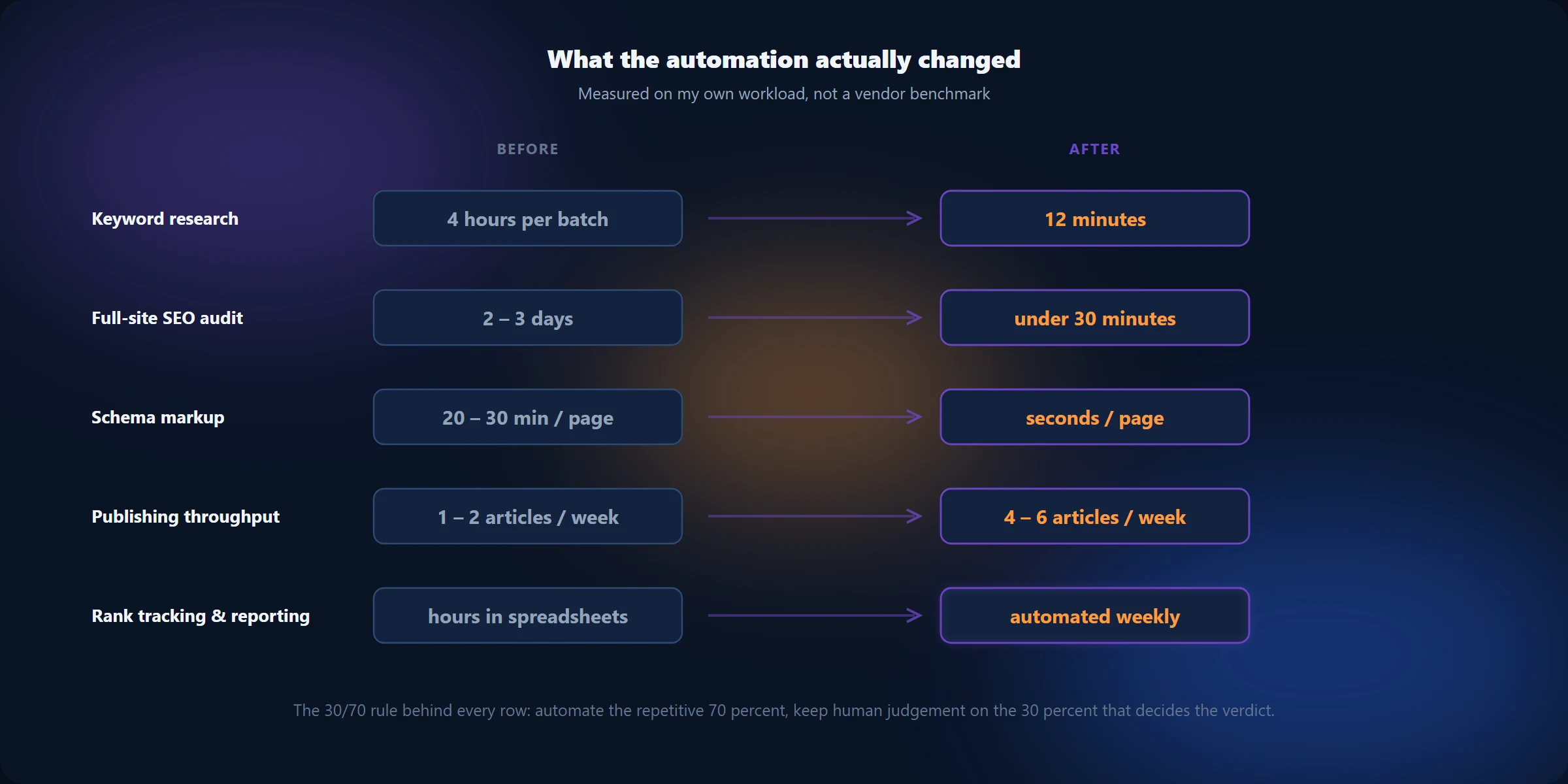
Here is what production-grade automation actually changes in practice:
- Keyword research: 4 hours of manual work per batch → 12 minutes with automated n8n pipelines.
- Full-site SEO audit: 2–3 days with traditional tools → under 30 minutes with custom Claude Code skills running 6 parallel agents.
- Schema markup: 20–30 minutes per page manually in Rank Math → seconds per page via API scripts.
- Content pipeline throughput: 1–2 articles per week manually → 4–6 articles per week with the SEVOsmith automated pipeline.
- Rank tracking and reporting: hours of spreadsheet work → fully automated weekly reports delivered to inbox.
Lessons Learned
Building NextGrowth.ai has not been a straight path. Here are a few things I got wrong before getting them right:
- I over-automated too early. My first SEO pipelines tried to automate the entire content lifecycle end-to-end with zero human input. The output was technically correct but lacked the strategic thinking that makes content rank. That failure led to the 30/70 hybrid model: automate the repetitive 70%, keep human judgment on the strategic 30%.
- I underestimated monitoring. My first n8n deployment ran for three weeks before I realized workflows were silently failing. No alerts, no logs, no visibility. That painful lesson is why every guide on this site now starts with observability as a non-negotiable requirement, not an afterthought.
- I built for scale before proving the concept. I spent two weeks setting up a Kubernetes cluster for n8n before discovering that a single Docker Compose setup on a 0 VPS could handle my entire workload. Now I always recommend starting simple and scaling only when the numbers demand it.
These mistakes shaped how I build and teach today. If a guide on this site seems opinionated about monitoring, simplicity, or keeping humans in the loop, it is because I learned those lessons the hard way.
Join Me
Whether you’re a DevOps engineer looking to apply your skills to automation or an SEO professional ready to build truly unbreakable workflows, you’re in the right place.
The code behind these guides is public on GitHub, and I answer questions on LinkedIn. If you are deploying something from this site and it breaks, tell me: the failure cases are how these guides get corrected.
Let’s build reliable systems, together.