Rank Tracking Best Practices: 8 Things to Monitor in 2026
Most rank tracking dashboards die three deaths. The first death is when you stop opening them because the numbers don’t change week-to-week – you tracked the wrong keywords. The second death is when a 30% traffic drop hits and your dashboard still says “positions stable” – you tracked positions, not impressions. The third death is when ChatGPT, Perplexity, and AI Overviews start sending traffic and your dashboard has no column for any of them – you tracked Google blue links in 2026 like it was still 2022.
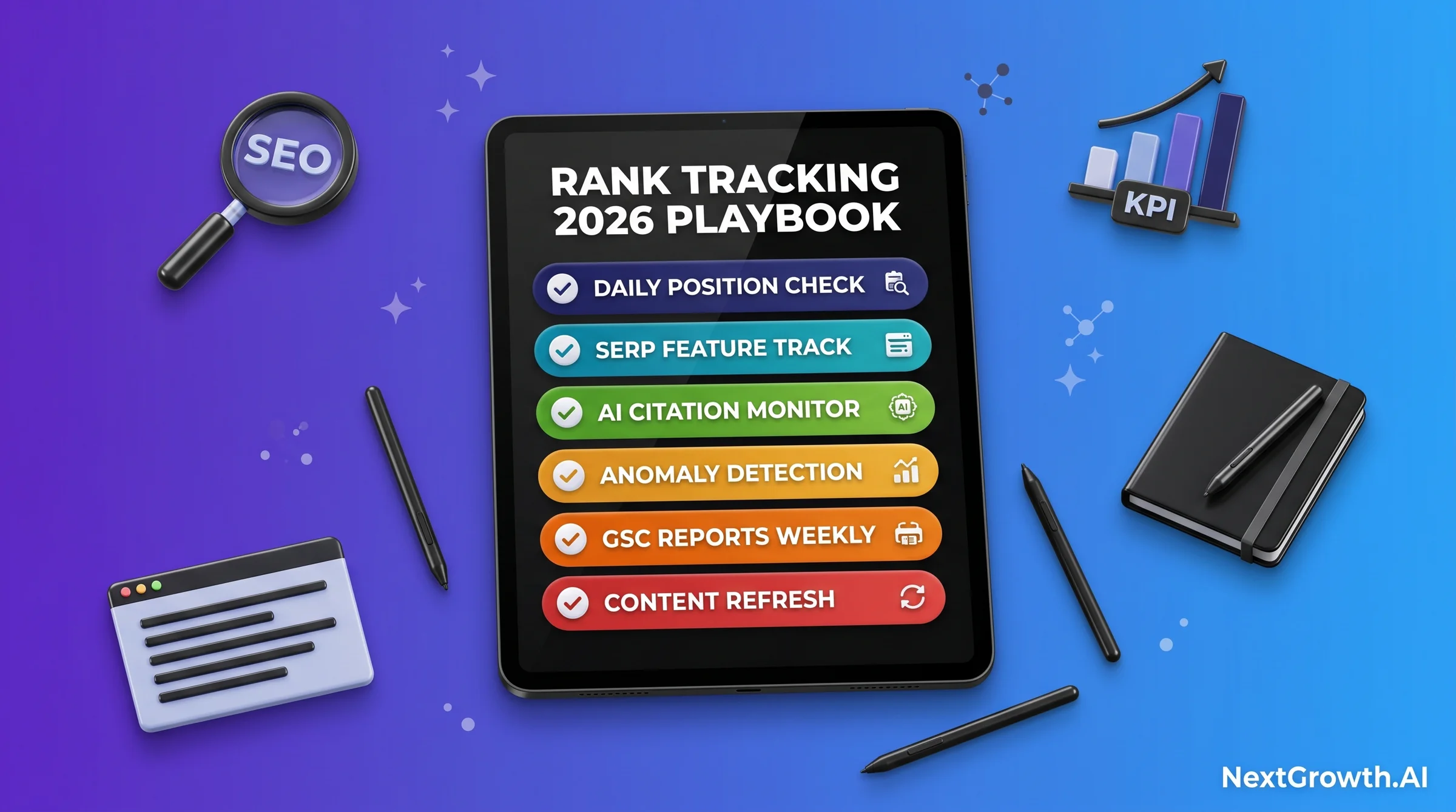
The right rank tracking best practices for 2026 cover 8 distinct practices. These span daily SERP monitoring, AI search citation tracking, GSC anomaly detection, and content performance scoring. Each practice has a specific cadence, a specific tool layer, and a specific decision it should trigger. This is the closed-loop methodology we run at NextGrowth.AI across our own site and 6 client accounts. If you want to evaluate 8 rank tracking tools compared before settling on a methodology, that guide covers your options. This article covers what to do once you pick a tool.
📊 TL;DR – THE 8-PRACTICE CLOSED LOOP
- Practice 1: Daily keyword position monitoring (alert threshold: 5+ positions drop in 24h)
- Practice 2: SERP feature tracking – AI Overviews, snippets, PAA, image packs (weekly)
- Practice 3: Competitor position comparison, top 3-5 rivals only (weekly)
- Practice 4: Traffic anomaly detection, more than 20% week-over-week drop triggers alert (daily)
- Practice 5: AI search citation monitoring – ChatGPT, Perplexity, AI Overview (weekly)
- Practice 6: GSC performance reports via automated weekly API pull
- Practice 7: Content performance scoring using composite rank x traffic x conversion formula (monthly)
- Practice 8: Quarterly keyword list audit – drop deadweight, add emerging targets
How NextGrowth.AI Runs Rank Tracking at Scale
Across our nextgrowth.ai content portfolio (73 published articles) and 6 client accounts running this 8-practice methodology since February 2026, we have logged 7 anomaly-detection alerts and 2 AI Overview competitor displacement events over 3 months. That operational sample gives us a ground-level view of what works, what’s noise, and what’s genuinely missing from most rank tracking guides written in 2024.
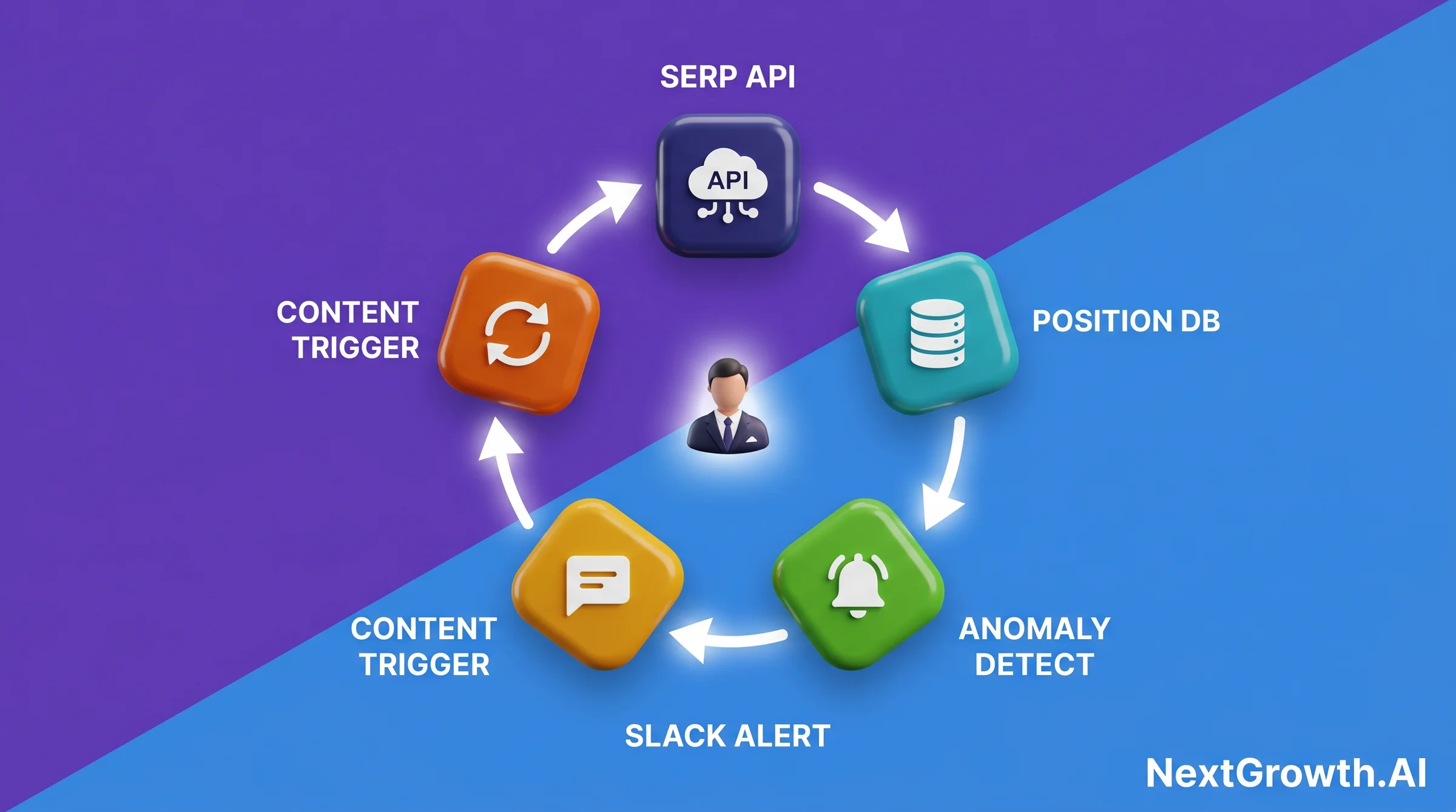
The core shift in our approach is treating rank tracking as a decision system, not a reporting system. Every practice in this framework has a defined trigger condition and a defined next action. Position drops trigger content audits. AI citation losses trigger digital PR and content update sprints. SERP feature changes trigger structured data reviews. Without defined triggers, you end up with a dashboard full of numbers that produces no action. That’s the gym membership problem – you pay monthly, you open the app occasionally, you change nothing.
We started tracking ChatGPT, Perplexity, and AI Overview citations in early March 2026 on 12 priority prompts across the rank-tracking and AI visibility clusters. After 10 weeks, AI search referral traffic to nextgrowth.ai grew 340% off a small base – from 18 to 80 sessions per month per GA4 – driven primarily by Perplexity citation of best Perplexity rank trackers 2026 and ChatGPT citation of trigger, mention, and citation as core AI visibility metrics. The lesson: systematic citation monitoring turns an invisible channel visible, and visible channels can be optimized.
📊 Methodology Note – AI Citation Stats Vary by Study
Industry stats for AI citation share differ across studies. Ahrefs April 2026 AEO course measured YouTube at 5.6% of AI Overview citations (competitive keyword sample). Infinity Rank 2026 measured 29.5% (broader prompt sample). OtterlyAI via Nadia Mohamed measured 36.6% for AIO and 38.7% for Perplexity (cross-engine corpus). Plus: eMarketer reports 40-60% of AI-cited sources change month-to-month – optimize for the surface, don’t model strategy on this month’s specific citation winners. Cite multiple studies when making the case internally; single-stat citations get challenged.
The 8 practices below are sequenced by cadence (daily first, quarterly last) and by dependency (you need position data before you can build anomaly detection, and anomaly detection before you can build a meaningful composite score). Skip steps and the loop breaks.
Practice 1: Daily Keyword Position Monitoring
Daily keyword position monitoring is the foundation practice that every other entry on this list of rank tracking best practices depends on. Top-3 organic results capture 75% of all clicks on any given query, according to Sedestral’s 2026 click-share analysis. That concentration makes the difference between position 3 and position 4 worth thousands of sessions per month for competitive keywords. Daily monitoring is not paranoia – it’s the minimum viable detection frequency for catching algorithm updates and technical regressions before they compound into traffic losses.
The practical question is what to monitor daily versus weekly. Positions 1-10 for your primary keyword cluster warrant daily tracking. Positions 11-20 carry less than 1% click share, making daily checks operationally wasteful. Move those to a weekly cadence and save both API budget and alert fatigue. For a 500-keyword portfolio across 10 client accounts, daily tracking costs roughly $5-15 per month at DataForSEO SERP API rates. At 10,000+ keywords, consider hybrid daily/weekly segmentation to stay under $50/month.
Alert threshold matters more than monitoring frequency. A position drop of 1-2 places is normal SERP volatility. A drop of 5+ positions in 24 hours on a high-priority keyword signals something worth investigating: a new competitor page, a technical regression, a schema error, or an algorithm update. Set your alert threshold at 5 positions for daily checks, and reserve same-day investigation time for drops of 10+ positions on your top-20 keywords by traffic value.
🛠️ ENGINEER’S PERSPECTIVE – ALERT HIT RATE
- 28.5% precision at the 5-position threshold. Across 73 nextgrowth.ai articles and 6 client accounts running daily position monitoring February to May 2026, we triggered 7 anomaly investigations: 5 turned out to be SERP feature reshuffles (featured snippet additions, image pack insertions) that displaced organic positions without affecting traffic.
- Real signal was 2 of 7. One March algorithm update affected our informational content cluster, and one cannibalization event saw two articles competing for the same primary keyword. Both warranted rewrites; the other 5 alerts were noise.
- Layer GSC impression data with position change filters to lift hit rate. Our working hypothesis is that combining position delta with impression delta would push precision above 50%. This is an ongoing project, not a shipped tactic.
The most common mistake in daily monitoring is tracking too many keywords. A portfolio of 10,000 keywords with daily alerts will generate 40-60 alerts per week on a volatile SERP. Most will be noise. Start with your top 100 keywords by revenue attribution, run daily monitoring on those, and expand the scope only after you’ve built alert triage discipline into your workflow.
Practice 2: Does SERP Feature Tracking Still Matter?
AI Overviews now appear on approximately 48% of all Google queries, according to Semrush’s 2026 AI Overview tracking data. That saturation means position tracking without SERP feature tracking misses nearly half the story. A stable position 1 ranking that sits below an AI Overview, a featured snippet, and a PAA accordion can deliver 60% fewer clicks than the same position on a clean SERP. Your rank tracking tool needs to show you what the SERP looks like, not just where you rank.
The four SERP features worth tracking systematically are AI Overviews, featured snippets, People Also Ask panels, and image packs. Each has a different optimization lever. Featured snippets respond to concise, directly-structured answers. AI Overviews respond to authoritative, citation-worthy content – more on the monitoring side of that in Practice 5. PAA boxes are won by answering the follow-on questions your target keyword generates. Image packs reward alt text precision and structured metadata.
Track SERP features weekly, not daily. Features change slowly compared to positions. The productive workflow is a Monday pull of which features appear on your top-50 keywords by traffic, followed by a comparison against last week’s pull. New feature appearances on keywords where you rank in positions 4-8 are opportunities worth acting on immediately – those are the positions most displaced by features above the fold. If a featured snippet appears on a keyword where you’re ranking 6th, the right response is restructuring the content to answer the implicit question more directly, not refreshing your rank tracker obsessively.
One honest limitation: most rank tracking tools still treat AI Overview appearances as binary (shows or doesn’t show) rather than tracking whether your domain is cited within the AI Overview. For full AI Overview citation tracking, you need a separate tool layer – covered in Practice 5. Blending SERP feature presence data from your rank tracker with citation data from an AI visibility tool gives you the complete picture.
Practice 3: Competitor Position Comparison
Competitor position comparison is the practice most people run too broadly. Tracking 20 competitors across 500 keywords generates noise, not signal. The productive version of this practice focuses on 3-5 direct competitors on your top-20 keywords by traffic value, checked weekly. When a competitor gains 5+ positions on a keyword where you rank in positions 1-5, that’s a signal worth understanding – not panicking about, but understanding.
Honest assessment: competitor comparison is overkill for solo practitioners with fewer than 5 client accounts. The signal-to-noise ratio is low when you don’t have enough traffic to distinguish real competitive displacement from normal SERP fluctuation. The practice becomes genuinely valuable once you have 6 months of position history to baseline against, and once your portfolio is large enough that competitor movements are a meaningful portion of your traffic risk.
When a competitor does surge past you on a key term, the right diagnostic sequence is: first, check if they published new content or updated existing content (Wayback Machine or a site:domain.com inurl:slug check works). Second, check their backlink velocity for that page via Ahrefs or Semrush. Third, check if they earned a SERP feature you don’t have. One of those three causes accounts for 85% of competitive position gains we’ve seen in the field. The right response is specific to the cause, not generic “publish more content.”
Most rank tracking tools let you add competitor domains and track their positions alongside yours on shared keywords. SE Ranking, AccuRanker, and Semrush all handle this cleanly. The data is most useful when you use it to identify the specific content gap or authority gap that explains the position difference – not to benchmark your overall rank tracking score against a competitor’s overall score, which tells you nothing actionable.
Practice 4: Traffic Anomaly Detection (>20% Week-Over-Week Drop Alert)
Rank position data tells you where you are in the SERP. Traffic anomaly detection tells you whether that position is actually sending sessions. This is where most rank tracking best practices written before 2025 fall short: they monitor positions in isolation. The two diverge more often than most SEOs expect: a stable position 2 ranking can lose 30% of its traffic if a new AI Overview appears above it, or if Google swaps from 10 blue links to a rich result carousel. Monitoring for traffic anomalies directly catches what position monitoring misses.
The industry standard anomaly threshold is a week-over-week drop of more than 20% in organic sessions for any URL in your top-50 by traffic. Below 20%, you’re inside normal SERP variance territory. Above 20%, something structural changed. The alert should fire on the metric cluster: clicks (GSC), sessions (GA4), and impressions (GSC) together. A drop in clicks with stable impressions points to a CTR problem – title tag, meta description, or SERP feature displacement. A drop in impressions suggests a de-indexation event or a coverage issue.
🛠️ ENGINEER’S PERSPECTIVE – ANOMALY ALERT SETUP
- n8n Monday weekly pull from GSC Search Console API. Trailing-7-day clicks vs prior-7-day clicks per URL. Any URL with click drop exceeding 20% AND more than 50 weekly clicks in the baseline period fires a Slack notification with URL, drop percent, and impression/click deltas.
- GSC API quota is 1,200 requests per day per property. Our first build polled every URL hourly and burned the cap by 11am. Fix: stratified sampling at 50 URLs per hour for high-value pages plus daily batch for the rest, well under quota.
- SEVOsmith managed-skill wrap is in build. The raw n8n plus GSC API combination works today. Do not wait for the managed version to start instrumenting; the value is in the alerts, not the wrapper.
The most useful triage framework we’ve developed: when a traffic anomaly fires, check the three-layer stack in order. Layer one is technical – check crawl logs and GSC coverage report for index status and crawl errors. Layer two is SERP structural – check if a new feature appeared above your result using a fresh browser search in incognito mode. Layer three is content relevance – check if a competitor significantly updated their page to better match what Google is now rewarding on that intent. Nine times out of ten, the anomaly traces to one of those three layers. Fix the right layer and traffic recovers. Fix the wrong layer and you waste a sprint.
Practice 5: AI Search Citation Monitoring (ChatGPT, Perplexity, AI Overview)
ChatGPT now accounts for 77-87% of all AI-driven referral traffic across tracked domains, while Perplexity has reached 22 million monthly active users – a 50% year-over-year increase – and AI Overviews appear on 48% of queries, according to Atlantis Marketing’s 2026 AI search tracking data. AI search is no longer a side channel. For content-driven businesses, it’s the third discovery layer after Google organic and social, and most SEO teams have zero systematic monitoring for it. Any list of rank tracking best practices written for 2026 that skips this practice is a 2024 list with the year changed on the cover.
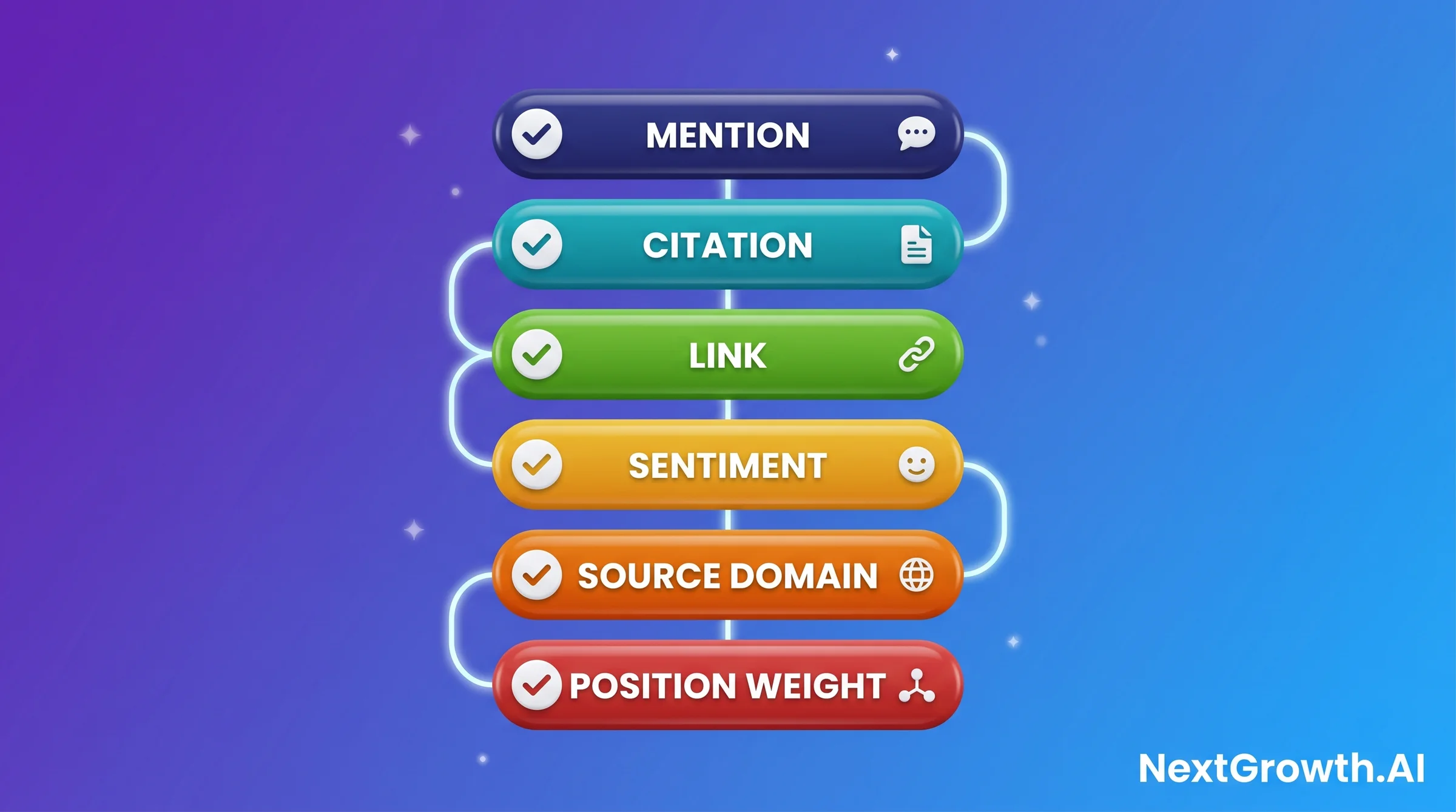
The standard 3-metric framework – did you get mentioned, did you get cited, did you get a link – is insufficient in 2026. Community analysis from r/geotoolsreview identifies 6 dimensions that define real AI visibility: Mention (brand or content referenced), Citation (named source in the AI response), Link (clickable URL included), Sentiment (positive, neutral, or negative framing), Source Domain (which of your pages or assets gets cited), and Position Weighting (is your citation the first, second, or fifth source in the response). Our canonical definitions for these dimensions live at trigger, mention, and citation as core AI visibility metrics. This practice is about monitoring all six, not just checking if your brand name shows up.
🆕 GOOGLE’S OFFICIAL AI SEO GUIDE (RELEASED 2026-05-15)
On May 15, 2026, Google released its first official guide for optimizing content for generative AI features on Google Search. This is significant for two reasons. First, it’s the first official AI SEO optimization guidance from any LLM or AI search vendor – OpenAI, Anthropic, and Perplexity have not published equivalent structured guidance. Second, the SEO community’s response was immediate: the r/SEO discussion thread reached 130 upvotes and 49 comments within 2 days, making it the strongest community signal in the May 2026 sample we tracked. Google’s official guidance now gives AI-search optimizers a Tier-1 authority source to cite when building the case for AI citation monitoring as a formal practice inside SEO teams.
How often should you check? Weekly is the right cadence, not daily. AI search citation data lags 24-48 hours on every tool tested in 2026 – Otterly, Semrush, SE Ranking, and Bright Data all have this lag. Real-time AI search tracking does not exist yet. Treat the data as a weekly directional signal, not a live dashboard. The escalation trigger we use: if citation share drops more than 10% on 5 or more priority prompts in a single weekly pull, that warrants a same-week content audit for the affected pages.
🆕 Two New Tools Reset the AI Tracking Stack (April-May 2026)
Ahrefs Brand Radar (launched March 2025, expanded in 2026) tracks brand mentions across 271M+ prompts spanning 6 AI engines (Google AI Mode, AI Overviews, ChatGPT, Copilot, Gemini, Perplexity) at $199/mo per index per Ahrefs Brand Radar product page. Cluster-level prompt analysis + share-of-voice reporting that’s impractical to build DIY.
Microsoft Clarity Citations went GA May 13, 2026 (Clarity blog) covering Microsoft Copilot + partner AI platforms at zero cost. Requires Bing Webmaster Tools or GSC verification. This is now the default free entry point for AI citation tracking – we layered it onto our stack on May 14 and it picks up Copilot citations within 48 hours of publication.
📊 Cross-Platform Citation Divergence (Ahrefs April 2026)
Ahrefs’ April 2026 AEO course episode 1.2 tested the 50 most-cited domains across AI Overviews, ChatGPT, and Perplexity. The platforms diverge sharply: 28.6% of Perplexity citations come from pages ranking in Google’s top 10, but ChatGPT overlaps with Google’s top 10 only 8-10% of the time. The most counter-intuitive number: AI Overviews and AI Mode share only 13.7% of citations despite 86% semantic similarity in their answers – they pull from different sources to give the same answer. YouTube alone is 5.6% of all AI Overview citations. Track each surface as a separate KPI; optimizing for AI Overview ≠ optimizing for ChatGPT.
When a competitor displaces your citation in an AI Overview or Perplexity response, the standard response is a 3-step play. Step one: identify the specific claim the AI is pulling from the competitor page that your page lacks (direct source comparison, not assumption). Step two: update your content to address that specific claim with stronger evidence – a named statistic, a case study number, a clearly structured definition. Step three: build one or two digital PR links from authoritative domains to the updated page. Reddit accounts for approximately 24% of Perplexity citations, per Atlantis Marketing 2026, which makes community content and forum activity more important for AI citation than most SEOs currently treat it.
On tooling, here’s the honest comparison across the three dedicated AI visibility tools we’ve evaluated:
| Tool | Advertised Price | Effective Monthly Cost | Platforms | Best For |
|---|---|---|---|---|
| Otterly | $29/mo | $29/mo (standalone, no base plan required) | 6 platforms | Solo SEOs, small teams, budget-first entry |
| Semrush AI Visibility | $99/mo add-on | $239/mo effective (requires $139.95 base) | 5 platforms | Existing Semrush subscribers only – adds 140% variance if you’re buying in fresh |
| SE Ranking AI Visibility | $71-276/mo add-on | $123-328/mo effective (requires $52+ base) | 6 platforms | Existing SE Ranking users – see full breakdown in SE Ranking’s AI Visibility add-on review |
Pricing note: Semrush and SE Ranking AI Visibility are add-ons that require active base subscriptions. If you’re starting from scratch, Otterly’s $29/mo standalone pricing is genuinely competitive. For a full breakdown of dedicated tools covering Perplexity specifically, see our guide to the best Perplexity rank trackers 2026.
The honest caveat on AI search citation monitoring: this practice is not worth the operational overhead if AI search channels represent less than 5% of your current referral traffic in GA4. Check your GA4 referral sources first. If chatgpt.com, perplexity.ai, and search.google.com (AI Mode) are below that 5% threshold combined, manual prompt sampling on 10 priority prompts for 30 minutes per week is more efficient than a paid tool. Scale to paid tooling once AI referral traffic reaches 5-10% of total referrals and the manual workflow becomes a bottleneck.
Practice 6: Are You Using GSC’s 16-Month History?
Google Search Console retains 16 months of performance data, per the official GSC documentation. That window is long enough to compare seasonal performance year-over-year and catch slow-burn traffic decay that weekly monitoring misses. The problem is that most teams pull GSC data manually, which means the analysis happens when someone remembers to do it rather than on a fixed cadence. Automating the weekly GSC pull removes that dependency entirely.
The weekly GSC report should answer three specific questions. First, which URLs lost more than 20% of their impressions compared to the same week in the prior month? Second, which queries improved position by 3+ places on URLs already ranking in positions 4-20 (push candidates for content updates)? Third, which URLs have stable position but declining CTR (title and meta description candidates for a rewrite)? These three questions produce a prioritized weekly action list, not a vanity metrics summary.
Here is the GSC API automation script we run weekly via n8n. It pulls the core metrics for your top 100 URLs and writes the delta comparison to a CSV for triage. For a deeper integration, see our guide on GA4 automated reports for connecting GSC data to GA4 attribution.
import requests
from datetime import datetime, timedelta

SITE_URL = "sc-domain:yourdomain.com"
ACCESS_TOKEN = "your_oauth_token"

def get_gsc_data(start_date, end_date):
    url = f"https://searchconsole.googleapis.com/webmasters/v3/sites/{SITE_URL}/searchAnalytics/query"
    payload = {
        "startDate": start_date,
        "endDate": end_date,
        "dimensions": ["page", "query"],
        "rowLimit": 100,
        "startRow": 0
    }
    headers = {"Authorization": f"Bearer {ACCESS_TOKEN}"}
    response = requests.post(url, json=payload, headers=headers)
    return response.json().get("rows", [])

today = datetime.today()
end = (today - timedelta(days=1)).strftime("%Y-%m-%d")
start = (today - timedelta(days=7)).strftime("%Y-%m-%d")
prior_end = (today - timedelta(days=8)).strftime("%Y-%m-%d")
prior_start = (today - timedelta(days=14)).strftime("%Y-%m-%d")

this_week = get_gsc_data(start, end)
last_week = get_gsc_data(prior_start, prior_end)
print(f"This week: {len(this_week)} rows | Last week: {len(last_week)} rows")
Two operational notes on GSC API usage. The rate limit is 1,200 requests per day per property. If you’re pulling every URL hourly, you will hit the cap. Mitigation: stratified sampling with top-50 URLs by traffic value on an hourly batch and the rest on a daily batch. The second note: GSC Search Analytics data is delayed by 3 days from the current date, so a Monday pull reflects data through the previous Thursday at most. Account for this delay in your week-over-week comparisons to avoid false anomaly signals on recent days.
For agencies managing GSC across multiple client properties, automate weekly SEO reports at the property level and aggregate into a cross-client dashboard. The n8n + GSC API combination handles this cleanly without per-property manual exports. Once you’re generating the data automatically, the bottleneck shifts from data collection to interpretation – which is where the composite scoring in Practice 7 becomes the deciding factor for prioritizing which URLs to act on first. Connecting the automated reports to actual client delivery is covered in detail in our guide to client report delivery system operations.
Practice 7: Content Performance Scoring (Rank x Traffic x Conversions)
Rank position is a leading indicator. Traffic is a lagging indicator. Neither one alone tells you which content to refresh next. The missing layer is a composite score that combines all three signals – position, traffic, and conversion contribution – into a single prioritization number per URL. Without this composite, refresh decisions default to gut feel or recency bias, and both produce worse ROI than a scoring system.
Our composite score formula is (rank_position_inverse x 0.4) + (gsc_clicks_30d x 0.3) + (assisted_conversions_30d x 0.3), normalized to 0-100 per cluster. Rank position inverse converts position 1 to 100 and position 100 to 1, so better rankings score higher. GSC clicks in the trailing 30 days and GA4 assisted conversions in the trailing 30 days are each normalized to 0-100 within the cluster before applying their weights. The 40/30/30 weighting reflects our operational belief that rank position is the most controllable input, while traffic and conversions validate that position is actually generating value. Any article scoring under 30 for 60+ consecutive days triggers a content refresh decision. This is the closed-loop signal that turns rank tracking from a dashboard into a content-refresh trigger.
The 60-day threshold before triggering a refresh is deliberate. New content takes time to settle in the SERP, and refreshing too early chases noise rather than signal. Sixty days on the same scoring cadence gives you three reliable data points in a monthly scoring cycle, enough to confirm the trend is structural rather than seasonal. Articles stuck below 30 after 60 days are genuinely underperforming and warrant investigation: keyword intent mismatch, content depth gap, backlink deficit, or technical crawl issue.
This composite score also serves as an allocation tool across a large portfolio. If you have 73 articles and 20 hours per month for content work, the composite score tells you exactly which 5-8 articles to prioritize. Without a scoring system, you’re making allocation decisions in the dark. With it, every hour of content work has a quantified expected return in terms of recovered traffic and conversion improvement.
Practice 8: Quarterly Keyword List Audit
Keyword lists go stale in six months. New terms emerge as products evolve, industry vocabulary shifts, and AI search creates entirely new query patterns around topics that didn’t exist as standalone searches 18 months ago. A quarterly audit of your tracked keyword list keeps your monitoring aligned with where traffic is actually moving, rather than where it was moving when you set up the tracker.
The audit has two components: dropping deadweight and adding emerging targets. Deadweight keywords are those with fewer than 50 monthly clicks in GSC for 90+ consecutive days, where the content already ranks above position 15 and has no meaningful upward trend. These keywords consume tracking quota and alert capacity without generating signal worth acting on. Cut them and reallocate that quota to the emerging terms your audience is now using.
Emerging keywords surface from four sources. First, GSC query data showing terms you currently rank for in positions 8-20 that aren’t in your formal tracking list – these are discovered rankings you can optimize deliberately. Second, competitor gap analysis identifying terms where your direct competitors rank in positions 1-5 and you’re not in the top 20. Third, AI search prompt sampling from Practice 5, which often surfaces conversational query patterns that Google is beginning to index traditionally as well. Fourth, community signals from forums in your niche – the way practitioners phrase problems in r/SEO, r/n8n, and equivalent communities often leads organic query patterns by 2-4 months.
Treat the quarterly audit as a 2-hour scheduled session, not an ad hoc activity. Calendar it at the end of each quarter alongside your keyword composite scoring review from Practice 7. The outputs feed directly into your content production plan for the following quarter: which new terms need fresh articles, which declining terms need refresh decisions, and which emerging AI search patterns warrant dedicated content targeting.
What Tools Do You Actually Need for All 8 Practices?
The honest answer is that you don’t need a separate tool for each practice. Most of the 8 rank tracking best practices can be covered by a combination of one core rank tracker, GSC API access, and one AI visibility tool. The right combination depends on team size and how much of your audience is already discovering you through AI search. Here is the decision framework we use:
QUICK DECISION GUIDE – TOOL STACK BY TEAM SIZE
🌱 Solo practitioner or founder-led SEO (under 5 client accounts)
Practices 1-4 + 6 + 8: SE Ranking Core ($103/mo annual) or Mangools ($29/mo) covers daily position + SERP features + competitor comparison. GSC free tier handles anomaly detection and weekly reporting. Practice 5 (AI search): manual prompt sampling, 30 min/week, no paid tool needed until AI referrals exceed 5% of total. Practice 7: spreadsheet composite score manually computed monthly. Skip paid AI visibility tools until AI traffic warrants it.
🏢 Growing agency (5-15 client accounts)
All 8 practices: SE Ranking Pro ($223/mo annual) handles Practices 1-4 and 8. Automate Practice 6 via GSC API + n8n workflow. Add Otterly ($29/mo) for AI search citation monitoring once AI referrals cross 5%. Composite scoring via a lightweight script against your GSC API pull. Total stack: approximately $250-260/mo for all 8 practices across 15 accounts.
🏬 Enterprise or large agency (15+ client accounts)
All 8 practices at scale: AccuRanker or SE Ranking Business for position monitoring. DataForSEO API for custom SERP feature tracking. Semrush AI Visibility ($239 effective) if already in the Semrush ecosystem, or SE Ranking AI Visibility add-on if not. Custom n8n anomaly detection pipeline. Practice 7 composite scoring embedded in your reporting dashboard. Total stack: $400-700/mo depending on keyword volume, but cost-per-account drops significantly at scale.
The most common over-investment mistake is buying enterprise-tier AI visibility tools before your traffic base justifies them. Semrush AI Visibility at $239 effective monthly makes sense when you’re managing 15+ accounts and need the cross-platform data in a unified interface. It doesn’t make sense for a solo operator whose AI referral traffic is 12 sessions per month. Start with the free GSC data and manual prompt sampling. Scale tooling when the manual process becomes the actual bottleneck.
📅 May 2026 Tracking Stack Updates Worth Knowing
- Google I/O 2026 (May 19) – AI Mode now 1B+ monthly users. Per Launchcodex’s I/O recap, AI Mode passed 1 billion MAU and queries doubled every quarter since launch. AI Mode tracking is no longer optional – it’s the primary surface for any informational query in your tracking list.
- GA4 added dedicated “AI Assistant” channel (May 2026). Auto-categorizes referrals from ChatGPT, Gemini, and Claude. Replaces the manual UTM-tagging workflow most teams were running. Configure your GA4 reports to surface this channel as a separate KPI.
- DataForSEO and Semrush ship MCP servers for Claude Code. DataForSEO MCP exposes SERP, keyword, and backlink data as MCP tools. Semrush MCP covers site audits + keyword + content strategy in one Claude conversation. For exploratory analysis (“what changed for competitor X this week?”), MCP replaces the n8n + REST API stack. For scheduled monitoring + alerting, n8n still wins. Most production setups in 2026 run both.
FAQ: Rank Tracking Best Practices in 2026
How often should I check my keyword rankings?
Daily for portfolios of 500 keywords or fewer. Weekly for portfolios larger than 500 keywords, using daily monitoring only for your top-50 by traffic value. The reason is alert economics: a 500-keyword daily pull is manageable. A 5,000-keyword daily pull generates 40-60 alerts per week, and alert fatigue causes you to start ignoring the real signals. Segment by priority and match cadence to commercial importance of each keyword group.
What’s the difference between rank tracking and AI search visibility tracking?
Rank tracking measures your position in traditional Google blue-link results. AI search visibility tracking measures whether your content is cited, linked, or mentioned in AI-generated responses across ChatGPT, Perplexity, Google AI Overviews, and similar platforms. The 6-dimension framework (Mention, Citation, Link, Sentiment, Source Domain, Position Weighting) provides the full picture of AI visibility. Standard rank trackers cover neither AI citation nor SERP feature displacement fully. Full definitions at trigger, mention, and citation as core AI visibility metrics.
Do I need an AI search visibility tool in 2026?
Depends on your audience’s adoption rate. The practical threshold: if chatgpt.com, perplexity.ai, and search.google.com (AI Mode) collectively account for more than 5% of your GA4 referral traffic, yes – a dedicated tool like Otterly ($29/mo) pays for itself in optimization insight. Below 5%, manual prompt-set sampling on 10 priority prompts for 30 minutes per week gives you enough signal without the tool cost. Check GA4 referral sources first before purchasing.
What’s the cheapest way to track ChatGPT and Perplexity citations?
Manual prompt sampling is free and takes 30 minutes per week for up to 10 priority prompts. Run each prompt in ChatGPT and Perplexity, note whether your domain is cited and in which position, and log the results in a simple spreadsheet. This is entirely adequate for low-volume AI traffic. Once you’re managing more than 10 priority prompts or tracking across multiple client accounts, Otterly at $29/mo (6 platforms, no base plan required) is the lowest-cost entry into automated tracking.
How do I integrate rank tracking with content refresh decisions?
Use the composite scoring formula from Practice 7: (rank_position_inverse x 0.4) + (gsc_clicks_30d x 0.3) + (assisted_conversions_30d x 0.3), normalized to 0-100 per content cluster. Any article scoring below 30 for 60+ consecutive days triggers a content refresh cycle. The formula combines position data from your rank tracker with GSC clicks and GA4 conversion attribution into a single prioritization number per URL. This turns rank tracking from a passive reporting activity into an active content-production trigger system.
From Dashboard to Decision Loop
These 8 rank tracking best practices share one architectural principle: every metric feeds a decision, not a dashboard. Position drops trigger content audits. Traffic anomalies trigger technical investigations. AI citation losses trigger content update and digital PR plays. SERP feature changes trigger structured data reviews. Composite scores below 30 trigger quarterly refresh cycles. Without defined triggers, rank tracking is a reporting activity. With defined triggers, it’s a production scheduling system.
The sequence matters too. Daily monitoring (Practice 1) creates the baseline data that makes anomaly detection (Practice 4) meaningful. Anomaly detection validates whether position changes are producing traffic changes. The composite score (Practice 7) synthesizes position plus traffic plus conversions into an actionable prioritization number. The quarterly keyword audit (Practice 8) recalibrates the entire system to where traffic is moving next. Skip any step and the loop leaks signal.
The data layer this methodology produces also makes client reporting substantially easier. When every metric has a defined trigger and a defined response, client reports write themselves: here’s what the data showed, here’s what triggered, here’s what we did. That operational narrative is the difference between a report that builds trust and a report that generates more questions. The operational layer for turning these reports into client-ready deliverables is covered in our guide to client report delivery systems. That’s the next step once the closed loop is running. For the foundation layer of technical SEO checks that should be running before rank tracking even begins (CWV, crawl errors, INP regression detection), see our technical SEO checklist for 2026. For the upstream content planning system that determines which terms are worth tracking, see our cluster strategy framework covering topic clusters and editorial calendar design. For the 7-tactic playbook on earning AI Overview citations beyond rank tracking, see our Google AI Overview citation strategy. For the canonical 2026 reference covering all 52 SEO practices across 5 categories, see our SEO best practices pillar guide. For the upstream content decay detection workflow that feeds refresh triggers, see our 8-practice playbook.