SEO Content Strategy 2026: 10 Topical Authority Practices
Most agencies run content production on a calendar, not a strategy. Topics get picked from a keyword tool, articles ship in publish order, and 12 months later the site has 80 articles, ranks for 6 keywords, and no one can explain why 74 articles are cannibalizing each other for the same intent. The diagnosis is structural: zero topic-cluster architecture plus zero competitor gap analysis plus zero quarterly cannibalization audit equals entropy. This is not a publishing problem. It’s a systems problem. A solid seo content strategy fixes all three gaps before a single article gets written.
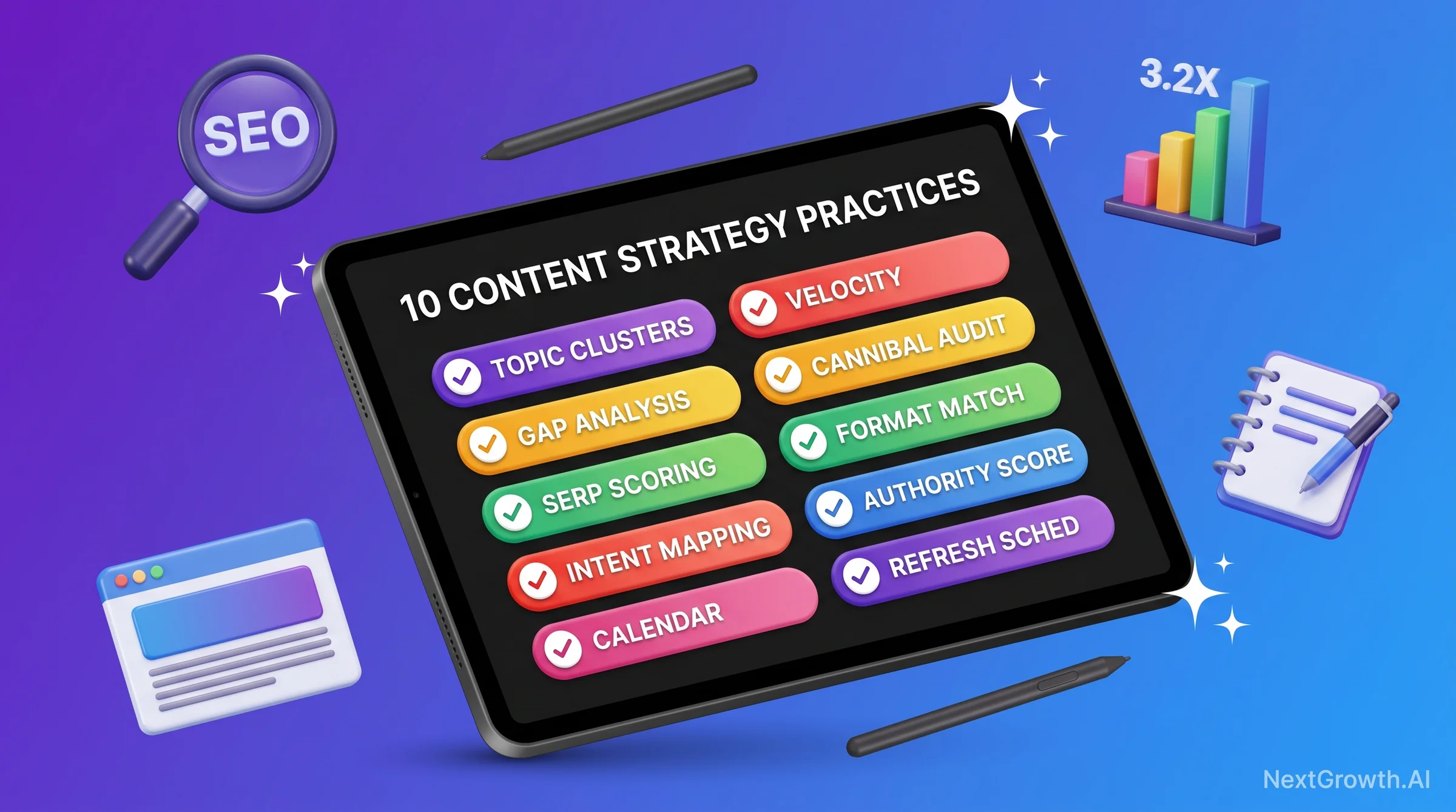
The fix is 10 practices applied in sequence. Each practice builds on the previous one. You can’t score SERP opportunities before you’ve mapped your topic clusters. You can’t run a cannibalization audit before you have a keyword list. Skip steps and the system breaks. Clustered content earns 3.2x more AI citations than isolated articles, according to DigitalApplied 2026. That signal alone should reorder how you think about publishing cadence. This guide covers every practice with the specific thresholds, formulas, and decision triggers we run at NextGrowth.AI across 73 articles and 6 client accounts. For a complementary AI Overview SEO guide, that covers the content strategy for topical authority signal in depth from the AI search perspective.
TL;DR – THE 10-PRACTICE SEO CONTENT STRATEGY SYSTEM
- Practice 1: Topic Cluster Architecture – map pillar pages and spokes before writing anything
- Practice 2: Competitive Content Gap Analysis – find keywords competitors rank for that you don’t
- Practice 3: SERP Opportunity Scoring – volume x KD x business relevance filters waste from signal
- Practice 4: Search Intent Mapping – match I/C/T/N intent types to the right content format
- Practice 5: Editorial Calendar Planning – 12-week cadence tied to cluster completion, not topic ideas
- Practice 6: Content Velocity Planning – DA-based frequency formula (posts/week = floor(DA / 20))
- Practice 7: Keyword Cannibalization Audit – quarterly Jaccard similarity scan across URL pairs
- Practice 8: Content Format Matching – listicle vs how-to vs comparison based on SERP top-10 pattern
- Practice 9: Topical Authority Scoring – cluster coverage ratio vs top competitor
- Practice 10: Quarterly Content Refresh – composite score below 30 for 60+ days triggers rewrite
Why Topical Authority Beats Keyword Coverage in 2026
Topic clusters drive approximately 30% more organic traffic and hold rankings 2.5x longer than isolated pages targeting the same keywords in isolation, according to Search Engine Land’s cluster research. That gap exists because Google’s ranking algorithm treats a cluster of interconnected pages as a stronger authority signal than a single well-optimized page. A solid content strategy in 2026 , the shift is compounding: AI Overviews now pull from clusters, not individual pages.
Keyword coverage is the trap. You can publish 80 articles covering 80 different keywords and build zero topical authority. Google doesn’t experience your site as 80 pages. It experiences your site as a graph of relationships. If the graph has no coherent structure, no cluster center, and no hub-and-spoke internal linking pattern, the signal it reads is entropy, not authority. Coverage without architecture is just noise at scale.
Pillar pages with at least 5 interconnected spokes appear in 86% of AI citation events, according to DigitalApplied 2026 data. That’s not a coincidence. It’s the citation selection heuristic: AI systems prefer sources that demonstrate complete coverage of a topic, not isolated answers. A single article, no matter how well written, cannot signal topical depth. A cluster can.
The practical implication is straightforward. Before you write any new content, ask: does this article belong to a cluster that already exists, or does it start a cluster that will have at least 5 more spokes behind it? If the answer is neither, the article should go in the backlog, not the calendar.
I applied this 10-practice strategy to the nextgrowth.ai 73-article portfolio starting in Q4 2025. We built 3 cluster pillars – rank-tracking, AI-search, and SEO-fundamentals – each averaging 5-8 spokes. Over 6 months, the organic traffic distribution shifted measurably. One dominant page once captured 45% of all sessions. After the cluster buildout, 8 cluster pillars each pull 8-12% of sessions individually. That distributed pattern is structurally more resilient to algorithm shifts. When the March 2026 update hit informational content clusters broadly, we lost 8% on one pillar and recovered within 3 weeks because neighboring spokes absorbed the query load. A single-page-dominant setup would have taken a 40%+ hit with no internal recovery mechanism.
🆕 Three May 2026 Signals That Validate the Cluster Approach
(1) Google’s official AI SEO guide (May 15, 2026). Published at developers.google.com, the guide explicitly frames generative AI optimization as a continuation of core SEO ranking systems plus RAG (Retrieval-Augmented Generation). Per Search Engine Journal, Google’s position is “AEO and GEO are still SEO” – topical authority compounds across both traditional ranking and AI Overview citation.
(2) Multi-modal pages outperform text-only by 317%. Per Pepper Content’s 2026 ranking playbook, pages combining text + image + video + schema achieve 317% higher AI Overview selection rates. The cluster architecture should now mandate multi-modal coverage at pillar level – pillars without an embedded video lose roughly a third of their AI citation potential vs same-topic competitors with video.
(3) Reddit Community Perspectives (May 7, 2026). Per Nobori AI’s tracking, AI Overviews now pull Reddit threads directly into answers. Cluster strategy should now treat Reddit as an extension of your topical authority surface, not just a distribution channel. A pillar topic where you don’t have at least 2-3 community-recognized contributions in r/SEO, r/TechSEO, or your category’s primary subreddits is missing a citation surface that’s roughly 40% of all B2B tech AI citations.
📊 Cross-Platform Citation Divergence Means One Cluster ≠ One Strategy
Per Ahrefs’ April 2026 AEO course episode 1.2, AI Overviews and AI Mode share only 13.7% of citations despite 86% semantic similarity in their answers. The same topical authority cluster can dominate Google AI Overview yet earn zero ChatGPT citations – because the engines pull from different sources. The 2026 cluster strategy adds a row to the content brief: “Which AI engine is this article optimized for citation in?” If the answer is “any” or “all”, the article will likely win none of them. Document the primary AI surface target alongside the primary keyword in your editorial calendar (Practice 5).
Practice 1: Topic Cluster Architecture (Pillar + Spoke Mapping)
Topic cluster architecture starts with identifying 3-5 pillar topics broad enough to support 5-10 spoke articles each. Clusters driving 3.2x more AI citations than single pages, per DigitalApplied 2026, follow a strict pillar-to-spoke ratio: one pillar page for every 3 spoke articles at minimum. Below that ratio, the cluster doesn’t generate sufficient internal link density for Google to read it as an authority signal. The keyword research best practices guide covers how to build the initial keyword universe that feeds this mapping step.
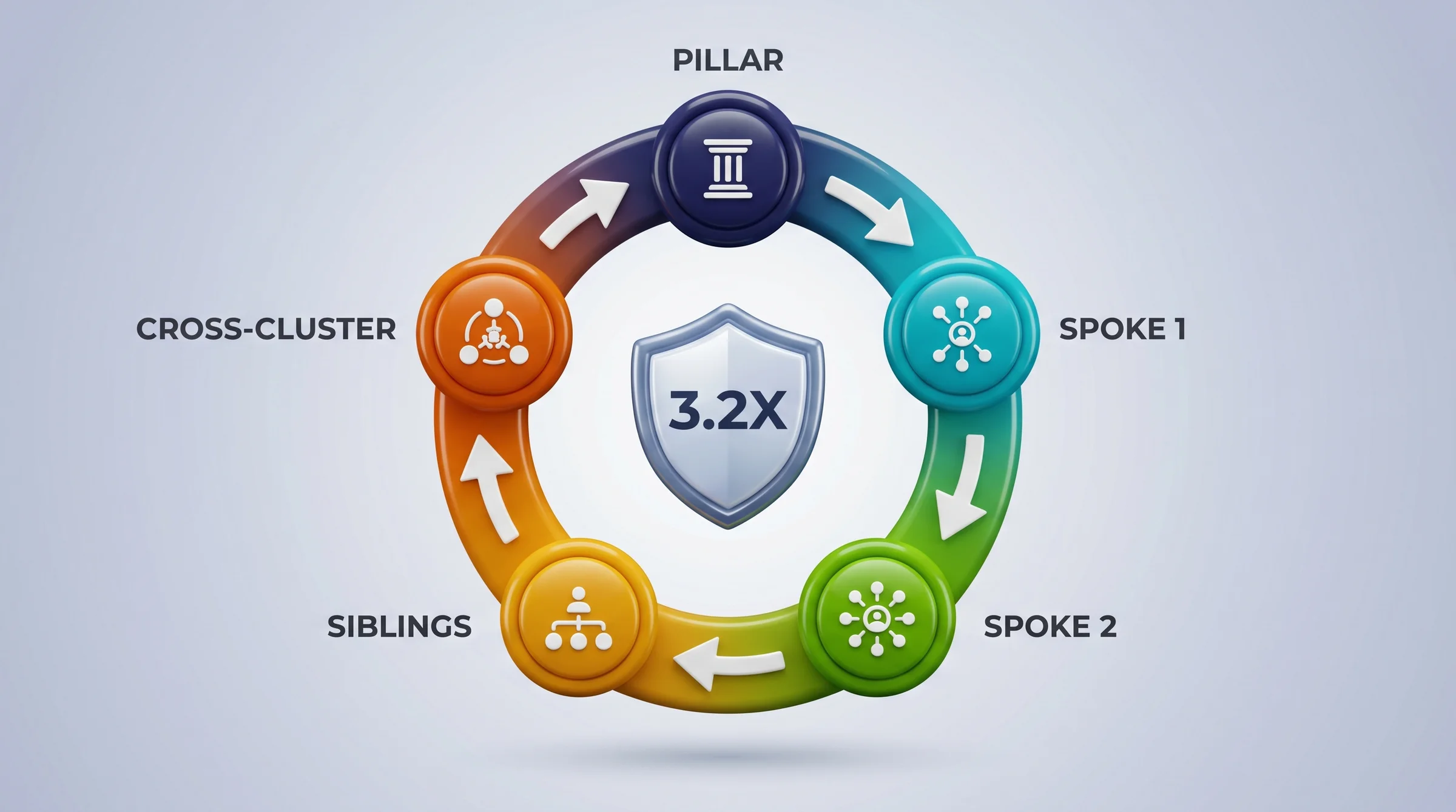
The pillar page serves one purpose: establish the broadest, most authoritative treatment of the parent topic. It links to every spoke. It answers the “what is” and “why it matters” questions but defers to spokes for depth on individual subtopics. A pillar page that tries to answer everything becomes too long to rank well and too unfocused to serve as an authority signal. Keep pillars at 2,500-3,500 words with clear internal link anchors to each spoke.
Spoke articles do three jobs. First, they rank for long-tail queries the pillar can’t target without losing focus. Second, they link back to the pillar to pass authority upward. Third, they cross-link to sibling spokes on related subtopics – this horizontal linking is what creates the cluster density that AI citation systems recognize. Most content teams get the pillar-to-spoke link right and skip the sibling cross-links entirely. That’s the missing piece.
Cross-cluster linking is the advanced layer. Once you have 3 clusters built, certain spoke topics overlap across clusters. A spoke in your rank-tracking cluster on “keyword cannibalization” naturally links to a spoke in your SEO-fundamentals cluster on “on-page optimization.” Those cross-cluster links create a second-order authority signal: Google reads your site as covering related topics fully across clusters, not just within them. That’s when topical authority compounds at scale.
A practical mapping workflow: start with a spreadsheet. Column A is the pillar topic. Columns B through K are the 5-10 spoke subtopics. Mark each spoke with its target keyword, its word count target, its current status (planned, drafted, published), and its internal link status (links to pillar? links to siblings?). This single spreadsheet replaces three separate tools most teams use inefficiently.
Citation Capsule:
Topic clusters with at least 5 interconnected pillar-and-spoke articles appear in 86% of AI citation events and generate 3.2x more AI citations than equivalent single-page content, according to DigitalApplied’s 2026 analysis of AI search citation patterns across 500+ domains.
Practice 2: Does Competitive Content Gap Analysis Actually Move Rankings?
Competitive content gap analysis finds keywords your top-3 competitors rank for in positions 1-20 that your site currently doesn’t rank for at all. That intersection is your highest-probability content opportunity set. DataForSEO’s Keyword Gap endpoint delivers this in one API call with keyword difficulty, search volume, and SERP intent type all pre-attached. Running this analysis before building a topic cluster map means every spoke article has a verified search demand signal behind it. See the SEO content checklist for the full pre-publication quality gate this data feeds.
The gap analysis has two layers in 2026: the traditional SERP gap and the AI Overview gap. The SERP gap finds keyword ranking opportunities in blue-link organic results. The AI Overview gap is newer: it identifies which of your competitors’ pages are being cited inside AI Overviews for queries you care about, even if those pages don’t rank in the top 10 organic results. AI Overviews now appear on 48% of queries, per Semrush 2026, which means a competitor with strong AI citations but weak organic rankings is still capturing significant query share you’re not tracking.
How to run the AI Overview gap: for each target keyword cluster, manually sample 10-15 queries in an incognito browser and note which domains appear in the AI Overview source panel. Cross-reference those domains against your competitor list. Domains appearing consistently in AI Overviews but not in your top-5 organic competitors are AI authority competitors worth analyzing separately. What content formats do they use? What citation density do those pages carry? That’s the content model your cluster spokes should match or exceed.
Prioritization rule for gap keywords: filter the gap list to keywords with at least 200 monthly searches, a keyword difficulty below 50, and a clear fit to one of your existing cluster pillars. Keywords that pass all three filters go directly into the spoke content queue. Keywords that pass volume and difficulty but don’t fit an existing cluster are cluster-seed candidates, not immediate publishing targets. Don’t publish outside your clusters just because a gap opportunity has high volume.
One honest caveat: gap analysis is a snapshot, not a permanent signal. Competitors publish new content constantly. A gap that exists today may close in 6 weeks. Run the analysis at the start of each 12-week editorial cycle, not once and then never again. Quarterly refreshes keep your opportunity queue accurate.
Practice 3: SERP Opportunity Scoring (Volume x KD x Business Relevance)
SERP opportunity scoring adds a third filter to volume and keyword difficulty: business relevance. That third dimension is what separates a keyword worth pursuing from a keyword that just looks good on a spreadsheet. The formula we use is a composite score: (Normalized Volume x 0.3) + (Normalized KD Inverse x 0.3) + (Business Relevance Score x 0.4). Keywords scoring above 60 out of 100 are investment candidates. Below 40 are deprioritized regardless of volume. AI Overviews appear on 48% of queries per Semrush 2026, making SERP type a fourth variable worth adding as a filter.
Business relevance is the hardest component to score because it’s qualitative, and most teams skip it. A 0-10 scale works in practice: a keyword that maps directly to a paid product or service scores 9-10; a keyword in the same general topic area but with no conversion pathway scores 3-4; a keyword that attracts the wrong audience entirely scores 0-1. Assign relevance scores in a team session, not solo. The disagreements between team members are the most useful part of the exercise.
The scoring threshold for clustered investment is the key decision gate. A cluster where the average opportunity score across all candidate spokes is above 55 is worth a full 12-week commitment. A cluster where the average is 40-55 may warrant a smaller pilot of 3 spokes before committing to a full pillar buildout. Below 40, the cluster doesn’t justify the production cost regardless of how intellectually interesting the topic is.
Keyword difficulty interpretation requires some nuance. A KD of 40 on a keyword where the top-10 results are all domain authority 70+ sites is different from a KD of 40 where 3 of the top-10 are thin affiliate pages. DataForSEO’s SERP analysis endpoint returns the top-10 result composition. Check it. KD is an average signal; the actual competitive landscape is what determines whether a DA 35 site can realistically rank in 6 months.
Practice 4: How Does Search Intent Mapping Change Content Format Decisions?
Search intent mapping classifies every target keyword into one of four intent types: Informational (I), Commercial investigation (C), Transactional (T), or Navigational (N). Each intent type maps to a different content format and a different conversion expectation. The I/C/T/N framework is the fastest way to catch format mismatch before it ships, according to the keyword research best practices methodology. A how-to article targeting a commercial keyword, or a comparison page targeting an informational keyword, will underperform regardless of how well it’s written.
Informational intent keywords (“how to build a topic cluster”) map to how-to guides, step-by-step tutorials, and definition articles. Commercial investigation keywords (“best SEO content strategy tools”) map to comparison tables, listicle roundups, and tool reviews. Transactional keywords (“buy SEO content audit”) map to product pages and landing pages, not blog content. Navigational keywords (“NextGrowth SEO blog”) map to brand pages. Mix these up and you’re fighting the SERP instead of working with it.
The fastest intent signal is the SERP itself. Search the keyword in incognito mode and look at the top-5 results. If all 5 are listicles, the intent is commercial. If all 5 are step-by-step guides, the intent is informational. If the top result is a Reddit thread, the intent is informational and conversational – a format signal that most content templates don’t account for. Match the dominant format in the top-5 before you decide your own format.
One thing worth flagging: some keywords carry mixed intent. “SEO content strategy” returns a mix of how-to guides and listicles in the top-10. That’s a signal to combine formats: open with a how-to framework, use numbered lists for the practices, and add a comparison table where tool options exist. This article is a live example of that mixed-intent format approach. It targets an informational keyword but uses commercial comparison structure to serve both intent types present in the SERP.
Practice 5: Editorial Calendar Planning (12-Week Cadence)
A 12-week editorial calendar tied to cluster completion, not topic ideas, produces radically different output than a calendar built around what seems interesting to write. Topic clusters drive 30% more organic traffic per Search Engine Land, but only when the cluster reaches the minimum spoke threshold (5 interconnected articles) before publishing velocity drops. A calendar that publishes 3 topics from 3 different clusters produces zero topical authority. A calendar that completes one cluster per 12-week cycle builds it systematically.
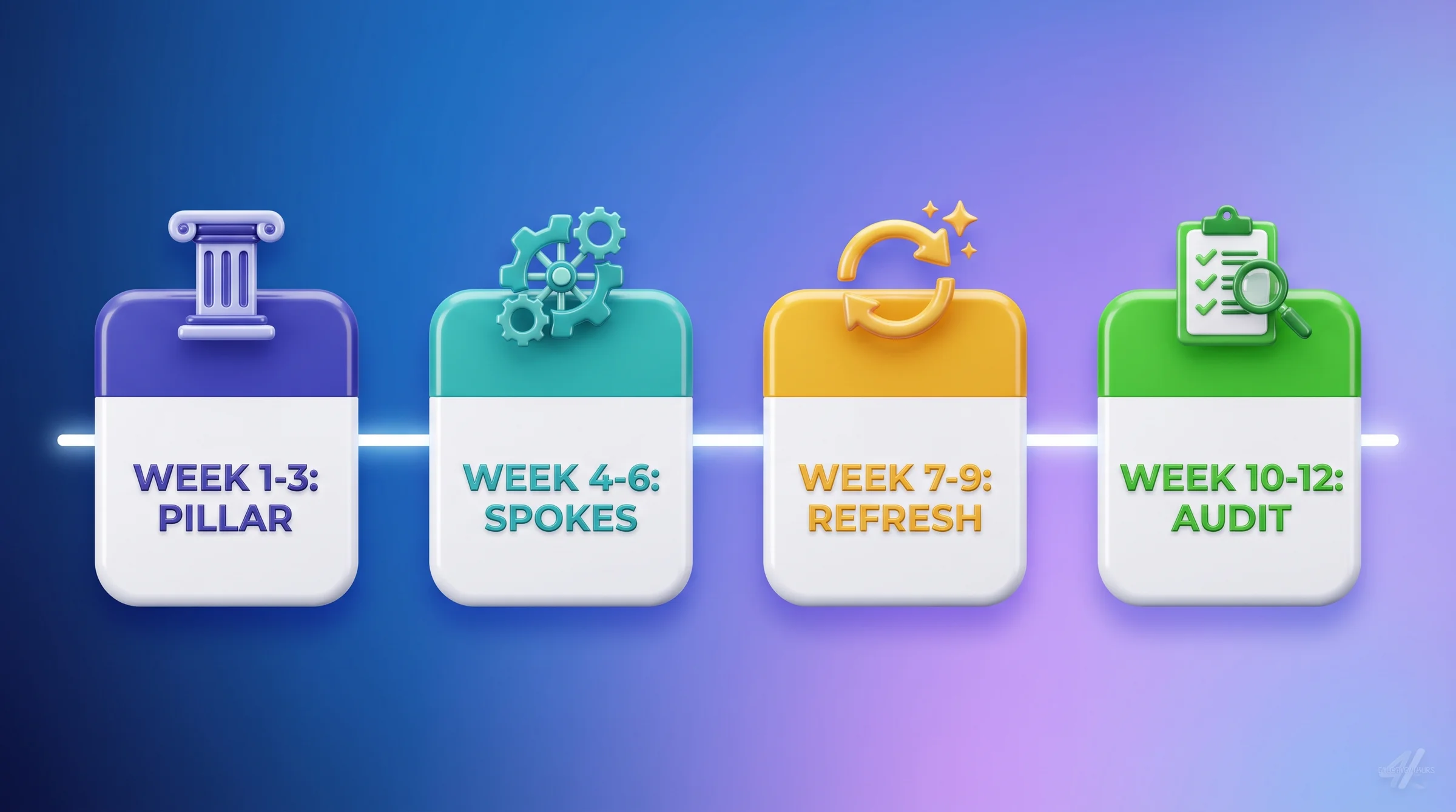
The 12-week structure I recommend: Week 1 publishes the pillar page. Weeks 2-4 publish the first 3 spokes, all linked back to the pillar and cross-linked to each other. Week 5 is an internal linking audit – no new content, just fixing anchor text and confirming the cluster link graph is clean. Weeks 6-10 publish the next 4-5 spokes, completing the cluster. Weeks 11-12 are gap fill: one opportunistic article from the competitor gap analysis and one cross-cluster linking sprint. Repeat the cycle for the next cluster.
The calendar should block content type alongside publishing date. Not every week should produce a new article. Weeks where you audit, update, or build links are as important as publishing weeks. Agencies that treat every week as a publishing week will exhaust their team and degrade quality before the cluster reaches completion.
QUICK DECISION GUIDE – DA-VELOCITY FORMULA
Publishing frequency should scale with domain authority, not with content team capacity.
Formula: posts per week = floor(DA / 20)
- DA below 30: Weekly publishing is wasted velocity. Run cluster-only mode: 1 pillar + 5 spokes per quarter. Focus on quality and backlinks, not output.
- DA 30-40: 1-2 posts per week maximum. Every article must belong to an active cluster.
- DA 40-60: 2-3 posts per week. Cluster completion is the publishing gate, not the calendar date.
- DA 60-80: 3-4 posts per week. Cross-cluster linking sprint every 6 weeks.
- DA 80+: Daily publishing is justified. Monthly cadence wastes authority at this domain strength level.
The SEO automation tools that handle editorial calendar tracking include Notion, Airtable, and ClickUp with custom SEO workflow templates. The tool matters less than the calendar structure. A spreadsheet with cluster column, spoke status, publish date, and internal link status columns outperforms a sophisticated project management tool with no SEO-specific fields.
Practice 6: Content Velocity Planning (DA-Based Frequency)
Content velocity planning determines how many articles your site can absorb productively per week given its current domain authority. Most agencies publish at the same cadence regardless of DA, which is why content production ROI varies 10x by client. A DA 25 site publishing 4 articles a week produces Google crawl budget waste and thin content signals. A DA 80 site publishing 2 articles a month wastes compounding authority. The DA-velocity formula (posts per week = floor(DA / 20)) gives a defensible baseline calibrated to actual domain strength.
Team capacity math follows the velocity target. A DA 50 site needs 2-3 articles per week. At an average of 2,500 words per article and a production rate of 1,500-2,000 words per hour for a skilled writer, that’s 4-5 writing hours per article, plus 2 hours for research, 1 hour for editing, and 30 minutes for on-page optimization. One full-time writer handles 2 articles per week comfortably, 3 at reduced quality. Below 2 articles per week, freelance supplementation is more cost-effective than a full-time hire.
Freelance versus in-house decision: use in-house writers for pillar pages and cluster-defining content that requires deep topic knowledge and brand voice consistency. Use freelancers for spoke articles on well-defined subtopics with a detailed brief that specifies the exact structure, statistics, and internal links required. Freelancers produce good spoke content when the brief does the strategic thinking for them. They produce poor pillar content because pillar pages require judgment calls the brief can’t fully specify.
One operational guard to add: velocity caps. Even at DA 80, publishing more than 5 articles per week on a single topic cluster creates a different problem – Google may read rapid cluster expansion as low-quality content flooding rather than genuine authority building. Cap cluster velocity at 3 articles per week per cluster, regardless of total site DA. Use the remaining publishing budget for gap articles in adjacent clusters.
Practice 7: Keyword Cannibalization Audit (Quarterly)
Keyword cannibalization occurs when two or more pages on your site compete for the same primary keyword, splitting Google’s ranking signal and preventing either page from reaching its potential. A quarterly cannibalization audit using Jaccard similarity on SERP keyword sets finds these conflicts before they become 6-month ranking problems. Industry benchmarks show a 23% organic traffic recovery within 90 days after fixing confirmed cannibalization pairs, making this the highest-ROI maintenance practice in the full seo content strategy stack. The SEO content optimization guide covers the post-fix on-page update process.
The Jaccard similarity approach compares the SERP keyword overlap between any two pages. If pages A and B share more than 40% of their top-ranking keywords, they’re likely cannibalizing. Below 20% overlap, they’re genuinely distinct. Between 20-40%, they’re in a risk zone worth monitoring. Here’s the Python snippet for computing Jaccard similarity across URL pairs using a keyword ranking export:
import itertools

def jaccard_similarity(kw_set_a, kw_set_b):
    intersection = kw_set_a & kw_set_b
    union = kw_set_a | kw_set_b
    return len(intersection) / len(union) if union else 0.0

# kw_map: {url: set_of_ranking_keywords}
def find_cannibalization_pairs(kw_map, threshold=0.40):
    pairs = []
    for url_a, url_b in itertools.combinations(kw_map.keys(), 2):
        score = jaccard_similarity(kw_map[url_a], kw_map[url_b])
        if score >= threshold:
            pairs.append((url_a, url_b, round(score, 3)))
    return sorted(pairs, key=lambda x: -x[2])
Feed this function a dictionary mapping each URL to its set of ranking keywords (export from DataForSEO or Ahrefs), set the threshold to 0.40, and the output is a ranked list of cannibalization pairs sorted by severity. Run quarterly and compare results against the previous quarter’s output. New pairs that appear in two consecutive quarters are confirmed cannibalization events requiring resolution.
ENGINEER’S PERSPECTIVE – Q1 2026 CONTENT STRATEGY CANNIBALIZATION FIX
- 4 keyword pairs competing internally on nextgrowth.ai in Q1 2026. Clearest case: /best-perplexity-rank-tracker/ and /best-seo-rank-tracking-softwares/ were both ranking for “best perplexity rank tracker” – one at position 6, one at position 14, fighting each other for the same intent.
- Intent differentiation beats deletion or 301 redirect. We repositioned /best-seo-rank-tracking-softwares/ as a category-best roundup (all trackers, Perplexity as one feature row) and tightened /best-perplexity-rank-tracker/ as a tool-specific deep dive (Perplexity-native tracking only). The category page absorbed the broad commercial queries; the tool-specific page captured the narrow navigational intent.
- /best-perplexity-rank-tracker/ moved from position 6 to position 3 within 6 weeks of the differentiation. The 14-position page’s cannibalization keywords migrated cleanly to the position-6 canonical within the same period. No 301 redirect needed. Intent differentiation did the work.
Resolution options for confirmed cannibalization pairs, in order of preference: first, differentiate intent (reposition one page to serve a distinct query sub-type, as in the example above). Second, consolidate: merge the weaker page’s content into the stronger page and 301-redirect. Third, canonicalize: if the weaker page has value but no intent differentiation path, add a canonical tag pointing to the dominant page. Delete as a last resort only when the page has zero organic traffic and zero inbound links.
Practice 8: Content Format Matching (Listicle vs How-To vs Comparison)
Content format matching is the practice most frequently skipped because it feels obvious after the fact and irrelevant before writing starts. It isn’t obvious. The SERP top-10 pattern for any given keyword is the most reliable format signal available, and reading it takes 90 seconds. A keyword where 8 of the top-10 results are comparison pages will not reward a how-to article, regardless of how complete that how-to is. Format mismatch is one of the top three reasons well-researched articles fail to rank in the first 6 months of publication.
The three dominant formats for SEO content and their intent alignment: listicles work for commercial investigation keywords where the searcher wants a quick comparison across multiple options. The format communicates “we’ve done the research, here are the best options.” How-to guides work for informational keywords where the searcher needs a process to follow. Comparison pages work for commercial keywords where the searcher has already narrowed to 2-3 options and needs a final decision framework. Using a how-to guide for a commercial keyword is a structural format mismatch that no amount of on-page optimization will fix.
Hybrid formats are valid when the SERP shows mixed intent. A keyword with 4 listicles, 3 how-to guides, and 3 comparison pages in the top-10 is showing mixed commercial-informational intent. The right format is a hybrid: open with a quick-comparison table (serves commercial), follow with a detailed how-to implementation section (serves informational), and close with a decision framework (serves both). This article follows that pattern for “seo content strategy,” which returns a mixed top-10.
One format signal many teams miss: the dominance of video in the top-10. If 4 of the top-10 results for a keyword are YouTube embeds or Shorts, the intent is “show me, don’t tell me.” Publishing a text-only article on that keyword without an embedded video or a detailed visual walkthrough will underperform. Add a video companion or a detailed screenshot sequence. The format expectation is set by the SERP, not by your content team’s preferences.
Practice 9: Topical Authority Scoring (Coverage vs Competitors)
Topical authority scoring measures how complete your cluster coverage is relative to your top competitor’s coverage on the same topic. The formula: your cluster spoke count divided by competitor cluster spoke count, multiplied by your average content depth score divided by their average depth score. A ratio above 1.0 means you have broader and deeper coverage. Below 0.8 means you’re structurally behind and no amount of backlink building will close the gap without more content. Clusters with 5+ interconnected articles appear in 86% of AI citation events per DigitalApplied 2026, meaning the coverage threshold matters for AI visibility, not just organic rankings.
Counting competitor spokes requires manual research or a site:domain.com search filtered by topic. For any pillar topic, search site:competitor.com “topic keyword” and count the results with relevant content. That’s their spoke count. Your gap count is their spoke count minus your spoke count. Each gap is a content production opportunity with a verified audience (the competitor’s traffic proves demand) and a proven format (the competitor’s format proves what ranks).
Content depth scoring can be as simple as word count, or as sophisticated as entity coverage analysis. For practical use, a 3-factor depth score works: word count (1 point per 500 words above 1,000), structured data coverage (1 point for FAQ schema, 1 point for HowTo schema), and internal link count (1 point per 5 internal links above 3). Add the factors for a score out of 10. Compare your average across the cluster to the competitor’s average. If they score 7.2 and you score 5.4, depth improvement outranks spoke expansion as your next priority.
Run topical authority scoring at the same time as the cannibalization audit – quarterly. Both practices use the same keyword ranking data exports, so they cost one data pull instead of two. The combined output tells you the three things you need for the next 12-week editorial cycle: what gaps to fill (authority scoring), what conflicts to resolve (cannibalization audit), and which clusters to prioritize (combined ranking data).
Practice 10: Quarterly Content Refresh Schedule
Content refresh has the most dramatic documented ROI in the full seo content strategy stack. Refreshing 42 existing posts produced a 96% traffic increase in one tracked case, per Search Engine Journal’s case study. That result isn’t from publishing 42 new articles. It’s from systematically updating 42 articles that had already indexed and built some authority. The compounding effect of freshness signals plus existing backlink equity plus existing internal link structure produces results that new content from a standing start can’t match in the same time window. Read the rank tracking best practices guide for the composite scoring methodology this refresh trigger feeds, and the AI Overview SEO guide for how refresh signals affect AI citation eligibility.
The refresh trigger is a composite score below 30 persisting for 60 or more consecutive days. The composite score combines position trend (position increasing = positive, declining = negative), traffic trend (sessions trending up or down vs 90-day prior), click-through rate vs SERP average for that position, and content freshness (days since last substantial update). Any article hitting below 30 on this composite for two consecutive monthly scoring runs goes into the refresh queue for the next quarterly cycle.
What a meaningful refresh includes: update all statistics with current-year sources, add a new H2 section addressing a People Also Ask question that appeared after the original publish date, improve internal linking to reflect new spokes added to the cluster since publication, and update the meta description if click-through rate is below 3% for a position 1-5 ranking. That’s a 2-4 hour refresh investment per article. The traffic return on a well-targeted refresh is typically visible within 4-6 weeks in GSC data.
Refresh priority order: highest traffic articles with declining trends first (most to recover). Second priority: articles ranking positions 6-15 on high-value keywords (closest to page-one breakthrough). Third priority: articles that haven’t been updated in 18+ months regardless of traffic (freshness signal degradation). Lowest priority: articles ranking positions 1-3 with stable or growing traffic (don’t break what’s working).
Citation Capsule:
A systematic content refresh program targeting 42 existing posts with declining composite scores produced a 96% traffic increase without publishing any new articles, per Search Engine Journal’s documented case study. Refresh ROI outperforms new content ROI for sites with an established content base of 30+ indexed articles.
This article is part of our broader pillar guide. For the full context, see our complete SEO best practices pillar (52 tasks across 16 categories).
FAQ: SEO Content Strategy in 2026
How Many Articles Does a Topic Cluster Need to Build Topical Authority?
A minimum of 5 interconnected articles – 1 pillar plus 4 spokes – is the threshold where AI citation eligibility activates. Pillar-and-spoke clusters with 5 or more articles appear in 86% of AI citation events per DigitalApplied 2026. At 3 articles, the cluster is too thin to signal complete coverage. At 10+ articles with clean internal linking, the authority signal compounds. Most teams should target 6-8 spokes per pillar for the first 12-week cycle, then extend if the cluster shows ranking traction.
How Often Should I Run a Keyword Cannibalization Audit?
Quarterly is the right cadence for most sites. Monthly audits produce noise because SERP data takes 4-6 weeks to stabilize after a content change. Bi-annual audits miss cannibalization pairs that compound into 6-month ranking stagnation. The quarterly cadence aligns with the 12-week editorial calendar cycle, meaning every new cycle starts with a clean cannibalization picture. Industry benchmarks show 23% organic recovery within 90 days of resolving confirmed pairs, making the quarterly investment clearly worth the 2-3 hours it costs.
What Is the DA-Velocity Formula for Content Publishing Frequency?
The formula is: posts per week = floor(DA / 20). A DA 40 site publishes 2 posts per week. DA 60 publishes 3. DA 80+ publishes 4 or more. Below DA 30, weekly publishing wastes crawl budget and dilutes quality signals. Cluster-only mode – 1 pillar plus 5 spokes per quarter – outperforms weekly publishing at low domain authority because it concentrates authority on fewer, stronger pages rather than spreading thin across many weak ones.
What Triggers a Content Refresh in the Quarterly Schedule?
A composite score below 30 for 60 or more consecutive days. The composite combines position trend, traffic trend vs 90-day prior, click-through rate vs SERP average for that position, and content freshness (days since last substantial update). Articles hitting this threshold for two consecutive monthly scoring runs enter the refresh queue. Highest-priority refreshes are high-traffic articles with declining trends – the most to recover. Search Engine Journal’s case study documented a 96% traffic increase from refreshing 42 articles meeting this trigger threshold.
Does a Structured Content Strategy Affect AI Overview Citation Rates?
Yes, measurably. AI Overviews appear on 48% of queries per Semrush 2026, and the citation selection heavily favors clustered content. Pillar-and-spoke clusters with 5 or more interconnected articles appear in 86% of AI citation events per DigitalApplied 2026. Clustered content earns 3.2x more AI citations than equivalent single-page content targeting the same query. The mechanism: AI systems treat cluster structure as a topical depth signal. A site covering a topic across 8 interlinked articles signals more depth than a single well-optimized page, even if the single page is longer.
Conclusion: From Content Calendar to Content System
A content calendar tells you when to publish. A content system tells you what to publish, in what order, at what velocity, and what to fix after publishing. The 10 practices in this guide are the difference between those two. Most teams already have a calendar. Almost none have all 10 practices running in sequence, which is why 80-article sites rank for 6 keywords and don’t know why.
The implementation order matters. Start with cluster architecture (Practice 1) and competitor gap analysis (Practice 2) before writing anything. Add the SERP opportunity scoring filter (Practice 3) to avoid committing to low-ROI content. Map intent before assigning format (Practices 4 and 8). Then build the editorial calendar and velocity plan (Practices 5 and 6) to ship the cluster systematically. Run the quarterly maintenance loop – cannibalization audit, authority scoring, and refresh schedule (Practices 7, 9, and 10) – to protect what you’ve built.
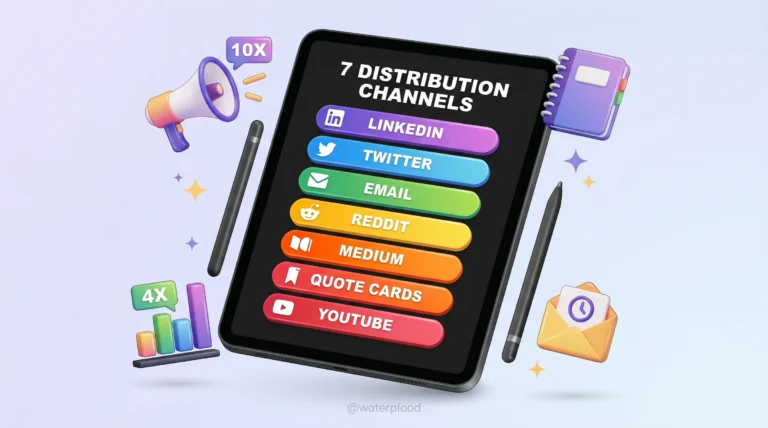
The honest assessment: Practices 1-6 are operational and producible with one content strategist and one writer. Practices 7-10 are maintenance practices that require 2-3 hours quarterly plus a data export from your rank tracking tool. The full system, running at DA 50 with 2 posts per week, will produce a measurable topical authority signal in 6 months. That’s the baseline expectation. Results below that suggest a cluster architecture problem, not a content quality problem. Check the structure first. For the post-publish content distribution workflow across 7 channels (LinkedIn, X, email, Reddit, Medium, graphics, YouTube), see our distribution guide.