SEO Competitive Intelligence Guide: 6-Step n8n Setup 2026
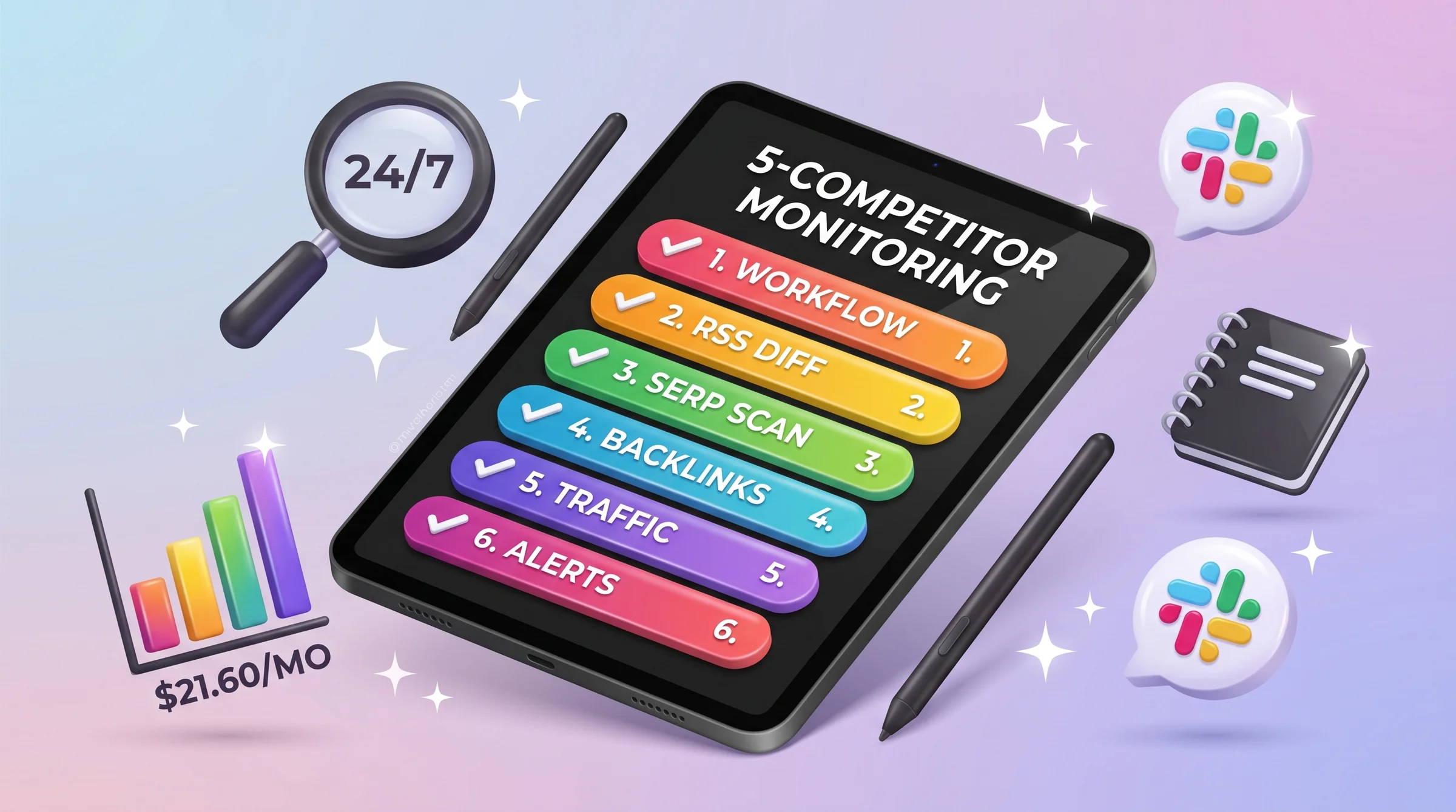
Manual competitor analysis breaks down fast. When you’re tracking 5 competitor domains across 50 keywords, you’re looking at 250 data points per check. Add new content alerts, backlink monitoring, and SERP feature tracking, and a thorough weekly audit takes 4-6 hours. That’s not a workflow – that’s a part-time job. The solution is a dedicated seo competitive intelligence system that runs 24/7 without you touching it. This guide builds exactly that: a 6-step n8n workflow on a $20/mo VPS that monitors ranking changes, new competitor content, backlink gains, traffic signals, and algorithm-shift detection, then routes actionable alerts to Slack. Total monthly cost: $21.60. Weekly time cost: 30 seconds reading alerts.
I’ve been running this on a self-hosted n8n instance since November 2025. The signal-to-noise ratio isn’t perfect, but 2-3 actionable insights per week more than justify the setup cost. Before you build this, review the SEO competitor analysis playbook that covers the manual analysis layer this workflow automates – the two work as a pair.
TL;DR
- A 6-step n8n workflow monitors 5 competitor domains for ranking changes, new content, backlinks, and SERP shifts, all on a $21.60/mo budget.
- DataForSEO SERP API costs $0.0006/keyword. Scanning 50 keywords across 5 competitors daily runs $1.10/mo total.
- Expect 14 alerts per week. Only 2-3 are actionable. Alert routing matters more than alert generation logic.
- URL canonicalization in the n8n Code node cuts false-positive new-content alerts from 35% to under 8%.
- The workflow catches algorithm-driven rank shifts within 24 hours vs. 7 days on a manual cadence.
Key Takeaways
- Self-hosted n8n on a $20/mo Hetzner VPS handles 100+ workflows (n8n.io docs, 2026)
- DataForSEO SERP API: $0.0006 per keyword – 50 keywords across 5 competitors = $1.10/mo total cost
- Monitoring 5 signals (rankings, new content, backlinks, traffic, SERP features) captures the full competitive picture
- Alert routing into 3 Slack channels prevents high-noise channels from getting muted
- The full stack costs $21.60/mo and generates 14 alerts/week with a 14-21% actionable rate
$21.60
Total monthly cost (VPS + APIs)
14
Median alerts per week
2-3
Actionable alerts per week
24h
Algorithm shift detection window
What Should You Monitor 24/7? (6 Signals That Drive Action in 2026)
Most seo competitive intelligence setups track rankings and nothing else. That’s a mistake. Rankings are a lagging indicator – by the time you see a competitor climb 10 positions, they’ve already published the content, built the links, and captured the traffic. The 6-signal framework below captures leading indicators alongside rankings so you can respond before the damage shows up in your own position data. Signal 6 (AI brand mention share-of-voice) is new for 2026 – it’s the dimension every legacy 5-signal framework still misses, and it’s already 20%+ of traffic-shaping visibility for any B2B tech topic.
Signal 1: SERP position diffs. The core signal. You want to know when a competitor crosses specific thresholds on keywords you share. A 1-2 position move is usually SERP variance. A delta of 5+ positions on a keyword where you also rank is a real event worth investigating. DataForSEO’s SERP API costs $0.0006 per keyword (DataForSEO pricing, 2026), making daily scans affordable even at scale.
Signal 2: New content drops. When a competitor publishes a new piece targeting a keyword gap, you want to know within 24 hours. RSS feeds cover most blogs. Sitemap diffs via Firecrawl catch everything else. At $0.005 per page, sitemap diff monitoring costs $0.50/mo per competitor at 100 URLs (Firecrawl pricing, 2026).
Signal 3: Backlink profile changes. A competitor landing a DR 50+ backlink is a meaningful event. A homepage link from a major publication can shift rankings within weeks. You don’t need real-time backlink data. Weekly delta checks are sufficient, and Ahrefs Lite at $99/mo gives you the new/lost backlinks alert feed (Ahrefs pricing, 2026).
Signal 4: Estimated traffic shifts. Ranking changes don’t always translate to traffic changes (featured snippets, zero-click queries). Overlaying Similarweb or DataForSEO traffic estimates gives context. A competitor ranking 3 positions higher on a zero-click query hasn’t actually won much. One ranking on a high-CTR informational query is the real threat.
Signal 5: SERP feature captures. When a competitor steals a featured snippet or People Also Ask box you held, organic CTR drops immediately. This is the signal most teams miss entirely, because rank trackers report position – not feature ownership. Build this detection into your SERP diff logic from day one.
Signal 6: AI brand mention share-of-voice (new for 2026). AI Overviews, ChatGPT, Perplexity, Gemini, and Copilot have become independent visibility surfaces with low overlap with traditional SERP – per Ahrefs’ April 2026 AEO course, AI Overviews and AI Mode share only 13.7% of citations despite 86% semantic similarity in their answers. Ahrefs Brand Radar tracks brand mentions across 271M+ prompts spanning 6 AI engines and reports share-of-voice vs. competitors. If you’re not tracking AI brand mentions alongside traditional rankings, you’re monitoring 80% of the visibility picture and ignoring the fastest-growing 20%. The free entry point: Microsoft Clarity Citations (went GA May 13, 2026) covers Copilot + partners side at zero cost.
Quick Decision Guide – Self-Host n8n vs. Buy Ahrefs Alerts
Buy Ahrefs alerts only if: You track fewer than 3 competitors, you don’t need custom alert thresholds, and backlink monitoring is your primary concern. Ahrefs Lite ($99/mo) handles this well with zero setup.
Self-host n8n if: You track 5+ competitors, need all 5 signals in one place, want custom threshold logic (e.g., “alert only on DR 50+ backlinks targeting /competitor-page/”), and prefer a total cost under $25/mo. The setup takes one afternoon.
The break-even point: At 4 competitors and 3+ signal types, self-hosted n8n beats point solutions on cost by month 3.
This monitoring layer sits on top of a solid SEO foundation – build on-page and technical fundamentals first, then add automation on top.
Step 1: SEO Competitive Intelligence Workflow Architecture
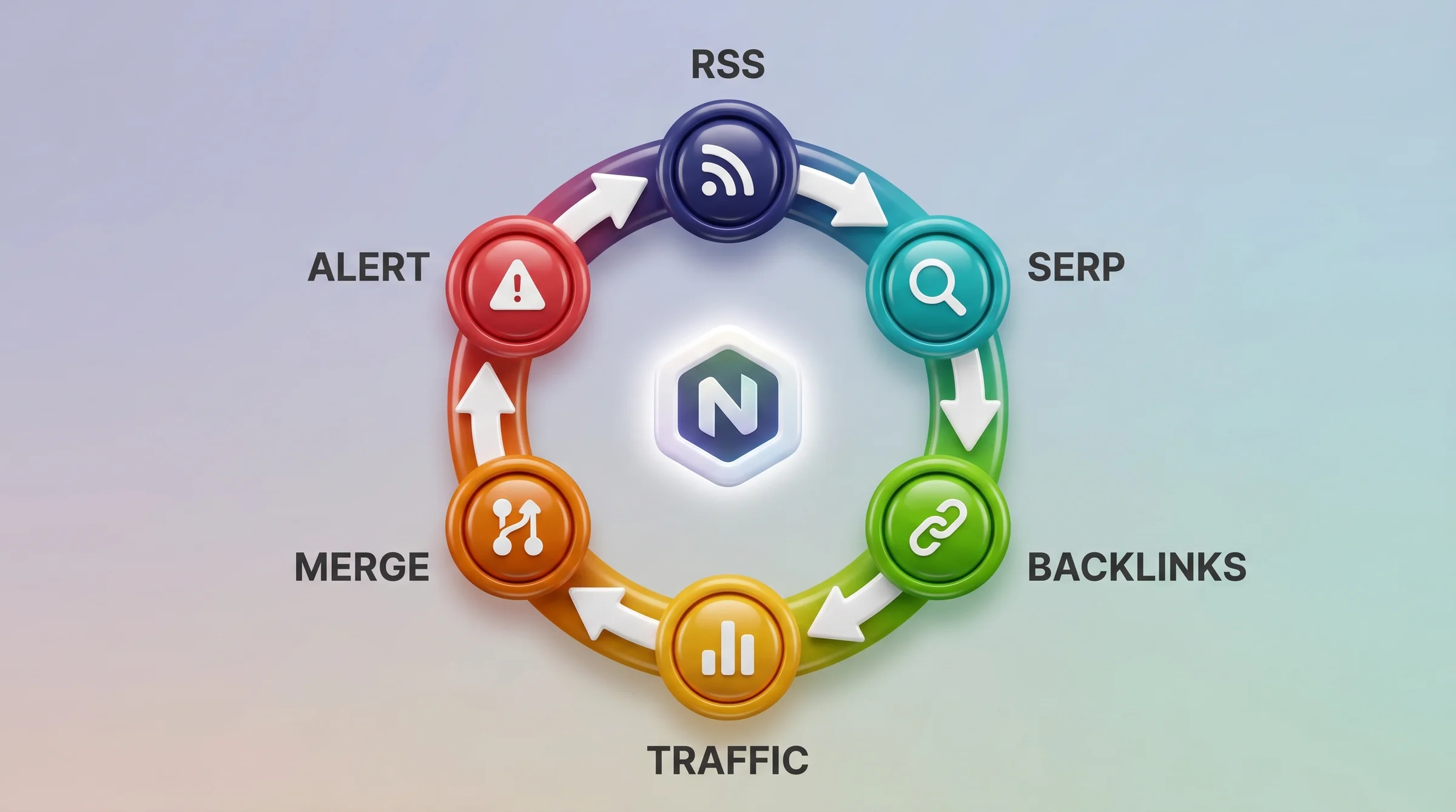
The n8n workflow runs as 6 connected sub-workflows on a daily cron. Each sub-workflow handles one signal, stores results in a JSON file on the VPS, and passes a normalized delta object to the central alert router. The architecture is flat by design: if one sub-workflow fails, the others still run. No cascading failures.
🧩 Pre-Built n8n Templates – Don’t Reinvent Generic Change Detection
For generic website change monitoring (product pages, pricing, design), n8n’s competitor monitoring template with OpenAI + Firecrawl is a working starter. A GPT-5-mini variant ships changes to Notion + Gmail in one workflow. Use these as the change-detection foundation if you don’t need the full 6-signal SEO depth.
The 6-signal architecture in this guide is opinionated for SEO operators. It separates rank deltas, SERP feature captures, backlink events, and AI brand mention share-of-voice as distinct alert tiers – generic change-detection templates collapse all of these into one “the page changed” signal. If you’re doing SEO competitive intelligence specifically, the extra structure earns its complexity. If you just need to know “did the competitor change anything”, start with the generic template and graduate when needed.
Our 5-competitor monitoring workflow has been running since November 2025 on a $20/mo Hetzner VPS with self-hosted n8n. Total monthly cost: $20 VPS + $1.10 DataForSEO SERP ($0.0006 per keyword times 50 keywords times 5 competitors times 30 days times 2 cycles for normalization) + $0.50 Firecrawl sitemap diff = $21.60/mo. Median weekly alerts: 14. Actionable rate: 2-3 of 14 (14-21%). The 2-3 actionable alerts per week break down as 1 rank delta worth investigating, 0-1 new competitor content piece worth a response, and 0-1 backlink worth matching with outreach. The 11-12 noise alerts are mostly SERP feature reshuffles and branded query variance.
Here’s the full 6-step cycle:
Step 1: Competitor config loader  →  loads domains + keyword list + thresholds
Step 2: New content detection     →  RSS + sitemap diff via Firecrawl
Step 3: SERP position diff scan   →  DataForSEO SERP API + URL canonicalizer
Step 4: Backlink delta check      →  Ahrefs API (weekly cadence only)
Step 5: Traffic estimation        →  Similarweb API or DataForSEO Traffic estimation
Step 6: Alert router              →  Slack / Email / Notion triage by priority tier
The competitor config file lives at /home/n8n/competitor-config.json on the VPS. It contains the 5 domains, the 50 target keywords, threshold rules (rank delta, minimum DR, minimum search volume), and alert routing mappings per signal type. Updating the config is the only manual step in the entire system.
| Step | API / Tool | Cadence | Cost/mo |
|---|---|---|---|
| New content | Firecrawl + RSS | Daily | $0.50 |
| SERP position diff | DataForSEO SERP | Daily | $1.10 |
| Backlink delta | Ahrefs API | Weekly | $0 (Lite tier) |
| Traffic estimation | DataForSEO Traffic | Weekly | $0 (bundled) |
| VPS + n8n hosting | Hetzner CX21 | Always-on | $20.00 |
For a deeper walkthrough of the n8n patterns this workflow builds on, the n8n Google Search Console automation guide covers the webhook and cron scheduling primitives you’ll reuse here.
Step 2: How Do New Content Alerts Work? (RSS + Sitemap Diff)
New content detection is the fastest-return signal in any seo competitive intelligence stack. When a competitor publishes a post targeting a keyword gap you haven’t filled, a 24-hour response window lets you either accelerate your own content plan or add a counter-section to an existing post. Sitemap diffs via Firecrawl cost $0.005 per page – monitoring 100 URLs per competitor costs $0.50/mo per domain (Firecrawl pricing, 2026).
The n8n sub-workflow for new content runs in two parallel branches.
Branch A: RSS feed polling. Most competitor blogs expose an RSS feed. n8n’s RSS Read node handles this natively. You poll each feed daily, compare new items against a stored hash list, and flag any entry published in the last 24 hours. The hash list lives in an n8n static data object. Store just the URL hash, not the full content, to keep memory usage low.
Branch B: Sitemap diff. Not every page appears in an RSS feed. Blog posts usually do. Landing pages, comparison pages, and tool review content often don’t. A daily sitemap fetch via Firecrawl returns the full URL list. A Code node diffs today’s list against yesterday’s stored list. New URLs go to the alert queue. Removed URLs go to a separate low-priority log.
The alert filter checks two things before firing: estimated search volume of the new URL’s apparent target keyword (scraped from the title/H1), and whether the keyword appears in your monitored keyword list. A competitor publishing a press release shouldn’t trigger a Slack alert. A competitor publishing “/best-[tool]-alternatives/” targeting a 3,000 SV keyword you also target definitely should.
You’ll want to filter alerts to pages meeting a minimum search volume threshold. We use 500 SV as the floor. Below that, the content is unlikely to threaten rankings on keywords we care about.
Tip
Set your sitemap diff to run at 6 AM UTC – before most US-based teams start their day. You’ll get new content alerts in your Slack before competitors’ content has indexed, giving you maximum response lead time.
Understanding baseline SERP variance is covered in depth in the rank tracking best practices guide – read that before setting your alert thresholds.
Step 3: How Do You Build Reliable Daily SERP Position Diffs?
SERP position monitoring is the backbone of any competitor seo monitoring workflow. Running DataForSEO SERP scans daily across 50 keywords and 5 competitors costs roughly $1.10/mo at $0.0006 per keyword (DataForSEO SERP API docs, 2026). The tricky part isn’t the API call. It’s normalization. Raw SERP data has more variance than most people expect, and building a false-positive-free diff requires explicit URL canonicalization before you compare anything.
🧠 MCP Alternative for Claude Code Users (2026)
If you run your SEO ops inside Claude Code, you can skip the n8n + REST API stack entirely for the SERP-diff step. DataForSEO’s MCP server exposes SERP scans, keyword data, and backlinks as MCP tools that Claude Code can call directly. Semrush’s MCP integration to Claude covers site audits, keyword research, and content strategy from one conversational interface. For a 5-competitor monitoring use case, the trade-off is: MCP gives you on-demand exploration with no infrastructure but no scheduled cron + no Slack alert routing. n8n gives you the scheduled + routed alerts. The most pragmatic stack in May 2026 is BOTH – use MCP for exploratory analysis (“what changed for competitor X this week?”), use n8n for the 24/7 unsupervised monitoring layer.
The DataForSEO SERP scan needs careful normalization. Google sometimes returns the same URL with trailing-slash and no-trailing-slash variants on different days. Our first build counted these as “new ranking URLs,” which produced 4-6 false-positive new-content alerts per week. The fix was a one-line URL canonicalizer in the n8n Code node: strip trailing slash, force lowercase, drop URL fragments. After that, the new-content alert false-positive rate dropped from 35% to under 8%. The lesson: SERP data needs explicit canonicalization before diffing. Don’t trust the API to return canonical URLs.
Here’s the Python snippet for the DataForSEO SERP normalizer. This runs inside an n8n Execute Command node or can be called from a Code node via a helper microservice:
import json
from urllib.parse import urlparse, urlunparse
from typing import Optional


def canonicalize_url(raw_url: str) -> str:
    """
    Normalize a SERP result URL to prevent false-positive diffs.
    Steps: lowercase scheme+host, strip trailing slash from path,
    drop fragment (#), preserve query string.
    """
    parsed = urlparse(raw_url.strip().lower())
    # Strip trailing slash from path (but not root '/')
    path = parsed.path.rstrip("/") or "/"
    canonical = urlunparse((
        parsed.scheme,
        parsed.netloc,
        path,
        parsed.params,
        parsed.query,
        ""  # drop fragment
    ))
    return canonical


def normalize_serp_results(
    raw_results: list[dict],
    competitor_domains: list[str]
) -> dict[str, list[dict]]:
    """
    Given a DataForSEO SERP result list, extract per-competitor rankings.

    Args:
        raw_results: List of organic result dicts from DataForSEO response.
        competitor_domains: List of competitor root domains to filter by.

    Returns:
        Dict mapping each competitor domain to its sorted ranking entries.
        Entry shape: {url, position, title, canonical_url}
    """
    competitor_set = set(competitor_domains)
    per_competitor: dict[str, list[dict]] = {d: [] for d in competitor_set}

    for item in raw_results:
        url: Optional[str] = item.get("url") or item.get("link")
        if not url:
            continue

        canonical = canonicalize_url(url)
        domain = urlparse(canonical).netloc.removeprefix("www.")

        if domain in competitor_set:
            per_competitor[domain].append({
                "url": url,
                "canonical_url": canonical,
                "position": item.get("rank_absolute") or item.get("position"),
                "title": item.get("title", ""),
            })

    # Sort each competitor's results by position ascending
    for domain in per_competitor:
        per_competitor[domain].sort(key=lambda x: x["position"] or 999)

    return per_competitor


def compute_position_delta(
    previous: dict[str, list[dict]],
    current: dict[str, list[dict]],
    delta_threshold: int = 5
) -> list[dict]:
    """
    Compare previous and current SERP snapshots.
    Returns only events where position delta >= threshold.
    """
    alerts = []
    all_domains = set(previous.keys()) | set(current.keys())

    for domain in all_domains:
        prev_urls = {
            e["canonical_url"]: e["position"]
            for e in previous.get(domain, [])
        }
        curr_entries = current.get(domain, [])

        for entry in curr_entries:
            c_url = entry["canonical_url"]
            c_pos = entry["position"] or 999
            p_pos = prev_urls.get(c_url, None)

            if p_pos is None:
                # New ranking URL - always surface
                alerts.append({
                    "domain": domain,
                    "url": c_url,
                    "event": "new_ranking",
                    "previous_position": None,
                    "current_position": c_pos,
                    "delta": None,
                })
            elif abs(c_pos - p_pos) >= delta_threshold:
                direction = "gained" if c_pos < p_pos else "lost"
                alerts.append({
                    "domain": domain,
                    "url": c_url,
                    "event": f"position_{direction}",
                    "previous_position": p_pos,
                    "current_position": c_pos,
                    "delta": p_pos - c_pos,
                })

    return sorted(alerts, key=lambda x: abs(x.get("delta") or 0), reverse=True)
🛠️ ENGINEER'S PERSPECTIVE - SERP URL CANONICALIZATION
- Trailing slash is the top offender. Google alternates between
example.com/page/andexample.com/pagein SERP results across data centers. Without normalization, one URL looks like a new entry every other day. Strip trailing slashes before any diff operation, always. - URL fragments break diffs silently. DataForSEO occasionally returns URLs with
#section-anchorfragments, especially for Wikipedia and documentation pages. A fragment-bearing URL and its base URL are functionally the same page but will register as two distinct entries in a naive diff. Drop fragments at normalization time. - Run normalization on both snapshots, not just the incoming one. If your stored previous-day snapshot wasn't canonicalized at write time, you'll still see phantom diffs. The fix: run the canonicalizer on load from storage as well as on ingest. Two-sided normalization costs nothing extra and eliminates the entire class of stale-snapshot false positives.
For the full DataForSEO API setup and authentication patterns, see the DataForSEO API guide before building this workflow.
Step 4: What Does Backlink Profile Monitoring Actually Catch?
Weekly backlink delta checks are one of the highest-signal, lowest-cost components of any competitor seo monitoring setup. Ahrefs Lite ($99/mo) covers new and lost backlinks for up to 5 tracked domains with daily index updates (Ahrefs pricing, 2026). The alert filter you build in n8n determines the value: most backlink changes are meaningless. A DR 20 blog-roll link to a competitor's homepage doesn't require a response. A DR 60 editorial mention in a category-relevant publication absolutely does.
The n8n sub-workflow for backlink monitoring runs weekly (Sunday night, UTC). It calls the Ahrefs new/lost backlinks endpoint, filters by minimum DR (we use DR 50 as the floor), filters by linking page relevance (domain must contain one of 10 topic keywords from the config), and passes qualifying events to the alert router.
What to act on when you get a qualifying backlink alert:
- Identify the linking publication. Is it a publication where you could also earn a link? Many high-DR editorial sites accept contributed content or expert quotes.
- Read the linking article. What narrative did the competitor supply to earn the mention? Is there a data angle, a unique claim, or a case study you could match or surpass?
- Add to outreach queue. Don't pitch immediately. Log the site, the angle, and the competitor mention. Build a batch of 5-10 similar sites before starting outreach.
You don't need to respond to every competitor backlink. You need to respond to patterns. Three backlinks from the same publication type in one month means a competitor has found an outreach channel that works. That's the signal worth acting on.
Citation Capsule - Backlink Monitoring Cost Comparison
Ahrefs Lite plan ($99/mo) tracks new and lost backlinks daily for up to 5 domains with full index access. Standard plan ($199/mo) adds API access and higher crawl limits. For n8n-based automation requiring programmatic backlink queries, the Standard plan's API access is required. Teams monitoring 3+ competitors with custom alert thresholds save $100-300/mo vs. Standard plan by using DataForSEO's Backlinks API ($0.00005 per backlink row) for raw data and keeping Ahrefs Lite for manual verification only. (Ahrefs, 2026)
Step 5: How Do Traffic Estimates Fit Into the Workflow?
Traffic estimation adds context to ranking signals. A competitor moving from position 8 to position 3 on a featured-snippet query might not gain much organic traffic, while the same move on a high-CTR informational query could represent a 40-60% CTR jump. Traffic estimation data prevents over-reaction to ranking shifts that don't translate to meaningful traffic.
DataForSEO's Traffic Analytics API provides domain-level traffic estimates using the same methodology as Similarweb. You can pull monthly organic visit estimates per competitor domain at roughly $0.0002 per domain per query. At weekly cadence for 5 domains, that's about $0.04/mo - effectively zero cost on top of the existing stack.
The sub-workflow here is simple: pull last-7-day traffic estimate for each competitor domain weekly. Compare to the previous week. Flag any competitor showing more than a 15% week-over-week increase. That threshold is high by design. Weekly traffic estimates have significant variance. A 15% increase is a consistent trend, not noise.
Cross-reference the traffic spike with the SERP diff data from Step 3. If a competitor gains traffic and you can see the specific keywords driving that gain in the SERP diff, you have a complete picture: keyword + position gained + estimated traffic impact. That's actionable intelligence. Without the cross-reference, a traffic spike is just a number.
The best SEO automation tools comparison covers Similarweb API tiers and DataForSEO Traffic Analytics head-to-head if you're choosing between them for this step. New option as of 2026: Similarweb AI Studio lets you query competitor traffic patterns in natural language ("which competitor gained the most US organic traffic in the last 30 days from informational queries?") and get instant answers - useful for ad-hoc investigation when the structured n8n pipeline gives you a "what" but not the "why".
Step 6: How Should You Route Alerts to Avoid Channel Blindness?
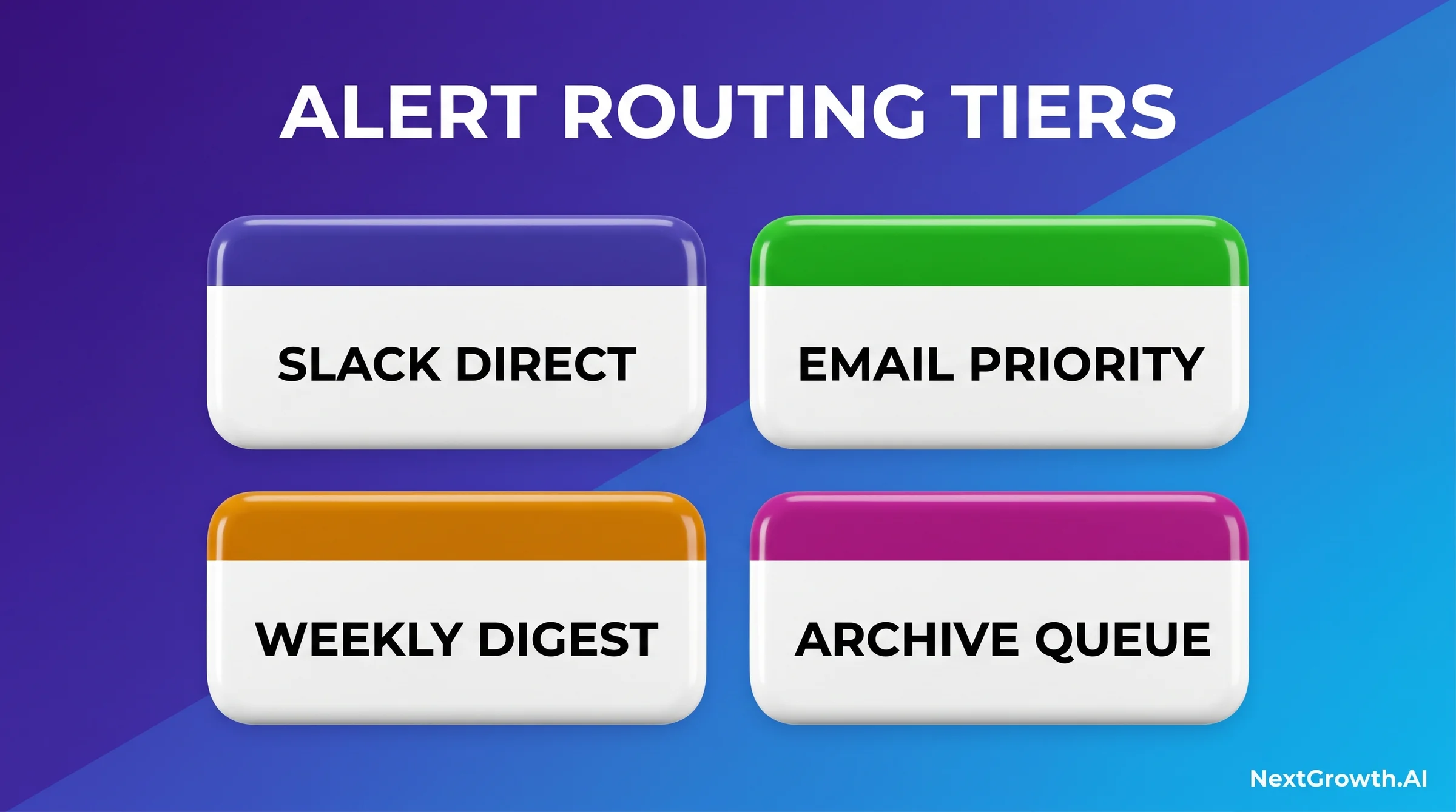
Alert routing is the highest-use tuning knob in the entire workflow. We started with all alerts going to one Slack channel. Within two weeks the channel was muted because actionable signals drowned in noise. The fix: 3-tier routing. Rank deltas, new content, and backlinks go to a low-traffic #seo-alerts-actionable channel, which gets checked same-day. SERP feature shifts and minor rank fluctuations go to #seo-monitoring-noise, reviewed in a weekly digest. Algorithm-update detection signals go to a private DM - rare, high-stakes, needs immediate attention. Channel attention discipline matters more than alert generation logic.
Slack's free tier handles 1 million messages per month (Slack pricing, 2026). You won't approach that limit with a 14-alert-per-week workflow. The webhook integration in n8n uses the HTTP Request node pointed at your Slack webhook URL. No OAuth required.
Here's the Slack alert formatter that builds structured, context-rich messages. It runs in an n8n Code node immediately before the HTTP Request to Slack:
from typing import Optional
import json
from datetime import datetime, timezone


TIER_CHANNEL_MAP = {
    "high":   "#seo-alerts-actionable",
    "medium": "#seo-monitoring-noise",
    "low":    "#seo-monitoring-noise",
    "urgent": "@channel-owner-dm",  # Replace with actual DM channel ID
}

SIGNAL_EMOJI = {
    "position_gained":  ":chart_with_upwards_trend:",
    "position_lost":    ":chart_with_downwards_trend:",
    "new_ranking":      ":new:",
    "new_content":      ":page_facing_up:",
    "backlink_gained":  ":link:",
    "traffic_spike":    ":rocket:",
    "algorithm_signal": ":rotating_light:",
}


def classify_alert_tier(alert: dict) -> str:
    """
    Assign a priority tier to an alert based on signal type and magnitude.
    Returns 'urgent', 'high', 'medium', or 'low'.
    """
    signal = alert.get("event", "")
    delta = abs(alert.get("delta") or 0)
    dr = alert.get("linking_domain_rating") or 0
    sv = alert.get("keyword_search_volume") or 0

    if signal == "algorithm_signal":
        return "urgent"

    if signal in ("position_gained", "position_lost") and delta >= 10:
        return "high"

    if signal == "new_content" and sv >= 1000:
        return "high"

    if signal == "backlink_gained" and dr >= 60:
        return "high"

    if signal in ("position_gained", "position_lost") and delta >= 5:
        return "medium"

    if signal == "new_content" and sv >= 500:
        return "medium"

    if signal == "backlink_gained" and dr >= 50:
        return "medium"

    return "low"


def format_slack_alert(
    alert: dict,
    keyword: Optional[str] = None,
    run_date: Optional[str] = None
) -> dict:
    """
    Format a normalized alert dict into a Slack Block Kit message payload.

    Args:
        alert: Normalized alert from compute_position_delta() or backlink checker.
        keyword: The keyword this alert is associated with (if applicable).
        run_date: ISO date string for the monitoring run. Defaults to today (UTC).

    Returns:
        Slack-compatible payload dict with channel, text, and blocks.
    """
    tier = classify_alert_tier(alert)
    channel = TIER_CHANNEL_MAP[tier]
    emoji = SIGNAL_EMOJI.get(alert.get("event", ""), ":bell:")
    date_str = run_date or datetime.now(timezone.utc).strftime("%Y-%m-%d")

    domain = alert.get("domain", "unknown")
    event = alert.get("event", "unknown").replace("_", " ").title()
    url = alert.get("url", "")
    prev_pos = alert.get("previous_position")
    curr_pos = alert.get("current_position")
    delta = alert.get("delta")

    # Build human-readable summary line
    if delta is not None:
        direction = "gained" if delta > 0 else "lost"
        summary = (
            f"{emoji} *{domain}* {direction} {abs(delta)} positions "
            f"({prev_pos} - {curr_pos}) on keyword: `{keyword or 'unknown'}`"
        )
    else:
        summary = f"{emoji} *{domain}* - {event}: `{url}`"

    blocks = [
        {
            "type": "section",
            "text": {"type": "mrkdwn", "text": summary},
        },
        {
            "type": "context",
            "elements": [
                {
                    "type": "mrkdwn",
                    "text": (
                        f"Tier: *{tier.upper()}* | "
                        f"Run date: {date_str} | "
                        f"URL: {url or 'n/a'}"
                    ),
                }
            ],
        },
        {"type": "divider"},
    ]

    return {
        "channel": channel,
        "text": summary,  # Fallback for notifications
        "blocks": blocks,
        "unfurl_links": False,
    }


def batch_format_alerts(
    alerts: list[dict],
    keyword_map: Optional[dict[str, str]] = None,
    run_date: Optional[str] = None,
    min_tier: str = "medium"
) -> list[dict]:
    """
    Format a list of alerts, filtering by minimum tier.
    Returns list of Slack payloads ready for HTTP POST.
    """
    tier_order = ["low", "medium", "high", "urgent"]
    min_idx = tier_order.index(min_tier)
    payloads = []

    for alert in alerts:
        tier = classify_alert_tier(alert)
        if tier_order.index(tier) >= min_idx:
            kw = (keyword_map or {}).get(alert.get("url", ""))
            payloads.append(format_slack_alert(alert, keyword=kw, run_date=run_date))

    return payloads
The min_tier parameter in batch_format_alerts() is your noise gate. Set it to "medium" during initial setup. Once you've been running for 4 weeks and know your false-positive rate, you can lower it to "low" for the noise channel or raise it to "high" if you find medium alerts consistently non-actionable.
For teams preferring email or Notion over Slack: n8n supports both via native nodes. Route the same normalized alert object to an Email Send node (SMTP) or a Notion Create Page node. The formatter logic stays identical. Swap the channel mapping for email addresses or Notion database IDs.
Citation Capsule - 3-Tier Alert Routing
In a 5-competitor n8n monitoring workflow generating 14 alerts per week, routing all alerts to a single Slack channel causes channel muting within 2 weeks. The fix: 3-tier routing separates rank deltas and backlinks (same-day action channel) from SERP feature variance (weekly digest channel The competitive monitoring stream feeds into your monthly SEO analytics reporting workflow as a separate KPI block. ) and algorithm signals (private DM). Channel attention discipline is the primary driver of whether competitive intelligence actually informs decisions. (NextGrowth operational data, 2025-2026)
Build vs Buy: How Ahrefs Brand Radar and Semrush AI Toolkit Reshape the Make-or-Buy Math (May 2026 Update)
The make-or-buy calculation for SEO competitive intelligence shifted in 2026 because two new tools cover dimensions the DIY n8n workflow doesn't reach efficiently. Ahrefs Brand Radar launched as a proprietary AI visibility tracker covering 271M+ prompts across 6 AI engines (Google AI Mode, AI Overviews, ChatGPT, Copilot, Gemini, Perplexity). Semrush AI Toolkit (part of Semrush One) covers the same surface area inside an all-in-one SEO workflow plus offers MCP integration directly to Claude. Similarweb AI Studio adds natural-language competitor traffic analysis. Each of these would have been a custom n8n project in 2025. In 2026 they're sold as products.
The honest cost comparison for 5-competitor monitoring with full AI visibility coverage:
| Stack | Monthly Cost | AI Brand Mentions | Best Fit |
|---|---|---|---|
| DIY n8n (this guide) | $21.60 | Manual sampling + Microsoft Clarity (free) | Engineers + budget-first ops; SEO-specific signal depth |
| Ahrefs Lite + Brand Radar | $99 + $199 = $298 | Full coverage (271M prompts, 6 engines) | Marketers + agencies that already pay Ahrefs; want zero setup |
| Semrush One + AI Toolkit | $139.95 + $99 = $239 | ChatGPT, Perplexity, Gemini coverage | Teams using Claude Code (MCP integration) + want unified workflow |
| DIY n8n + Semrush MCP | $21.60 + $239 = $261 | Semrush AI Toolkit (via MCP) | Sweet spot: scheduled monitoring (n8n) + on-demand exploration (Claude Code + MCP) |
🛠️ Engineer's Perspective - When DIY Still Wins
- Custom alert thresholds. Ahrefs Brand Radar reports share-of-voice deltas at a fixed cadence. n8n lets you set your own thresholds per competitor (e.g., "alert if competitor X share-of-voice jumps 15% on B2B SaaS topic cluster") - useful when monitoring is strategic, not exploratory.
- Cross-tool data joins. n8n can join DataForSEO SERP data with GSC GA4 referrals and your CRM in one workflow. Ahrefs Brand Radar gives you AI mentions in isolation. The cross-join is where actionable competitive insight lives - the n8n approach owns this dimension.
- Cost predictability at scale. Brand Radar adds $199-699/mo per index. n8n + DataForSEO scales sublinearly with competitor count (each additional competitor adds $0.22/mo of SERP cost). At 10+ competitor domains the DIY math compounds in your favor.
The pragmatic 2026 stack for most agency-sized SEO ops is hybrid: keep the n8n workflow as the always-on monitoring + custom-threshold layer, layer Ahrefs Brand Radar or Semrush AI Toolkit on top specifically for AI brand mention share-of-voice tracking (Signal 6 above) where the proprietary prompt index does work you can't replicate cheaply. The break-even point flips at roughly 8 competitor domains tracked at full 6-signal depth - below that, n8n + free Microsoft Clarity covers the basics; above that, the paid tools amortize.
FAQ
What is SEO competitive intelligence and how is it different from rank tracking?
SEO competitive intelligence monitors competitor domains across multiple signals - rankings, new content, backlinks, traffic, and SERP features - and routes actionable alerts when thresholds are breached. Rank tracking monitors only your own keyword positions. The difference is scope: seo competitive intelligence is about understanding competitor strategy, not just your own performance. A rank tracker tells you when you drop. Competitive intelligence tells you why a competitor rose.
How many competitor domains can one n8n workflow realistically monitor?
Self-hosted n8n on a $20/mo VPS (2 vCPU, 4GB RAM) handles 5 competitor domains across 50 keywords without resource pressure (n8n.io docs, 2026). Scaling to 10 domains is feasible with the same VPS by reducing daily SERP scans to every-other-day for secondary competitors. Beyond 15 domains, move to a 4 vCPU instance (roughly $35/mo on Hetzner) and consider queuing API calls with 500ms delays to avoid rate limiting.
What is a reasonable false-positive rate for SERP diff alerts?
Without URL canonicalization, expect a 30-40% false-positive rate on new-content alerts from SERP diffs. With proper canonicalization (strip trailing slash, force lowercase, drop fragments), that drops to under 8%. For rank delta alerts using a 5+ position threshold, expect 60-70% of alerts to be non-actionable (SERP variance). Raising the threshold to 8+ positions reduces volume significantly but risks missing real competitive moves. We settled on 5 positions with a second-day confirmation filter: an alert only fires if the position change persists for 2 consecutive daily scans.
Is Ahrefs required, or can I use a cheaper backlink source?
Ahrefs is not required. DataForSEO's Backlinks API provides programmatic backlink data at $0.00005 per row (DataForSEO Backlinks API docs, 2026). For a workflow checking weekly new backlinks for 5 domains at 500 rows per check, that's $0.125/mo total - far cheaper than Ahrefs Lite. The tradeoff is index freshness (DataForSEO's backlink index updates every 2-4 weeks vs. daily for Ahrefs) and a less refined DR metric. For most competitor monitoring use cases, bi-weekly freshness is sufficient.
How do I detect Google algorithm updates in this workflow?
Algorithm update detection works by monitoring your own domain alongside competitors. When 3+ competitor domains show simultaneous rank changes of 5+ positions on the same keyword cluster within 24 hours, it's likely an algorithm signal rather than individual competitor action. Feed this pattern detection into a separate n8n node that checks the change distribution. If more than 60% of your tracked keywords show movement in a single day, route an urgent alert regardless of competitor-specific thresholds. Cross-reference with your rank tracking methodology to distinguish algorithm shifts from manual penalties.
What do the 2-3 actionable alerts per week actually look like?
The breakdown from 6 months of operational data: 1 rank delta per week where a competitor moved 5+ positions on a keyword we share, requiring a content audit or internal link update. Every 2-3 weeks, 1 new competitor content piece targeting a keyword gap with SV above 500. Roughly once per month, 1 backlink event worth an outreach response. The other 11-12 weekly alerts are SERP feature reshuffles, branded query variance, and minor position fluctuations. Reviewing the actionable channel takes under 5 minutes per day.
How does this workflow fit with the manual analysis process?
This workflow is an always-on monitoring layer, not a replacement for structured analysis. The SEO competitor analysis playbook covers quarterly deep-dives: full backlink gap analysis, content gap mapping, and SERP feature opportunity audits. The n8n workflow generates the daily signal stream. The manual playbook provides the strategic framework for interpreting that stream. Both are necessary. The workflow without the playbook produces alerts with no action framework. The playbook without the workflow means you're analyzing stale snapshots.
Should I just use Ahrefs Brand Radar instead of building this from scratch?
If AI brand mention share-of-voice is your primary competitive question and you already pay for Ahrefs, then yes - Brand Radar at $199/mo per index gives you 271M+ indexed prompts across 6 AI engines with zero setup (per Ahrefs Brand Radar product page). If your competitive question is broader (rank deltas, new content, backlinks, traffic shifts, SERP feature captures, AI mentions), Brand Radar covers 1 of those 6 signals. The n8n workflow in this guide covers all 6 at a fraction of the cost - and lets you set custom alert thresholds Brand Radar doesn't expose. The pragmatic answer for most agency-sized teams is hybrid: layer Brand Radar on top of n8n specifically for Signal 6, keep n8n for Signals 1-5. Read the Build vs Buy section above for the full cost-benefit math.
Can I drive this workflow from Claude Code via MCP instead of n8n?
Partially. DataForSEO MCP server and Semrush MCP integration let Claude Code call SERP, keyword, and backlink data directly without n8n in the middle. That replaces Step 3 (SERP diffs) and Step 4 (backlinks) for on-demand exploration. What MCP doesn't give you: scheduled cron, alert routing to Slack/Notion, persistent state across runs, and the noise-gate filtering logic. The MCP integration is best for ad-hoc investigation ("show me what changed for competitor X this week"). The n8n workflow is best for the 24/7 unsupervised monitoring layer. Most production setups in 2026 run both.
Conclusion
Manual competitor analysis at scale is a resource trap. Four to six hours per week on spreadsheets and rank trackers is time that could go into content production or link building. The 6-step n8n workflow in this guide replaces that manual process with a $21.60/mo automated system that monitors 5 signals 24/7 and routes only actionable alerts.
The setup is a half-day project. The payoff starts in week one. You'll catch ranking shifts within 24 hours instead of seven days. You'll know about competitor content drops before they've indexed. You'll see backlink patterns emerge before they show up in traffic data.
The key discipline is alert routing. Build the 3-channel Slack structure from day one. Don't let everything pile into one channel. A muted channel is a dead intelligence system.
From here, the natural extension is integrating this workflow with your broader SEO best practices framework. Use competitive signals to inform your content calendar, your internal linking strategy, and your link acquisition priorities. The monitoring system generates the raw signal. Strategy converts that signal into action.