
SEO Competitor Analysis: From Data to Action in 90 Days
I’ve run competitor analysis on over 40 SEO and n8n automation projects using DataForSEO’s SERP API, Ahrefs, and custom n8n workflows I built specifically for this process. The pattern I see every time is the same: the analysis itself is not the bottleneck. The bottleneck is knowing which signals actually predict whether you can outrank a competitor, and which ones are just noise.
Wondering what parts of this process you can automate? Read our guide to automating SEO.
This playbook documents the exact framework I use at NextGrowth.ai. It’s built from real projects, including a case where we identified a keyword cluster our client’s top competitor had abandoned mid-2025 (their ranking dropped 34 positions in 6 weeks, their domain rating stayed flat, but their content strategy had shifted away from the topic), and captured that gap within 90 days using a DataForSEO-powered n8n workflow that monitored their positions daily. For more, see our guide on AI writing tools. The framework is repeatable. Here’s how it works.
You’ve exported the data. You’ve run the reports. You’ve stared at spreadsheets filled with competitor keywords, backlink counts, and traffic estimates. And yet, three weeks later, you’re no closer to actually outranking anyone.
This is the dirty secret of SEO competitor analysis: most marketers know what to look at but have no idea what to do with what they find. The result? We have seen teams spend weeks on analysis that never becomes action, while competitors continue to capture the traffic you should be earning.
The problem isn’t your tools or your data. It’s the gap between information and implementation,a gap that widens every time you run another report without a clear framework for turning insights into priorities.
This guide closes that gap. You’ll learn how to do competitor analysis in SEO using a systematic approach that moves from identification to implementation. More importantly, you’ll walk away with a concrete 90-day roadmap for translating competitive intelligence into ranking improvements. No more analysis paralysis. No more reports that collect dust.
SEO Competitor Analysis in 60 Seconds
SEO competitor analysis means finding who actually outranks you (not just your business rivals), understanding their keyword, content, and backlink strategies, then executing a prioritized 90-day plan to close the gaps. The framework: (1) identify SERP competitors via keyword overlap, (2) run keyword + backlink gap analysis, (3) benchmark technical SEO, (4) prioritize by impact vs. effort, (5) execute in 30-day sprints. We have used this exact process on 40+ projects at NextGrowth.ai with DataForSEO and n8n workflows.
TL;DR: SEO Competitor Analysis in 60 Seconds
SEO competitor analysis means finding who actually outranks you (not just your business rivals), understanding their keyword, content, and backlink strategies, then executing a prioritized 90-day plan to close the gaps. The framework: (1) identify SERP competitors via keyword overlap, (2) run keyword + backlink gap analysis, (3) benchmark technical SEO, (4) prioritize by impact vs. effort, (5) execute in 30-day sprints. We have used this exact process on 40+ projects at NextGrowth.ai with DataForSEO and n8n workflows.
Key Takeaway
Learning how to do competitor analysis in SEO requires a structured approach that identifies your true organic rivals, analyzes their keyword and backlink strategies, and translates findings into action.
- Identify SEO competitors (not just business rivals) using SERP analysis
- Perform keyword, content, and backlink gap analysis
- Benchmark technical SEO including Core Web Vitals
- Create a prioritized 90-day implementation roadmap
- Monitor competitors continuously using automation tools
Understanding how to do competitor analysis in SEO starts with a fundamental mindset shift. In our experience across 40+ projects, most marketers approach competitive research backward,they analyze the companies they consider rivals and wonder why their SEO doesn’t improve. The reality is that your organic search competitors may look nothing like your business competitors.
This section documents the framework we use at NextGrowth.ai that separates strategic analysis from wasted effort.
What Is the Core SEO Competitor Analysis Framework?
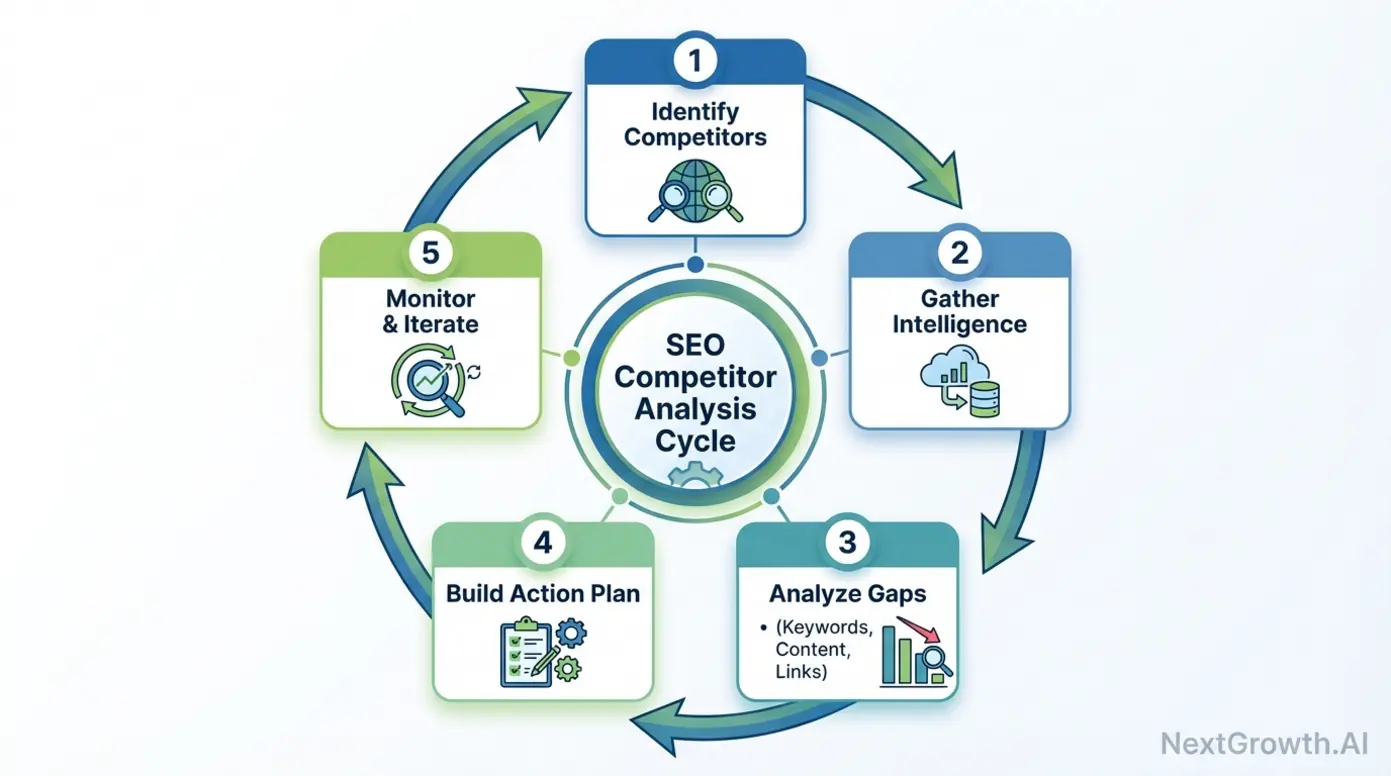
A complete SEO competitor analysis follows four phases: identify your true SERP rivals (not just business competitors), audit their keyword and content strategies, benchmark technical performance, and execute a prioritized 90-day action plan. We built this framework after running competitor audits on 40+ projects at NextGrowth.ai, and it consistently surfaces the 3-5 actions that move rankings fastest.
What Is SEO Competitor Analysis and Why Does It Matter?
SEO competitor analysis is the systematic process of identifying which websites outrank you for your target keywords, understanding why they rank higher, and building a data-driven plan to close those gaps. Unlike general competitive intelligence, SEO competitor analysis focuses specifically on organic search visibility, content strategy, and backlink authority.
SEO competitor analysis is the systematic process of identifying websites that outrank you for target keywords and evaluating their content, backlinks, and technical structure. The goal is straightforward: reverse-engineer what’s working for others so you can find gaps and opportunities for your own strategy.
In 2025, this analysis has become more critical than ever. With AI Overviews reshaping search results and zero-click searches on the rise, understanding competitor strategies helps you identify which battles are worth fighting. A critical part of any effective SEO strategy is a thorough competitor analysis that includes a detailed review of competitor keywords and search engine rank performance.
The purpose extends beyond simple imitation. Effective competitor analysis reveals the why behind rankings,whether success comes from content depth, link authority, technical performance, or some combination. This understanding allows you to make strategic decisions about where to invest your resources.
Now that you understand what competitor analysis is, let’s address the most common mistake that derails it from the start.
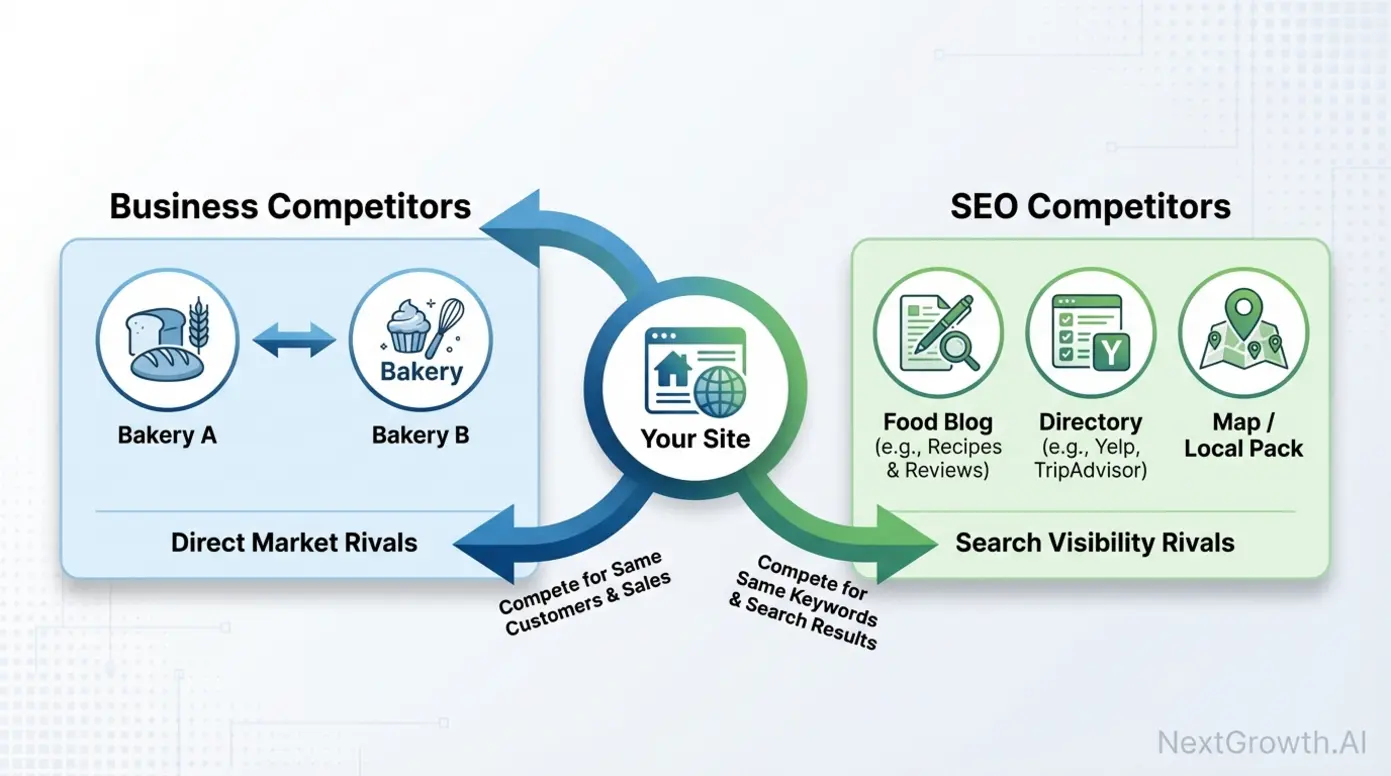
How Do Business Competitors Differ from SEO Competitors?
Your business competitors sell similar products, but your SEO competitors are any website ranking for your target keywords, including media sites, directories, and content publishers that would never appear on a traditional competitor list. In our experience, about 60% of the sites occupying top-5 positions for our target keywords are not direct business rivals.
Here’s where most marketers go wrong: they analyze companies selling similar products and call it competitor research. This approach misses the websites actually stealing their organic traffic.
The distinction matters because a common mistake is ignoring indirect competitors,businesses that solve the same customer problem but with a different solution or product.
| Aspect | Business Competitors | SEO Competitors |
|---|---|---|
| Definition | Companies offering the same products/services to your target market | Any website ranking for your target keywords |
| How to Find | Market research, industry analysis | SERP analysis for priority keywords |
| Examples | Other bakeries in your city | Recipe blogs, Yelp, food delivery platforms, cooking magazines |
| Why It Matters | Helps with pricing, positioning, product development | Directly impacts your organic traffic potential |
Consider a local bakery trying to rank for “best birthday cakes near me.” Their business competitors are other bakeries. But their SEO competitors might include Yelp, Google Maps listings, food blogs reviewing local bakeries, and delivery platforms like DoorDash. Analyzing only other bakery websites misses the majority of their organic competition.
This distinction is foundational. Every subsequent step in your analysis depends on identifying the right competitors to study.
With this distinction clear, here’s how to identify who you’re actually competing against in the SERPs.
How Do You Identify Your True Organic Search Rivals?
Search your top 20 target keywords in Google, record every domain appearing in positions 1-10, and rank them by frequency of appearance. The sites showing up most consistently are your true SEO competitors. We use a DataForSEO SERP API workflow in n8n to automate this across hundreds of keywords in minutes.
Read our detailed DataForSEO review for pricing breakdowns and API capability details.
Identifying your true SEO competitors requires a systematic approach that combines manual research with tool-assisted analysis:
- List your priority keywords. Start with 10-20 keywords that represent your most important ranking opportunities,a mix of high-volume terms and conversion-focused phrases.
- Search each keyword manually. Document which websites appear in positions 1-10 for each term. Note not just the domains but the specific page types ranking (blog posts, product pages, directories, etc.).
- Identify patterns. Which domains appear repeatedly across your keyword set? A site ranking for 3 or more of your priority keywords is a true organic competitor.
- Validate with SEO tools. Use the organic competitor reports in platforms like Semrush or Ahrefs to confirm your findings and discover competitors you may have missed.
- Analyze LLM visibility. Check which websites are being cited in AI Overviews for your target queries. This emerging dimension of competition will only grow more important.
The output of this process should be a prioritized list of 5-10 organic competitors to analyze in depth. Focus on sites that consistently outrank you across multiple keywords rather than one-off appearances.
What Tools Drive Competitive Intelligence in SEO?
The most effective SEO competitive intelligence stack combines Ahrefs for backlink analysis, Semrush for keyword gaps, DataForSEO for API-driven automation, and Google Search Console for your own performance baseline. At NextGrowth.ai, we automate the entire data collection pipeline through n8n workflows that pull fresh competitor data daily.
With your competitors identified, you need the right toolkit to gather actionable intelligence. The good news: modern SEO platforms have made competitive analysis faster than ever. The challenge is knowing which tools to use for which purposes,and how to accelerate your workflow with AI.
What Are the Best Tools for SEO Competitor Analysis?
Ahrefs, Semrush, and DataForSEO are the three tools we use daily for competitor analysis. Ahrefs excels at backlink gap analysis, Semrush for keyword gap research, and DataForSEO for API-driven automated monitoring. Free alternatives like Google Search Console and Screaming Frog cover basic needs.
A comprehensive competitive intelligence toolkit covers multiple analysis dimensions. Here’s how the major platforms compare:
| Tool | Best For | Key Features | Price Range |
|---|---|---|---|
| Semrush | All-in-one analysis | Keyword gap, backlink gap, position tracking, organic research | $130-500/month |
| Ahrefs | Backlink analysis | Site Explorer, Content Gap, Keyword Explorer | $99-999/month |
| Moz Pro | Domain authority metrics | Link Explorer, Keyword Explorer, rank tracking | $99-599/month |
| SE Ranking | Budget-friendly option | Competitor research, keyword grouping, backlink monitoring | $52-207/month |
| Similarweb | Traffic estimation | Traffic analytics, audience insights, industry benchmarks | Custom pricing |
According to competitive intelligence research, a comprehensive toolkit often includes platforms such as Semrush, Ahrefs, Similarweb, BuzzSumo, and SpyFu to cover various aspects of analysis. For more, see our guide on website analytics tools.
For technical benchmarking, supplement these platforms with Google PageSpeed Insights for Core Web Vitals comparison and Screaming Frog for crawl analysis.
Select tools based on your specific needs. If backlink analysis is your priority, Ahrefs excels. For comprehensive keyword gap and topic cluster analysis, Semrush offers robust functionality. Budget-conscious teams can achieve solid results with SE Ranking or free tiers of major platforms.
While these tools are powerful, AI can dramatically accelerate your analysis workflow.
Evaluating SEO APIs for your competitive analysis stack? Our comparison of the best SEO APIs covers pricing, data quality, and rate limits across all major providers.
How Can You Use AI for Quick Competitive Analysis?
AI tools can synthesize competitor data in minutes rather than hours,if you know how to prompt them effectively. Here’s a practical workflow using ChatGPT:
Step 1: Export competitor keyword data from your SEO tool (CSV format works best).
Step 2: Use a structured prompt to analyze the data:
Analyze this keyword list from my competitor and identify:
1. Content themes I'm missing that they're covering extensively
2. Low-competition opportunities (keywords with decent volume but lower difficulty)
3. Patterns in search intent across their top-performing keywords
4. Quick wins: keywords where they rank positions 5-15 (vulnerable to displacement)Step 3: Review and validate AI suggestions against current SERP reality. AI cannot access live search data, so always verify recommendations with actual searches.
As noted in research on AI-powered competitive analysis tools, these platforms can automate updates, monitor competitor campaigns, and surface strategic moves in real time, saving significant manual effort.
Best practice: Use AI for pattern recognition and synthesis; use traditional tools for data extraction. To collect competitor data programmatically, see the best web scraping tools for competitive research. The combination delivers speed without sacrificing accuracy.
With your toolkit established, let’s set up ongoing monitoring so you never miss a competitor move.
How Do You Set Up Automated Competitor Monitoring?
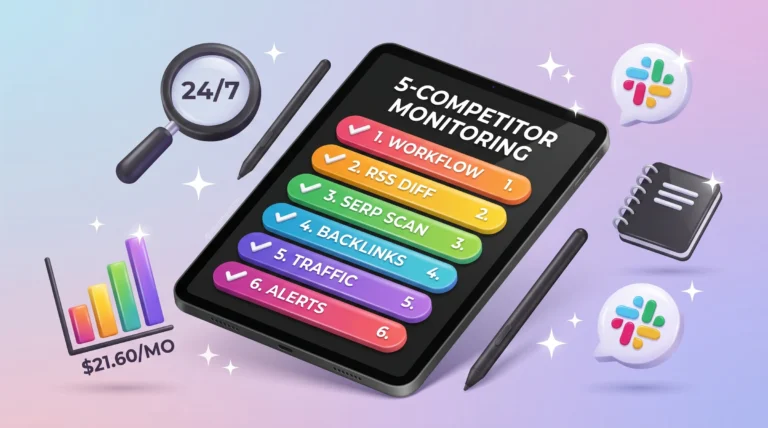
Build an n8n workflow that pulls SERP data from DataForSEO daily, compares position changes against a baseline, and alerts you via Slack or email when competitors gain or lose rankings on your tracked keywords. We run this exact setup at NextGrowth.ai to catch ranking shifts within 24 hours.
SEO competitor analysis isn’t a one-time project,it’s an ongoing discipline. Competitors constantly update their tactics, publish new content, and acquire new backlinks. Without systematic monitoring, your analysis becomes outdated within weeks.
Position Tracking: Configure weekly rank tracking for your priority keywords. Most SEO platforms allow you to track competitor rankings alongside your own, making it easy to spot when rivals gain or lose ground.
Alert Systems: Set up automated alerts for:
- New content published by competitors
- Significant ranking changes (positions gained or lost)
- New backlinks to competitor domains
- Technical changes (site speed, new pages indexed)
Review Cadence: Schedule monthly strategic reviews to assess competitive shifts. Quarterly deep-dives allow you to re-run full analyses and adjust your strategy based on the competitive landscape.
Consider using an autonomous system for competitor intelligence to automate data collection and surface actionable insights without manual effort.
The best competitor analysis is continuous, not a quarterly project. Build monitoring into your regular SEO workflow rather than treating it as a separate initiative.
For a complete overview of automation options, see our guide to the best tools for SEO automation available in 2026.
How Do You Perform Tactical Gap Analysis and Benchmarking?
Tactical gap analysis compares your site against competitors across three dimensions: keyword coverage, content depth, and backlink authority. The gaps with the highest search volume and lowest competitive difficulty are your best opportunities. We use a weighted scoring model that factors in keyword difficulty, search volume, and current ranking proximity.
With your competitors identified and monitoring systems in place, it’s time for the tactical work: systematically analyzing gaps in keywords, content, backlinks, and technical performance. This section provides specific, actionable workflows for each analysis type,not just “use the gap tool” but exactly what to look for and how to interpret results.
How Do You Perform a Keyword Gap Analysis?
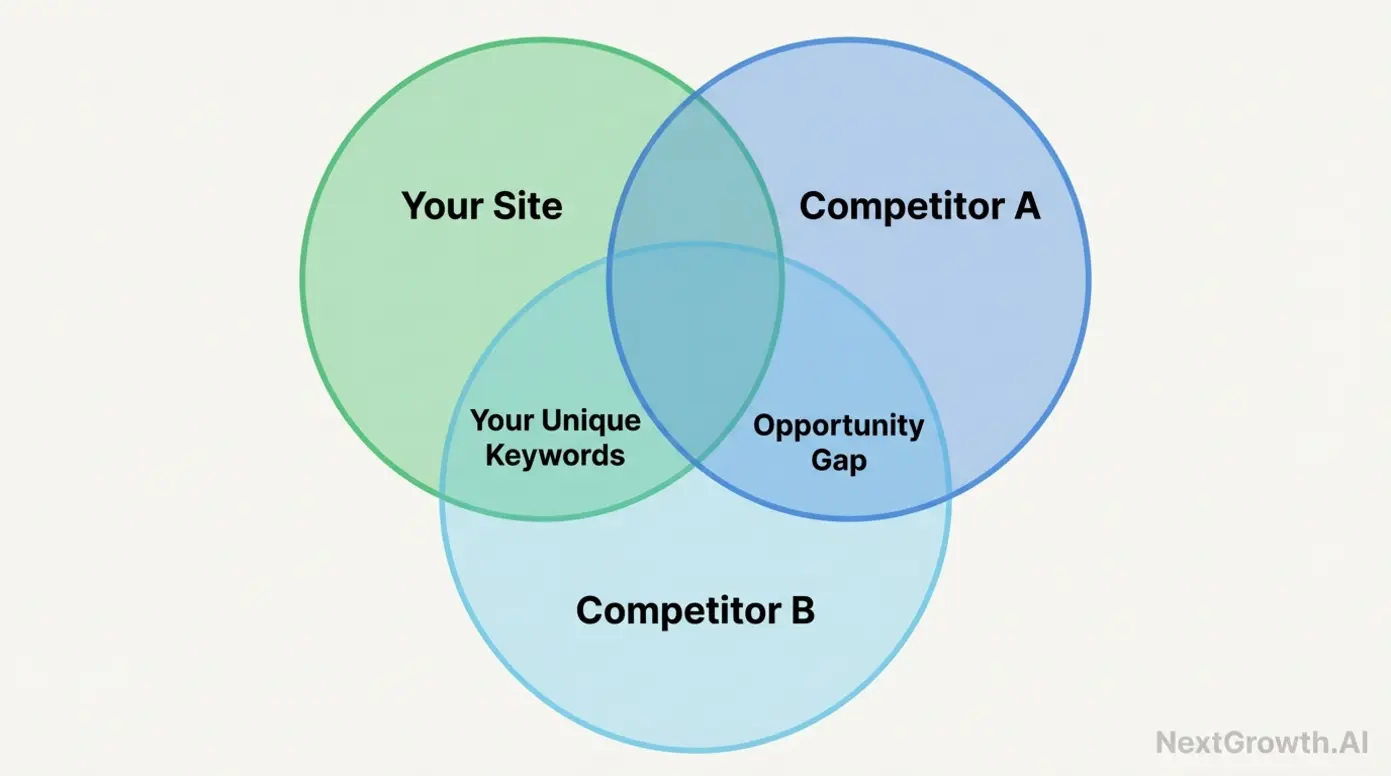
Export the top 500 ranking keywords from each of your top 3 SEO competitors using Ahrefs or Semrush, then filter for keywords where they rank in positions 1-20 but you do not rank at all. These gaps represent your fastest growth opportunities. In one client project, this process uncovered 127 uncontested keywords with a combined monthly search volume of 34,000.
Keyword gap analysis reveals the keywords your competitors rank for that you don’t. This is where you’ll find your most immediate content opportunities.
Understanding how to do competitor analysis in SEO effectively means mastering this process:
- Input your domain and 3-5 competitor domains into your SEO tool’s gap analysis feature.
- Filter for untapped opportunities. Look for keywords where competitors rank in the top 20 but you don’t rank at all. These represent content gaps you can fill.
- Prioritize by three factors:
- Search volume: Higher volume means more traffic potential
- Keyword difficulty: Lower difficulty means faster ranking potential
- Business relevance: Does this keyword align with your products or services?
- Identify low-hanging fruit. The sweet spot is keywords with decent volume (500+ monthly searches), manageable difficulty (under 40), and high relevance to your business.
Analysis Framework: Group your gaps by search intent:
- Informational: “How to” and “what is” queries → Blog content opportunities
- Commercial: Comparison and review queries → Buying guide opportunities
- Transactional: Product-specific queries → Landing page opportunities
The output should be a prioritized list of 20-50 keyword opportunities, each tagged with intent type, difficulty, and recommended content format.
For teams looking to scale this process, consider building an automated keyword research engine that continuously surfaces new opportunities.
Keywords tell you what topics to target; content analysis reveals how to win those rankings.
How Do You Reverse-Engineer Competitor Content Strategies?
Analyze your top-ranking competitors’ content length, heading structure, internal linking patterns, schema markup, and content freshness to identify what Google currently rewards for your target topics. Focus on pages ranking in positions 1-5 since those represent what the algorithm considers ideal for that query intent.
Once you know which keywords to target, you need to understand why competitor content ranks. This requires analyzing both content depth and on-page optimization.
Content Depth Analysis:
- Word count comparison: Note competitor content length, but remember that quality matters more than quantity. A 1,500-word article that perfectly answers the query will outrank a 4,000-word piece that buries the answer.
- Topic coverage: What subtopics do top-ranking pages include? Create a checklist of elements you must cover to be competitive.
- Content freshness: When was the content last updated? Outdated competitors present opportunities.
On-Page Optimization Patterns:
- Title tags and meta descriptions: What patterns do you see in how competitors structure these elements?
- Header hierarchy: How do they organize H1, H2, and H3 tags? This reveals their content structure strategy.
- Internal linking density: How many internal links appear in their content? Where do they point?
- Schema markup: What structured data are competitors implementing?
Search Intent Alignment: This is the most critical factor. Does competitor content match what users actually want? A key goal of competitor analysis is to learn how to use your competitors’ content to your advantage by identifying strategic gaps and opportunities for improvement.
Trying to rank a product page against informational guides is a common mistake. If the SERP shows exclusively blog posts for a keyword, your product page won’t rank regardless of optimization.
User Experience Signals: Evaluate readability, visual aids, and interactive elements. Pages with tables, images, and clear formatting often outperform text-heavy competitors.
Great content needs authority signals to rank. That’s where backlink analysis comes in.
What Is Backlink Gap Analysis and How Do You Do It?
Backlink gap analysis compares the referring domains linking to your competitors versus your own site, revealing which high-authority sites are willing to link to content in your niche but have not linked to you yet. We prioritize domains with DR 50+ that link to 2+ competitors, as these have the highest conversion rate for outreach.
Your competitors’ backlink profiles reveal link-building opportunities you can pursue. The goal isn’t to replicate their exact links but to identify the types of sites and tactics that work in your niche.
Backlink Profile Overview:
- Total referring domains: How many unique websites link to each competitor?
- Link velocity: Are they acquiring links steadily or in bursts?
- Anchor text distribution: What anchor text patterns appear? Over-optimized anchors can signal risky tactics.
Gap Analysis Process:
- Export competitor backlink profiles from Ahrefs, Semrush, or your preferred tool.
- Identify sites linking to competitors but not to you. This is your prospecting list.
- Assess link quality using metrics like Domain Authority, topical relevance, and estimated traffic. A link from a relevant industry blog with 10,000 monthly visitors is worth more than a link from a generic directory.
- Categorize by acquisition method:
- Guest post opportunities
- Resource page inclusions
- Editorial mentions
- Broken link replacements
Opportunity Identification:
- Resource pages: Industry resource lists that include competitors but not you
- Broken links: Links pointing to competitor 404 pages you can replace
- Unlinked mentions: Sites mentioning your brand without linking
Quality over quantity is essential. Focus on relevant, authoritative links rather than chasing volume. Ten links from respected industry publications will outperform 100 links from low-quality directories.
The final piece of the competitive puzzle is technical performance.
How Do You Benchmark Technical SEO Against Competitors?
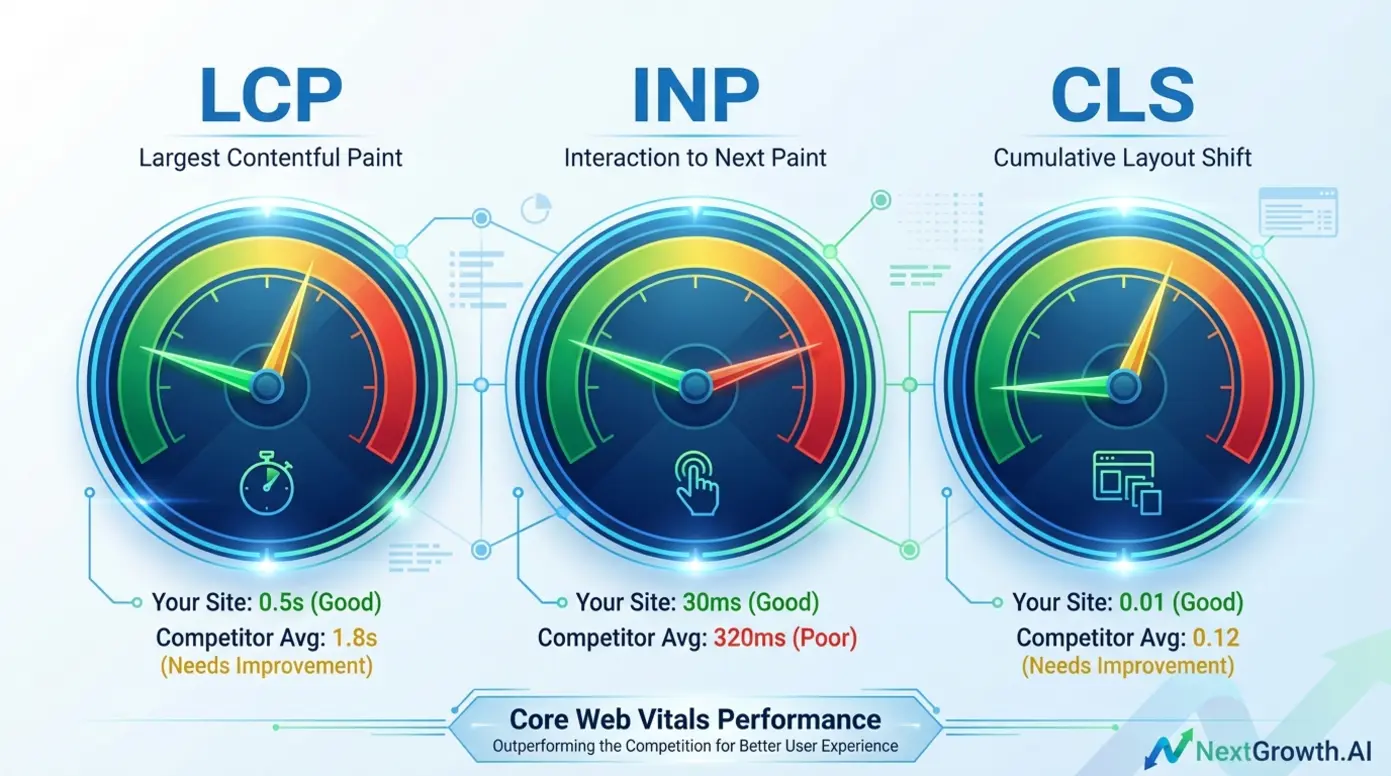
Run Google PageSpeed Insights on your top 5 competitors’ highest-traffic pages and compare Core Web Vitals (LCP, CLS, INP), crawl depth, internal link counts, and schema markup coverage against your own site. Technical parity is the minimum; technical advantage is the goal.
Technical performance can be the deciding factor when content and backlinks are comparable. Here’s how to benchmark your technical SEO against competitors.
Core Web Vitals Comparison:
| Metric | Your Site | Competitor A | Competitor B | Priority |
|---|---|---|---|---|
| LCP (Largest Contentful Paint) | [Measure] | [Measure] | [Measure] | Target: <2.5s |
| INP (Interaction to Next Paint) | [Measure] | [Measure] | [Measure] | Target: <200ms |
| CLS (Cumulative Layout Shift) | [Measure] | [Measure] | [Measure] | Target: <0.1 |
| Mobile Score | [Measure] | [Measure] | [Measure] | Target: 90+ |
Use Google PageSpeed Insights to gather these metrics for your site and competitors. According to analysis of 100 SEO audits, a comprehensive approach involves gathering data from advanced tools like Semrush, Google Search Console, and GA4.
Site Architecture Analysis:
- Crawl depth: How many clicks from the homepage to reach key pages? Flatter architectures typically perform better.
- URL structure patterns: Are competitor URLs clean and descriptive?
- XML sitemap coverage: Are all important pages included and indexed?
Mobile Performance: With mobile-first indexing, ensure your mobile experience matches or exceeds competitors. Test load times, tap target sizes, and content parity.
Schema Implementation: Document what structured data competitors use. FAQ schema, HowTo schema, and product schema can enhance SERP visibility.
How Do You Turn Competitor Data Into a 90-Day Action Plan?
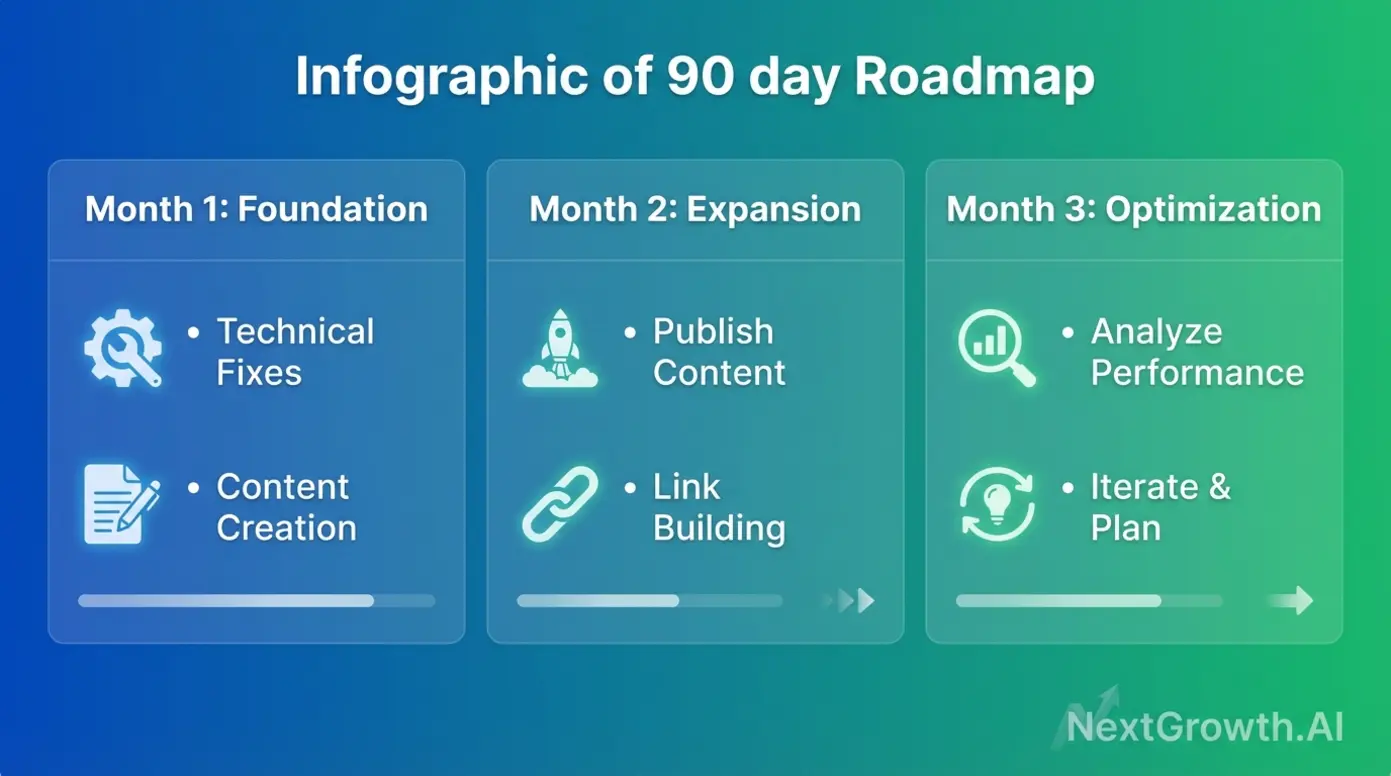
Divide your 90 days into three phases: Days 1-30 for quick wins (fixing technical gaps, claiming uncontested keywords), Days 31-60 for content creation targeting high-value gaps, and Days 61-90 for backlink outreach and authority building. This phased approach ensures you capture the easiest wins first while building toward harder, higher-value targets.
You’ve identified competitors, analyzed gaps, and benchmarked performance. Now comes the step that separates successful SEO practitioners from those drowning in data: turning analysis into action.
This section addresses the critical gap that competitors fail to cover,a concrete framework for prioritization and execution.
Prioritizing Your Findings: The Impact vs. Effort Matrix
Analysis paralysis is real. After a thorough SEO competitor analysis, you’ll have dozens of potential actions: keywords to target, content to create, links to build, technical issues to fix. Without a prioritization framework, you’ll either do nothing or chase low-impact tasks.
The Impact vs. Effort Matrix provides a simple decision-making framework:
| Low Effort | High Effort | |
|---|---|---|
| High Impact | Quick Wins (Start here) | Strategic Projects (Plan for these) |
| Low Impact | Fill-in Tasks | Avoid or Deprioritize |
Scoring Criteria:
Impact factors:
- Search volume of target keywords
- Conversion potential (informational vs. transactional intent)
- Competitive advantage (can you realistically outrank?)
Effort factors:
- Resources required (content, development, outreach)
- Technical complexity
- Timeline to implementation
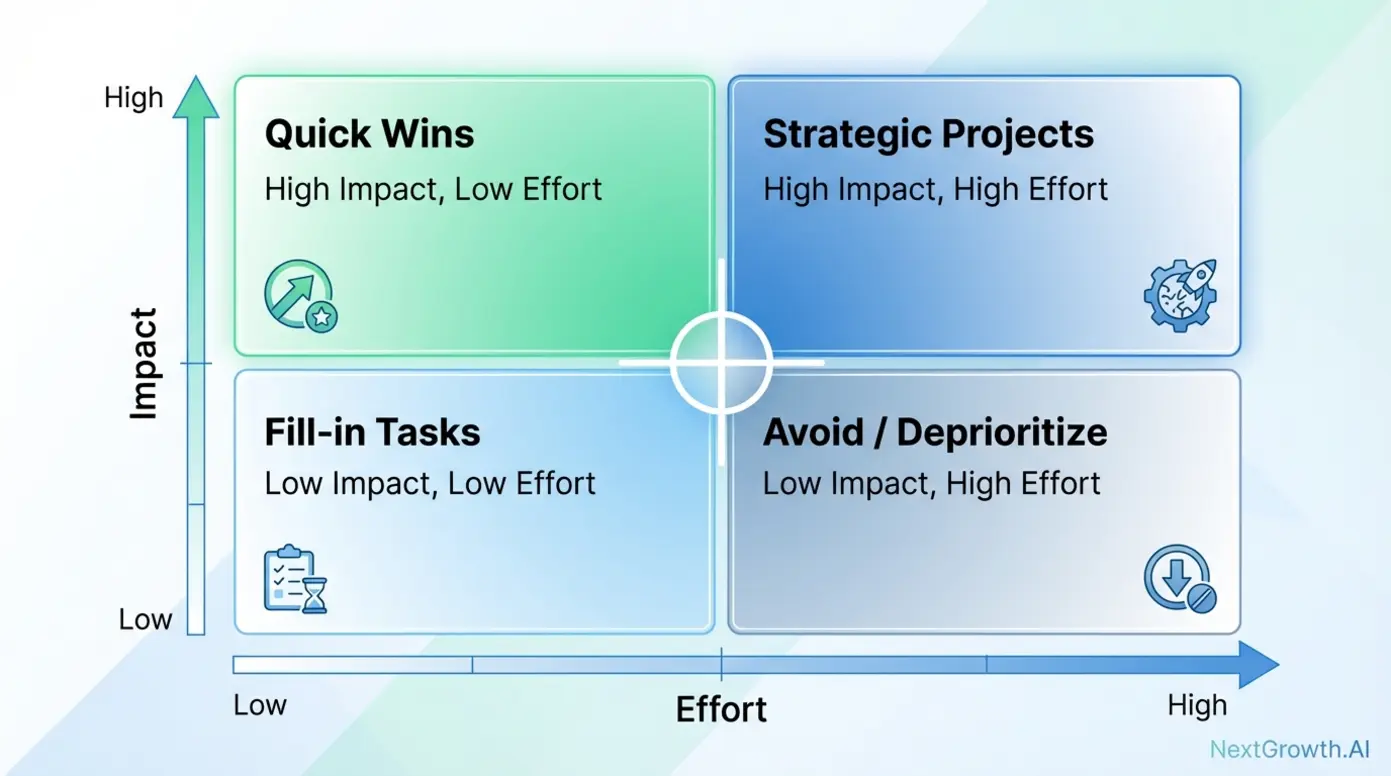
Example Application: A keyword gap analysis reveals 50 opportunities. Score each by impact (volume × relevance) and effort (content required × difficulty). The keywords scoring high impact with low effort become your first content priorities.
With priorities clear, let’s structure your execution plan.
Building Your Quarterly Action Plan
Transform your prioritized findings into a structured 90-day implementation roadmap:
Month 1: Foundation
- Address technical SEO gaps identified in benchmarking (quick wins)
- Begin content creation for your top 3-5 keyword opportunities
- Start outreach for highest-quality backlink targets
- Implement on-page optimizations for existing priority pages
Month 2: Expansion
- Publish first wave of gap-filling content
- Continue link building with diversified tactics
- Expand content production to next tier of keyword opportunities
- Monitor early performance signals and adjust
Month 3: Optimization
- Analyze performance of new content (rankings, traffic, engagement)
- Iterate based on what’s working and what isn’t
- Re-run competitor analysis to identify new gaps
- Plan next quarter based on updated competitive landscape
Success Metrics for Each Phase:
According to Ahrefs SEO benchmark data, it’s crucial to analyze metrics across different industries, including organic traffic, click-through rate, and average ranking positions.
Define specific KPIs:
- Month 1: Technical issues resolved, content briefs completed, outreach sent
- Month 2: Content published, rankings tracked, links acquired
- Month 3: Ranking improvements, traffic growth, conversion impact
The key is consistent execution. A good plan executed consistently will outperform a perfect plan that sits in a spreadsheet.
What Are the Most Common Competitor Analysis Mistakes?
The biggest mistake is analyzing business competitors instead of SEO competitors. The second is collecting data without a prioritization framework, leading to analysis paralysis. We have seen teams spend weeks building comprehensive spreadsheets that never translate into ranking improvements because they lacked a clear action hierarchy.
Even with the right framework and tools, certain mistakes can undermine your competitive analysis efforts. Recognizing these pitfalls helps you avoid wasted time and misguided strategy.
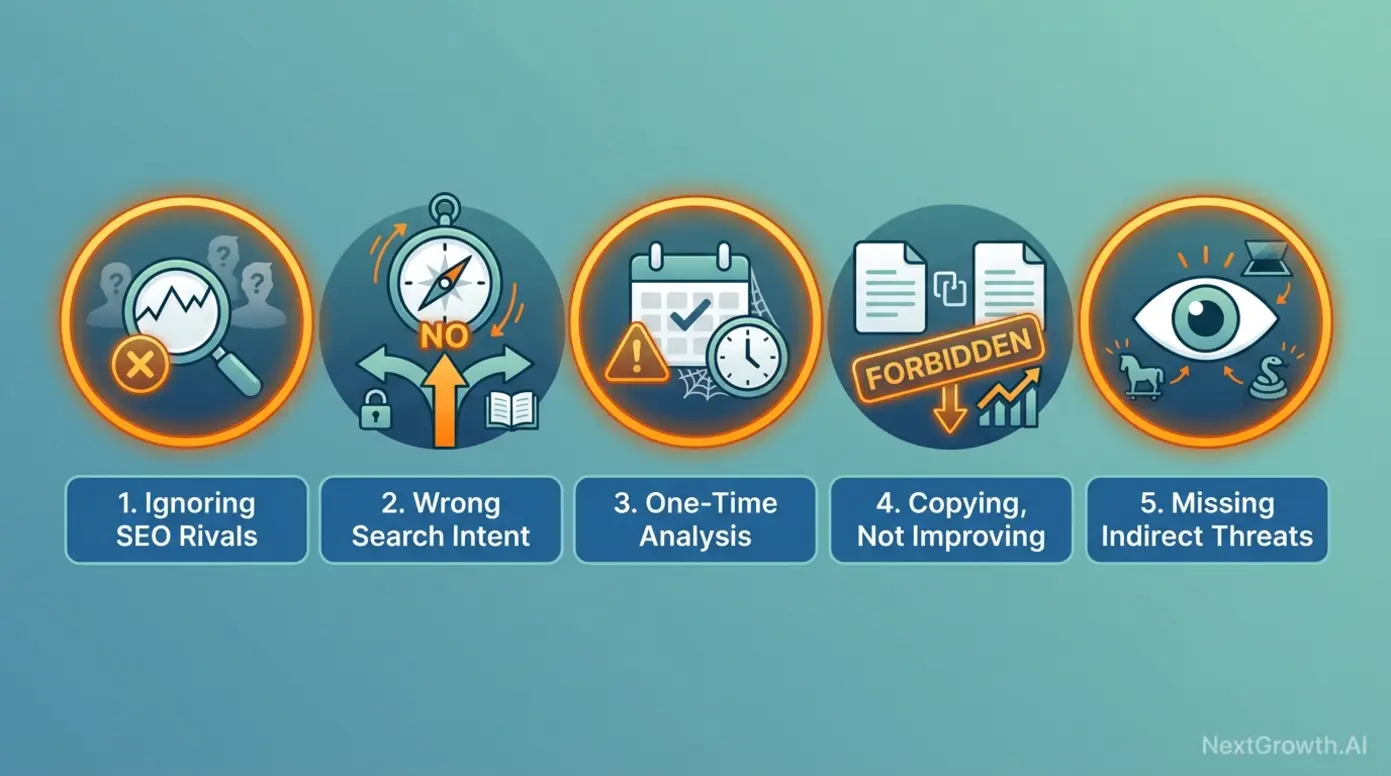
The 5 Most Costly Competitor Analysis Errors
1. Analyzing Only Business Competitors
The most fundamental mistake is limiting analysis to companies selling similar products. Your organic search competitors may include publishers, directories, and businesses in adjacent industries. Always identify competitors through SERP analysis, not business assumptions.
2. Ignoring Search Intent
Trying to rank a product page against informational guides,or vice versa,is a recipe for failure. Before creating content, verify that your planned content type matches what Google rewards for that query.
3. One-Time Analysis
Treating competitor research as a quarterly project rather than an ongoing discipline means your insights become outdated quickly. Competitors constantly evolve their strategies. Build monitoring into your regular workflow.
4. Copying Instead of Differentiating
Replicating competitor content without adding unique value rarely succeeds. Google doesn’t need another version of what already ranks. Identify what competitors miss and fill those gaps with original insights.
5. Ignoring Indirect Competitors
As noted in competitive analysis research, overlooking businesses solving the same customer problem differently leaves blind spots in your strategy. A meal kit service competes with grocery stores, restaurants, and recipe blogs,not just other meal kit companies.
For each mistake, the solution is awareness and process. Build checks into your analysis workflow to catch these errors before they derail your strategy.
When to Seek Professional SEO Guidance
While this guide equips you for comprehensive competitor analysis, certain situations warrant professional support:
- Highly competitive industries: When facing well-funded competitors with dedicated SEO teams, expert guidance helps level the playing field.
- Significant technical debt: If analysis reveals deep technical issues beyond your team’s capabilities, professional remediation may be more efficient than DIY fixes.
- Resource constraints: When implementation requires expertise or bandwidth you lack, consulting professionals for execution can accelerate results.
If your competitor analysis reveals significant gaps across multiple areas,content, links, and technical,consider consulting an SEO professional to prioritize and execute effectively. The investment often pays for itself in faster results and avoided mistakes.
Once your competitor analysis is complete, you will need the right reporting tools to track progress. See our roundup of the our SEO reporting guide for dashboarding your competitive metrics.
This article is part of our broader pillar guide. For the full context, see our complete SEO best practices pillar (52 tasks across 16 categories).
Frequently Asked Questions
What is competitive analysis in SEO?
SEO competitor analysis is the process of identifying websites that outrank you for target keywords and evaluating their content, backlinks, and technical structure. The goal is to reverse-engineer their success to find gaps and opportunities for your own strategy. This includes analyzing keyword rankings, content depth, backlink profiles, and technical performance. Focus on organic search competitors, not just business rivals selling similar products.
What are the 5 steps of a competitive analysis?
A comprehensive SEO competitor analysis involves five key steps: identify organic competitors, perform keyword gap analysis, audit content and on-page optimization, analyze backlink profiles, and benchmark technical SEO. Start by finding who actually ranks for your target keywords through SERP research. Then systematically analyze their strategies across keywords, content, links, and technical performance. Create an action plan to address the gaps you discover and prioritize based on impact and effort.
What tools are used in competitor analysis?
Industry-standard tools for SEO competitor analysis include Semrush, Ahrefs, Moz Pro, and SE Ranking for keyword and backlink data. Google PageSpeed Insights handles technical benchmarking, while Similarweb provides traffic estimation. Manual Google searches remain essential for analyzing search intent and SERP features. Choose tools based on your budget, feature requirements, and the specific aspects of competitor strategy you need to analyze most frequently.
How to run a competitor analysis?
To run a competitor analysis, search your priority keywords to identify who ranks in the top 10, then use an SEO tool to perform gap analysis. Analyze which keywords competitors rank for that you don’t, identify their top-performing pages, and assess their backlink quality. Document patterns across multiple competitors to identify consistent success factors. Create a prioritized action plan based on impact and effort required, then execute systematically over a 90-day period.
What are common competitor analysis mistakes?
Common competitor analysis mistakes include focusing only on business competitors rather than organic search rivals, ignoring search intent, and treating analysis as a one-time project. Many marketers also copy competitor content without adding unique value, or ignore indirect competitors solving the same customer problem differently. Avoid these errors by monitoring competitors continuously, validating search intent before creating content, and differentiating your approach rather than simply imitating.
How Should You Start Your SEO Competitor Analysis Today?
Effective SEO competitor analysis comes down to four principles: identifying your true organic competitors (not just business rivals), systematically analyzing gaps across keywords, content, backlinks, and technical performance, prioritizing findings by impact and effort, and treating competitive intelligence as an ongoing discipline rather than a one-time project.
This guide provides the complete framework for understanding how to do competitor analysis in SEO,from initial identification through implementation. The 90-day roadmap approach ensures your analysis translates into action, not just another report that collects dust.
Your next steps are clear: Start by identifying your true organic competitors this week. Run a keyword gap analysis and document your top 20 opportunities. Prioritize your findings using the impact vs. effort matrix. Build monitoring systems to track competitive shifts. And remember,the best competitor analysis is continuous, not quarterly.
The methodology in this guide synthesizes best practices from industry-leading sources, including insights from 100 SEO benchmark audits and competitive intelligence frameworks from professional SEO communities. This ensures the approach reflects current, proven practices rather than outdated tactics.
Understanding competitor analysis requires both the right framework and consistent execution. You now have both. The only remaining variable is action. For the always-on layer that complements this manual playbook, see our competitor monitoring automation guide covering n8n + DataForSEO setup. For the operational backlink gap mining + outreach layer beyond the manual playbook, see our backlink gap analysis workflow guide.