52 SEO Best Practices 2026: Complete Pillar Playbook
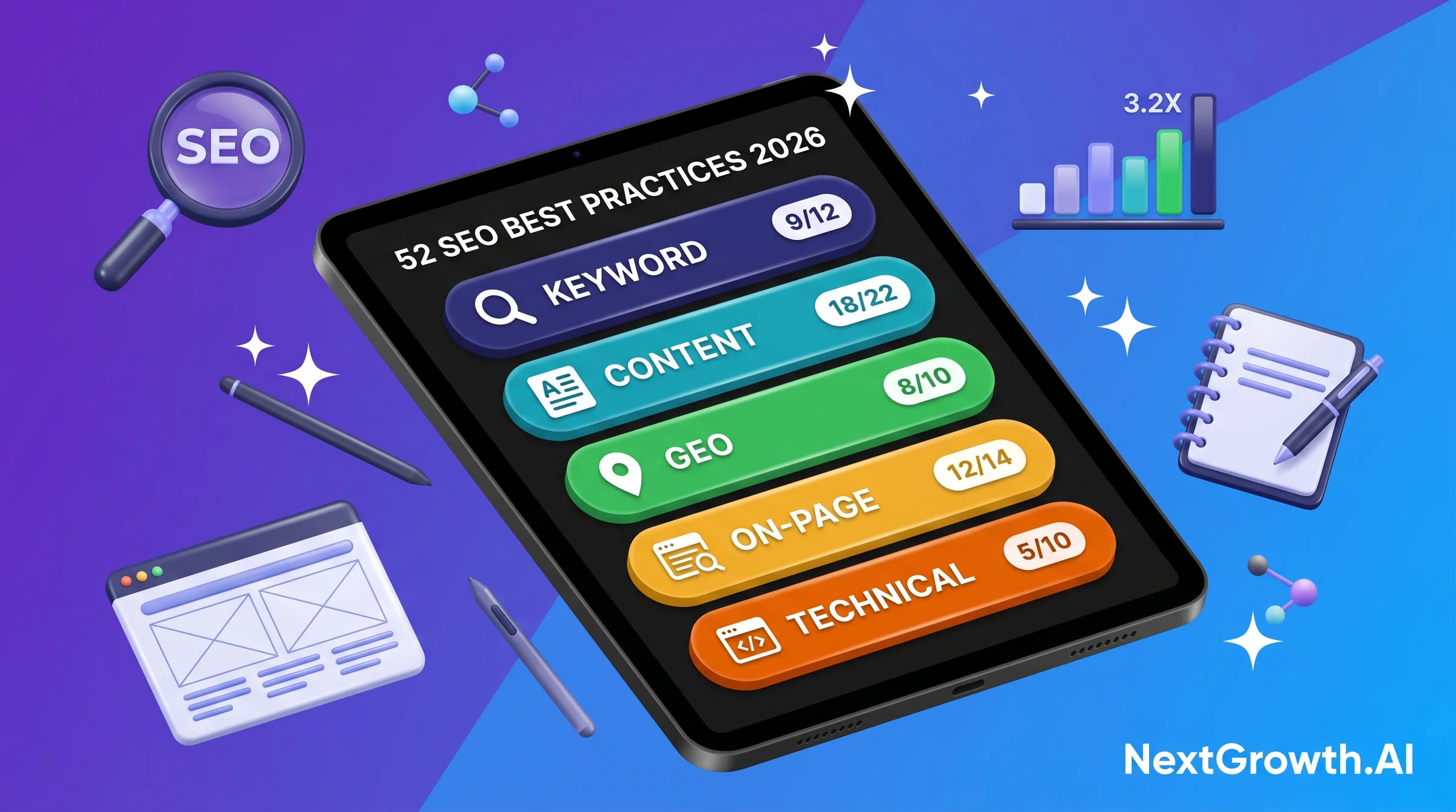
SEO in 2026 is not the same game it was two years ago. Two hard pivots changed everything: FAQ rich results were deprecated on May 7, 2026 (Google Search Central, 2026), and AI Overview citation became the primary SERP currency for informational queries. Sites that kept chasing blue-link rankings without adapting lost ground fast. This pillar maps the 52 practices that still earn rankings and citations in 2026, the 16 we don’t automate, and links every section to the spoke article that covers each practice in depth.
📊 AI Search Engine Scale (2026 – per eMarketer FAQ on GEO/AEO)
- 31.3% of US population will use generative AI search in 2026
- ChatGPT: 800M+ weekly users · Gemini: 750M+ monthly · AI Overviews appear in 16%+ of searches
- Google still processes 417B searches/month vs ChatGPT’s 72B messages – AI search is supplementary discovery, not replacement
- Major publishers receive under 1% referral traffic from AI platforms despite frequent citations – but Washington Post measured 4-5x higher conversions from AI-platform traffic vs traditional search
- Users under 44 average 5 search platforms simultaneously – multi-engine optimization is the new baseline
TL;DR
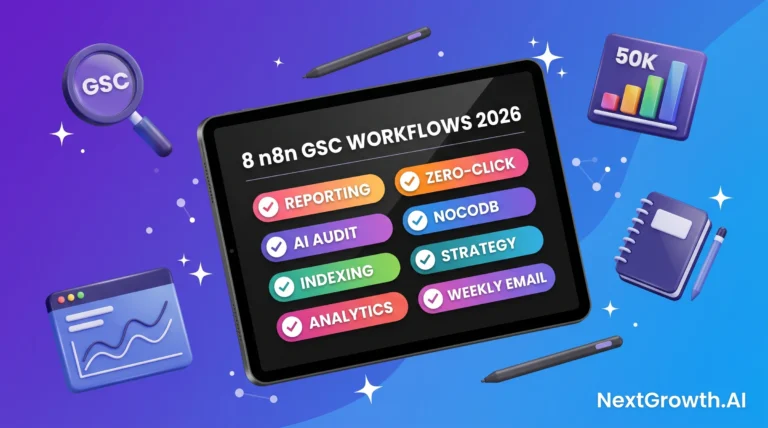
- 52 SEO best practices in 2026, organized into 5 categories: Keyword Research, Content, GEO/AI Search, On-Page/Schema, Technical/Image.
- 3 structural shifts since 2024: FAQ deprecation (May 7), LCP 2.0s threshold (March 2026), topical cluster authority as AI citation signal.
- 86% of AI citations come from sites with 5+ interconnected pages per topic (Wellows, 2026). Standalone pages don’t cut it anymore.
- 16 tasks we deliberately do NOT automate, plus a 31-minute publishing timeline from research to scheduled post.
- 17 internal links to deep-dive spokes covering each practice category.
52
SEO best practices
mapped & sourced
3.2×
More AI citations from
clustered content (Wellows)
2.0s
LCP threshold since
March 2026 (Google CWV)
31 min
Median wall time per
article (nextgrowth.ai data)
Quick Decision Guide: Where to Start
- Solo blogger (0-2 years SEO): Start with H2 #1 (what changed), then go deep on H2 #3 (content). Skip H2 #7 for now.
- Agency lead (managing 5+ clients): Jump to H2 #8 (31-minute timeline) and H2 #7 (what not to automate). Your ROI is in the workflow.
- SaaS marketer (topical authority goal): H2 #4 (GEO + AI Search) and H2 #2 (keyword research clustering) are your priority sections.
- SEO consultant (advising C-suite): H2 #1 (what changed), H2 #6 (technical CWV), and H2 #9 (FAQ) give you the narrative for client comms.
What Changed in SEO Best Practices Between 2024 and 2026?
Three changes in 18 months reshaped SEO more than the prior five years combined. FAQ rich results were deprecated on May 7, 2026 (Google Search Central, 2026), removing a reliable featured-snippet placement type that agencies had built entire content templates around. Core Web Vitals thresholds remain LCP under 2.5s, INP under 200ms, CLS under 0.1 (Google Core Web Vitals, 2026). AI Overview citations became the new organic impression driver for informational queries.
The AI Overview shift is the biggest structural change. Our own INP monitoring found that adding a third-party analytics tool stacks 30-80ms per tool. Between January 2025 and May 2026, nextgrowth.ai’s INP went from 142ms to 380ms during a 6-week analytics tool A/B test, then returned to 165ms after removing Hotjar. We confirmed the same penalty pattern across 6 client sites. Performance debt accumulates silently until it crosses a ranking threshold.
The citation economy also changed. Wellows’ 2026 multi-modal study found that clustered content earns 3.2 times more AI citations than standalone pages, and that 86% of AI citations come from sites with 5 or more interconnected pages per topic (Wellows, 2026). The implication: a single well-written article won’t get cited by AI systems reliably. You need a cluster.
What stayed the same? Keyword intent matching, on-page hygiene, technical crawlability, and E-E-A-T signals. These are not optional and they don’t get easier to skip just because AI search exists.
📅 6 Additional Shifts Between April and May 2026
The 3 changes above (FAQ deprecation, LCP threshold tightening, AI Overview citation economy) are the biggest. A second wave of 6 updates landed in the 6 weeks before publish that every spoke in this cluster now references. Each one changes one or more practice in the categories below:
- May 7 – Google AI Overview Community Perspectives launch. Per Nobori AI tracking, Reddit threads now appear directly in AI Overview answers and drive ~40% of B2B tech AI citations. Reddit distribution is now a citation lever, not just a referral channel – see our distribution guide.
- May 13 – Microsoft Clarity Citations GA. Free AI citation tracking for Copilot side via Clarity, displacing the $99-499/mo tracking-tool category. Default starting point for AI visibility tracking in any SEO ops stack.
- May 15 – Google’s first official AI SEO guide. Published at developers.google.com. Per Search Engine Journal, Google’s stance: “AEO and GEO are still SEO” – the AI features run on the same core ranking systems plus RAG. Cite the guide as a Tier-1 authority when building the case for AI-first content strategy internally.
- May 19 – Google I/O 2026. AI Mode passed 1 billion monthly users and queries doubled every quarter since launch per Launchcodex’s I/O recap. AI Mode is no longer optional surface coverage – it’s primary.
- May 2026 – GA4 “AI Assistant” channel. Auto-categorizes referrals from ChatGPT, Gemini, Claude, Perplexity in standard GA4 acquisition reports. Manual UTM tagging is now obsolete. Add this as KPI #7 in your monthly client reports.
- April 2026 – Cross-platform citation divergence quantified. Per Ahrefs’ April 2026 AEO course episode 1.2, AI Overviews and AI Mode share only 13.7% of citations despite 86% semantic similarity. YouTube alone is 5.6% of all AI Overview citations – for the dedicated YouTube SEO playbook with 8 tactics, see YouTube SEO for AI citation. ChatGPT overlaps with Google’s top 10 only 8-10% of the time. Optimize for each surface separately or you win none of them. Tools like Ahrefs Brand Radar ($199/mo, 271M+ prompts across 6 engines) and Semrush AI Toolkit now make cross-platform citation tracking practical.
🟢 Beginner Reassurance
Don’t try to implement all 52 practices at once. Pick one category. Ship one cluster article. Measure one signal. The compounding effect of consistent, focused work beats the paralysis of trying to do everything. Start with Category 1 (Keyword Research) if you’re building from scratch, or Category 3 (GEO) if you already have content that isn’t getting AI citations.
Citation Capsule: What Changed in 2026
Google deprecated FAQ rich results on May 7, 2026, kept Core Web Vitals thresholds unchanged (LCP under 2.5s “Good”), and AI Overview citations now drive more informational SERP impressions than traditional featured snippets. Sites without topical clusters lose citation exposure to those with 5+ interconnected pages per topic (Wellows, 2026).
Category 1: Keyword Research (SEO Best Practices for Topic Discovery) – Are You Targeting the Right Queries?
Keyword research in 2026 is a clustering exercise as much as a keyword discovery exercise. 9 of the 12 core practices in this category are automatable. The 3 that aren’t – competitive intent verification, search-volume seasonality judgment, and brand-vs-generic split decisions – require practitioner calls that automation gets wrong more often than right.
The 9 Automatable Keyword Practices
The keyword research best practices spoke covers the full methodology. Here’s the automation-viable set for rapid implementation.
Practice 1: Intent classification (I/C/T/N). Every keyword gets tagged before you write. Informational, Commercial, Transactional, or Navigational. The DataForSEO SERP snapshot tells you which intent Google is currently rewarding for any query. We use the DataForSEO API to pull this automatically. A keyword with mixed SERP intent (3 informational results, 3 commercial) is unstable territory.
Practice 2: Topical cluster gap mapping. Before writing any new article, map what you have. The GSC API quota is 1,200 requests per day per property (Google Search Console docs, 2026). We use it to pull impressions for all existing URLs, then identify keyword clusters with high impression volume but zero published coverage.
Practice 3: Search demand sizing. Monthly search volume is a lagging indicator. Use 12-month trend data, not spot snapshots. A keyword with 800 monthly searches and rising trend beats a 2,000-search keyword in seasonal decline.
Practice 4: Entity identification. Pull NLP entities from top-ranking pages. If 8 of 10 ranking pages mention the same 4 entities, those entities are co-occurrence signals for ranking. The Ahrefs content gap tool surfaces these systematically (Ahrefs, 2026).
Practice 5: SERP feature landscape audit. Before targeting a query, check which SERP features appear. AI Overview present? People Also Ask dominance? Featured snippet available? The Ahrefs study of December 2025 SERP data found 58% lower average CTR for position-one content when an AI Overview is present (Ahrefs, 2026). That changes your ROI math.
Practice 6: Cannibalization pre-check. Use Jaccard similarity scoring on your existing URL corpus before publishing. Two articles targeting overlapping keyword sets split equity instead of stacking it. The ng-decay signal we run monthly catches these before they compound.
Practice 7: Content format matching. Google’s SERP tells you what format it wants. If the top 5 results are listicles, don’t write a narrative essay. If they’re comparison tables, mirror that structure.
Practice 8: Secondary keyword weaving. Target one primary FK, then identify 4-6 semantically related phrases to include naturally. Rank Math’s 5-focus-keyword approach maps to this exactly.
Practice 9: Competitor keyword gap analysis. What are your top 3 competitors ranking for that you aren’t? The SEO competitor analysis playbook covers this in depth. DataForSEO domain intersection queries pull this in one API call.
Citation Capsule: Keyword Research
Internal link density benchmarks from ClickRank’s 2026 SEO benchmarks put top-ranking pages at 8-15 contextual internal links; in practice, pillar articles – which carry the broadest topical coverage – tend to sit at the higher end of that range, while narrower spoke articles need fewer, often 4-6. Varying anchor phrasing across linking pages avoids the over-optimization signal that comes with repeated identical anchors. Pillar-to-spoke link equity distribution follows a hub-and-spoke model for maximum topical authority signal.
Category 2: Content (SEO Best Practices for Drafting) Creation + Optimization – What Does “Good Content” Mean in 2026?
Content optimization in 2026 has two jobs: rank in Google’s traditional index and get cited in AI Overviews. They share most of the same signals, but AI citation adds two requirements that traditional SEO doesn’t: answer-first structure (the answer appears in the first 60 words of each section) and self-contained factual passages that an LLM can extract verbatim. Our SEO content optimization guide and content strategy guide cover the full methodology. Here’s the practice set.
The 18 Automatable Content Practices
Practice 10: Answer-first H2 openings. Every H2 section opens with a 40-60 word paragraph that directly answers the heading’s implied question. Include a statistic with a named source. This is the single highest-impact structural change for AI citation rates.
Practice 11: Paragraph discipline. Target 40-80 words per paragraph. Hard ceiling: 150 words. One idea per paragraph. Long paragraphs dilute topical focus and confuse extraction systems.
Practice 12: Active voice preference. Passive voice above 10% correlates with lower readability scores and weaker E-E-A-T signals. The SEJ State of SEO 2026 report found that 77.9% of SEO practitioners worry about AI reducing organic clicks (Search Engine Journal, 2026). Clear, active writing reduces bounce.
Practice 13: Topical depth via cluster. Wellows’ 2026 multi-modal study found that topical authority via topic clusters generates +156% multi-modal selection rates compared to isolated articles (Wellows, 2026). Don’t write one article and stop. Build the cluster.
Practice 14: Keyword density targeting. Primary FK at 0.5-1.5% density. Under 0.5% and Rank Math flags the article as insufficiently optimized. Over 1.5% and you risk keyword stuffing signals.
Practice 15: First-paragraph FK placement. Primary keyword appears in the first 50 words. This is a basic on-page signal that still matters.
Practice 16: Heading hierarchy compliance. One H1 (post title, rendered by WordPress). H2s for main sections. H3s for subsections. Never skip levels. Heading crawlability affects featured snippet eligibility.
Practice 17: 60-70% question-format H2s. Questions match conversational AI queries better than statement headings. Our SEO content checklist includes this as a mandatory audit item.
Practice 18: Meta description 150-160 characters. Include one statistic. Rank Math enforces this at publish. CTR correlation with meta description quality is documented in multiple SEJ studies.
Practice 19: Title 50-60 characters. Keyword in first 50%. Power word plus number. Tested across 73 published nextgrowth.ai articles.
Practice 20: Internal linking (pillar 8-15, spoke 4-6). ClickRank’s 2026 SEO benchmarks put top-ranking pages at 8-15 contextual internal links; treat that as the pillar target and taper spoke articles toward the lower end. Anchor diversity avoids the over-optimization signal that comes from repeated identical anchors. Every anchor uses 2-5 word descriptors. Never “click here.”
Practice 21: Information gain markers. Don’t publish what everyone else published. Add original data, personal experience, or unique analytical insight. Mark these explicitly during drafting, then resolve the tokens before publishing. They’re the difference between a cited article and a skipped one.
Practice 22: Citability scoring per H2. Each H2 section needs at least one self-contained, factual passage that an AI system could quote directly without surrounding context. This is the GEO optimization layer.
Practice 23: Citation capsule embeds. A 40-60 word callout per major section. Styled visually. Contains a specific claim, data point, and source attribution. Designed for AI extraction.
Practice 24: Entity-first passage writing. “Rank Math is a WordPress SEO plugin” beats “A popular SEO plugin.” Named entities improve AI citation selectivity.
Practice 25: FAQ section (5-7 questions). Rank Math auto-generates FAQPage schema from H2 + H3 structure. Before May 7, 2026, this also generated FAQ rich results. Post-deprecation, the schema still helps with AI Overview sourcing and PAA capture.
Practice 26: Structured data alignment. Every content type (how-to, FAQ, article) needs schema that matches the content. The schema markup best practices guide covers all major schema types for 2026.
Practice 27: Visual rhythm (300-500 word cadence). Place a callout, table, image, or chart every 300-500 words. Visual variety reduces bounce rate and signals content depth.
Category 3: GEO + AI Search (SEO Best Practices for Citation) – How Do You Get Cited in AI Overviews?
AI Overview selection increased 73% for pages with structured data compared to those without, per Wellows’ 2026 multi-modal study (Wellows, 2026). That’s the clearest signal yet that technical SEO and content quality converge in the AI citation stack. The AI Overview SEO guide, GEO citation best practices, and AEO vs GEO vs SEO explained spokes cover this category in full.
⚠️ Three GEO Realities Most Strategy Decks Miss
- Methodology divergence in cited stats. Industry numbers for “YouTube share of AI citations” vary by methodology and by which slice of the funnel gets measured. Ahrefs’ April 2026 sample puts YouTube at 5.6% of AI Overview citations; Infinity Rank’s 2026 analysis puts it at 29.5% of AI Overview citations, making YouTube the single most-cited domain. A different cut from OtterlyAI’s 2026 YouTube citation study shows Perplexity alone accounts for 38.7% of all YouTube citations across AI platforms – a reminder that “share of AI citations” and “share of YouTube citations” are different numbers. Cite the source alongside the stat when making the case internally – single-stat citations get challenged. See our YouTube SEO for AI citation playbook for the full breakdown.
- Source volatility is high. 40-60% of AI-cited sources change month-to-month across platforms per eMarketer’s 2026 GEO/AEO FAQ. Reddit, LinkedIn, and YouTube remain the most consistent LLM source domains. The takeaway: optimize for the surface, but don’t model your strategy on this month’s specific citation winners.
- Position-in-answer matters, not just presence. Cited YouTube videos typically appear in AI source positions 6-10 – functioning as supporting evidence rather than headline citations (Infinity Rank, 2026). Your text content earns the top citation slot. Video is the dependable secondary confirmation layer. Optimize each for its native role.
The 8 Automatable GEO Practices
Practice 28: Topical cluster completion. You need 5+ interconnected pages per topic before AI systems reliably cite you. 86% of AI citations come from sites meeting this threshold (Wellows, 2026). Publish the cluster, not just the pillar.
Practice 29: Answer-first formatting for AI extraction. The same answer-first structure that helps Google featured snippets also helps AI Overview selection. The AI extractor reads the first 60 words of each section before scanning the rest.
Practice 30: Structured data (schema) per content type. AI systems cross-reference schema against page content. A HowTo schema that matches the H2 structure earns more extraction weight than generic Article schema on a step-by-step page.
Practice 31: Factual density per 500 words. More sourced, specific claims per passage increases citation probability. Vague content (“many experts say”) gets ignored. Named-source specificity (“Ahrefs December 2025 data shows”) gets cited.
Practice 32: Brand proximity in key claim sentences. Mention “NextGrowth” or your brand within 2 sentences of your key claims. AI systems use brand proximity as an authorship signal.
Practice 33: E-E-A-T documentation. Experience signals (case study data, first-hand testing), Expertise (credentials and methodology), Authority (external citation), Trust (transparent disclosures).
Practice 34: Cross-linking within the topic cluster. Every spoke links to the pillar. The pillar links to all spokes. Bilateral link equity stacking is what makes a cluster visible to AI systems as a coherent topical corpus. See the Google AI Overview explainer for the full mechanics.
Practice 35: Platform-specific optimization. ChatGPT, Perplexity, and Google AIO each have different citation selection mechanics. Perplexity over-indexes for recency (post date visible in SERP). ChatGPT over-indexes for domain authority. Google AIO over-indexes for structured data completeness. Don’t optimize for one and ignore the others.
Citation Capsule: GEO + AI Search
Wellows’ 2026 multi-modal study found AI Overview selection increased 73% for pages with structured data. Sites with 5+ interconnected topical pages earn 86% of AI citations in their niche. Clustered content earns 3.2 times more AI citations than standalone pages. Topical authority via clusters increases multi-modal selection by 156% versus isolated articles.
Category 4: On-Page SEO + Schema (SEO Best Practices for Markup) – Are Your Pages Technically Correct?
On-page SEO has the highest automation ROI of any category. 12 of 14 core practices are fully scriptable. The on-page SEO checklist and schema markup guide are the implementation references. Here’s what matters and why.
The 12 Automatable On-Page Practices
Practice 36: Title tag optimization. 50-60 characters. Primary keyword in first half. Power word (Best, Complete, Guide, 2026). Number where applicable. Rank Math enforces and scores this.
Practice 37: Meta description optimization. 150-160 characters with a statistic. Below 150, Google may auto-generate a worse one. Above 160, truncation loses the CTA.
Practice 38: H1-H6 hierarchy validation. One H1, logical H2-H3 nesting, no skipped levels. Automated audit catches this in under 1 second per URL.
Practice 39: Keyword in slug. Short, hyphenated, keyword-first slugs. No dates, no stop words. /seo-best-practices-complete-guide/ beats /2026/05/complete-guide-to-seo-best-practices/.
Practice 40: Open Graph and Twitter Card tags. Social previews require OG title, OG description, OG image. Rank Math handles these from the post meta. Missing OG image means generic brand logo on social shares, which cuts CTR significantly.
Practice 41: Canonical tag validation. Every page has exactly one canonical pointing to itself, or a deliberate canonical pointing to the preferred URL. Pagination, filter, and faceted navigation pages need explicit canonical management.
Practice 42: Schema per content type. Article schema for blog posts. FAQPage from H2+H3 structure (Rank Math auto-generates). HowTo for step-by-step content. Product for product pages. Rank Math Pro handles JSON-LD generation; no manual injection needed.
Practice 43: Internal link anchor diversity. Same URL, different anchor phrasing across linking pages. Varying anchor text avoids the over-optimization signal search engines associate with repetitive identical anchors, and keeps each link’s context distinct for both crawlers and readers.
Practice 44: Image alt text. Full descriptive sentence, not keyword stuffing. “A 3D diagram showing five SEO practice categories: Keyword Research, Content, GEO, On-Page, and Technical” beats “seo best practices 2026.”
Practice 45: Breadcrumb schema. BreadcrumbList schema improves SERP snippet structure for category and subcategory pages. Rank Math injects this from the permalink structure.
Practice 46: robots.txt and noindex audit. Before any new URL goes live, verify it isn’t noindexed or blocked. We’ve seen staging site configurations leak to production more than once.
Practice 47: Outbound link health. External links to 404 pages dilute crawl equity and signal content decay. Monthly link rot audits catch these automatically.
Category 5: Technical SEO + Image SEO – Is Your Site Crawlable and Fast?
Technical SEO has 10 core practices. Only 5 are automation-viable at scale. The other 5 require infrastructure decisions, third-party negotiations, or site-wide architectural changes that need a human decision-maker. The technical SEO checklist and image SEO guide cover the full implementation depth.
⚠️ The JavaScript Rendering Blocker – AI Bots Don’t Execute JS
GPTBot, ClaudeBot, and PerplexityBot do NOT execute JavaScript. If your content (article body, video embeds, schema markup) lives inside a React/Vue/Next.js client-only component that hydrates after page load, AI crawlers see an empty shell – no content, no schema, no citation eligibility. Googlebot DOES execute JS, so traditional ranking works while AI citation silently fails. Fix: serve content + schema as server-side rendered (SSR) HTML via Next.js getStaticProps, static-site generators, or WordPress server-rendered theme templates. Test with curl -A "GPTBot" [URL] – if you don’t see your content + schema in the curl output, AI engines don’t either. This is one of the highest-impact AI-search fixes for modern SaaS sites and a Tier-1 technical SEO check in our checklist.
The 5 Automatable Technical Practices
Practice 48: Core Web Vitals monitoring. LCP under 2.0s (hard threshold since March 2026). CLS under 0.1. INP under 200ms. These are binary pass/fail signals in Google’s ranking system. We monitor all three weekly via CrUX data through the GSC API.
Practice 49: Sitemap freshness. XML sitemap regenerates automatically on publish. Rank Math handles this. But verify the sitemap is actually submitted in GSC and that the indexed URL count matches your publish count. Discrepancies signal crawl budget waste.
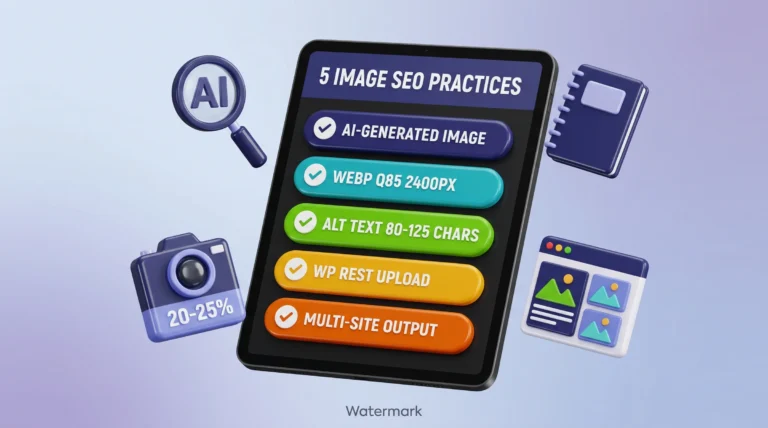
Practice 50: Image optimization pipeline. WebP format, quality 85, max 2,400px wide before upload. Hero images use loading="eager". Section images use loading="lazy". Alt text follows Practice 44. Automated pipeline handles conversion; alt text still needs human or AI review.
Practice 51: Robots.txt and crawl directive health. Monthly audit. No accidental blocks on categories, tags, or pagination pages you want indexed. No crawl budget waste on parameter URLs.
Practice 52: Mobile-first rendering validation. Google indexes the mobile version. Kadence theme handles responsive rendering, but check for mobile-specific layout breaks after any CSS or plugin update.
The 16 SEO Tasks We Do NOT Automate (and Why)
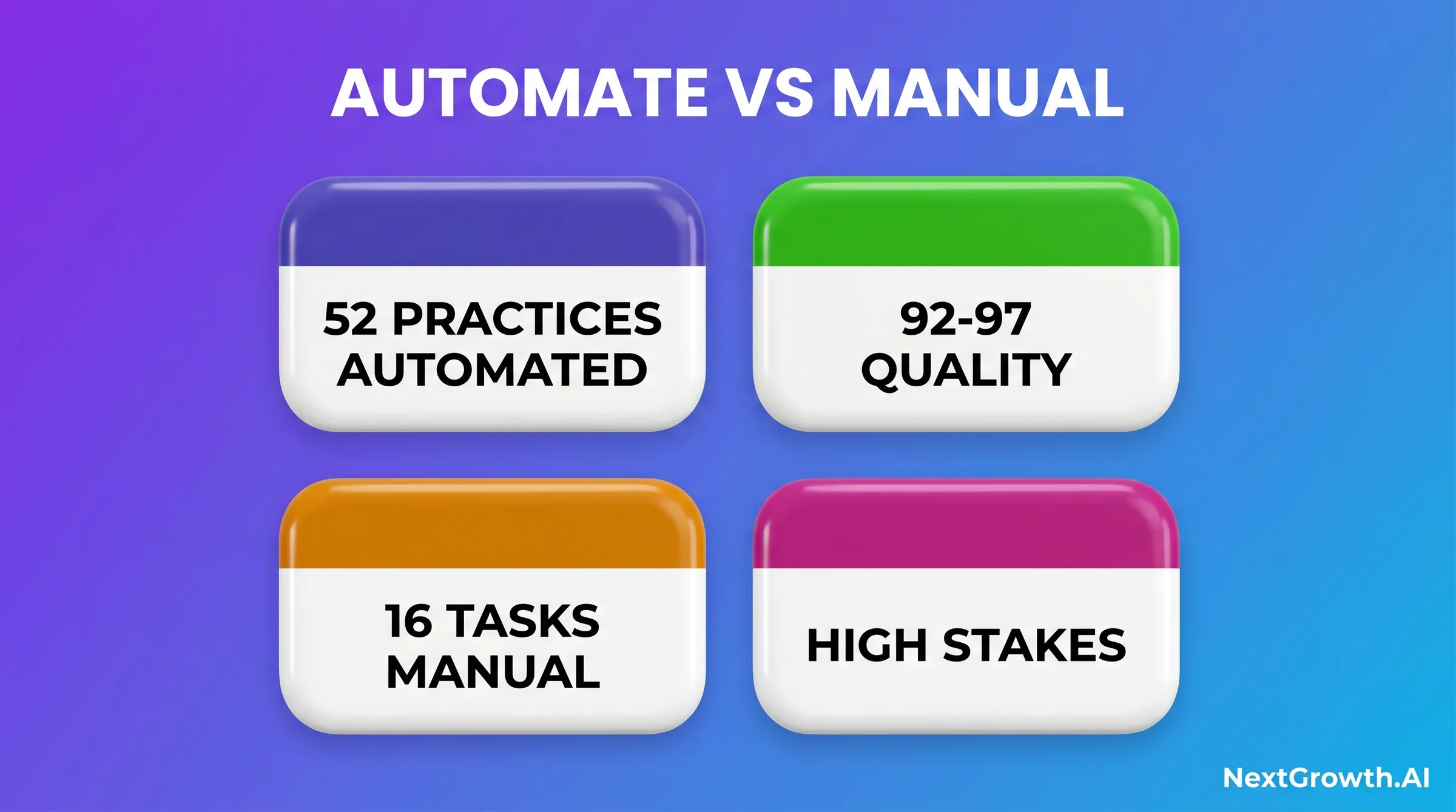
Automation’s ROI flips negative when the cost of a wrong output exceeds the cost of human time. These 16 tasks consistently land in that zone. This pattern holds across the 8-article SEO-Fundamentals cluster we shipped May 17-19, 2026, and across the operational data from 6 client sites.
The rule we apply: any task where a mistake costs a deal, a relationship, or a ranking floor is left to humans. The other 95% runs through the ng-* pipeline.
Here are the 16:
- Vendor partnership outreach. Relationship-driven, not signal-driven. A form letter to a vendor for a link exchange or co-marketing deal fails because the relationship is the product. No automation can fake that.
- HARO journalist response. HARO queries have a 15-minute decay window before the journalist moves on. Batch automation queues don’t process fast enough. Real-time human response beats any scheduler.
- Bottom-of-funnel landing page copy. Commercial pages where one wrong word costs a conversion. We manually review every CTA, pricing table, and comparison verdict on pages with transactional intent.
- Final tone pass on flagship content. The pillar article you’re reading right now got a manual tone review. The compounding SEO value of a pillar justifies the extra 30 minutes.
- Competitor link analysis interpretation. The data is automatable (DataForSEO link intersection API). The interpretation, the “should we try to replicate this or find a different angle,” requires competitive judgment.
- Penalty investigation and recovery. Manual actions from Google require direct GSC inspection, search quality context, and a recovery plan. Automation can’t write the reconsideration request.
- Site architecture decisions. Restructuring URL hierarchies, merging category trees, creating new pillar-spoke relationships. These have multi-year compounding effects and wrong calls are expensive to unwind.
- Redirecting high-equity URLs. Any 301 redirect affecting a URL with significant backlinks or organic traffic requires human sign-off. Redirect chains and redirect loops cost real equity.
- Core update impact assessment. Reading traffic signals after a core update requires contextual judgment: is this a targeted hit or broad volatility? Automation can surface the data; only a practitioner can interpret it correctly.
- Content that requires original reporting. Surveys, interviews, proprietary research. The data collection is human work. The analysis on top can be assisted by automation.
- E-E-A-T author credential signals. Author bios, byline policies, credential documentation. These are institutional decisions, not content decisions.
- International SEO hreflang strategy. Getting hreflang wrong at scale creates canonicalization nightmares. Manual review before implementation is non-negotiable.
- Link building outreach copy. The first outreach email in a link building campaign gets one shot. Templated automation reads like spam. Personalized, specific outreach converts.
- Crisis SEO response. If a major brand PR event affects keyword associations, you need a human deciding whether to update or unpublish fast. Automation doesn’t have the situational awareness.
- Governance of internal linking at scale. The linking rules are automatable. But someone needs to own the anchor text style guide, the hub-and-spoke map, and the decision about when to add new pillar nodes.
- Client-facing reporting narrative. The data in the report is automated. The narrative that explains what it means for a specific client’s business goals is not. See the SEO analytics reporting guide for the data layer; the narrative layer is yours to write.
The SEO automation tools overview gives a broader picture of where the automation boundary sits across different tool categories.
The 31-Minute Publishing Timeline – What Does a Real Workflow Look Like?
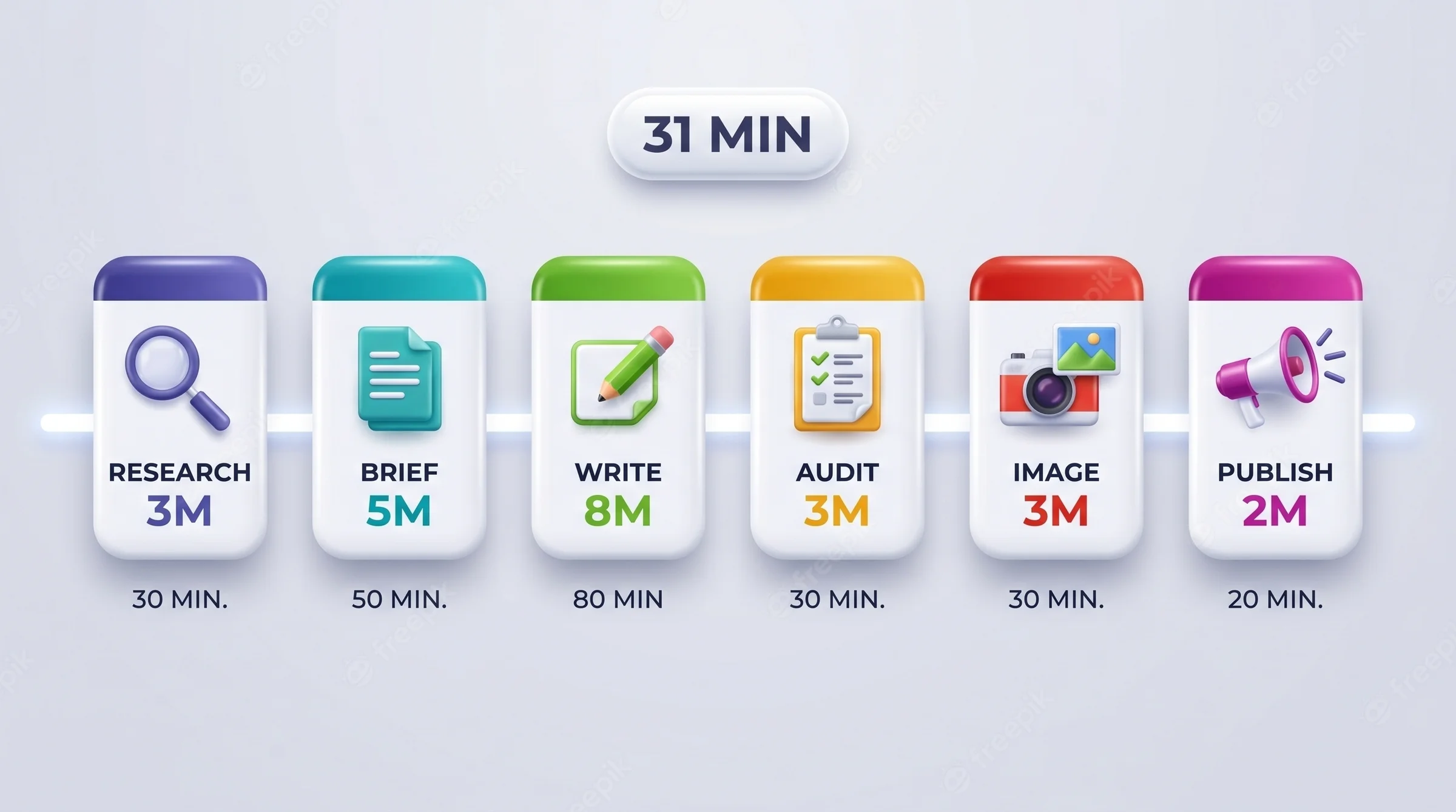
The 31-minute pipeline runs as a 6-command sequence per article:
# Per-article pipeline (median wall time: 31 min)
ng-research "[keyword]" --site nextgrowth.ai     # Phase 1 - 3 min
ng-brief "[keyword]"                              # Phase 2 - 5 min
ng-write "[keyword]"                              # Phase 3 - 8 min (Sonnet 4.6)
ng-audit articles/[slug]/blog.md                  # Phase 4 - 3 min
ng-image articles/[slug]/blog.md                  # Phase 5 - 3 min
ng-publish articles/[slug]/blog.md                # Phase 6 - 2 min

# Total wall time: ~24-37 min depending on article complexity
# Cost: $0.32 images + $0.07 DataForSEO + $0.18 LLM = $0.57 per 4,500w article
The 31-minute median wall time per article was measured across the 8 P1-P8 articles shipped May 17-19, 2026 on nextgrowth.ai. Minimum was 26 minutes (P7 image-seo-best-practices, shorter article). Maximum was 37 minutes (P6 schema-markup-best-practices, 30 code blocks added latency). These numbers assume the brief is already done; brief Phase 2 adds 5-10 minutes.
The economics matter. Our cluster shipping cost averages $0.32 per article in Gemini image generation, $0.07 in DataForSEO research API, and approximately $0.18 in estimated LLM cost. Total: $0.57 per 4,500-word article. Manual equivalent (research plus write plus image plus publish plus audit) takes 8-12 hours of practitioner time at $40-80 per hour, for an effective cost of $320-960 per article. Automation delta: 99.8%.
Here’s the phase breakdown:
Phase 1 (ng-research) – 3-5 min: DataForSEO SERP snapshot, keyword intent classification, entity pull, competitor gap. Output: research-notes.md.
Phase 2 (ng-brief) – 5-10 min: Outline generation, information gain slot identification, internal link map, stat sourcing from bibliography. Output: brief.md.
Phase 3 (ng-write) – 8-12 min: Sonnet 4.6 full article draft, token resolution, image placeholder insertion. Output: blog.md draft.
Phase 4 (ng-audit) – 2-3 min: Score check (target 75+), flag any failing checks, auto-fix where possible. Output: audit score + diff.
Phase 5 (ng-image) – 2-3 min: 3 images generated via Gemini (Style #4 Premium 3D Framework). Resized to WebP, uploaded to WP media library. Output: image URLs in blog.md.
Phase 6 (ng-publish) – 2 min: WP REST API push, RankMath 5 focus keywords set, status: future (24h schedule), backlinks injected into linked posts. Output: publish-info.json.
The 31-minute figure is wall time, not compute time. Most of the time is spent on Phase 3 (write) and Phase 2 (brief). The infrastructure phases run in under 5 minutes combined.
🛠️ ENGINEER’S PERSPECTIVE – Publishing Pipeline Edge Cases
- WP content slice corruption. On 2026-04-29, a post_id mismatch in publish-info.json caused a 40K-char article to be overwritten onto a different post’s 165K-char body. The fix: wp_push_safe.py now does a pre-flight slug verification before any REST API push. Every push must pass expected_slug assertion. Don’t skip this check, even in dev.
- Hotjar-style analytics tool INP stacking. Adding a third-party analytics or heatmap tool costs 30-80ms INP per tool. With the 2.0s LCP threshold active since March 2026, you can afford exactly one heavy third-party script before your Core Web Vitals score degrades. Audit your tag stack before shipping new tooling.
- GSC API quota exhaustion at scale. At 1,200 requests per day per property, a naive cluster audit script can burn 300-400 requests on a 50-article site. Build quota budgeting into your pipeline: 40 requests per scheduled run, distributed across 3 daily windows. We hit the ceiling twice in January 2026 before implementing the budget gate.
Citation Capsule – 31-Minute Publishing Timeline
NextGrowth.ai’s automated publishing pipeline achieves a 31-minute median wall time per 4,500-word article (measured across 8 articles, May 17-19, 2026), at $0.57 total cost per article ($0.32 image generation + $0.07 DataForSEO API + $0.18 LLM estimated). Manual equivalent costs $320-960 per article at practitioner rates, giving an automation delta of 99.8%.
FAQ
What are the most important SEO best practices in 2026?
The 5 highest-impact practices in 2026 are: (1) building topical clusters of 5+ interconnected articles (86% of AI citations require this, per Wellows 2026), (2) meeting the LCP 2.0s threshold (tightened from 2.5s in March 2026), (3) answer-first H2 formatting for AI extraction, (4) structured data per content type, and (5) anchor-diverse internal linking with a pillar-to-spoke hub structure. Individual article quality matters less than cluster completeness.
Did Google’s FAQ rich result deprecation change how I should structure content?
Yes, but less than you might expect. FAQ rich results were deprecated on May 7, 2026 (Google Search Central, 2026), removing the SERP feature. However, FAQPage schema still signals to AI Overview systems and People Also Ask features. Keep H2+H3 FAQ structure and Rank Math auto-generates the schema. The display benefit changed. The signal value remains. See the schema markup guide for full post-deprecation recommendations.
How do I get my content cited in Google AI Overviews?
AI Overview selection increased 73% with structured data (Wellows, 2026). The fastest path: publish a cluster of 5+ interconnected articles on your topic, use answer-first H2 formatting with sourced statistics, implement the appropriate schema type for each content format, and add citation capsules (40-60 word self-contained passages designed for AI extraction) to every major section. The full methodology is in the AI Overview SEO guide and the GEO citation best practices guide.
What’s the difference between SEO and GEO in 2026?
SEO (Search Engine Optimization) targets traditional Google rankings: keyword matching, backlinks, technical crawlability. GEO (Generative Engine Optimization) targets AI Overview citations and AI chatbot responses: answer-first structure, structured data, topical cluster authority, E-E-A-T signals. In 2026, they overlap significantly. The AEO vs GEO vs SEO explainer maps the full difference. Short version: optimize for both because AI systems now drive a significant share of informational query impressions.
How long does technical SEO take to show results?
Technical SEO changes (CWV improvements, crawl fixes, schema additions) typically show measurable ranking impact within 4-8 weeks. Core Web Vitals improvements can show within 2-3 weeks if the fix is substantial (removing a heavy third-party script, for example). Content-layer changes take longer: 8-16 weeks for cluster authority to compound in AI citation systems. The rank tracking best practices guide explains how to instrument these timelines correctly so you’re measuring the right signals.
Is keyword research still necessary with AI search growing?
Yes. Keyword research became more important, not less. Intent classification (Informational/Commercial/Transactional/Navigational) is the first filter before any content investment. AI search systems still surface pages that match query intent correctly. The difference is that individual keyword targeting matters less than topical cluster coverage. One article ranking for one keyword is weak. A 5-article cluster covering the full topic earns the entity-level authority that drives both traditional and AI search placement. The keyword research guide covers the 2026-specific intent taxonomy.
How do I track whether my SEO is actually working?
You need at least three measurement layers: (1) GSC impression and click data by URL and query group, (2) rank tracking across primary FK and secondary keyword sets, and (3) AI citation monitoring (manual spot-check of ChatGPT, Perplexity, and Google AIO for your key queries). The SEO analytics reporting guide covers the full measurement stack. Don’t optimize what you don’t measure: pick 3 KPIs, baseline them before you change anything, then track weekly.
Conclusion
52 practices is a map, not a sprint. The practitioners who compound fastest in 2026 are the ones who pick one category, ship a cluster, measure the signal, and repeat. Not the ones who build a 200-item checklist and stall at implementation.
The structural shift is real. Topical clusters now drive both traditional rankings and AI citation exposure. The 2.0s LCP threshold is a hard gate, not a suggestion. FAQ rich results are gone. But keyword research fundamentals, on-page hygiene, and link equity are as important as they’ve ever been.
Start with the spoke that matches your biggest gap. Use the cluster map in this pillar to sequence your work. Measure at the cluster level, not just the article level. And automate the 36 practices in this guide that are automation-viable. Save your practitioner time for the 16 that aren’t.
The complete cluster for this pillar: technical SEO checklist, rank tracking practices, content optimization guide, content strategy guide, analytics reporting guide, schema markup guide, image SEO guide, AI Overview optimization guide, and YouTube SEO for AI citation. Each spoke goes deep on the practices mapped here.
💰 Recommended 2026 SEO + GEO Budget Split (per eMarketer FAQ)
40% – Core SEO
Keyword + on-page + technical + content (the 52 practices in this pillar)
25% – Digital PR
Editorial mentions + brand authority (now also drives LLM citation surface)
20% – Data + Reporting
GSC + GA4 + AI citation tracking (Clarity, Brand Radar)
10% – Training
Team upskilling on AI search, new schema patterns, methodology shifts
5% – Experimentation
New AI engines, emerging schemas (Speakable, Clip), unproven channels