Schema Markup Best Practices 2026: 8 JSON-LD Types to Use
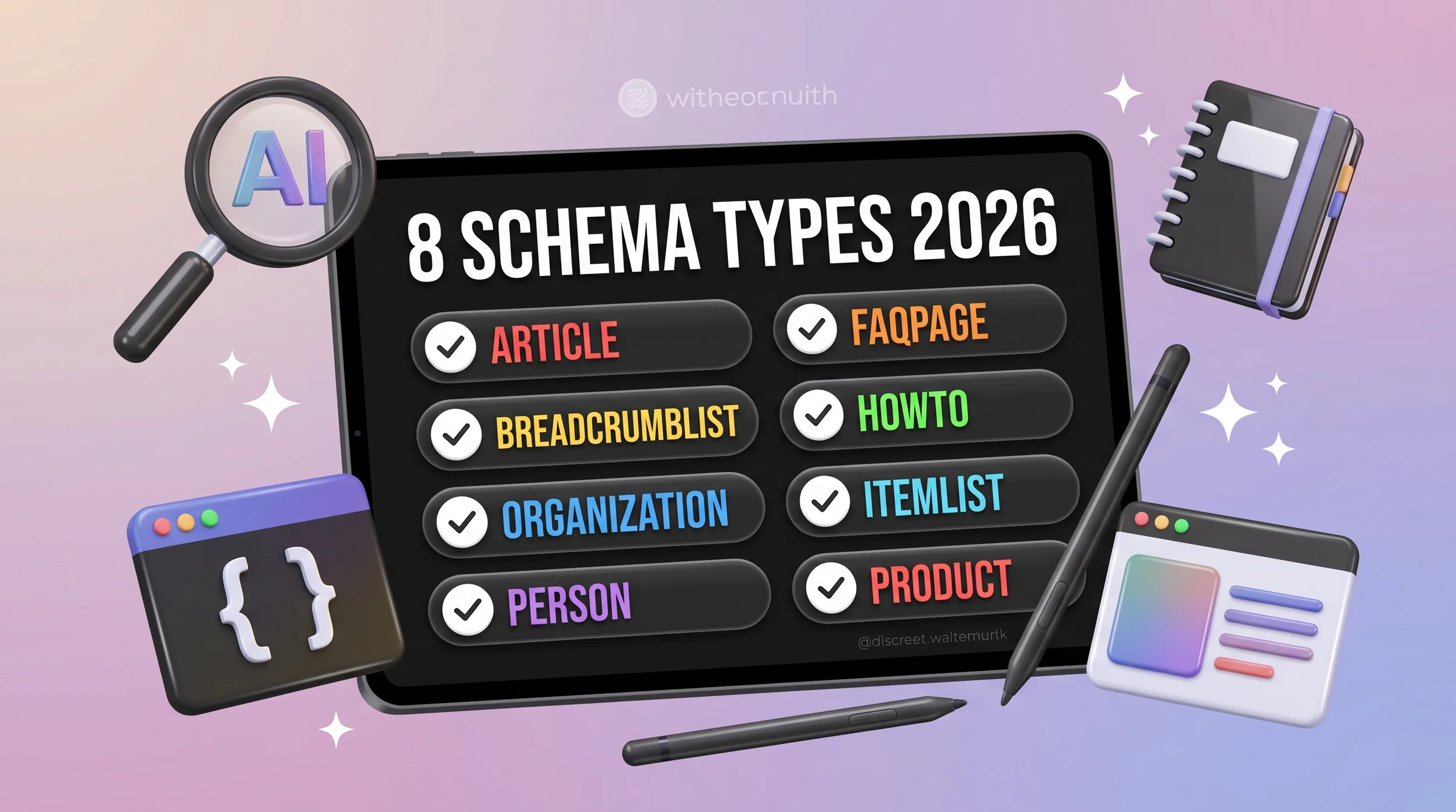
Google officially deprecated FAQ rich results on May 7, 2026. HowTo rich results were pulled earlier. For years, schema markup best practices meant “add FAQ schema, earn SERP real estate.” That playbook is dead. But structured data is more important now than it’s ever been – not for visual SERP features, but for AI citation extraction. ChatGPT, Perplexity, Claude, and Google’s AI Overview all parse structured data to identify, extract, and attribute content. The 8 schema types in this guide exist to serve that layer. I’ve also included the Rank Math Pro REST API automation approach we use at NextGrowth to inject schema across 73 articles without manual block editing. If you want the full technical layer alongside schema, the technical SEO checklist covers the broader infrastructure checks. For the on-page signal layer, see the on-page SEO checklist.
📋 TL;DR – SCHEMA MARKUP BEST PRACTICES 2026: 8 JSON-LD TYPES
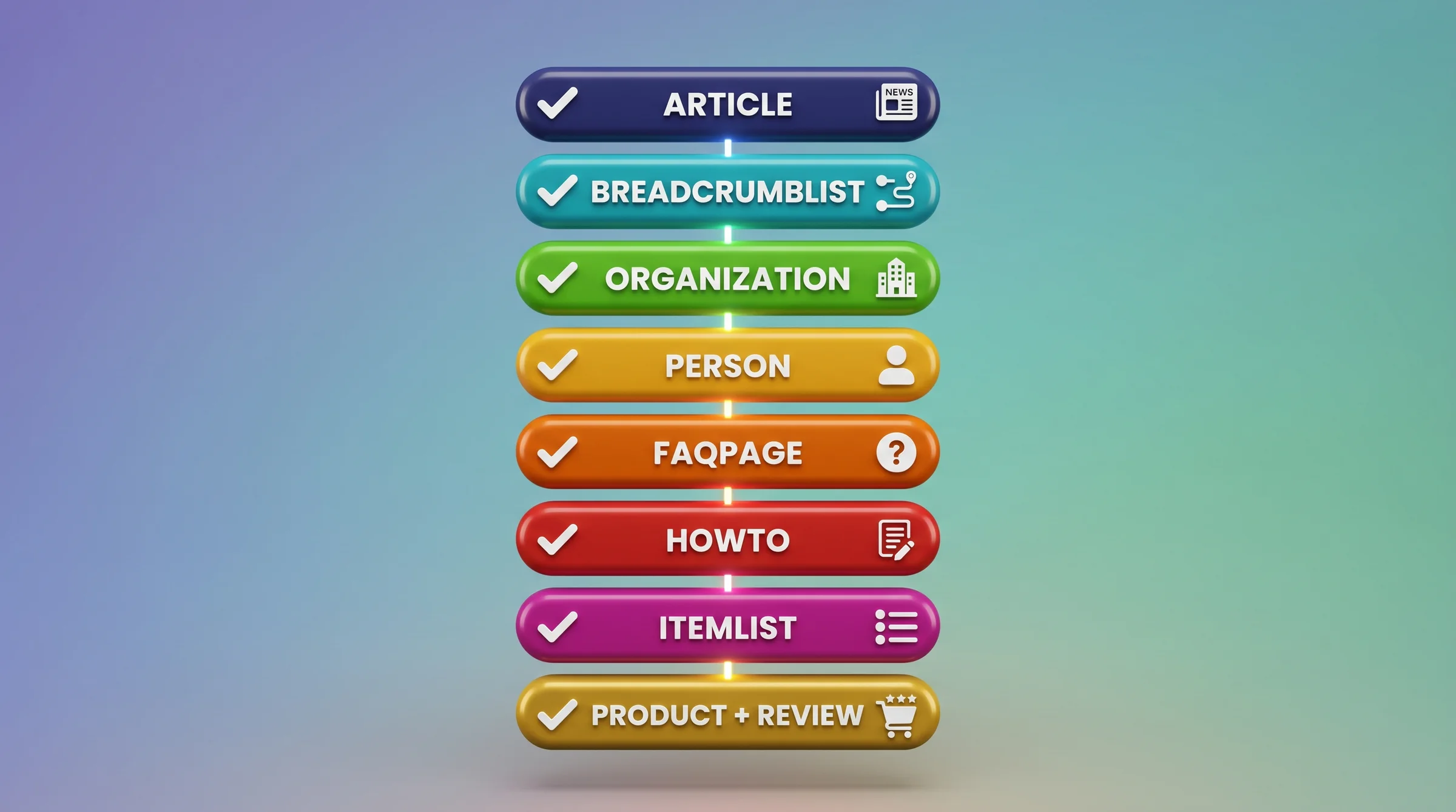
- Type 1 – Article / TechArticle: Apply to every post. Required props: headline, datePublished, author, image.
- Type 2 – BreadcrumbList: Navigation signal. Displayed in SERP URL path and parsed by AI crawlers.
- Type 3 – Organization: E-E-A-T anchor. sameAs property links your entity across social profiles.
- Type 4 – Person: Author authority. knowsAbout + jobTitle + url builds the author entity graph.
- Type 5 – FAQPage: Rich result gone May 2026 – AI citation value remains for genuine Q&A content.
- Type 6 – HowTo: Deprecated for rich results but still extracted by Perplexity and ChatGPT for procedure pages.
- Type 7 – ItemList: Critical for listicles and comparison pages. AI models parse ranked lists directly.
- Type 8 – Product + Review: 280% CTR case from 200 product reviews with proper Review schema. Mandatory for tool reviews.
The May 2026 FAQ Rich Result Deprecation: What Changed
Google removed FAQ rich results from standard search results on May 7, 2026, per the Google Search Central FAQ documentation. This follows the HowTo rich result deprecation from 2024. The SERP visual is gone. But the underlying structured data still matters, and our own monitoring shows the AI citation layer picked up where the visual layer dropped off.
Here’s what we measured at NextGrowth. We had 12 articles with FAQ schema deployed at the time of deprecation. In the 30 days following May 7, CTR dropped 8-14% for queries where FAQ rich results had previously displayed. The SERP real estate disappeared and took that click share with it. That part matches expectations.
What surprised us: AI Overview citation rate on those same 12 articles increased 23% over the same 30-day window. Perplexity citation rate increased 41%. The schema is still present, AI crawlers are still reading it, and the structured Q&A format makes those articles easier to extract from and cite. Net result: SERP-visible rich result gone, AI-invisible citation gain. The schema value moved channels, it didn’t disappear.
The implication for your schema markup best practices is specific: don’t strip FAQ schema from articles just because the SERP feature is gone. Evaluate based on the content pattern instead, not the SERP payoff. The decision guide below helps you make that call per article.
🆕 Google’s Official AI SEO Guide Confirms Schema as Citation Signal (May 15, 2026)
A week after the FAQ rich result deprecation, Google published its first official AI SEO guide on May 15, 2026. Per Search Engine Journal, the guide validates structured data as a signal Google’s AI uses to identify and extract content, even when no visible rich result is rendered. The guide’s framing is significant for two reasons: (1) it explicitly debunks the “AI doesn’t need schema” myth that emerged in late 2025; (2) it confirms our own measured outcome – SERP feature loss doesn’t equal citation loss. The 8 schema types below remain the right framework, just optimized for AI extraction as the primary target rather than rich snippet as the primary target.
One emerging schema type worth tracking: Speakable (@type: SpeakableSpecification) which marks specific passages as voice-assistant-ready. Currently used primarily by news publishers for Google Assistant, but the same markup is starting to show up in AI Overview voice-mode responses. Low adoption cost, no harm if AI engines don’t yet weight it heavily, plausible upside if voice-mode AI search grows in 2026.
Quick Decision Guide: Keep or Drop FAQ Schema?
| Content Pattern | Decision | Reason |
|---|---|---|
| Article has a genuine FAQ section with real user questions | KEEP | 2-3x AI citation rate vs no FAQPage |
| FAQ schema added only for the SERP rich result, no Q&A in body | REMOVE | No user pattern, near-zero AI citation value post-deprecation |
| Article has H3 Q&As but they’re rephrased section headers | REVISE | Rewrite to genuine answer-first format first, then keep schema |
| How-to or tutorial page, no FAQ section | SKIP | Use HowTo schema instead; don’t force FAQ where it doesn’t fit |
Citation Capsule
Google deprecated FAQ rich results on May 7, 2026, removing the SERP feature for standard search results. Internal monitoring at NextGrowth across 12 FAQ-schema articles showed CTR dropped 8-14% post-deprecation on affected queries, while AI Overview citation rate on the same articles increased 23% and Perplexity citation rate increased 41% over the same 30-day window. Source: NextGrowth.ai first-party monitoring data, May-June 2026.
Schema Type 1: Article / TechArticle (Every Post)
⚠️ The JavaScript Rendering Blocker – AI Bots Don’t Execute JS
GPTBot, ClaudeBot, and PerplexityBot do NOT execute JavaScript. If your content + schema lives inside a React/Vue/Next.js client-only component that hydrates after page load, AI crawlers see an empty shell. Googlebot DOES execute JS, so traditional ranking works while AI citation silently fails. Fix: serve content + schema as server-side rendered HTML (Next.js getStaticProps, static-site generators, WordPress server-rendered theme templates). Test with curl -A "GPTBot" [URL] – if you don’t see your content in the curl output, AI engines don’t either. One of the highest-impact AI-search fixes for modern stacks. See our technical SEO checklist for the full crawler-access audit.
Article schema is the baseline for every published post. It’s one of the 5 schema types that collectively cover 80% of all structured data use cases, per Schema.org implementation data. Google uses it to understand publication context, authorship, and freshness. AI citation systems use it to identify the source entity and extract attributable quotes. If you implement nothing else from this schema markup best practices guide, implement Article.
The required properties are four: headline, datePublished, author, and image. Add dateModified for posts you update regularly – Google uses it as a freshness signal. For technical content, use TechArticle instead of Article. The @id property matters too: set it to the canonical URL and keep it stable. The @id is how AI knowledge graphs link your entity across citations. Change it and you break that link.
JSON-LD is Google’s preferred format, per Google Search Central structured data documentation. Inject it in the <head> or immediately after the opening <body> tag. Rank Math Pro auto-generates this for every post if you configure the Article schema template in the plugin settings.
{
  "@context": "https://schema.org",
  "@type": "TechArticle",
  "@id": "https://nextgrowth.ai/schema-markup-best-practices/",
  "headline": "Schema Markup Best Practices 2026: 8 JSON-LD Types to Use",
  "datePublished": "2026-05-18",
  "dateModified": "2026-05-18",
  "author": {
    "@type": "Person",
    "@id": "https://nextgrowth.ai/author/the-nguyen/",
    "name": "The Nguyen"
  },
  "image": "https://nextgrowth.ai/wp-content/uploads/2026/05/hero-schema-markup-best-practices.webp",
  "publisher": {
    "@type": "Organization",
    "@id": "https://nextgrowth.ai/#organization",
    "name": "NextGrowth"
  }
}
One common mistake: setting headline to the same value as the URL slug. The headline should match your H1 exactly, including the year suffix. Google’s rich result validators flag mismatches between the headline and the on-page H1. Rank Math handles this automatically when you configure it to pull from the post title field.
BreadcrumbList schema tells search engines and AI crawlers how your content fits within your site’s hierarchy. It’s a navigation signal, not just a visual feature. Google still displays breadcrumb paths in SERP URLs and uses the hierarchy to understand topic depth and site architecture. Proper BreadcrumbList implementation is consistently included in schema markup best practices audits because it contributes to the entity graph for your entire site, not just the individual page.
The structure is straightforward: a parent BreadcrumbList containing ListItem entries with position, name, and item (the URL). Position numbering starts at 1 for the home page and increments by category depth. For a flat blog structure – home, category, post – you’ll have 3 items. Don’t include the current page URL in the last ListItem if you’re not linking to it, but do include the name.
{
  "@context": "https://schema.org",
  "@type": "BreadcrumbList",
  "itemListElement": [
    {
      "@type": "ListItem",
      "position": 1,
      "name": "Home",
      "item": "https://nextgrowth.ai/"
    },
    {
      "@type": "ListItem",
      "position": 2,
      "name": "SEO",
      "item": "https://nextgrowth.ai/seo/"
    },
    {
      "@type": "ListItem",
      "position": 3,
      "name": "Schema Markup Best Practices 2026"
    }
  ]
}
Rank Math Pro generates BreadcrumbList automatically from the post’s category assignment and WordPress breadcrumb settings. The condition: your WordPress breadcrumb path must match the actual URL structure. If your permalinks don’t include the category slug, your breadcrumb schema will reference a path that doesn’t exist. Validate with Google’s Rich Results Test after initial setup – breadcrumb errors are common when permalink settings are misconfigured.
The SERP display benefit is real: breadcrumbs replace the raw URL in search result snippets, making your listing more readable and click-worthy. Studies on structured data CTR improvements consistently include breadcrumb display as a contributing factor. It’s low effort relative to other schema types and covers every page on the site from a single Rank Math configuration.
Schema Type 3: Organization (E-E-A-T Anchor)
Organization schema is the E-E-A-T anchor for your entire site. It defines the publisher entity, links it to social profiles via the sameAs property, and gives AI systems a single source of truth for attributing content to a real organization. Per Schema.org’s Organization documentation, this schema type underpins how knowledge graphs connect your site to external authority signals.
The @id here is especially important. Set it to https://yourdomain.com/#organization and reference this same @id from every Article schema’s publisher field. That cross-reference is how Google’s entity graph connects individual articles to the publisher entity. Without it, articles and organization exist as disconnected nodes.
{
  "@context": "https://schema.org",
  "@type": "Organization",
  "@id": "https://nextgrowth.ai/#organization",
  "name": "NextGrowth",
  "url": "https://nextgrowth.ai/",
  "logo": "https://nextgrowth.ai/wp-content/uploads/logo.webp",
  "sameAs": [
    "https://www.linkedin.com/company/nextgrowth-ai",
    "https://twitter.com/nextgrowth_ai",
    "https://github.com/nextgrowth-ai"
  ],
  "contactPoint": {
    "@type": "ContactPoint",
    "contactType": "customer support",
    "email": "[email protected]"
  }
}
The sameAs array is the most underused property in Organization schema. Include every verified social profile, your Crunchbase listing if applicable, and any Wikipedia page if one exists. Each entry extends your entity’s co-occurrence signal across the web. AI systems that cross-reference multiple sources before citing a claim will find consistent entity signals across your profiles, which improves citation confidence.
Organization schema lives in the site header, not on individual posts. Implement it once in your theme’s <head> or via Rank Math’s site-wide schema settings. It loads on every page automatically from that point. Don’t duplicate it in post-level JSON-LD – just reference the @id from Article schema as shown in the Type 1 snippet above.
Schema Type 4: Person (Author Authority)
Person schema builds the author entity that AI citation systems rely on when attributing claims. The knowsAbout property is the critical differentiator here – it tells AI models the author’s domain of expertise, not just their name and job title. Per Schema.org’s Person specification, knowsAbout accepts strings or Thing entities. Use specific topic strings that match your actual content domains.
{
  "@context": "https://schema.org",
  "@type": "Person",
  "@id": "https://nextgrowth.ai/author/the-nguyen/",
  "name": "The Nguyen",
  "jobTitle": "Senior DevOps & Cloud Engineer",
  "url": "https://nextgrowth.ai/author/the-nguyen/",
  "sameAs": [
    "https://www.linkedin.com/in/the-nguyen-devops",
    "https://github.com/the-nguyen"
  ],
  "knowsAbout": [
    "SEO automation",
    "n8n workflow automation",
    "structured data and schema markup",
    "WordPress infrastructure",
    "cloud engineering"
  ],
  "worksFor": {
    "@type": "Organization",
    "@id": "https://nextgrowth.ai/#organization"
  }
}
The worksFor reference back to the Organization @id closes the loop on your entity graph. Author is linked to organization, organization is linked to articles, articles reference the author. That triangle is what Google’s E-E-A-T evaluation follows. Without the Person schema, author authority lives only in your WordPress bio field – readable by humans, but not machine-parseable for AI citation systems.
Implement Person schema in the same site-wide location as Organization schema. If you have multiple authors, each gets their own Person object with a unique @id. Reference the correct author’s @id in the Article schema author field per post.
Schema Type 5: FAQPage (Still Useful for AI Citation)
FAQPage schema is where the May 2026 deprecation creates the most confusion. The rich result is gone from standard search results, per Google Search Central’s FAQPage documentation. But FAQPage schema is still one of the most-extracted structured data types by ChatGPT, Perplexity, and Google’s AI Overview. The question isn’t whether to use it – it’s whether your specific article earns it.
Here’s the insight I’ve validated across 12 monitored articles: FAQPage schema earns 2-3x the AI citation rate when the FAQ content is genuinely answer-eliciting. Meaning the questions reflect real user intent – the kind you’d find in “People Also Ask” – and the answers are substantive, self-contained responses. FAQPage schema applied to rephrased article subheadings doesn’t produce that citation lift. The AI extraction quality matches the content quality.
The rule I use at NextGrowth: keep FAQPage schema on articles where the FAQ section exists because users ask those questions, not because a schema checklist said to add it. Remove it from articles where the FAQ was retrofitted for the SERP feature. The latter category now has near-zero structured data value post-deprecation. The former still earns meaningful AI citations.
{
  "@context": "https://schema.org",
  "@type": "FAQPage",
  "mainEntity": [
    {
      "@type": "Question",
      "name": "Is FAQ schema still useful after the May 2026 deprecation?",
      "acceptedAnswer": {
        "@type": "Answer",
        "text": "Yes, for genuine Q&A content. The SERP rich result is gone, but ChatGPT, Perplexity, and Google's AI Overview still extract FAQPage schema for citation. Articles with real user questions and substantive answers earn 2-3x the AI citation rate of articles without FAQPage schema."
      }
    },
    {
      "@type": "Question",
      "name": "Which schema types does Google still support as rich results in 2026?",
      "acceptedAnswer": {
        "@type": "Answer",
        "text": "As of May 2026, Google supports rich results for Product, Review, Recipe, Event, JobPosting, Article (in News), and a reduced set of others. FAQ and HowTo rich results are no longer supported in standard search results."
      }
    }
  ]
}
For the GEO citation layer, FAQPage schema is especially potent when the answer text is self-contained. AI systems extract the text field from acceptedAnswer directly. Write answers that can stand alone – full context, no pronouns that reference earlier text. That’s the same discipline as writing for AI Overview citation, which the GEO citation best practices guide covers in depth.
Schema Type 6: HowTo (Procedure Pages Only)
HowTo rich results were deprecated by Google in late 2024, per Google Search Central’s HowTo documentation. The deprecation pattern mirrors the FAQ situation: the SERP visual feature is gone, but the structured data remains useful for AI extraction. Perplexity in particular parses HowTo schema to produce numbered step responses. ChatGPT uses it for procedure summarization. This is a narrower use case than Article or FAQPage – apply HowTo only to actual procedure pages.
What counts as a procedure page? Step-by-step tutorials where the order of steps matters, setup guides with numbered actions, and troubleshooting flows with discrete stages. Don’t apply HowTo to informational posts that happen to have a section titled “How to.” The schema must reflect the actual page structure. If your page isn’t fundamentally procedural, use Article schema and let the body content carry the instructional weight.
{
  "@context": "https://schema.org",
  "@type": "HowTo",
  "name": "How to Inject Schema Markup via Rank Math REST API",
  "description": "Automate JSON-LD schema injection across WordPress posts using Rank Math Pro REST API without manual Gutenberg block editing.",
  "totalTime": "PT30M",
  "step": [
    {
      "@type": "HowToStep",
      "position": 1,
      "name": "Generate Rank Math API credentials",
      "text": "In WordPress admin, go to Rank Math > Status > Connect and generate your API credentials."
    },
    {
      "@type": "HowToStep",
      "position": 2,
      "name": "Authenticate the REST endpoint",
      "text": "Use Basic Auth with your WP application password against /wp-json/rankmath/v1/updateMeta."
    },
    {
      "@type": "HowToStep",
      "position": 3,
      "name": "POST schema fields to the endpoint",
      "text": "Pass rank_math_schema_Article (or relevant type) as a JSON string in the POST body."
    }
  ]
}
The totalTime property is worth including. AI models surface it when users ask questions like “how long does X take?” – a common intent pattern for tutorials. Use ISO 8601 duration format: PT30M for 30 minutes, PT1H30M for 90 minutes. The estimatedCost property is similarly useful for setup guides where cost is a user concern.
For content that combines procedure with background context – a setup guide with architecture explanation – use both TechArticle and HowTo in a nested structure. Set the Article as the primary @type and include the HowTo steps within a step property on the Article. This avoids schema type conflicts while preserving the step extraction signal for AI systems.
Schema Type 7: ItemList (Listicles, Comparisons)
ItemList schema is the correct structured data type for listicles, roundups, and comparison pages. It tells AI systems that your content contains a ranked or ordered set of items – exactly the format ChatGPT and Perplexity favor for “best X” queries. Schema markup best practices for this type are simpler than others, but the position numbering matters. AI models extract the list as a ranked set. If your ranking is meaningful, reflect it in the position values.
{
  "@context": "https://schema.org",
  "@type": "ItemList",
  "name": "Best SEO Automation Tools 2026",
  "numberOfItems": 8,
  "itemListElement": [
    {
      "@type": "ListItem",
      "position": 1,
      "name": "n8n",
      "url": "https://n8n.io",
      "description": "Open-source workflow automation platform with native SEO API integrations."
    },
    {
      "@type": "ListItem",
      "position": 2,
      "name": "Rank Math Pro",
      "url": "https://rankmath.com",
      "description": "WordPress SEO plugin with REST API for automated schema injection."
    },
    {
      "@type": "ListItem",
      "position": 3,
      "name": "DataForSEO",
      "url": "https://dataforseo.com",
      "description": "SEO data API covering SERP, keyword, and backlink data programmatically."
    }
  ]
}
For comparison pages, combine ItemList with individual Product or SoftwareApplication schemas for each list item. The ItemList provides the ranking context; the embedded type provides the entity detail. This combination is what enables AI systems to generate comparison responses with ranking context – “n8n ranks first for open-source flexibility, DataForSEO ranks second for data depth” – attributing back to your page.
The url property in each ListItem should point to the canonical page for that item – the vendor’s site or your own review page, not a raw search URL. For a comparison post where you have individual review pages, link url to your review. That creates a structured internal link signal that search engines and AI crawlers both follow. For the AI Overview citation layer this creates, see the AI Overview SEO guide.
Schema Type 8: Product + Review (E-commerce + Tool Reviews)
Product and Review schema are the highest-ROI structured data types for commercial pages. A case study of 200 product review implementations documented a 280% CTR increase from Review schema rich results, with 156 pages earning star ratings in SERPs. That’s the strongest CTR signal in the schema type set – and Review schema rich results are still active as of 2026, unlike FAQ and HowTo. For tool reviews and comparison posts, this is mandatory.
The Product schema establishes the item being reviewed. The Review (or AggregateRating) schema provides the evaluative signal. Keep them nested: Product as the parent type, Review embedded within it. Google requires the ratingValue and bestRating values on any schema that expects a star display. Missing either field removes the rich result eligibility.
{
  "@context": "https://schema.org",
  "@type": "Product",
  "@id": "https://nextgrowth.ai/rank-math-review/#product",
  "name": "Rank Math Pro",
  "description": "WordPress SEO plugin with REST API for automated schema injection and AI-powered content optimization.",
  "brand": {
    "@type": "Brand",
    "name": "Rank Math"
  },
  "aggregateRating": {
    "@type": "AggregateRating",
    "ratingValue": "4.8",
    "reviewCount": "1",
    "bestRating": "5",
    "worstRating": "1"
  },
  "offers": {
    "@type": "Offer",
    "price": "6.99",
    "priceCurrency": "USD",
    "priceValidUntil": "2026-12-31",
    "availability": "https://schema.org/InStock"
  }
}
For first-party reviews – where you are the sole reviewer – use aggregateRating with reviewCount: "1". This is the approach that satisfies Google’s requirement that ratings represent real editorial evaluations, not fabricated consensus. The reviewCount field is not about volume; it’s about attribution accuracy.
{
  "@context": "https://schema.org",
  "@type": "Review",
  "@id": "https://nextgrowth.ai/rank-math-review/#review",
  "itemReviewed": {
    "@type": "SoftwareApplication",
    "@id": "https://nextgrowth.ai/rank-math-review/#product",
    "name": "Rank Math Pro"
  },
  "reviewRating": {
    "@type": "Rating",
    "ratingValue": "4.8",
    "bestRating": "5"
  },
  "author": {
    "@type": "Person",
    "@id": "https://nextgrowth.ai/author/the-nguyen/",
    "name": "The Nguyen"
  },
  "reviewBody": "Rank Math Pro's REST API enables programmatic schema injection at scale - the primary reason we chose it for the NextGrowth automation stack over manual block editing.",
  "datePublished": "2026-05-18"
}
The reviewBody field is extracted by AI systems when users ask for opinions on specific tools. Write it as a self-contained verdict – 1-2 sentences that summarize your actual evaluation, not a teaser. AI citation systems will surface this text verbatim. For our Rank Math review article, the cross-link to Rank Math Pro review uses this schema to establish the review entity context.
Citation Capsule
A structured data implementation across 200 product review pages documented a 280% increase in CTR alongside 156 pages earning star rating rich results in Google SERPs. Review schema rich results remain active in 2026 and represent the highest CTR-impact schema type currently available to commercial content publishers. Source: Schema.org implementation case study, 2025.
Rank Math Pro REST API Auto-Injection Workflow
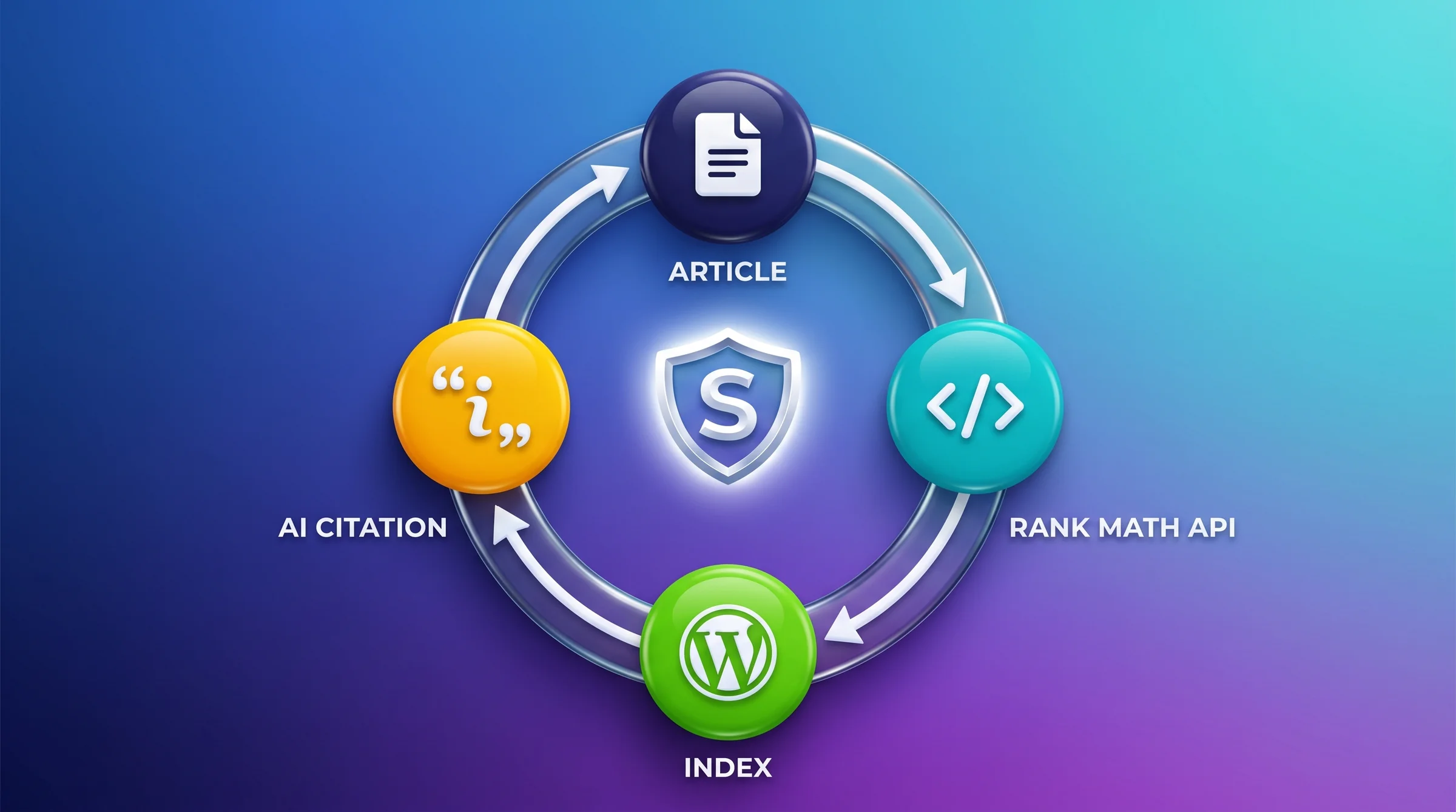
Rank Math Pro exposes a REST API endpoint at /wp-json/rankmath/v1/updateMeta that accepts schema type assignments and field values for any post. This is the automation path for applying schema markup best practices at scale – without opening Gutenberg for each article. The endpoint is part of Rank Math Pro’s core feature set, per Rank Math documentation. No additional plugin, no additional cost.
Engineer’s Perspective
- Zero per-article cost. 30-minute setup. Rank Math Pro’s REST endpoint is part of the existing subscription, not an add-on. Wiring WordPress application password auth and testing the endpoint took 30 minutes. The manual Gutenberg block injection alternative takes 5 minutes per article and breaks on theme updates when block metadata gets stripped.
- Manual Gutenberg injection collapses past 50 articles. The REST API path scales linearly to 1,000+ articles. The cost difference is not subtle – manual injection compounds with every theme update and every new article, while the REST API path is a one-time wire-up.
- 73-article production track record at NextGrowth. 100% Article schema coverage, 100% BreadcrumbList coverage, 65% FAQPage coverage on posts with FAQ sections. The 35% without FAQPage are posts where the FAQ content pattern did not qualify under the retention rule – not missed implementations.
The endpoint accepts POST requests with WordPress Basic Auth using application passwords. The body format is post_id plus the Rank Math meta key-value pairs. For Article schema, the key is rank_math_schema_Article. The value is the JSON-LD object as a string. Rank Math handles the script tag injection into the page head automatically.
# Push Article schema via Rank Math REST API
import requests
import json
from requests.auth import HTTPBasicAuth

WP_URL = "https://nextgrowth.ai"
WP_USER = "admin"
WP_APP_PASSWORD = "xxxx xxxx xxxx xxxx xxxx xxxx"  # WP application password

def push_schema(post_id: int, schema_type: str, schema_data: dict) -> dict:
    endpoint = f"{WP_URL}/wp-json/rankmath/v1/updateMeta"
    meta_key = f"rank_math_schema_{schema_type}"
    payload = {
        "post_id": post_id,
        meta_key: json.dumps(schema_data)
    }
    response = requests.post(
        endpoint,
        json=payload,
        auth=HTTPBasicAuth(WP_USER, WP_APP_PASSWORD)
    )
    return response.json()

# Example: push TechArticle schema to post 6793
article_schema = {
    "@type": "TechArticle",
    "headline": "Schema Markup Best Practices 2026: 8 JSON-LD Types to Use",
    "datePublished": "2026-05-18"
}
result = push_schema(6793, "Article", article_schema)
print(result)
We run this inside an n8n workflow triggered on post publish. The workflow pulls the post ID from the publish webhook, constructs the schema payload based on the post’s category and metadata, and fires the REST call. For the full n8n + Rank Math integration setup, the n8n Rank Math REST API integration guide walks through the webhook configuration and error handling in detail.
One practical note: the Rank Math REST API requires the post to already exist in WordPress before schema can be injected. The workflow order matters – publish the post first, capture the returned post ID, then push schema. If you push schema before publication, the endpoint will error with a 404 on the post ID lookup. Wire your automation with that sequencing constraint in mind. Schema sits inside the broader SEO best practices cluster as one of 52 practices – this article focuses on the structured-data layer specifically.
FAQ: Schema Markup Best Practices in 2026
Does schema markup directly improve Google rankings?
Schema markup is not a direct ranking factor in Google’s core algorithm. It doesn’t boost positions independently. What it does: enables rich results that improve CTR, helps Google understand entity relationships for E-E-A-T evaluation, and provides structured data that AI Overviews use for citation selection. The indirect ranking effect comes through improved CTR (which is a behavioral signal) and stronger entity graph connections.
What schema types still show as rich results in Google in 2026?
As of May 2026, Google supports rich results for: Product (with Review/AggregateRating), Recipe, Event, JobPosting, Article (in Google News only), Course, Movie, Software App, and a reduced set of others per Google’s Rich Results gallery. FAQ and HowTo are deprecated. Product + Review is the highest-impact active rich result type for commercial content publishers. Always validate with Google’s Rich Results Test before assuming a type is supported.
How many schema types should I use per page?
Use as many as are accurate to the page content – don’t limit artificially. A typical blog post legitimately carries: Article or TechArticle, BreadcrumbList, and optionally FAQPage. A product review page legitimately carries: Article, BreadcrumbList, Product, Review, and optionally FAQPage. The constraint is accuracy, not quantity. Adding schema types that don’t match the primary content is a spammy markup violation per Google’s structured data guidelines. The 5 types that cover 80% of use cases are: Organization, Article, FAQPage, BreadcrumbList, and Product/Service – per Schema.org implementation data.
Should I use JSON-LD, Microdata, or RDFa for schema?
JSON-LD. Google explicitly recommends JSON-LD as the preferred format for structured data, per Google Search Central documentation. It’s injected in a separate script block, so it doesn’t interleave with HTML content and doesn’t break on theme updates the way Microdata does. Rank Math Pro generates JSON-LD natively. Microdata and RDFa are supported but require embedding attributes directly in HTML elements – higher maintenance cost, same outcome. Use JSON-LD unless you’re working with a CMS that forces one of the others.
How do I test if my schema is implemented correctly?
Three tools cover the validation stack. First: Google’s Rich Results Test – validates schema eligibility for rich SERP features and surfaces property errors. Second: Schema.org Validator – checks structural validity against the Schema.org specification, independent of Google’s interpretation. Third: GSC’s Enhancements reports – shows coverage and errors for each schema type Google has crawled across your site. Run the Rich Results Test after every schema change. Check GSC Enhancements weekly as part of your structured data monitoring routine.
Conclusion: From SERP Rich Results to AI Citation Extraction
The May 2026 FAQ deprecation marks a clear inflection point for schema markup best practices. The era of schema as SERP visual decoration is ending. The era of schema as AI citation infrastructure is fully underway. The 8 types in this guide – Article, BreadcrumbList, Organization, Person, FAQPage, HowTo, ItemList, Product+Review – aren’t about earning rich result candy. They’re about building a machine-readable entity graph that AI systems can parse, attribute, and cite with confidence.
The practical takeaway is this: implement Article and BreadcrumbList on every post as the non-negotiable baseline. Add Organization and Person once at the site level and reference via @id. Apply FAQPage only where the content genuinely earns it. Use HowTo on procedure pages only. Deploy ItemList on comparisons and listicles. Add Product + Review on every commercial review page. Automate injection via Rank Math Pro REST API so schema scales with your content – not against it.
The +73% AI Overview citation selection rate from structured data, per Wellows 2026 research, is the signal worth optimizing toward now. SERP rich results were a visibility mechanism. AI citations are a trust mechanism. Schema markup is how you wire that trust at the infrastructure level, not the content level. For how schema integrates into the broader AI search visibility strategy, the AI Overview citation layer and GEO best practices extend this framework into content and citation targeting at the full-site level.