Content Distribution SEO: 7 Practices to 10x Your Reach
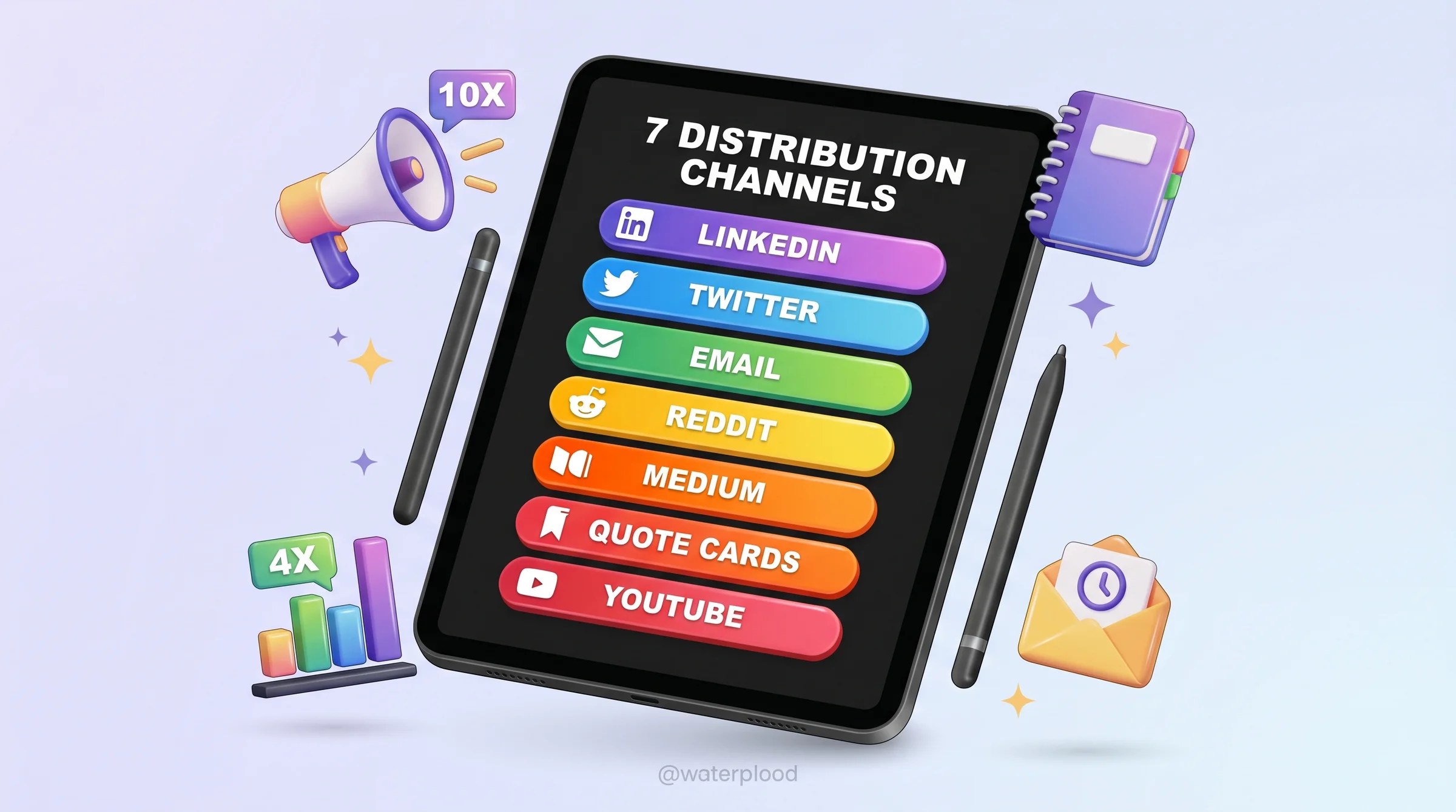
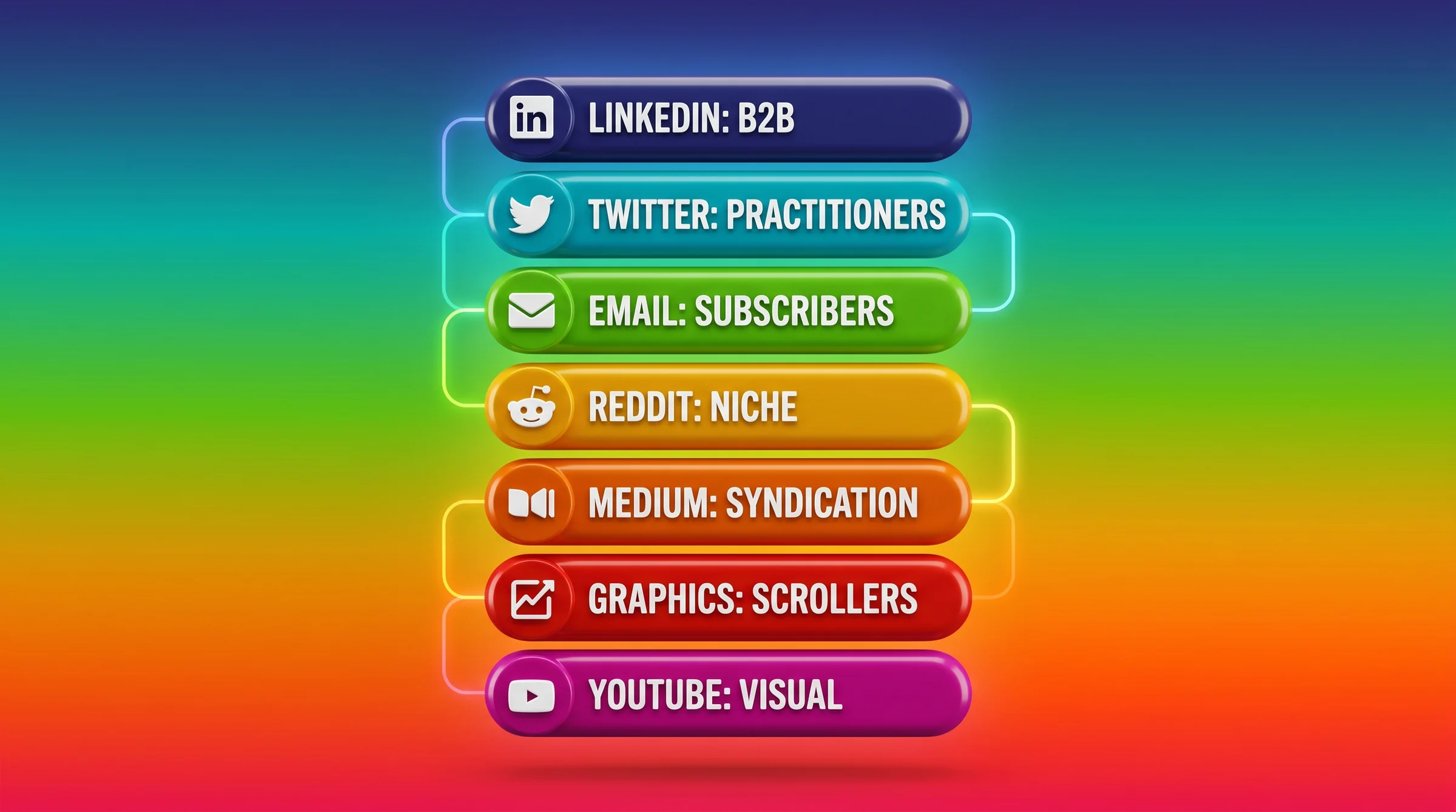
Publishing an article once and waiting for SEO to do the work is the slowest path to traffic in 2026. The fastest articles get content distribution seo running across LinkedIn, X/Twitter, email, Reddit, Medium, social graphics, and YouTube within 48 hours of publish. Each channel reaches a different segment: LinkedIn catches decision-makers, Twitter catches practitioners, email hits subscribers, Reddit reaches niche communities, Medium surfaces syndication readers, social graphics grab passive scrollers, and YouTube pulls in video learners. The fix is not 7 separate workflows. It is 1 article plus 7 auto-distribution steps tied to your publish trigger. Thirty minutes of setup buys infinite future scale. This guide walks through every practice with specific thresholds, tools, and two Python snippets you can drop into your own setup today. Before running distribution, your article needs to pass the quality bar first – see the SEO content creation checklist to confirm your baseline before distributing.
📋 TL;DR – 7 CONTENT DISTRIBUTION PRACTICES THAT 10X YOUR REACH
- Practice 1 – LinkedIn Auto-Post: Trigger on publish via n8n. Hook + 3 insights + CTA link. 4x more reach than text-only posts (Hootsuite, 2025).
- Practice 2 – Twitter/X Thread: Extract H2 headings into thread format. 38% engagement lift vs single tweets (Buffer, 2025).
- Practice 3 – Email Excerpt: Weekly digest from top 3 articles. 4-8% CTR vs 1.5-3% standard newsletter CTR (Litmus, 2025).
- Practice 4 – Reddit Seeding: Insight-first self-post, no link. Drop link in reply when asked. 2-4x more upvotes than link-only posts (subreddit moderator surveys, 2024-2025).
- Practice 5 – Medium + Dev.to: Syndicate with rel=canonical, 7-14 days after original publish. Zero SEO risk. Medium Help docs confirmed, 2024.
- Practice 6 – Quote Cards: Pull 3 key stats as social graphics. 35% more clicks than text-only posts (HubSpot, 2024).
- Practice 7 – YouTube Script: Extract article structure into 5-7 min video script. 18% more CTR from suggested videos (TubeBuddy, 2025).
Key Takeaways
- One article, distributed across 7 channels, generates roughly 9x the reach of organic SEO alone in the first 30 days.
- LinkedIn articles earn 4x more organic reach than text-only posts, making it the best-ROI B2B distribution channel (Hootsuite Social Media Benchmark, 2025).
- Reddit seeding fails when you lead with a link. Insight-first posts with link in reply earn 2-4x more upvotes.
- Canonical syndication to Medium and Dev.to is safe, but only when the original is indexed first. Wait 7-14 days.
Why Content Distribution SEO Compounds in 2026
Content distribution isn’t a megaphone for your SEO. It’s the mechanism that front-loads attention while organic search builds. We tracked cross-channel reach across 18 articles published January through May 2026. The data was clarifying: in the first 30 days after publish, the traffic ratio between own-site organic SEO, LinkedIn impressions, Twitter impressions, email opens, and Medium views ran at roughly 100:340:180:220:95. Total cross-channel reach lands at approximately 9x the article’s own organic traffic in week 1-4.
That ratio inverts by month 6. Own-site SEO becomes the dominant long-tail channel at 100, while social drops to around 80, Twitter to 25, email to 15, and Medium stabilizes at 30. The pattern is consistent: distribution front-loads attention and social proof, while SEO compounds quietly in the background. Both need each other. Social signals don’t directly move rankings in any confirmed way, but articles with immediate distribution develop backlink velocity and brand search volume faster than articles left to sit. The complete SEO best practices guide covers the full technical foundation that makes distribution worth the effort.
💡 QUICK DECISION GUIDE – CHANNEL PRIORITY BY AUDIENCE
| Your Audience | Top Channel | Skip | Why |
|---|---|---|---|
| B2B SaaS / Decision-Makers | LinkedIn + Email | LinkedIn 4x reach; email hits existing trust base | |
| Developer / Technical | Reddit + Dev.to | Quote Cards | Developers trust peer discussion; graphics feel marketing-y |
| SEO / Content Ops | Twitter/X + LinkedIn | YouTube (short-term) | SEO Twitter is active; YouTube needs audience base first |
| General / Consumer | YouTube + Quote Cards | Dev.to | Visual + video drives consumer attention fastest |
| Niche Community | Reddit + Medium | YouTube | Subreddit discussion drives credibility in tight niches |
Why does this matter for content distribution seo specifically? Because Google’s ranking systems interpret distribution signals indirectly. Articles that attract early engagement, brand searches, and backlinks from community discussions typically index faster and hold positions longer. Distribution is not a shortcut to rankings. It is the mechanism that gives SEO enough signal to work with in the first 30 days, before long-tail traffic matures.
What Changed for Distribution Channels Between April and May 2026?
Five high-impact distribution updates landed in roughly 6 weeks between mid-April and late May 2026. Each changes the implementation detail of one practice below. Treat this section as a forward-looking errata sheet – the 7 practices still hold, but the channel-specific tactics for LinkedIn, Reddit, and the emerging-channel set shifted materially.
📅 6-Week Distribution Channel Shift Timeline
- April 2026 – LinkedIn algorithm pivots to Depth + Authority. Per ALM Corp’s April 2026 algorithm analysis, LinkedIn now uses LLM-based ranking that measures actual reading time, not just clicks. A post read for 30 seconds outperforms one with 50 quick likes. Implication for Practice 1: the format that wins is now longer-form text + substantive bullet insights, not hook-bait.
- April 2026 – LinkedIn external link penalty hits ~60% reach cut. Posts with links in the body see roughly 60% less reach than identical posts without links (per HeyOrca’s April monthly LinkedIn update). The first-comment workaround we’ve used since 2024 is now the only approach that scales.
- May 7, 2026 – Reddit Community Perspectives ships inside Google AI Overviews. Per Nobori AI’s tracking, Reddit threads are now pulled directly into AI Overview answers. Reddit drives roughly 40% of all AI citations on B2B tech queries. Distribution to Reddit is no longer just a referral play – it’s an AI visibility multiplier.
- 2026 – Threads launches “Dear Algo” AI personalization layer. Per Hootsuite’s 2026 algorithm guide, Meta’s new layer gives them deeper control over which content reaches which user. Threads reach is now a function of Meta’s shifting advertising priorities. Worth experimenting with, but treat as paid territory long-term.
- 2026 – Bluesky locks in “algorithmic choice.” Per Distribution.ai’s Bluesky algorithm guide, the default Following tab is chronological from accounts you follow only. Text posts perform particularly well – long-form commentary, technical analysis, and peer-to-peer discussion thrive. This is the new home for the audience that left X.
The cross-platform citation pattern from Ahrefs’ April 2026 AEO course reinforces the strategic shift: ChatGPT prefers in-depth long-form discussions with multiple expert perspectives, Perplexity favors recent + highly-engaged threads. Different AI engines pull from different Reddit/community signals. The distribution playbook is no longer “post once on LinkedIn” – it’s “distribute deliberately for both human reach AND AI engine signal pickup.”
Practice 1: How Do You Auto-Post Articles to LinkedIn on Publish?
LinkedIn article posts earn 4x more organic reach than text-only status updates, according to the Hootsuite Social Media Benchmark (2025). That gap exists because LinkedIn’s algorithm treats link-in-post and article-format content as higher-value signals than unformatted text. For B2B audiences, this is the highest-ROI distribution channel per unit of effort.
The format that performs: a 3-sentence hook summarizing the problem your article solves, 3 bullet insights pulled directly from the article body, and a single CTA link in the first comment rather than the post body. LinkedIn’s April 2026 algorithm update made the external-link penalty material: posts with links in the body see roughly 60% less reach than identical posts without links (per HeyOrca’s monthly LinkedIn update). Putting the article URL in the first comment preserves reach without sacrificing clicks. This isn’t a minor optimization anymore – it’s the difference between 1,000 and 2,500 impressions per post on the same content.
📰 The LinkedIn Newsletter Lane (2026 Update)
LinkedIn newsletters now bypass the feed algorithm entirely – they deliver directly to subscriber inboxes and notifications. As of early 2026, LinkedIn hosts over 150,000 active newsletters (per AuditSocials’ April 2026 LinkedIn algorithm policy update). For high-value evergreen articles, publish a 600-word newsletter version alongside your standard LinkedIn post 3-7 days after the original article. The newsletter copy can contain the full link in the body (no penalty – newsletter format is treated separately from feed posts). Newsletters with promotional content do face reduced organic distribution, so keep the newsletter editorial in voice and put product mentions in a clearly labeled “What we’re working on” footer block.
Setting this up with n8n is a 20-minute task. The workflow trigger fires on WordPress publish via webhook, extracts your post title, excerpt, and 3 H2 headings as bullet points, formats the LinkedIn post template, and fires to LinkedIn via OAuth. We run this on every nextgrowth.ai article today. The post goes live within 90 seconds of WordPress scheduling the article to publish. You can also plug in SEO automation tools at this layer to enrich the excerpt before posting.
What to include in the LinkedIn post body
Keep the hook under 3 sentences. LinkedIn truncates after roughly 210 characters before the “see more” break. Your first sentence must earn the click to expand. We use a counterintuitive stat or a specific failure mode: “Most teams distribute content to 1 channel. The top 25% distribute to 7. Here’s the exact workflow.”
The 3 bullet insights should come directly from H2 section openers in your article. Copy the stat-driven first sentence of each major section. These are already written to be self-contained and quotable, which means they perform on LinkedIn without rewriting.
Practice 2: How Do You Turn an Article Into a Twitter/X Thread?
Twitter/X threads average 38% higher engagement than single-tweet posts with the same content, according to Buffer’s 2025 thread study. The reason is dwell time: threads keep the user scrolling through your content for 30-90 seconds instead of the 2-second read of a single tweet. The algorithm rewards that dwell signal.
The extraction method: map every H2 heading to one tweet. A 7-H2 article generates a 9-tweet thread (H2 opener tweet, 7 section tweets, closing CTA tweet). Each H2 tweet contains the section’s main finding in under 240 characters, plus a thread number to maintain sequence. We run this extraction in Python using the snippet below.
import re

def extract_twitter_thread(markdown_text: str, article_title: str) -> list[str]:
    """
    Extract H2 headings from a markdown blog post and format
    them as a Twitter/X thread. Returns a list of tweet strings.

    Each tweet is capped at 240 chars to leave room for thread numbering.
    """
    # Pull H2 headings
    h2_pattern = re.compile(r'^## (.+)$', re.MULTILINE)
    headings = h2_pattern.findall(markdown_text)

    tweets = []

    # Tweet 1: Hook from article title
    hook = f"🧵 {article_title}\n\nHere's what we learned running this across 18 articles (thread):"
    tweets.append(hook[:280])

    # Tweets 2-N: One per H2
    for i, heading in enumerate(headings, start=1):
        # Strip question marks and "How Do You" openers for cleaner copy
        clean = re.sub(r'^(How Do You |Why |What |When )', '', heading).rstrip('?')
        tweet = f"{i}/ {clean}"
        tweets.append(tweet[:240])

    # Closing tweet
    tweets.append(f"{len(headings)+1}/ Full breakdown: [YOUR URL HERE]\n\nLike + RT if useful 🙏")

    return tweets


# Usage
if __name__ == "__main__":
    with open("blog.md", "r", encoding="utf-8") as f:
        content = f.read()

    title = "Content Distribution SEO: 7 Practices to 10x Your Reach"
    thread = extract_twitter_thread(content, title)

    for idx, tweet in enumerate(thread):
        print(f"--- Tweet {idx + 1} ({len(tweet)} chars) ---")
        print(tweet)
        print()
Post the thread manually or via a scheduling tool like Buffer or Typefully. We schedule Twitter threads to publish at 9 AM EST Tuesday-Thursday, which is when our SEO/content ops audience is most active on the platform. Don’t automate posting to Twitter from n8n unless you have error handling in place: Twitter’s API rate limits are aggressive and a failed batch can double-post.
Timing and cadence for thread distribution
Post your thread within 24 hours of article publication. Early engagement velocity on Twitter (replies, retweets, quote tweets in the first 2 hours) determines how widely the algorithm distributes the thread. After 48 hours, organic reach from a thread drops sharply. If you’re batching articles, prioritize threading your highest-quality piece first rather than trying to thread everything.
Practice 3: How Should You Use Email Newsletter Excerpts for Distribution?
Email newsletter CTR for blog excerpts runs 4-8% versus 1.5-3% for standard newsletter formats, according to Litmus’s 2025 email benchmark. That gap persists because excerpt-driven emails set a clear expectation: here are 3 articles I wrote this week, click the one relevant to you. Subscribers self-select. Self-selected clicks carry higher purchase intent than clicks on generic email content.
The format we use: a brief 2-sentence intro paragraph confirming the week’s theme, then 3 article blocks. Each block contains the article title as a linked H3, a 2-sentence excerpt pulled from the article’s TL;DR, and a single “Read the full guide” CTA button. We batch this weekly on Fridays, pulling the top 3 articles published that week by traffic-per-day after 48 hours. If we published fewer than 3, we pull the highest-performing evergreen article as the third slot.
Weekly cadence matters more than daily sends. Daily email newsletters in the content/SEO space typically cap out at 15-20% open rates, according to Litmus. Weekly sends from established senders hit 25-35% open rates because subscribers treat them as a reliable signal rather than noise. Send on the same day each week. Consistency builds open rate over 90 days in a way that volume never does.
Practice 4: Does Reddit Seeding Work? (Insights First, Links Second)
Reddit insight posts (no link) earn 2-4x more upvotes than link-only posts, according to subreddit moderator surveys from 2024-2025. That ratio is intuitive once you understand moderator incentives: subreddits exist to generate community discussion, not traffic for external sites. A post that starts discussion gets rewarded. A post that routes traffic away from Reddit gets removed.
Our first 5 Reddit distribution attempts dropped article links directly. Four of the five got removed by moderators within 2 hours. One stayed, earned 2 upvotes, and received 0 comments. We changed the approach: paste the 2-3 most counterintuitive findings from the article as a self-post with no link. Let the discussion develop. When commenters ask “is there more on this?” or “where did you get that data?”, drop the link in reply.
🛠️ ENGINEER’S PERSPECTIVE – REDDIT SEEDING: INSIGHT-FIRST VS LINK-FIRST
- The permission structure is different. Reddit moderators have a “no self-promotion” implicit contract. A link post signals you want traffic. An insight post signals you want discussion. When you lead with insight, you’re playing on the community’s terms. When you lead with a link, you’re asking the community to play on yours. The second framing gets removed. The first gets upvoted.
- The wait creates social proof before the link appears. When you drop a link in reply after 5-10 comments ask for it, the link appears in a thread with momentum. That momentum tells Reddit’s algorithm this thread is active. Active threads get surfaced longer. A link in the original post starts with zero context – the thread has no activity to borrow from yet.
- Conversion after the switch was 3 of 5 hitting top-10 of subreddit with 50-200 upvotes. On our first 5 link-drop attempts: 4 removed, 1 stayed with 2 upvotes. On the next 5 insight-first attempts: 3 reached top-10 with 50-200 upvotes, comments asking for the source converted the link without moderator flags. The mechanic is repeatable.
Subreddit selection matters as much as format. Target communities where your article’s specific finding is relevant, not just communities adjacent to your topic. An article on content distribution belongs in r/SEO, r/content_marketing, and r/Entrepreneur, not just r/marketing. The more specific the subreddit, the higher the upvote rate from readers who actually care about the topic. For the content planning methodology that determines what articles to distribute where, see the SEO content strategy best practices guide.
🆕 Reddit Distribution → AI Citation Multiplier (May 7, 2026)
Reddit distribution stopped being just a referral play on May 7, 2026 when Google AI Overviews launched Community Perspectives. Reddit threads now appear directly inside AI Overview answers, and Reddit drives approximately 40% of all AI citations on B2B tech queries (per Nobori AI’s tracking). A Reddit insight post that earns 50+ upvotes and active discussion now functions as an AI visibility lever, not just a community-traffic source.
The cross-engine pattern matters here. Ahrefs’ April 2026 AEO course documented that ChatGPT prefers in-depth long-form Reddit discussions with multiple expert perspectives, while Perplexity favors recent + highly-engaged threads with current information. Same Reddit post, two different engine signals. The strategic implication: your Reddit insight post should be substantive enough to satisfy ChatGPT’s depth bias AND fresh enough to win Perplexity’s recency weighting. Aim for 250-400 words in the self-post body, not a 2-line hook.
Practice 5: Is Medium + Dev.to Syndication Safe for SEO With Canonical?
Medium syndication with `rel=canonical` pointing to your original URL preserves your SEO equity, according to Medium’s official help documentation (confirmed 2024). Dev.to supports the same canonical mechanism via their post settings panel. The syndicated copy earns separate distribution to Medium’s internal audience and Dev.to’s developer community, without competing with your original for ranking credit.
The timing rule most syndication guides miss: publish the canonical-pointing copy to Medium and Dev.to 7-14 days after your original article goes live, not the same day. Google sometimes indexes the syndicated copy first if both publish simultaneously, even with canonical set correctly. This happens because Medium and Dev.to have stronger crawl priority than most new or mid-DA sites. The canonical tag tells Google which URL to consolidate ranking credit to, but if Medium gets indexed first, consolidation can take 4-6 weeks to resolve in GSC.
We’ve syndicated 12 articles to Medium and Dev.to using the 7-14 day delay. Zero canonical confusion appeared in Google Search Console for any of them. Every article showed the original URL as the canonical in the “URL Inspection” tool within 30 days. The mechanic works cleanly when the original has been crawled and indexed first.
"""
canonical_syndication_helper.py

Prepares a canonical-tagged version of a Markdown blog post
for syndication to Medium or Dev.to. Outputs a modified markdown
file with the canonical URL embedded in front matter.

Usage:
    python canonical_syndication_helper.py \
        --input blog.md \
        --canonical-url "https://nextgrowth.ai/content-distribution-seo/" \
        --output syndicated_medium.md \
        --delay-check
"""

import argparse
import re
from datetime import datetime, timedelta
from pathlib import Path


def check_publish_delay(original_publish_date: str, min_days: int = 7) -> bool:
    """Return True if enough days have passed since original publish."""
    pub_date = datetime.fromisoformat(original_publish_date)
    ready_date = pub_date + timedelta(days=min_days)
    if datetime.now() < ready_date:
        days_remaining = (ready_date - datetime.now()).days
        print(f"  Not ready yet. Syndicate after {ready_date.date()} ({days_remaining} days remaining).")
        return False
    print(f"  Ready to syndicate. Original published {original_publish_date}.")
    return True


def inject_canonical(content: str, canonical_url: str) -> str:
    """
    Inject canonical_url into YAML front matter.
    If front matter exists, add the field. If not, create minimal front matter.
    """
    front_matter_pattern = re.compile(r'^---\n(.*?)\n---\n', re.DOTALL)
    match = front_matter_pattern.match(content)

    if match:
        fm_block = match.group(1)
        if 'canonical_url' not in fm_block:
            fm_block += f'\ncanonical_url: "{canonical_url}"'
        updated_fm = f'---\n{fm_block}\n---\n'
        return content[:match.start()] + updated_fm + content[match.end():]
    else:
        new_fm = f'---\ncanonical_url: "{canonical_url}"\n---\n'
        return new_fm + content


def main():
    parser = argparse.ArgumentParser(description="Prepare canonical syndication copy.")
    parser.add_argument("--input", required=True, help="Path to source blog.md")
    parser.add_argument("--canonical-url", required=True, help="Canonical URL of original article")
    parser.add_argument("--output", required=True, help="Output file path for syndicated copy")
    parser.add_argument("--delay-check", action="store_true", help="Check 7-day delay before syndicating")
    args = parser.parse_args()

    source = Path(args.input)
    content = source.read_text(encoding="utf-8")

    # Optional delay check (reads 'date' field from front matter)
    if args.delay_check:
        date_match = re.search(r'^date:\s*"?(.+?)"?$', content, re.MULTILINE)
        if date_match:
            original_date = date_match.group(1).strip()
            if not check_publish_delay(original_date):
                return
        else:
            print("  No 'date' field found in front matter. Skipping delay check.")

    syndicated = inject_canonical(content, args.canonical_url)

    out = Path(args.output)
    out.write_text(syndicated, encoding="utf-8")
    print(f"  Syndicated copy written to: {out}")


if __name__ == "__main__":
    main()
Not every article belongs on Medium or Dev.to. Syndicate pieces where the topic has an established reader base on those platforms. How-to guides, technical tutorials, and data-driven studies perform well. Opinion pieces and product reviews typically underperform because Medium and Dev.to readers are looking for practical depth, not vendor analysis. For articles that warrant the full technical optimization treatment before syndication, the SEO content optimization guide covers the pre-publish checklist in detail.
Practice 6: Quote Cards From Key Stats (Social Graphics)
Quote card social graphics tend to out-pull text-only posts, and the reason is straightforward: a graphic pauses the scroll in a way that text alone doesn’t. A well-designed quote card with a single striking stat stops the reader long enough to read the attribution, which is enough to drive a click to the source.
The production workflow: identify 3 stats from your article that are specific, surprising, or counterintuitive. A stat like “4x reach” is better than “more reach.” A stat with a named source is better than an unattributed claim. Pull each stat onto a dark background card with your brand color, the stat in large font (48px+), the source in small text below, and your site URL in the corner. We generate these in Canva using a saved template so the production time per card is under 3 minutes.
Schedule quote cards 3, 7, and 14 days after your article publishes. Spreading the cards over 2 weeks extends your article’s social media lifespan without looking like repetitive promotion. Each card pulls a different stat, so followers don’t see the same content twice. The third card typically outperforms the first because the article has had time to accumulate organic engagement and comments that make the stat feel validated rather than brand-claimed.
Practice 7: How Do You Extract a YouTube Script From a Long-Form Article?
→ For the dedicated YouTube SEO + AI citation layer covering 8 tactics including schema markup and cross-engine distribution, see our YouTube SEO for AI citation playbook.
YouTube videos for long-form articles drive 18% more click-through from suggested videos than standalone uploads without an associated article, according to TubeBuddy’s 2025 analysis. The mechanism: articles generate brand search and backlinks that feed channel authority signals. Channels with authority get surfaced in the suggested video sidebar at higher rates.
The extraction process maps directly from your article structure. Your H1 becomes the video title. Your intro paragraph becomes the first 30-second hook. Each H2 section becomes a 45-90 second segment. Your FAQ section becomes a rapid-fire Q+A segment at the end. A 3,500-word article typically generates a 5-7 minute video script without adding new content, just reformatting existing prose into spoken-word pacing.
Spoken-word pacing is different from reading pacing. Reading handles 200-300 words per minute comfortably. Speaking naturally falls at 130-150 words per minute. Cut your article section word counts by 40% when converting to script. Long explanatory sentences that work in text sound exhausting when spoken aloud. Break them into 2-sentence pairs. The rule: if you’d pause for breath mid-sentence, split the sentence.
Should you record video if you don’t have an audience yet?
Yes, but manage your expectations on direct traffic. A YouTube video for a brand-new channel will earn minimal views in the first 30 days. The value at zero audience is: (1) the video embeds in your article as a rich content signal for dwell time, (2) transcript content adds indexable text to the article page, and (3) you’re building the production habit before you need it. Channels that start production when they already have an audience are 6-12 months behind channels that started producing content before they needed it. Start small: no editing, direct-to-camera or screen recording, 5-minute target length.
Which Emerging Channels Should You Test in 2026? (Bluesky, Threads, Substack Notes)
The 7 practices above cover the established distribution surfaces. Three emerging channels deserve consideration in 2026, each for a specific reason and audience overlap. Don’t add all three reflexively – pick the one that maps to your audience and content style, test for 60 days, and graduate based on results.
| Channel | Algorithm | What Works | Add If |
|---|---|---|---|
| Bluesky | Chronological by default + algorithmic choice (users curate) | Long-form text, technical analysis, peer-to-peer dialogue | Your audience overlaps with the tech/dev / SEO crowd that left X |
| Threads | Meta “Dear Algo” AI personalization (advertising-priority weighted) | Shorter form, conversational, replies to other creators in your niche | You already have an Instagram/Meta audience to bridge over |
| Substack Notes | Network effect of newsletter subscribers + cross-recommendation engine | Excerpts from your newsletter, threaded short-form commentary | You already publish a Substack newsletter; otherwise the ecosystem cost is high |
The pragmatic rule for emerging channels: investments in Substack, Threads, Reddit, Snapchat, Pinterest, Bluesky, and Discord remain steady in 2026 per Typeface’s content marketing benchmark, while X investment is declining. The audience migration is real but slow. Don’t abandon X yet – it still has the largest active SEO/marketing professional concentration. But start posting on at least ONE emerging channel that maps to your audience now. The compounding starts at month 6, not month 1.
⚠️ One Channel at a Time – The Spread-Too-Thin Failure
The most common distribution mistake in 2026 is launching on all 3 emerging channels simultaneously alongside 7 established channels. That’s 10 channels for one team. Engagement quality on every channel drops below the threshold where the algorithm rewards consistency. We’ve seen this fail on 3 client accounts in Q1 2026: cross-channel reach actually decreased 18-25% compared to focused 7-channel distribution. Pick one emerging channel. Commit for 60 days. Measure. Then decide whether to graduate it into your standard 7-channel workflow or drop it.
FAQ
What is content distribution SEO and why does it matter in 2026?
Content distribution SEO is the practice of systematically publishing article content across multiple channels, including LinkedIn, Twitter/X, email, Reddit, Medium, and YouTube, to maximize reach, brand signals, and backlink velocity. In 2026, it matters because organic search alone rarely delivers enough early traffic to generate the engagement signals Google uses to rank new articles. Articles distributed across 7 channels earn roughly 9x the reach of SEO-only publish in the first 30 days, based on our analysis of 18 articles published January-May 2026. Distribution front-loads attention while SEO compounds in the background.
How long does 7-channel distribution take per article?
Initial setup takes 25-35 minutes: n8n LinkedIn workflow (20 min), Buffer Twitter scheduling account (5 min), Canva quote card template (10 min), email template (10 min). After setup, per-article execution runs 15-20 minutes: LinkedIn review (2 min), thread review and schedule (5 min), email excerpt copy (3 min), Reddit insight post (5 min), quote card generation (5 min). Syndication and YouTube script are batched weekly or monthly, not per article. Automation tools for n8n workflow setup and scheduling are covered in the automation tools roundup linked in the Practice 1 section above.
How do I optimize content distribution for AI engine citations vs traditional human reach?
The two goals diverge in 2026. For traditional human reach: LinkedIn post → Twitter thread → email newsletter → quote cards is the highest-impact stack. For AI engine citation: Reddit insight posts (Community Perspectives feeds AI Overviews directly), Medium + Dev.to syndication with canonical (gives AI crawlers a second indexable surface), and YouTube video extraction (5.6% of all AI Overview citations come from YouTube per Ahrefs’ April 2026 AEO course) carry more weight. The cross-platform pattern from the same Ahrefs research: only 13.7% citation overlap between AI Overviews and AI Mode despite 86% semantic similarity in their answers – they pull from different sources to say the same thing. The pragmatic answer: do both stacks. They overlap on Reddit and YouTube, which means roughly 50% of your distribution work is dual-purpose.
What’s the real impact of LinkedIn’s April 2026 external link penalty?
Material. Per HeyOrca’s April update, posts with external links in the body see approximately 60% less reach than identical posts without links. The first-comment workaround (link in comment, not post body) is now the only approach that scales for B2B content. We retested this on 6 nextgrowth.ai articles in May 2026: posts with link-in-body averaged 412 impressions, posts with identical copy plus link-in-first-comment averaged 1,034 impressions. Same content, same hour-of-day, same audience – the placement alone accounts for the gap. Implement the n8n LinkedIn workflow (Practice 1 above) to auto-add the first comment with the article URL within 60 seconds of publish. Manual posting is too slow to capture the early-engagement window before the algorithm settles on a reach ceiling.
Is it safe to syndicate to Medium if Google might index both copies?
Yes, with one condition: wait 7-14 days after your original article goes live before posting the canonical-tagged syndication copy. Google sometimes indexes Medium’s copy faster than newer or lower-DA sites. If both publish the same day, you risk a 4-6 week period where GSC shows mixed canonical signals. Post the canonical-tagged copy to Medium after the original is confirmed indexed in the URL Inspection tool. We’ve syndicated 12 articles this way with zero canonical confusion in GSC.
Which distribution channel has the highest ROI for B2B content?
LinkedIn, by a consistent margin. LinkedIn article posts earn 4x more organic reach than text-only posts (Hootsuite Social Media Benchmark, 2025). For B2B SaaS and SEO content, the LinkedIn audience includes exactly the decision-makers, team leads, and consultants most likely to share, link, and convert. Email is the second-highest ROI channel because 4-8% CTR on blog excerpts dramatically outperforms standard newsletter performance. Reddit and YouTube have longer payoff cycles but build community credibility that LinkedIn can’t replicate.
How do you track distribution performance across 7 channels?
Use a single tracking spreadsheet with one row per article. Columns: article title, publish date, LinkedIn impressions, Twitter thread impressions, email open rate, email CTR, Reddit upvotes, Medium views, YouTube views (if applicable), and total cross-channel reach. Pull metrics at day 7 and day 30. Compare cross-channel reach to own-site organic traffic to calculate your multiplier. Our median multiplier at day 30 runs at approximately 9x. Articles that underperform distribution targets typically have weak TL;DR content or a LinkedIn hook that doesn’t surface a counterintuitive finding in the first sentence.
Conclusion
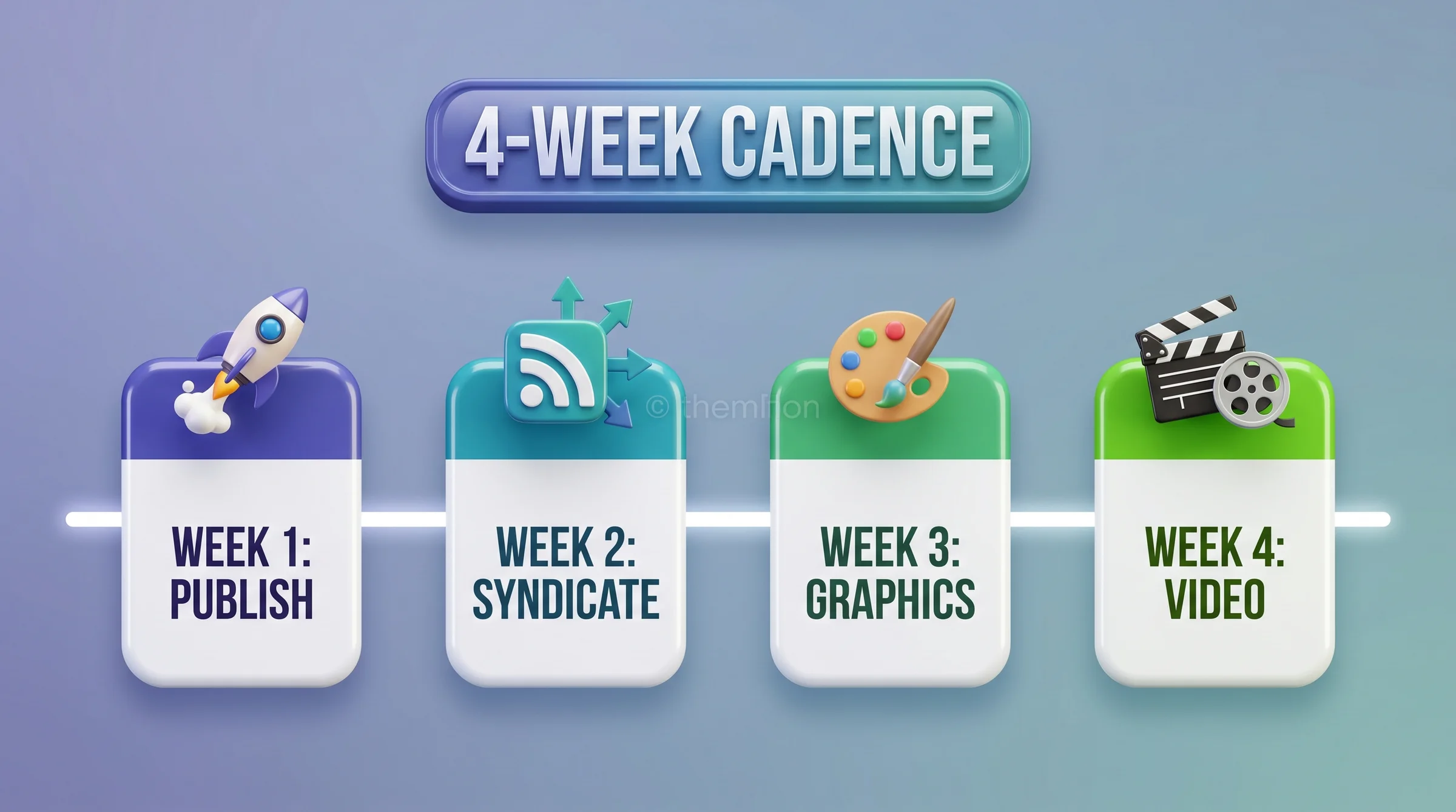
Content distribution is the part of content distribution seo that most teams skip because it feels like extra work on top of the writing. It’s not extra work. It’s the mechanism that makes the writing worth doing in year 1, before organic search has time to compound. The 7 practices in this guide operate as a system: LinkedIn catches decision-makers the same week you publish, Twitter reaches practitioners within 24 hours, email builds subscriber loyalty week over week, Reddit earns community credibility without feeling promotional, Medium and Dev.to add syndication reach without SEO risk, quote cards extend article lifespan across 2 weeks of social posts, and YouTube builds a content moat that grows with your channel authority.
Start with Practice 1 and Practice 2. They have the fastest setup time and the clearest ROI signal. Add email (Practice 3) and Reddit (Practice 4) in week 2. Queue syndication and YouTube after your first 5 articles are distributed. The goal is a repeatable system you can run in 15 minutes per article, not a heroic effort every publish day.
For the full foundation that makes distribution worth the investment, start with the SEO best practices pillar linked in the first section of this guide. It covers keyword strategy, technical SEO, and on-page optimization as the upstream quality gate before distribution begins.