AEO vs GEO vs SEO Explained: 3 Disciplines Compared
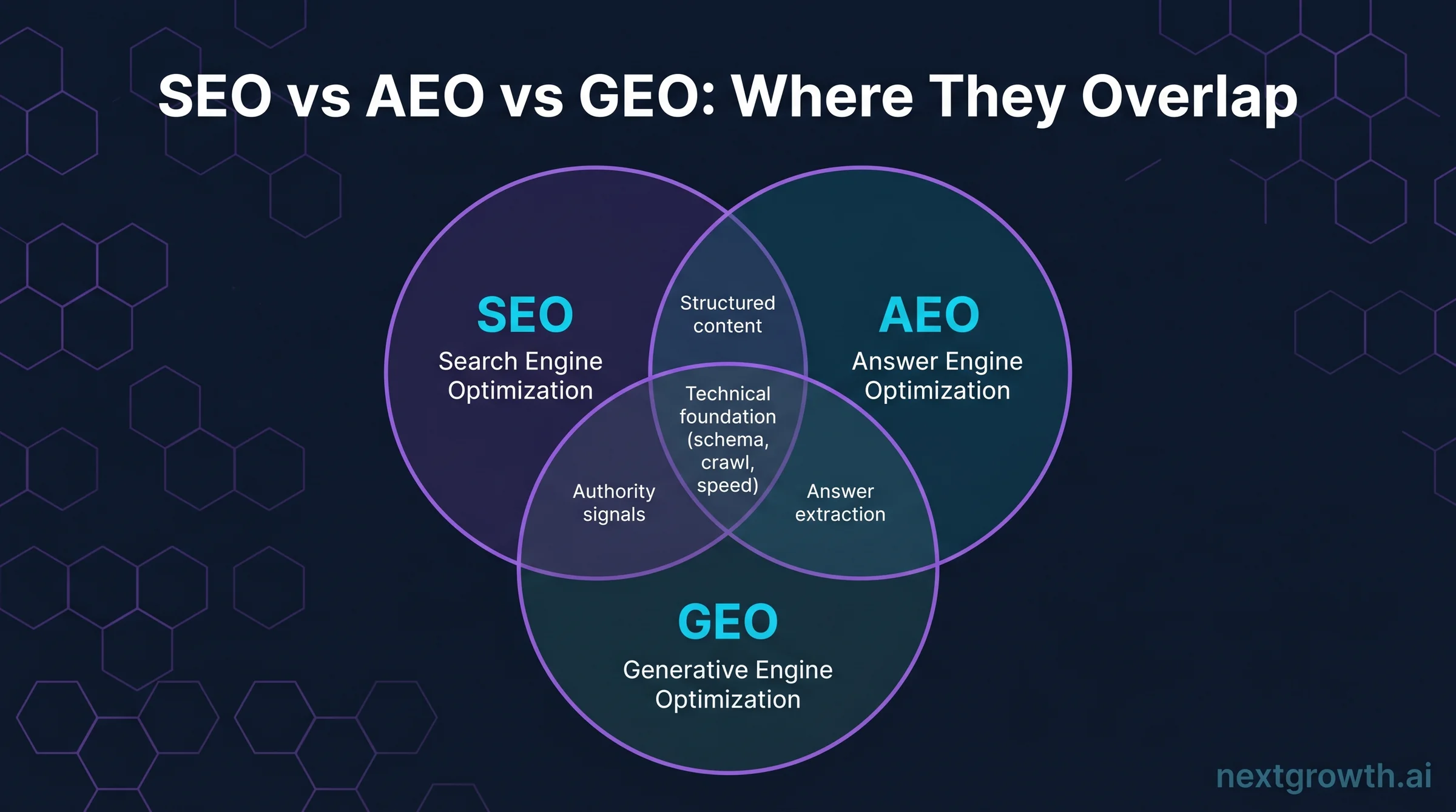
SEO, AEO, and GEO are three optimization disciplines that share technical foundations but optimize for different things. SEO (Search Engine Optimization) targets rank position on the traditional search engine results page. AEO (Answer Engine Optimization) targets inclusion in answer-engine surfaces like featured snippets, voice assistants, and AI-generated answer panels. GEO (Generative Engine Optimization) targets citations and brand mentions inside answers generated by large language models like ChatGPT, Perplexity, Gemini, and Claude.
This guide explains what each discipline is, where they overlap, where they differ, and which one to invest in first based on your current state. If you’ve heard “AEO vs GEO vs SEO” thrown around and want a clear breakdown, this is the explainer.
🟢 The 60-second summary
SEO = traditional. Optimize content to RANK on Google’s blue links. Measure: rank position.
AEO = answer engines. Optimize content to be the EXTRACTED ANSWER in featured snippets, voice assistants, AI Overview panels. Measure: extraction frequency.
GEO = generative engines. Optimize content + brand authority to be CITED INSIDE ChatGPT, Perplexity, Gemini, Claude answers. Measure: Trigger / Mention / Citation rate.
You don’t pick one. Modern strategy blends all three. The technical foundations overlap 70%+; the optimization unit differs. For the tactical Google AI Overview ranking playbook that puts these disciplines into practice, see AI Overview SEO: 7 tactics to rank in 2026.
What Is SEO (Search Engine Optimization)?
SEO is the original discipline: optimize web content to rank on traditional search engine results pages (SERPs) like Google, Bing, and DuckDuckGo. The optimization unit is the web page; the measurement is rank position (1 through 10 on page 1, lower positions thereafter); the win is a click-through to your site.
SEO has been practiced since the late 1990s and the foundational practices are well-codified: keyword research, on-page content optimization, technical site health (crawlability, mobile, speed), schema markup, internal linking, and off-site authority (backlinks, brand mentions). Modern SEO also includes E-E-A-T (Experience, Expertise, Authoritativeness, Trustworthiness) and user-experience signals like Core Web Vitals.
The thing SEO measures, rank position, remains the most common single metric in the industry. But as AI answer panels (AI Overview, ChatGPT search, Perplexity) consume increasing share of attention on the SERP, “rank position” alone no longer captures all of search visibility. That’s where AEO and GEO come in.
What Is AEO (Answer Engine Optimization)?
AEO targets surfaces that show extracted answers rather than blue-link rankings. The umbrella term covers featured snippets (Google’s position-zero passages), voice assistant answers (Alexa, Google Assistant, Siri), Google AI Overview panels, and other answer-shaped formats. The optimization unit is the extractable passage; the measurement is extraction frequency (how often is your content the surfaced answer); the win is being the cited source.
AEO emerged as a discipline around 2016-2018 when featured snippets and voice search became mainstream. It refined existing SEO patterns toward “answer-shaped content”: direct answers to specific questions, structured Q&A formatting, FAQPage schema markup, and 40-60-word answer paragraphs that voice assistants and AI extractors can read aloud or surface verbatim.
With Google AI Overview’s broad rollout in 2024-2026, AEO has become more critical than ever. AI Overview’s grounding step extracts passages from authoritative pages, and pages already optimized for AEO patterns are the ones AI Overview surfaces. AEO is, in effect, the prerequisite for ranking inside AI Overview citations.
What Is GEO (Generative Engine Optimization)?
GEO targets generative engines: large language model systems that generate answers, not just extract them. The dominant generative engines for search use are ChatGPT (web search), Perplexity, Google Gemini, Anthropic Claude, and Microsoft Copilot. GEO’s optimization unit is the brand-entity-passage triple (your brand name + your domain + extractable passage); the measurement is the three-signal framework (Trigger / Mention / Citation); the win is being mentioned by name and cited as a source inside generated answers.
The academic framing of GEO comes from the Aggarwal et al. paper “GEO: Generative Engine Optimization” (arXiv 2023, updated 2024). The discipline differs from SEO and AEO in two important ways:
- Off-site brand mention frequency matters more than in traditional SEO. LLMs surface brand names based on training-data + retrieval-source frequency. A brand mentioned 500 times across high-authority domains gets surfaced; a brand mentioned 5 times does not, no matter how well-optimized its own pages are.
- Three-signal measurement replaces single-rank measurement. Trigger (does an AI answer appear at all), Mention (is your brand named in the answer), and Citation (is your domain cited as a source) are independent signals requiring separate tracking and separate optimization. Our deeper AI search visibility metrics guide covers the three-signal framework in detail.
SEO vs AEO vs GEO: The Side-by-Side
One measurable difference worth planning around: generative engines lean noticeably
on recency. Ahrefs’ analysis of content decay found that URLs cited inside AI answers are on average
25.7% “fresher” than the organic results sitting beside them for the same query
(Ahrefs,
accessed 11 August 2026). That is a GEO-specific pressure rather than a general SEO one: a page can hold
its organic ranking for years while quietly dropping out of the citation set, because the model keeps
reaching for the more recently updated source. If you invest in GEO, budget for a refresh cadence, not
just a publishing one.
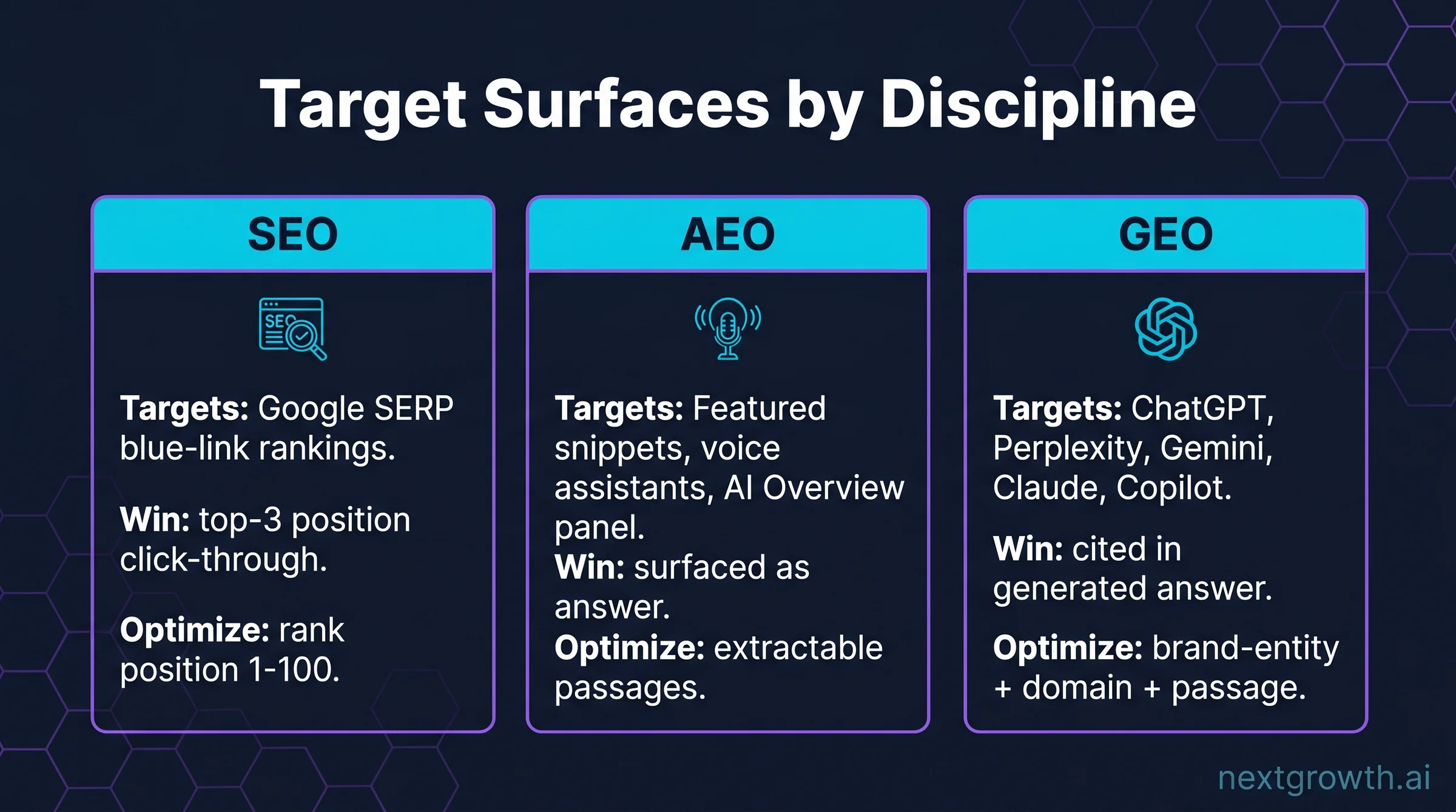
| Dimension | SEO | AEO | GEO |
|---|---|---|---|
| Target surface | SERP blue-link rankings | Featured snippets, voice, AI Overview panel | ChatGPT, Perplexity, Gemini, Claude answers |
| Optimization unit | Web page (whole-page ranking) | Extractable passage / Q&A pair | Brand entity + passage + domain citation |
| Primary metric | Rank position (1-100) | Extraction frequency | Trigger / Mention / Citation rate |
| Win condition | Position 1-3 click-through | Surfaced as answer | Cited inside generated answer + named |
| Main driver | Content relevance + authority + technical | Answer-first content + schema + existing rank | Off-site brand mention frequency + on-site structure |
| Schema importance | Moderate (helps E-E-A-T) | High (FAQPage, HowTo critical) | High (extraction-readiness) |
| Off-site brand mentions weight | Medium (link authority + brand signal) | Medium | Very high (dominates Mention rate) |
| When emerged | Late 1990s | 2016-2018 (snippets/voice) | 2023-2024 (LLM search) |
Where SEO, AEO, and GEO Overlap
The technical foundations overlap 70%+. All three disciplines benefit from:
- Crawlability and indexability: AI crawlers (GPTBot, ClaudeBot, PerplexityBot, Google-Extended) need access; traditional crawlers (Googlebot, Bingbot) need access. Both groups require open robots.txt and clean site architecture.
- Page speed and Core Web Vitals: Slow pages get sampled less by all crawlers, including AI grounding crawlers.
- Schema markup: Article, FAQPage, HowTo, Organization, and Person schema help all three disciplines: rich snippets in SEO, extraction in AEO, machine-readable citations in GEO.
- Existing Google ranking: AI Overview and most LLM grounding systems retrieve from top-10 Google results first. No Google ranking, no citation in AI Overview, no surface in Perplexity for that query.
- Content structure (answer-first, inverted pyramid): Both AEO and GEO favor pages that put the answer first; this also doesn’t hurt SEO and often helps user signals.
The overlap is so substantial that “modern SEO” practiced by the better agencies already includes AEO and GEO patterns implicitly. The label distinction matters more for measurement and reporting than for content production: the same writing patterns serve all three disciplines simultaneously.
Where They Differ
The differences become important in three places:
1. The optimization unit differs
SEO optimizes whole pages for ranking. AEO optimizes specific passages for extraction. GEO optimizes the brand-entity-passage relationship for citation + mention. A page can rank well (SEO win) without being extracted (AEO loss) without being cited (GEO loss). The differences in unit drive differences in writing patterns: AEO + GEO emphasize answer-first paragraph structure inside each section more strictly than traditional SEO does.
2. Off-site brand mentions weight differently
In SEO, brand mentions matter but link authority dominates. In GEO, brand mentions dominate and link authority is secondary. This is the single largest practical difference: GEO requires investment in PR, directory listings, podcast appearances, and Wikipedia presence that traditional SEO de-prioritizes. A brand that wins SEO purely through technical excellence + on-site content can fail at GEO if it doesn’t accumulate off-site mentions across authority domains.
3. Measurement is structurally different
SEO measures one variable (rank). AEO measures extraction frequency (binary per query). GEO measures three variables (Trigger / Mention / Citation), each independent, each requiring separate optimization. The measurement complexity is what makes GEO feel like a new discipline even though the underlying writing patterns overlap with AEO.
Which Discipline Should You Invest in First?
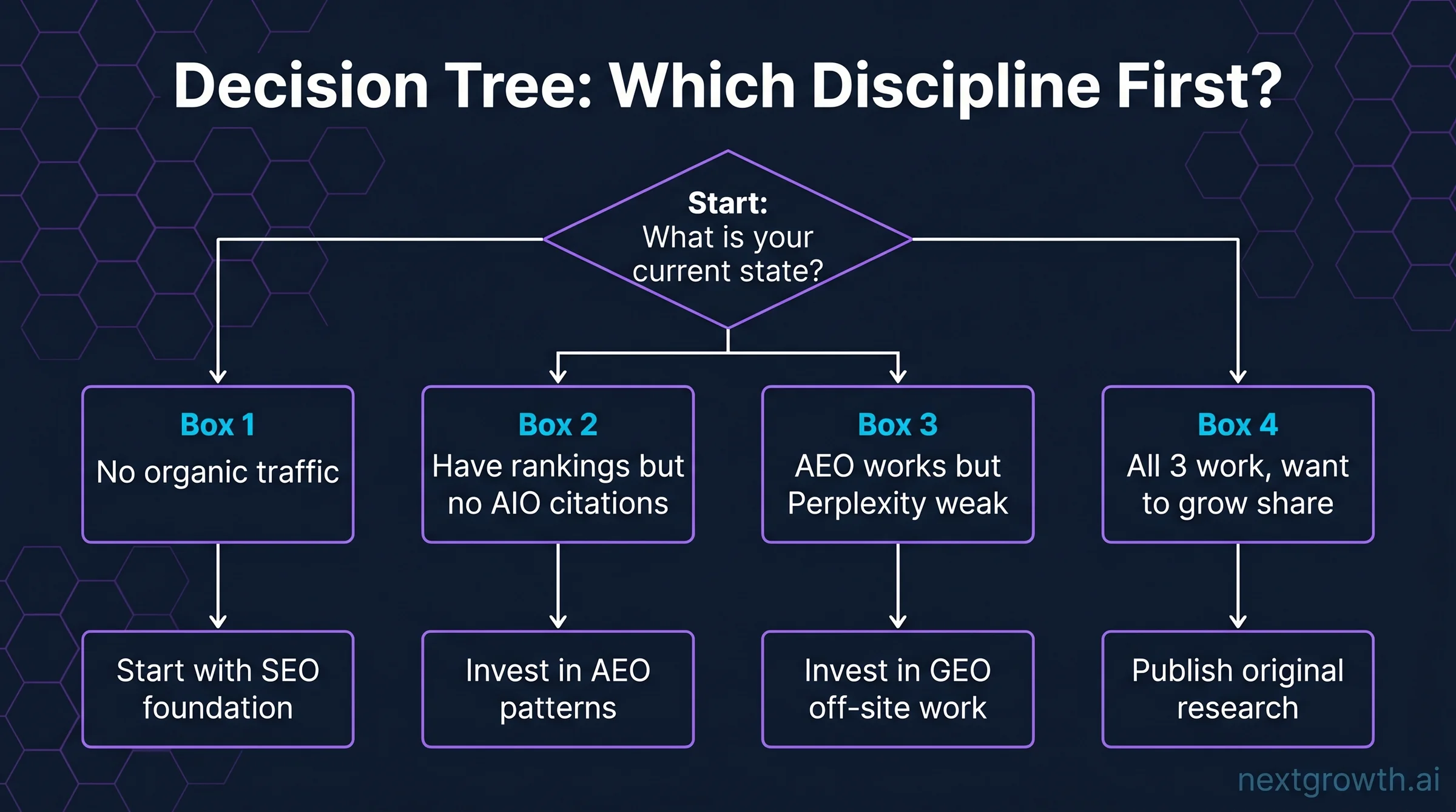
The right priority depends on your current state. Decision rules:
- If you have no organic traffic at all: Start with SEO. Foundational. Without page-1 Google ranking, AEO and GEO are largely unreachable. The minimum 6-12 months of foundation-building applies before AEO/GEO investment pays off.
- If you have Google rankings but rarely get featured snippets / AI Overview citations: Invest in AEO patterns next. Answer-first structure, FAQPage schema, definition + example + stat density per section. Quick wins, 30-60 days to lift extraction rate.
- If you have AEO wins (featured snippets, AIO citations) but low Perplexity / ChatGPT brand visibility: Invest in GEO. The bottleneck is off-site brand mention frequency, not on-site optimization. Focus on PR, directories, podcasts and Wikipedia, the off-site authority work that compounds over 90-180 days.
- If you have all three but want to grow share: Invest in original research, original data, and category-leading content that becomes the source of citations. The most-cited pages in any category are the ones that publish original findings, not the ones that synthesize competitor content.
In practice, most teams blend all three. Modern content production patterns serve SEO + AEO + GEO simultaneously: well-structured pages with answer-first H2 openings + FAQPage schema + entity-rich content + authoritative tone all benefit each discipline. The strategic question is where to allocate the marginal effort (more PR vs. more content vs. more technical optimization), and that depends on where your current weakest signal is.
What This Means in Practice
For a content team or in-house SEO function, the practical implications of the three-discipline framework:
- Content production: Use patterns that serve all three. Answer-first paragraphs, definition + example + stat density, FAQPage schema on Q&A sections, entity hub linking. You don’t need different content for SEO vs AEO vs GEO. You need content that satisfies all three patterns.
- Off-site investment: Treat PR + directories + podcasts as a GEO line item, not a “nice to have.” For brands prioritizing AI search visibility, off-site brand mention frequency is the single largest predictor of Mention rate.
- Measurement: Track rank (SEO), extraction frequency (AEO), and Trigger / Mention / Citation (GEO) as separate metrics. They move independently. A weekly or monthly rank report is incomplete in 2026; add an AI search visibility tracker (see our AI search monitoring tools comparison).
- Reporting cadence: Monthly for SEO + AEO (rank and extraction are stable enough that monthly captures meaningful trends). Quarterly minimum for GEO (Trigger / Mention / Citation move slower, especially Mention which compounds over 90-180 days).
- Team skills: The skill overlap is substantial. SEO practitioners can extend into AEO with content-structure training. AEO practitioners extend into GEO with off-site brand-building strategy. No separate “GEO specialist” hire is usually required, because it’s a discipline extension, not a different job.
AEO vs GEO vs SEO FAQ
Are SEO, AEO, and GEO competing disciplines or complementary?
Complementary. They share 70%+ of technical foundations and overlap heavily in content production patterns. The differences are in optimization unit (page vs passage vs brand-entity), primary metric (rank vs extraction vs three-signal), and the weight of off-site brand mentions (lower in SEO, higher in GEO). Modern strategy blends all three rather than picking one.
Is GEO the new SEO?
No, but it’s an essential extension. SEO continues to matter because page-1 Google ranking is the prerequisite for AI Overview citation and for most LLM grounding retrieval. GEO adds new measurements and new optimization patterns on top of SEO; it doesn’t replace SEO.
What’s the difference between AEO and GEO if both target AI answers?
AEO is the broader category covering all answer-engine surfaces (featured snippets, voice assistants, AI Overview, plus other answer formats). GEO specifically targets generative engines that produce LLM-written answers (ChatGPT, Perplexity, Gemini, Claude, Copilot). All GEO surfaces fall under AEO; not all AEO surfaces are generative (featured snippets are extractive, not generative).
Do I need a separate GEO strategy if I already do SEO?
You need separate measurement (Trigger / Mention / Citation tracking) but not necessarily separate content production. The content patterns that win at SEO also help at GEO; the difference is in the off-site work (PR, directories, podcasts) that drives Mention rate. If your current SEO strategy already invests in off-site brand building, you’re 70% of the way to GEO. If it focuses purely on on-site optimization + link building, GEO needs explicit off-site brand-mention investment added.
Which AI engines does GEO cover?
GEO covers the generative engines that produce LLM-based answers: ChatGPT (web search), Perplexity, Google Gemini, Anthropic Claude, Microsoft Copilot, and emerging engines (DeepSeek, You.com, Brave Leo). Google AI Overview is a hybrid, a generative system that lives inside Google search results, so it’s covered by both AEO and GEO depending on framing.
What’s the difference between “AI Overviews” and AI search engines like ChatGPT?
AI Overview is a feature inside Google search results (an AI-generated panel above blue links). ChatGPT, Perplexity, Gemini, and Claude are separate search products. They use similar underlying technology (LLMs + grounded retrieval) but are different surfaces. See our companion What is Google AI Overview guide for the full breakdown.
For deeper reading: AI search visibility playbook (5-step framework for GEO) | AI search visibility metrics: Trigger, Mention, Citation (the three-signal measurement framework) | 10 best AI search monitoring tools compared (tools to track all three signals).
This article is part of our broader pillar guide. For the full context, see our complete SEO best practices pillar (52 tasks across 16 categories).