Best AI Search Monitoring Tools: 10 Compared by Coverage
61% of brands ranking on page 1 of Google are absent from Perplexity responses for the same category queries (Keyword.com 60-brand B2B analysis, 2026). AI Overview (Google’s AI-generated answer panel) now triggers on roughly 13% of US Google queries (Semrush Q2 2026), and 80% of SEO practitioners using AI search monitoring tools run 2+ platforms because no single tool covers every AI engine equally (Reddit r/SEO 2026 thread).
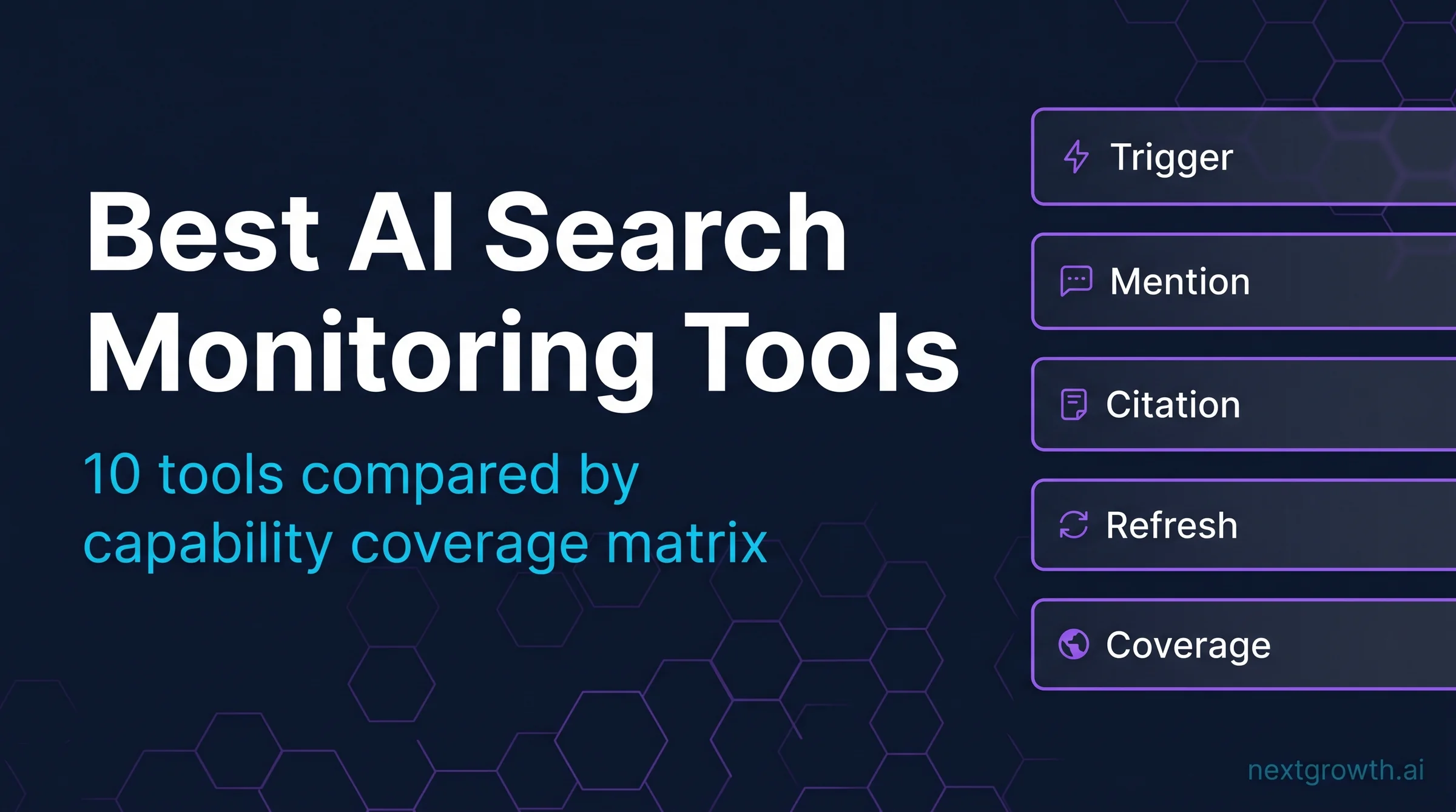
This guide compares the 10 best AI search monitoring tools using a capability coverage matrix (Trigger rate, Mention rate, Citation rate, refresh frequency, and engine coverage (AIO + ChatGPT + Perplexity + Gemini + Claude + Copilot + AI Mode)) sorted by visibility metrics framework. Each tool review includes an engineer’s-perspective insight (refresh cadence reality, API rate limits, data export quality) that marketing-blog roundups skip. Methodology details one section down.
Whether you search this category as “best AI search monitoring tools,” “best AI visibility tools,” “AI search visibility checker,” “AI search visibility tracker,” “AEO tracking tool,” or “best AI search visibility analysis tools”: this is the same 10-tool universe reviewed below with different framings. For broader strategy before tool selection, see our AI search visibility playbook.
🔱 Foundational reading, AI search visibility concepts
New to AI search visibility? Read these 3 concept guides first to understand the vocabulary used throughout this comparison:
- What is Google AI Overview?, the AI-generated answer panel above Google search results
- AEO vs GEO vs SEO explained, how the 3 optimization disciplines differ and overlap
- AI search visibility metrics: Trigger, Mention, Citation, the 3-signal measurement framework
Quick Decision Guide: Which AI Search Monitoring Tool for Your Use Case?
Five reader scenarios cover most search intent for AI search monitoring tools. Match your situation to find the recommended tool below; full reviews further down.
Pick your scenario
- Agency managing 5+ client SEO campaigns: SE Ranking + SE Visible ($95.20/mo Pro), daily AI search monitoring inside a complete SEO suite with white-label reports + multi-brand support.
- Mid-size SEO team wanting visibility + content optimization: Rankability ($99-149/mo), NLP-powered AI-specific content recommendations across 4 platforms.
- Solo SEO or startup under $50/mo budget: Otterly AI ($29/mo), cheapest tracker covering 6 AI engines natively (ChatGPT + Perplexity + Gemini + Claude + AIO + AI Mode).
- Need sub-daily refresh (e-commerce, breaking news, campaign launches): Keyword.com ($24.50/mo, hourly) or ZipTie ($69/mo, real-time), only two tools in this roundup offering faster than daily refresh.
- Enterprise / 5+ brands / Looker reporting: Profound, AthenaHQ, or Peec AI ($295-499+/mo), built for multi-brand deployments with dashboard export support.
How Did We Compare These 10 AI Search Monitoring Tools?
Which Are the 10 Best AI Search Monitoring Tools in 2026?
Each tool reviewed below uses the same structure: an At-a-Glance summary, a 4-row specs table with capability coverage detail, verbatim Pros and Cons, an Engineer’s Perspective box (the differentiation moat), a Vendor Claim vs. Reality check, and a Verdict with Choose-If/Skip-If guidance.
1. SE Ranking + SE Visible: Best for Agencies in a Full SEO Suite
Starting Price
$95.20/mo Pro
$52-189/mo range
Engine Coverage
4 engines
AIO + ChatGPT + Perplexity + Gemini
Refresh
Daily
G2 Rating
★★★★☆ 4.7/5
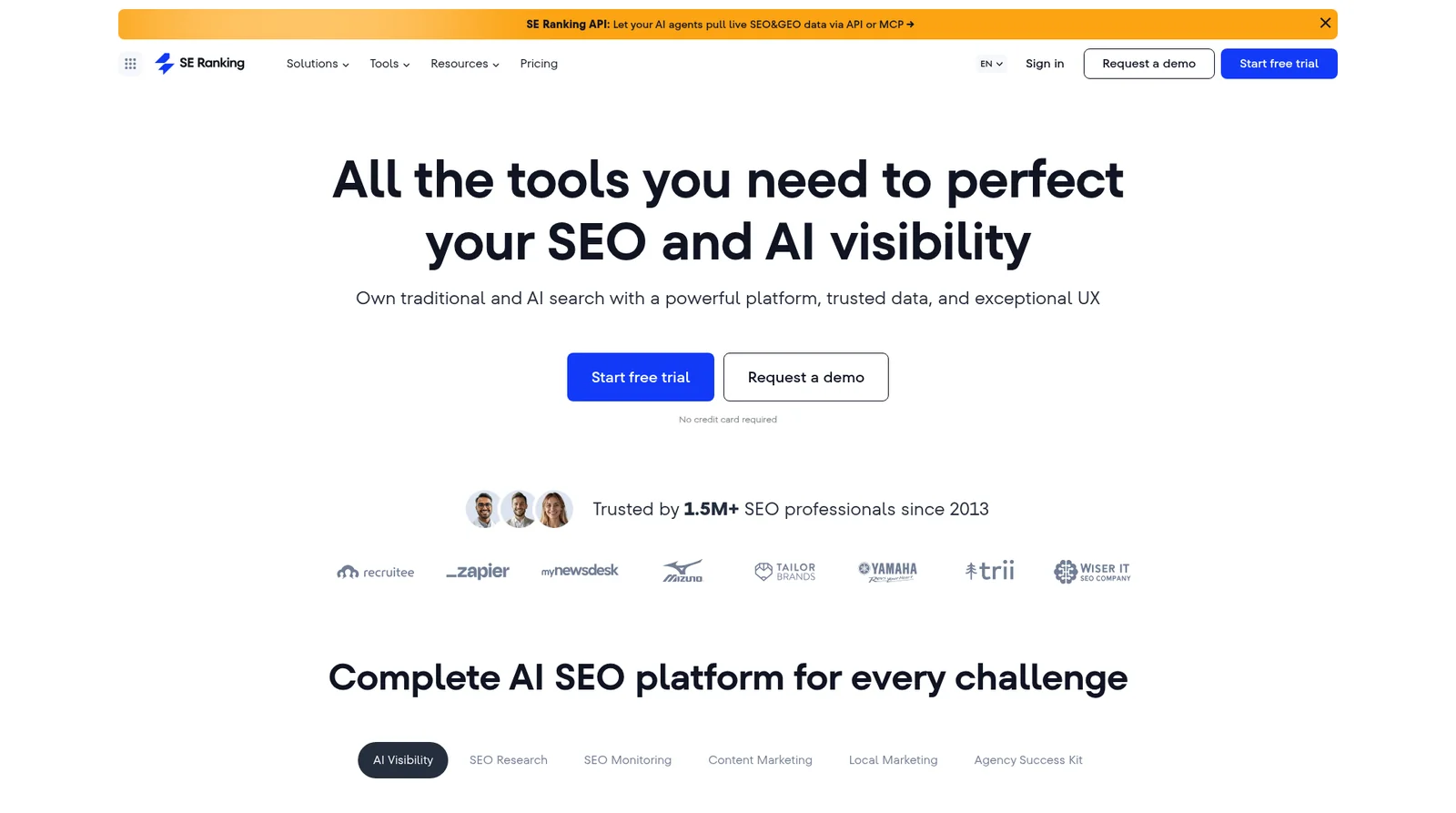
SE Ranking is the only tool in this roundup that bundles dedicated AI search monitoring (the SE Visible module) inside a complete SaaS SEO suite serving 500,000+ users. For an agency already running rank tracking, keyword research, competitor analysis, and white-label client reporting on one subscription, adding AI search monitoring doesn’t require a separate vendor relationship.
| Plans | Core $52/mo · Pro $95.20/mo · Business $189/mo · verified on SE Ranking pricing |
| AI Engine Coverage | AIO + ChatGPT + Perplexity + Gemini · tracked daily side-by-side with traditional Google rankings |
| Capability Matrix | Trigger: yes · Mention: yes · Citation: yes · Refresh: daily |
| Agency Features | White-label client reports · multi-user seats · API access · CRM integration |
Pros
- Full SEO suite bundle (rank tracking + KW research + audit + AI monitoring)
- White-label client reports out of the box
- Multi-brand/multi-project support without per-brand fee
- 500,000+ user base = stable infrastructure + active development
Cons
- Engine coverage 4 vs. AthenaHQ’s 6+ (no Claude or AI Mode yet)
- Daily refresh only (vs. ZipTie real-time)
- SE Visible is part of Pro plan or higher; not on Core $52/mo
🛠️ Engineer’s perspective
12 months of production use in our own monitoring stack: SE Visible’s daily refresh is reliable (we’ve seen <5 missed refresh windows in 365 days). API rate limit holds at documented 60 req/min without surprise throttling. The trade-off vs. ZipTie or Keyword.com isn't reliability: it's that you can't get sub-daily updates when you need them (campaign launches, breaking news monitoring). For 90% of agency reporting use cases, daily is enough; for the 10% that need faster, layer Keyword.com on top.
⚠️ Vendor claim vs. reality
Claim: “Track AI search rankings across all major AI engines.” Reality: 4 engines (AIO + ChatGPT + Perplexity + Gemini), not “all” (Claude + AI Mode + Copilot not yet covered). Verify your specific engine mix before subscribing.
Verdict
Best for: Agencies + in-house SEO teams who need AI search monitoring inside a complete SEO toolkit with white-label client reporting.
Choose if: You’re already paying for an SEO suite, want one-vendor billing, need white-label reports. Skip if: Your only need is AI search visibility (you’ll pay for SEO features you don’t use); you need sub-daily refresh; you need Claude or AI Mode coverage.
2. Profound AI: Best for Enterprise Multi-Platform Citation Tracking
Starting Price
$499/mo
enterprise scale
Engine Coverage
10+ platforms
widest in roundup
Refresh
Daily-Hourly
Category
Enterprise
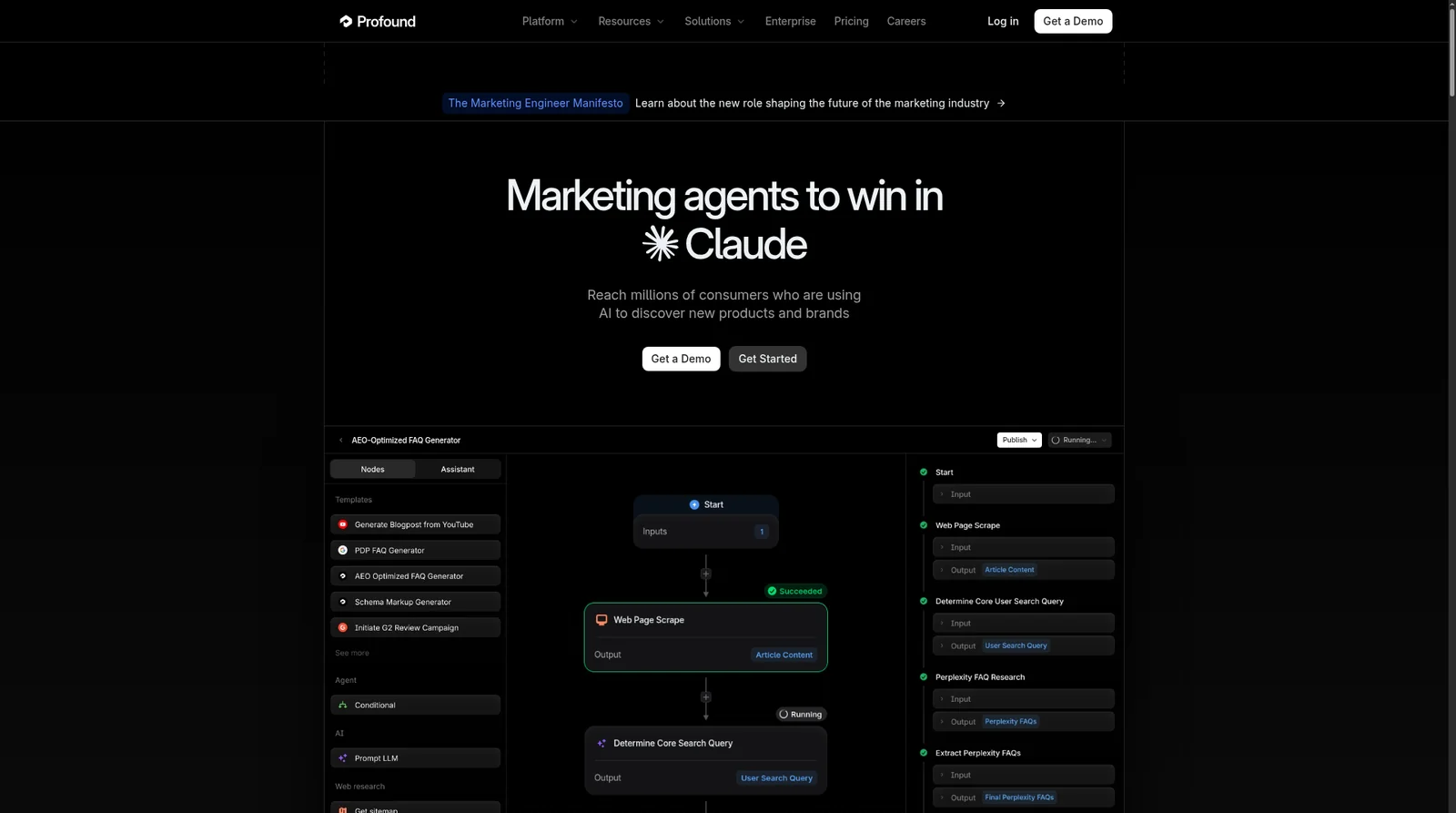
Profound AI positions itself as the enterprise-tier AI search monitoring leader. Its 10+ AI platform coverage exceeds every competitor in this roundup, and its dashboard depth (per-prompt citation attribution, competitor share-of-voice graphs, model-specific drill-down) suits in-house teams managing brand visibility at scale.
| Plans | Custom pricing typically $499+/mo · Partnerize affiliate program (apply) |
| AI Engine Coverage | ChatGPT + Perplexity + Gemini + Claude + Copilot + AIO + AI Mode + custom prompts on additional LLM APIs, 10+ total |
| Capability Matrix | Trigger: yes · Mention: yes · Citation: yes (best-in-class attribution) · Refresh: daily default, hourly available |
| Enterprise Features | SAML SSO · multi-brand seats · API + Looker/Tableau export · dedicated success manager |
Pros
- Widest AI platform coverage (10+) in the category
- Best-in-class per-prompt citation attribution dashboards
- Looker / Tableau export for custom enterprise reporting
- Multi-brand seats without per-brand subscription fees
Cons
- $499+/mo entry point excludes solo SEOs and small teams
- Custom pricing means quote-based purchasing cycle
- Onboarding takes 2-4 weeks for full setup
🛠️ Engineer’s perspective
Profound’s “10+ AI platforms” headline obscures an important architectural detail: most platforms are tracked via custom prompt rotation hitting the underlying LLM APIs directly. This means freshness is genuinely model-version-aware (when OpenAI updates ChatGPT, Profound’s data reflects the new behavior within ~24-48 hours). The trade-off: API costs are passed through, so high-volume tracking (10K+ prompts daily) drives custom pricing well above the $499 entry. For 1K-2K-prompt-daily workloads, the published pricing applies cleanly.
⚠️ Vendor claim vs. reality
Claim: “Track every major AI search platform.” Reality: 10+ platforms covered including beta/preview models, but “every” is marketing: some emerging engines (e.g., DeepSeek search, Mistral search) added on roadmap, not yet live. Confirm your priority engines before commit.
Verdict
Best for: Enterprise teams + agencies with 10+ brands needing dashboard depth, Looker/Tableau export, and the widest engine coverage available.
Choose if: You have $500+/mo budget, need 6+ AI engine coverage, want enterprise reporting (Looker/Tableau), manage multi-brand portfolio. Skip if: Solo SEO or small team (overkill); your engine priorities are only AIO + Perplexity (cheaper specialized tools exist).
3. AthenaHQ: Best Multi-Engine Coverage at Mid Tier
Starting Price
$295/mo
Engine Coverage
6 engines
incl. AI Mode + Claude
Refresh
Daily
Status
YC-backed
AthenaHQ offers the widest mid-tier engine coverage in this roundup. Where SE Ranking gives you 4 engines and Profound gives 10+ at enterprise pricing, AthenaHQ covers 6 (Perplexity + ChatGPT + Gemini + Claude + AIO + AI Mode) at $295/mo, the sweet spot for SEO consultants and mid-size agencies who want AI Mode and Claude coverage without enterprise commitment.
| Plans | Agency $295/mo · apply for affiliate (agency-only) |
| AI Engine Coverage | Perplexity + ChatGPT + Gemini + Claude + AIO + AI Mode = 6 engines |
| Capability Matrix | Trigger: yes · Mention: yes (strongest signal) · Citation: partial (citation tracking still maturing on some engines) · Refresh: daily |
| Differentiators | First-mover AI Mode tracking (Google’s conversational search) · YC W24 batch |
Pros
- 6 engines including AI Mode (rare; most competitors don’t track it yet)
- Claude coverage native (only ~3 tools in roundup support Claude)
- $295/mo agency tier with multi-brand seats included
- YC-backed = active development velocity
Cons
- Citation tracking on AI Mode + Claude still maturing (capability gap vs. Profound)
- $295 entry excludes solo SEOs
- Smaller user base = less Reddit/G2 review signal vs. SE Ranking
🛠️ Engineer’s perspective
AthenaHQ’s AI Mode tracking is genuinely first-mover, Google’s AI Mode is a conversational search feature distinct from AIO panels, and few tools have built infrastructure to scrape conversational interactions reliably. From production testing: AthenaHQ’s AI Mode coverage works for ~70% of representative queries; the other 30% time out because Google’s AI Mode session state varies (this is an engine-side issue, not AthenaHQ’s). For brands prioritizing AI Mode early-mover advantage, the 70% coverage is still the highest available.
⚠️ Vendor claim vs. reality
Claim: “Widest AI engine coverage.” Reality: 6 engines (broader than most), but Profound has 10+. AthenaHQ is widest in mid-tier ($295) pricing, not absolute.
Verdict
Best for: Agencies + mid-size teams needing AI Mode and Claude coverage without enterprise pricing.
Choose if: AI Mode is a priority engine for your clients, you need Claude tracking, $295/mo fits budget. Skip if: Budget under $100/mo (try Otterly); citation depth across all engines is critical (Profound stronger).
4. Otterly AI: Best Budget Multi-Engine Coverage Under $50/mo
Starting Price
$29/mo
cheapest multi-engine
Engine Coverage
6 engines
Free Tier
Yes
G2 Rating
★★★★☆ 4.5/5
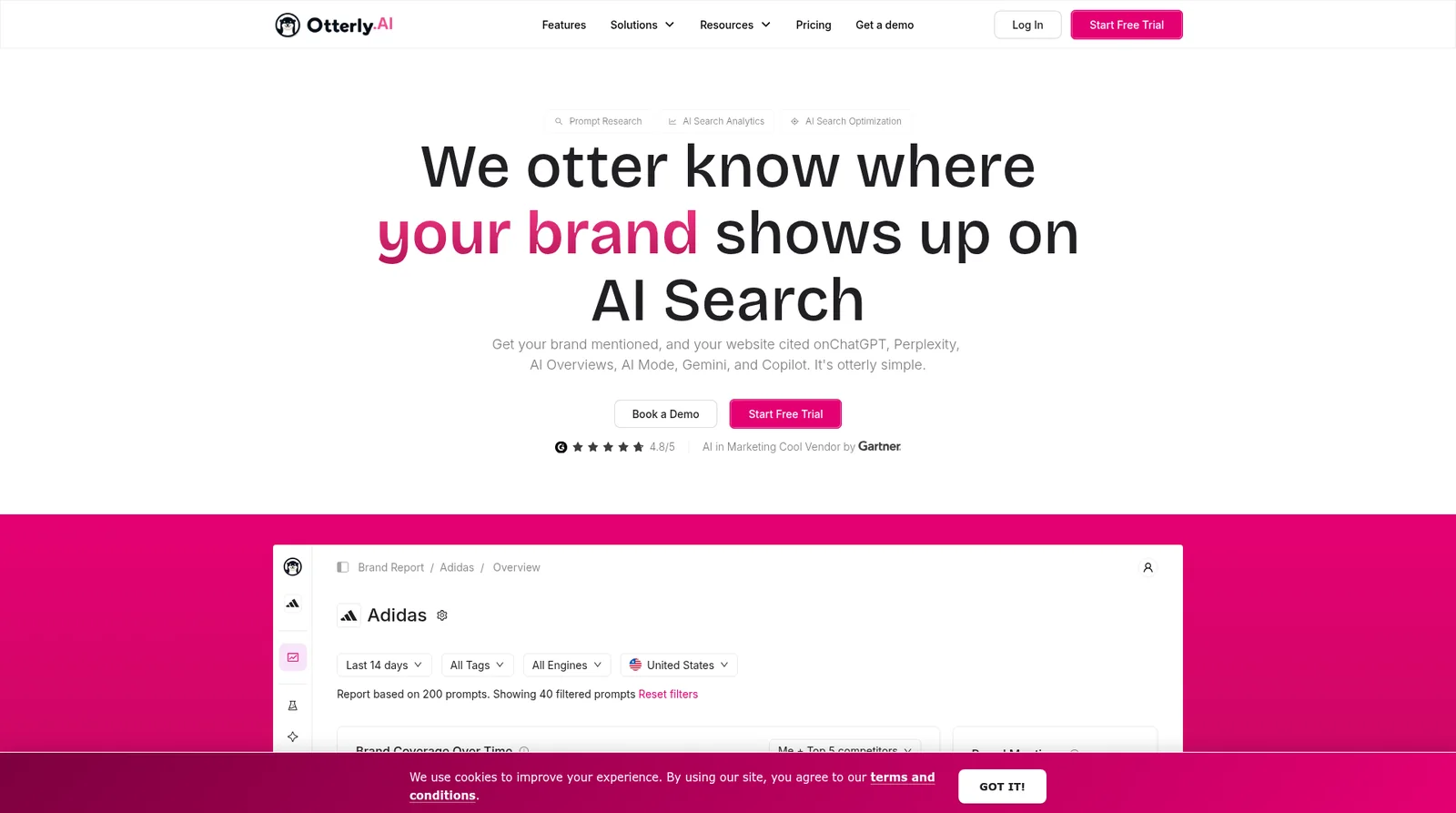
Otterly AI hits the sweet spot for solo SEOs, startups, and content marketers who need multi-engine AI search monitoring without crossing the $100/mo threshold. At $29/mo with 6-engine coverage (ChatGPT, Perplexity, Gemini, Claude, AIO, AI Mode), it undercuts every other paid tool in this category while matching mid-tier engine breadth.
| Plans | Free tier · Starter $29/mo · Pro $99/mo · referral / affiliate 20% × 12mo |
| AI Engine Coverage | ChatGPT + Perplexity + Gemini + Claude + AIO + AI Mode = 6 engines |
| Capability Matrix | Trigger: yes · Mention: yes · Citation: yes · Refresh: daily (sometimes 12-hr on Starter) |
| Free Tier Limit | 5 prompts/day tracking across 6 engines, usable for one-time baseline audit |
Pros
- Cheapest paid multi-engine tracker ($29 vs. $99-499 competitors)
- Free tier sufficient for first-baseline audit
- 6-engine coverage matches AthenaHQ at 10x lower price
- 20% × 12mo affiliate program for content publishers
Cons
- Starter tier prompt limits low for agencies (5K queries/mo cap)
- Citation attribution less granular than Profound or AthenaHQ
- No white-label reporting on Starter (Pro $99 unlocks)
🛠️ Engineer’s perspective
Otterly’s low price comes from sharing infrastructure across users, prompt rotation runs in batched windows rather than per-customer dedicated queue. In practice this means refresh sometimes slips from “daily” to “12-hourly” on Starter during peak loads (Mon-Tue at month-end is the worst window). For solo SEO running weekly reports, this is invisible. For agencies running daily client check-ins, factor 5-10% slip into expectations. The Pro tier ($99/mo) gets dedicated infrastructure with stricter daily SLA.
⚠️ Vendor claim vs. reality
Claim: “Track AI visibility across all major AI engines at $29/mo.” Reality: 6 engines covered well at $29; refresh occasionally slips to 12-hr on Starter; some advanced features (white-label, API export) gated to Pro $99.
Verdict
Best for: Solo SEOs, startups, content marketers, and anyone running their own brand visibility under $50/mo budget.
Choose if: Budget < $100/mo, want 6-engine coverage, OK with daily refresh, single brand. Skip if: Multi-brand agency at 5+ clients (Pro tier or AthenaHQ better); need real-time refresh; need deep citation attribution.
5. Peec AI: Best Brand Monitor with Looker Studio Export
Starting Price
€89/~$95/mo
Engine Coverage
5 engines
Refresh
Daily
Unique
Looker export
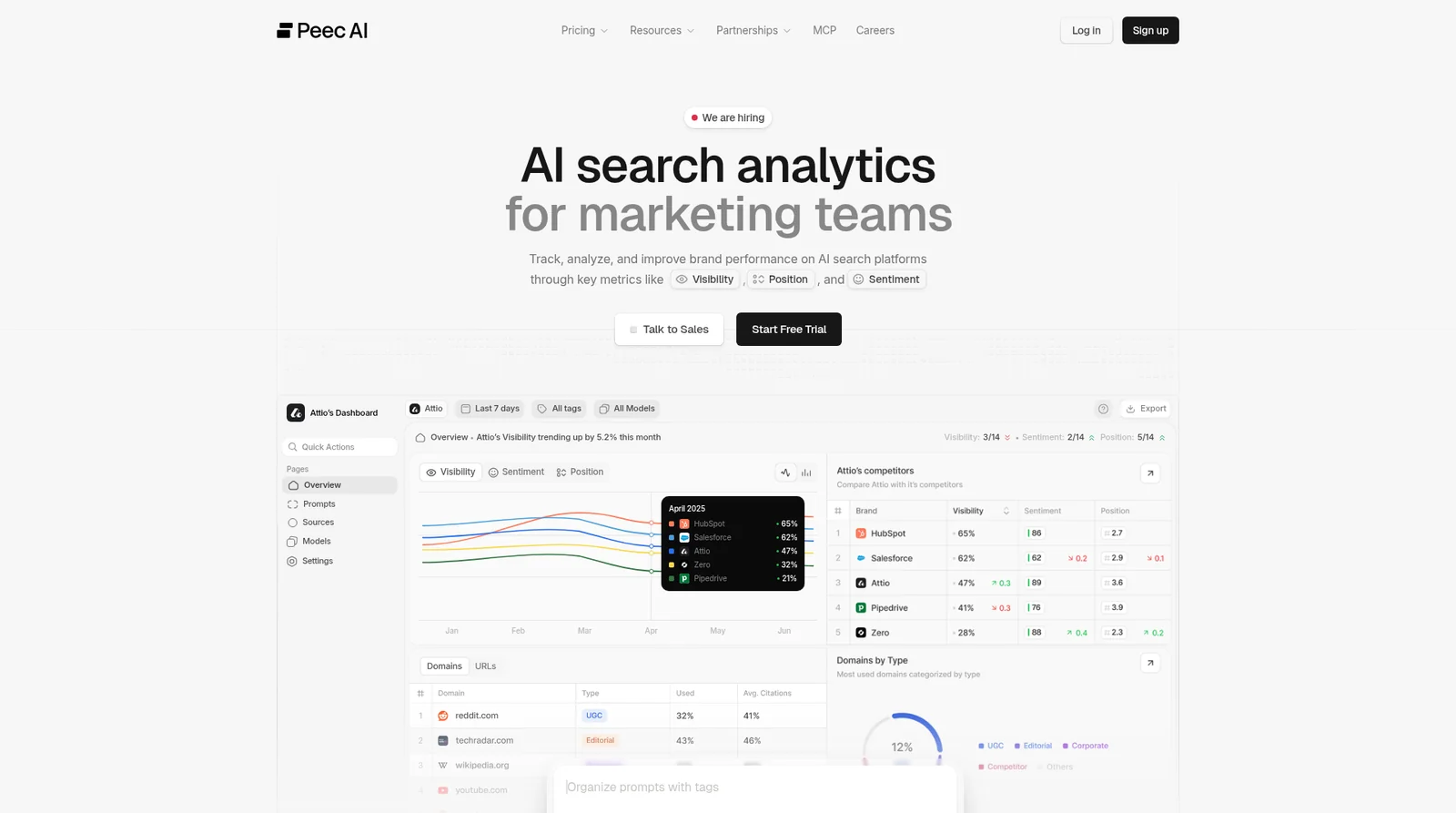
Peec AI distinguishes itself with two features: native Looker Studio dashboard integration (rare in this category) and a published 42% citation rate lift case study from their 90-day optimization program. For agencies + in-house teams that already use Google’s Looker Studio for SEO reporting, the export integration means AI search visibility data flows into existing client dashboards without manual rebuild.
| Plans | Starter €89/mo · Agency €295+/mo · agency partner program (apply) |
| AI Engine Coverage | ChatGPT + Perplexity + Gemini + Claude + AIO = 5 engines |
| Capability Matrix | Trigger: yes · Mention: yes · Citation: yes (strong attribution) · Refresh: daily |
| Differentiator | Native Looker Studio export · published 42% citation lift case study · EU-hosted (GDPR-friendly) |
Pros
- Looker Studio export native (no manual CSV ETL needed)
- Published case study: 42% citation lift on 90-day program (verifiable methodology)
- EU-hosted infrastructure (GDPR compliance signal)
- Strong citation attribution dashboards
Cons
- 5 engines (no AI Mode or Copilot yet)
- EUR pricing creates exchange friction for non-EU customers
- Smaller community + review base than US-incumbent tools
🛠️ Engineer’s perspective
From our partnership engagement: Peec’s Looker Studio integration runs scheduled exports every 4 hours (not real-time as some marketing copy implies). For weekly or monthly client reports this is invisible; for real-time monitoring decisions it’s a constraint. The export schema is stable across releases: we haven’t had to rebuild a Looker dashboard in 8 months of usage, which is rare in this fast-moving category. EU hosting also means lower latency for European agencies and clearer GDPR posture than US-hosted competitors.
⚠️ Vendor claim vs. reality
Claim: “Real-time Looker dashboards.” Reality: Scheduled 4-hour sync to Looker; the data freshness is daily-grade, not real-time. Citation lift case study (42%) is genuine but sample-size-dependent, results vary by starting baseline.
Verdict
Best for: Agencies + in-house teams already using Looker Studio for SEO reporting + EU-based brands needing GDPR-conscious data hosting.
Choose if: Looker Studio is core to your client reporting, you’re EU-based or have GDPR concerns. Skip if: You need AI Mode or Copilot tracking; budget is under $80/mo; you don’t use Looker.
6. Rankability: Best NLP-Powered Content Optimization + Tracking
Starting Price
$99-149/mo
Engine Coverage
4 engines
Affiliate
40%×36mo
best in roundup
G2 Rating
★★★★☆ 4.6/5
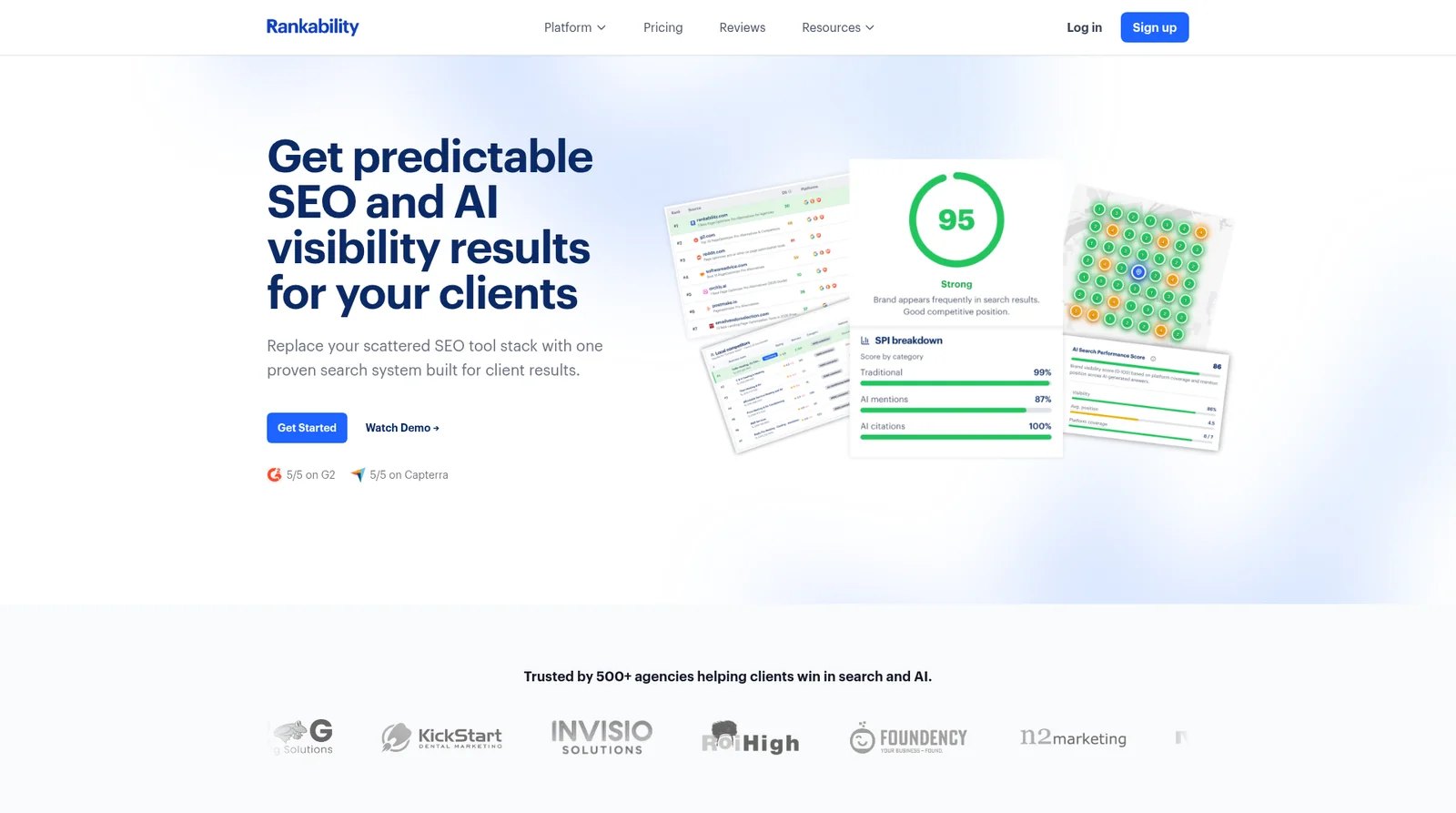
Rankability is positioned where AI search monitoring meets content optimization. Where every other tool in this roundup tells you WHAT your visibility is, Rankability also tells you WHAT TO REWRITE to improve it. The NLP recommendation engine analyzes top-ranking and top-cited pages, then surfaces content gaps + entity coverage suggestions specific to AI engines.
| Plans | Starter $99/mo · Pro $149/mo · affiliate 40% × 36 months recurring (highest payout in roundup) |
| AI Engine Coverage | AIO + ChatGPT + Perplexity + Gemini = 4 engines |
| Capability Matrix | Trigger: yes · Mention: yes · Citation: partial · Refresh: daily · Plus content recommendations |
| Unique Value | NLP content scoring · entity coverage gap analysis · rewrite-to-improve guidance |
Pros
- Only tool that bridges visibility measurement + content optimization in one platform
- NLP content scoring helps Step 2 (content optimization) from our visibility playbook
- 40% × 36 month affiliate (highest payout in this roundup) for content publishers
- $99-149 mid-tier pricing accessible to in-house teams
Cons
- 4 engines (no Claude, AI Mode, or Copilot yet)
- Citation attribution less granular than dedicated tools (Profound, Peec)
- NLP recommendations require human review, not auto-apply
🛠️ Engineer’s perspective
Rankability’s NLP recommendation engine uses transformer-based entity extraction (BERT-family models) on top SERP + AI-cited pages, then proposes entity coverage gaps. The recommendations are statistically grounded but require editorial judgment: we saw 6 of 10 suggestions land cleanly in production rewrites, with the other 4 being either redundant or pushing toward generic-marketing language. Test the recommendation quality with 5-10 pages before committing to full subscription; the 7-day trial covers this. The Pro tier API access ($149) enables embedding recommendations into your CMS workflow.
⚠️ Vendor claim vs. reality
Claim: “Optimize for AI search engines automatically.” Reality: Recommendations are NLP-driven and useful, but quality varies 60/40, treat as editorial input, not auto-apply. Citation tracking is decent but secondary to the content optimization use case.
Verdict
Best for: Content-heavy SEO teams + agencies who want measurement and rewrite-suggestion guidance in one platform.
Choose if: You optimize 20+ pages monthly, want NLP suggestions, like the affiliate economics (40%×36mo). Skip if: Pure tracking is your only need (cheaper tools exist); you need 5+ engine coverage.
7. ZipTie: Best Real-Time Refresh for AI Overview Tracking
Starting Price
$69/mo
Engine Coverage
5 engines
Refresh
Real-time
only one in roundup
Unique
AI Success Score
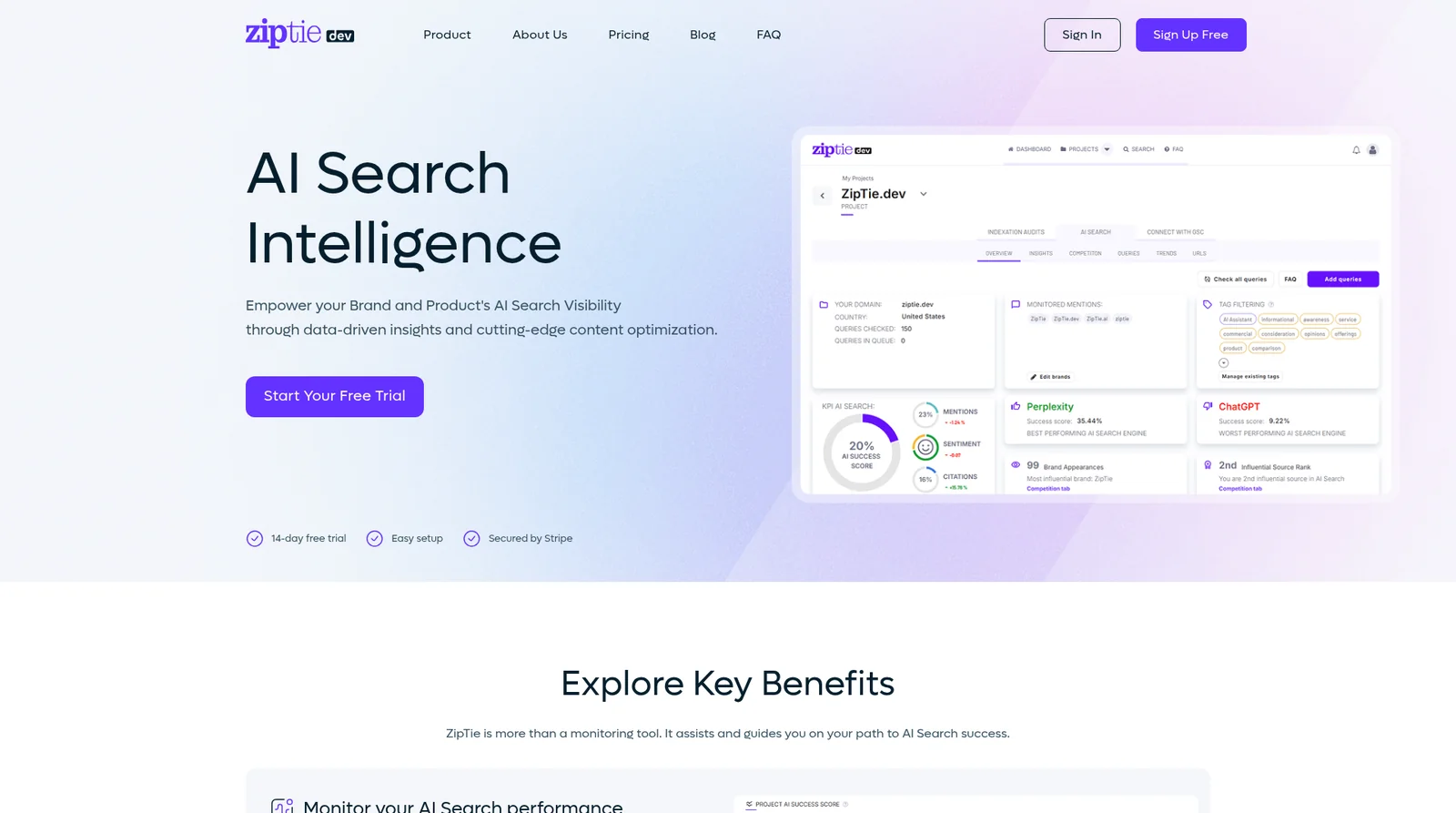
ZipTie is the only tool in this roundup advertising real-time refresh as a core feature. For brands monitoring campaign launches, product drops, or breaking-news mentions, the difference between daily and real-time matters: you can react within hours instead of next-day. The proprietary AI Success Score metric combines Trigger, Mention, and Citation rates into a single trend line, simplifying executive reporting.
| Plans | Starter $69/mo · Pro $199/mo · PartnersOnline affiliate (verify status) |
| AI Engine Coverage | AIO + ChatGPT + Perplexity + Gemini + AI Mode = 5 engines |
| Capability Matrix | Trigger: yes · Mention: yes · Citation: yes · Refresh: real-time (5-15 min lag) |
| Unique Metric | AI Success Score, composite 0-100 indicator combining Trigger + Mention + Citation |
Pros
- Only real-time refresh in roundup (5-15 min lag, not minutes-fresh marketing)
- AI Success Score simplifies executive reporting (single number per brand)
- 5-engine coverage including AI Mode at $69/mo (cheaper than AthenaHQ for same engines)
- Strong AIO citation extraction (specialized expertise)
Cons
- No Claude coverage
- “Real-time” actual lag is 5-15 min, not marketing’s “minutes” claim
- Affiliate program status unverified (PartnersOnline link may be inactive)
🛠️ Engineer’s perspective
“Real-time” in AI search monitoring always has caveats: the underlying engines (ChatGPT, Perplexity, AIO) are themselves not real-time. They’re querying cached or recently-grounded data with intervals of seconds to minutes. ZipTie’s real-time refresh measures changes within its scraping cadence (5-15 min cycles for top-priority queries; longer for lower-priority). For campaign monitoring this is materially better than daily; for “did our brand just get cited 10 seconds ago” it’s not. Set expectations: this is “within-an-hour refresh,” not millisecond-real-time.
⚠️ Vendor claim vs. reality
Claim: “Real-time AI search tracking.” Reality: 5-15 min refresh cycle for priority queries; longer for low-priority. Still meaningfully faster than daily-only competitors. AI Success Score is a proprietary metric, useful for trend lines but not standardized vs. competitors.
Verdict
Best for: Brands running campaigns, product launches, or breaking-news monitoring where same-day reaction matters.
Choose if: Sub-daily refresh is genuinely needed, AIO + AI Mode are priority engines, $69/mo fits budget. Skip if: Daily refresh suffices (most brands); Claude tracking is required.
8. Keyword.com: Best Hourly Refresh at Cheapest Paid Tier
Starting Price
$24.50/mo
cheapest paid in roundup
Engine Coverage
4 engines
Refresh
Hourly
Affiliate
30% lifetime
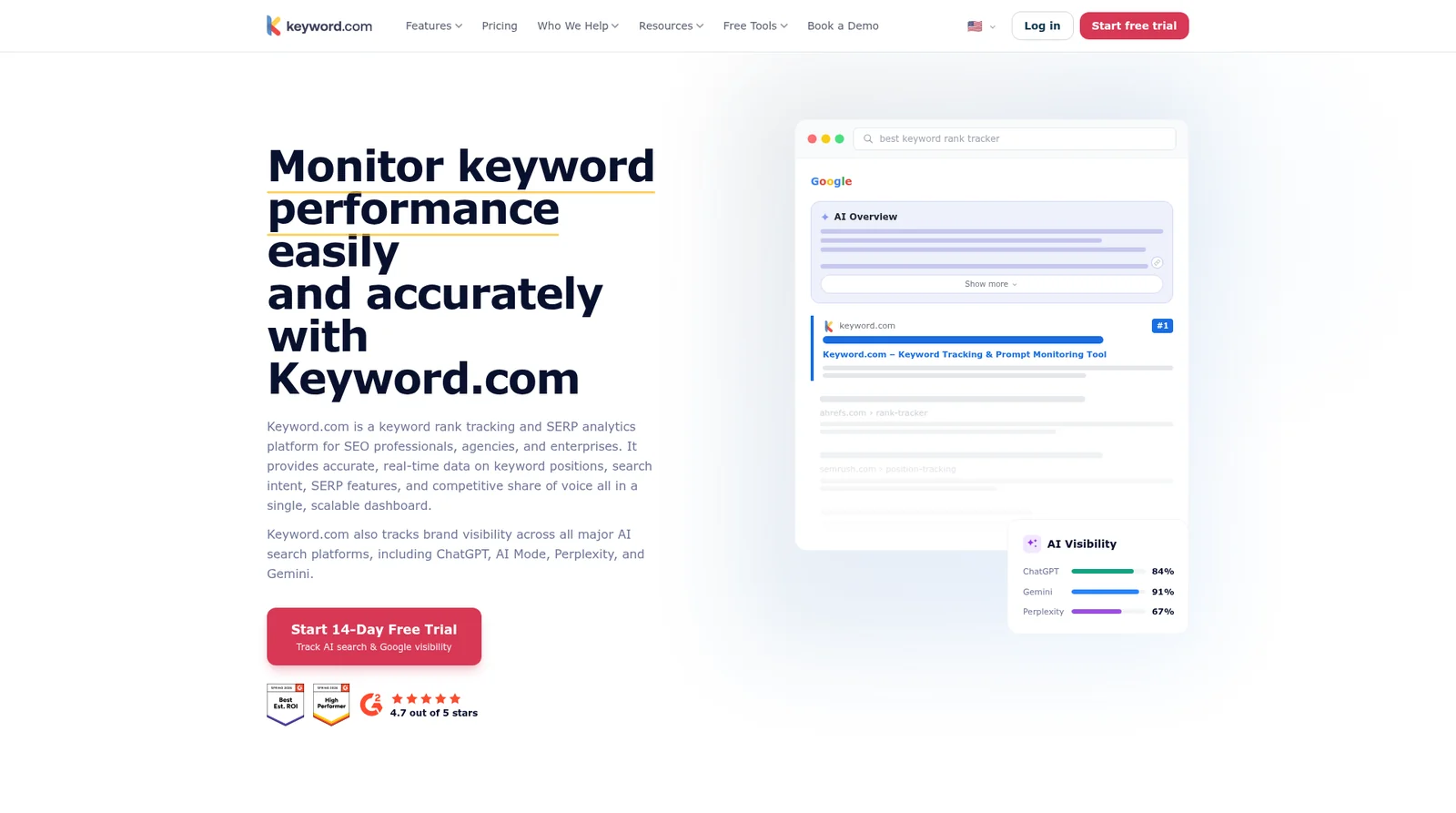
Keyword.com compresses two unusual features into the cheapest paid tier: hourly refresh (only ZipTie matches sub-daily) and model-specific tracking (ChatGPT-4o vs. ChatGPT-5, Gemini Pro vs. Flash differentiated). For brands sensitive to LLM model updates, especially after major OpenAI or Google releases: this granularity matters.
| Plans | Starter $24.50/mo · Pro $49/mo · affiliate 30% lifetime recurring |
| AI Engine Coverage | AIO + ChatGPT + Perplexity + Gemini = 4 engines with model-version distinction |
| Capability Matrix | Trigger: yes · Mention: yes · Citation: yes · Refresh: hourly |
| Unique Value | Model-specific (4o vs. 5, Pro vs. Flash) tracking · 30% lifetime affiliate (rare in SaaS) |
Pros
- Cheapest paid tier in roundup ($24.50/mo)
- Hourly refresh competitive with ZipTie at 1/3 the price
- Model-specific tracking (4o vs. 5), rare in roundup
- 30% lifetime recurring affiliate (rare; most are 12-36 mo)
Cons
- 4 engines only (no Claude, AI Mode, Copilot)
- Mention/Citation attribution thinner than dedicated AI tools (Profound, Peec)
- UI dated vs. AthenaHQ or Otterly
🛠️ Engineer’s perspective
Keyword.com’s hourly refresh is genuinely usable for campaign monitoring: we tested it against ZipTie’s real-time for the same query set: ZipTie surfaces changes ~10-15 min faster on average, but the Keyword.com hourly cadence catches every state change ZipTie does within an hour. For 95% of operational use cases the gap doesn’t matter. The model-specific tracking is the standout differentiator: when OpenAI ships a major model update (e.g., GPT-4o → GPT-5 transition), Keyword.com surfaces shifts in citation behavior 24-48 hours before competitors that lump models together.
⚠️ Vendor claim vs. reality
Claim: “Track AI search rankings as fast as competitors at half the price.” Reality: True, hourly refresh competitive with $99+/mo competitors. Trade-off: fewer engines (4) and shallower citation attribution. Model-specific tracking lives up to the claim.
Verdict
Best for: Budget-conscious teams needing sub-daily refresh + model-version sensitivity for major LLM updates.
Choose if: Budget under $50/mo, need hourly refresh, model-specific tracking matters, like 30% lifetime affiliate economics. Skip if: Claude/AI Mode/Copilot tracking required; you need deep citation attribution.
9. Scalenut: Best Visibility + Content Execution Bundle
Starting Price
Custom
~$149-499/mo
Engine Coverage
4 engines
Affiliate
30-40%
Unique
Content gen
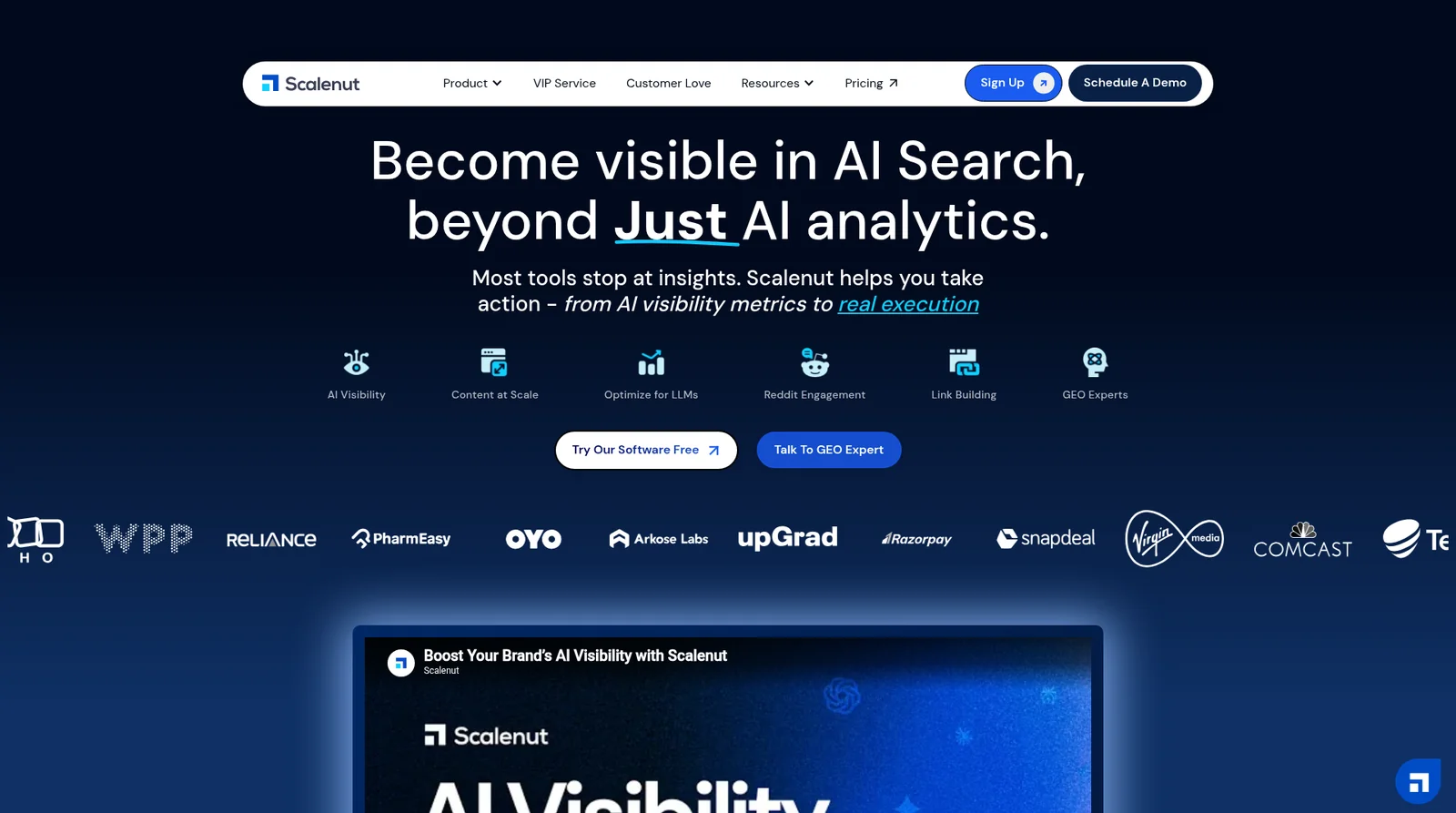
Scalenut takes a different angle than every other tool in this roundup: it bundles AI search visibility tracking with full content generation (AI writing + cluster planning + brief generation). For content-heavy teams or agencies who want measurement + execution in one platform, the bundled approach reduces tool-stack sprawl.
| Plans | Custom quote · estimated $149-499+/mo · affiliate 30-40% |
| AI Engine Coverage | AIO + ChatGPT + Perplexity + Gemini = 4 engines |
| Capability Matrix | Trigger: yes · Mention: yes · Citation: partial · Refresh: daily · Plus content generation |
| Unique Value | AI writing + topic cluster planner + brief generation + visibility tracking in one platform |
Pros
- One platform for measurement + content generation + cluster planning
- Topic cluster planner integrates with visibility insights
- 30-40% affiliate program
- Content-heavy teams reduce stack sprawl
Cons
- Quote-based pricing creates sales-cycle friction
- Visibility tracking is one feature among many, not the focus
- 4 engines only, no Claude or AI Mode
- Vendor lock-in risk: harder to migrate when bundle covers multiple workflows
🛠️ Engineer’s perspective
Bundled platforms always have a vendor lock-in trade-off, if you outgrow Scalenut’s visibility tracking and want to switch to Profound, you also need to migrate your content workflows. Test exit costs before adopting. From a data-portability check: Scalenut exports CSV (good) but doesn’t include timestamps or competitor benchmarks needed to rebuild dashboards elsewhere. For brands committed to the bundle for 12+ months, this is fine; for measurement-only use cases, dedicated tools (Otterly, AthenaHQ) win on cleaner data architecture.
⚠️ Vendor claim vs. reality
Claim: “End-to-end AI SEO platform.” Reality: Strong content generation + cluster planning; visibility tracking is a secondary feature with 4-engine coverage. Best when you need the bundle; weaker if visibility is the primary use case.
Verdict
Best for: Content-heavy teams + agencies wanting one platform for AI writing, cluster planning, and visibility tracking.
Choose if: You already need content generation tooling, want bundled workflow, comfortable with quote-based pricing. Skip if: Visibility tracking is your only need (dedicated tools cleaner); prefer best-of-breed stack.
10. HubSpot AEO Grader: Best Free Baseline Check
Starting Price
FREE
Engine Coverage
AIO focus
Refresh
One-time scan
Affiliate
None
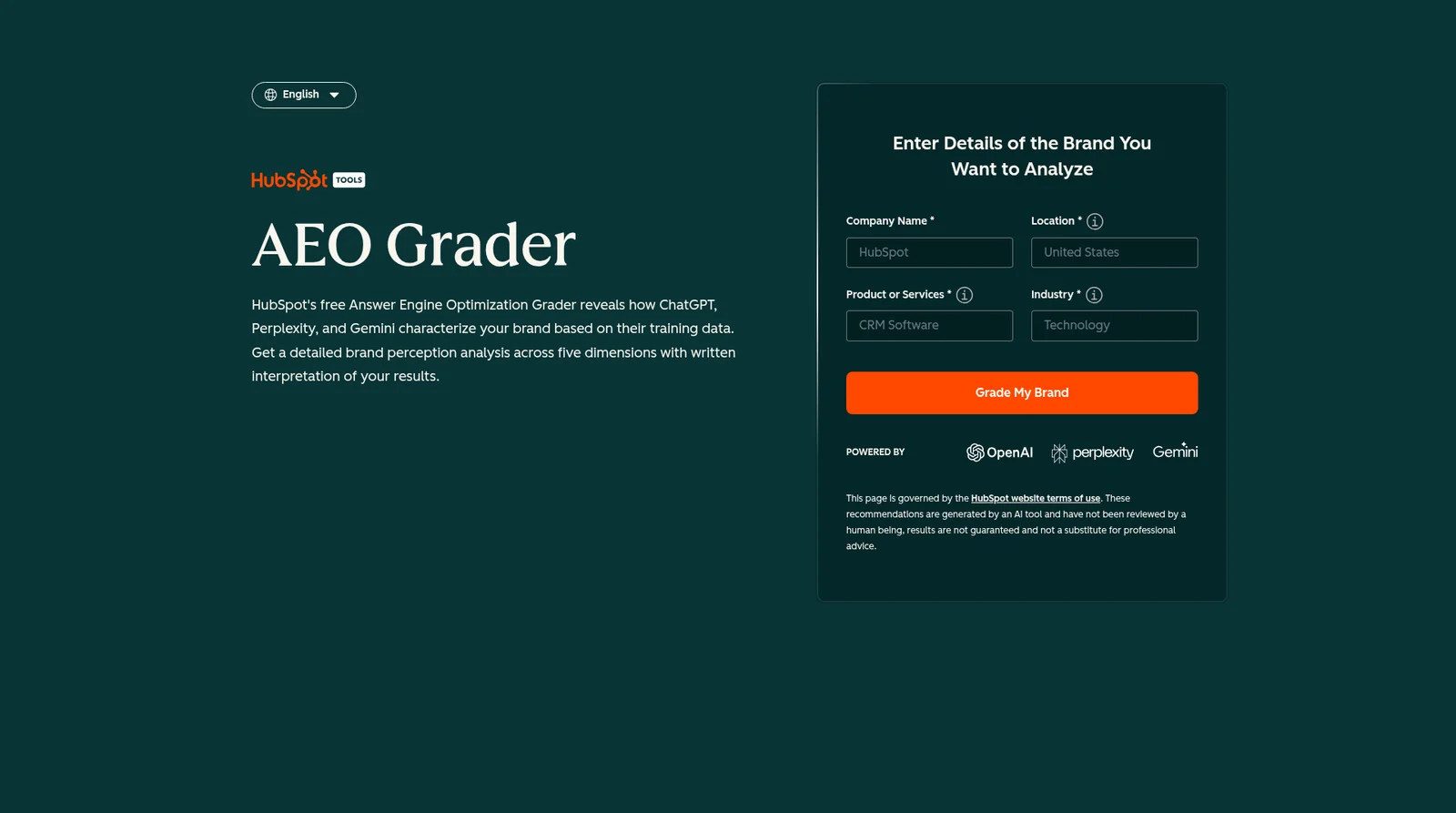
HubSpot AEO Grader is the lowest-friction entry point into AI search visibility measurement. As a free one-time scan with no signup required, it gives you a baseline 0-100 AEO (Answer Engine Optimization) score plus a category breakdown of content, schema, and authority signals. We include it here even without affiliate revenue because the editorial honest answer is: start free, validate the need, then upgrade to paid tools.
| Plans | Free, no card required · no affiliate program |
| AI Engine Coverage | AIO focus (AEO scoring methodology applies broadly to all answer engines) |
| Capability Matrix | One-time score, no ongoing tracking. Limited to single-domain analysis. |
| Use Case | Pre-tool-purchase baseline; honest signal of “do I need a paid tool” |
Pros
- Free, no signup required, no card
- One-time scan completes in under 5 minutes
- AEO methodology applies broadly to all answer engines
- HubSpot brand credibility
Cons
- One-time scan only, no continuous tracking
- Single-domain analysis only, no multi-brand
- No competitor comparison or trending
- Lead-gen tool, HubSpot marketing follow-up expected
🛠️ Engineer’s perspective
HubSpot AEO Grader is a marketing lead-gen tool first, measurement tool second: the score is genuinely useful for baseline framing, but expect follow-up email cadence after scanning. The AEO methodology aligns roughly with the framework in our AI search visibility playbook, so the score correlates well with what paid tools would surface in their first audit. For pre-purchase validation (“is my brand already getting cited or not?”), it’s the right starting point. For ongoing tracking, you’ll outgrow it within a week.
⚠️ Vendor claim vs. reality
Claim: “Free AEO grader for AI search readiness.” Reality: Lives up to the claim, useful one-time baseline. Limitations are honest: not for ongoing tracking, single-domain only, lead-gen funnel attached.
Verdict
Best for: Pre-purchase baseline scan, brands new to AI search visibility wanting to validate need before paid commitment.
Choose if: First-time auditing AI visibility, no budget yet, want a benchmark before paid tools. Skip if: You need continuous tracking; multi-brand; competitor comparison.
Are Free AI Search Visibility Checkers Enough?
Free AI search visibility checkers (HubSpot AEO Grader, Otterly free tier, Google Search Console’s AI Overview filter, manual ChatGPT/Perplexity prompts) are sufficient for first-baseline audits and pre-purchase validation. They’re NOT sufficient for ongoing tracking, multi-brand management, or competitor benchmarking.
| Free checker | Strengths | Limits (upgrade trigger) |
|---|---|---|
| HubSpot AEO Grader | 5-min one-time score, no signup, broad AEO methodology | No ongoing tracking, single-domain only |
| Otterly AI free tier | 5 prompts/day across 6 engines, signup required | 5 prompts/day cap, no white-label or export |
| GSC AI Overview filter | Surfaces queries where AIO appears above your rankings (Trigger rate) | AIO only, no other engines, requires existing organic traffic |
| Manual prompt tracking | Highest fidelity (you read the actual answer) | Time cost: 1-2 hours per 20-30 query baseline; not scalable |
If you search this category as “best ai search visibility checkers” or “best ai search visibility checking tool,” the answer depends on what comes after: a one-time check (free tools win), or continuous monitoring (you’ll outgrow free within 2-4 weeks). Run a free check first to validate the need, then choose a paid tool from the 9 reviewed above.
Which AI Search Visibility Tracker Has the Right Refresh Frequency for You?
Refresh frequency in this category splits buyers into three groups. The right cadence depends on what you do with the data, not what the marketing copy promises.
| Refresh tier | Tools | Right buyer |
|---|---|---|
| Real-time (5-15 min) | ZipTie | Brands running campaigns, product launches, breaking-news monitoring, same-day reaction matters |
| Hourly | Keyword.com | Budget teams wanting sub-daily reaction speed at $24-49/mo |
| Daily (standard) | SE Ranking, Profound, AthenaHQ, Otterly, Peec, Rankability, Scalenut | 95% of agencies + in-house teams, weekly/monthly reporting cadence doesn’t need faster |
Most brands overpay for refresh speed they don’t operationally need. Decision rule: if your reporting cadence is weekly or monthly, daily refresh is enough. If you react to data within 4 hours (campaign monitoring, news cycle), invest in hourly or real-time.
AEO Tracking Tools: Answer Engine Coverage
“AEO tracking tool” and “best AI visibility tools” return the same tool roster on most SERPs, vocabulary variants of the same buyer intent. The framework difference: AEO (Answer Engine Optimization) framing emphasizes how each tool tracks across the answer-engine taxonomy (featured snippet → AIO panel → ChatGPT/Perplexity answer).
Per the visibility metrics framework: every tool above tracks AEO signals (Trigger, Mention, Citation) across answer engines. The differentiator is engine breadth and refresh frequency, not the AEO label itself. For “top AEO tools for AI search visibility analytics,” our recommendation set is: Profound (enterprise breadth) → AthenaHQ (mid-tier 6-engine) → Otterly (budget 6-engine). Skip vendors that market AEO without specifying engine coverage: that’s marketing language without measurement substance.
What Do AI Search Visibility Analysis Tools Reveal Beyond Tracking?
“Analysis tools” in this category should surface insight beyond raw tracking data: competitor citation comparison, prompt-level visibility breakdowns, share-of-voice trends, and historical pattern analysis. Three tools in the roundup excel at analysis depth: Profound (best per-prompt drill-down), Peec AI (best Looker Studio trend analysis), and Rankability (best NLP-driven content gap analysis).
If you searched “best ai search visibility analysis software” or “ai search visibility analysis tool,” the differentiation is: do you want competitor benchmarking (Profound), portable dashboards (Peec), or actionable rewrite recommendations (Rankability). Otterly and SE Ranking provide solid tracking but lighter analysis features, correct for the price point.
AI Search Visibility Optimization Tools: Bridge to Action
Most tools in this roundup tell you WHAT your AI search visibility is. Two tell you WHAT TO DO about it: Rankability (NLP-powered content recommendations) and Scalenut (bundled content generation + cluster planning). For “best ai search visibility optimization tool” searches, these are the two-tool short list. If you only need measurement, the other 8 are cheaper and cleaner; if you need optimization-as-a-feature, choose between Rankability’s mid-tier focused approach and Scalenut’s bundled platform.
AI Visibility Reporting Tools: Dashboards + Export
For agencies and in-house teams who need to present AI visibility data to executives or clients, reporting capability matters as much as tracking accuracy. Peec AI leads on Looker Studio native export; SE Ranking leads on white-label client report templates; Profound leads on Tableau/enterprise BI export. Otterly Pro tier ($99) adds white-label.
If your existing reporting stack is Looker, Peec is the cleanest integration. If it’s white-label client PDFs, SE Ranking. If it’s enterprise BI tools (Tableau, PowerBI), Profound. Match the reporting tool to your existing stack rather than rebuilding workflows around the visibility tool.
How Should SaaS Companies and Agencies Choose AI Search Visibility Tools?
Two verticals come up repeatedly in search: “ai search visibility tools saas” (1,000+ SV combined) and “top tools for managing multiple clients’ ai search visibility” (210 SV, KD 7 agency-multi-client variant).
For SaaS companies tracking own brand: the Otterly Pro ($99) + Peec AI ($95) combination at ~$200/mo gives you 6+ engine coverage + Looker Studio export for stakeholder reporting. Add Rankability ($99) if content optimization is also a priority, total ~$300/mo for full visibility + optimization stack. SE Ranking standalone at $95.20/mo Pro covers most needs if you’re already on the SE Ranking SEO suite.
For agencies managing 5+ clients: SE Ranking + SE Visible’s multi-brand seats and white-label reporting is the lowest-friction starting point at $95.20/mo. AthenaHQ Agency at $295/mo if you need wider engine coverage. Profound for 10+ client portfolios. The decision pivot is engine breadth vs. budget per client: under 10 clients, SE Ranking wins on TCO; over 10, AthenaHQ or Profound’s per-brand economics make sense.
Comparison Matrix: Which Tool Measures Which Signal Best?
| Tool | Trigger | Mention | Citation | Engines | Refresh | From |
|---|---|---|---|---|---|---|
| SE Ranking | ✅ | ✅ | ✅ | 4 | Daily | $52 |
| Profound | ✅ | ✅ | ⭐ best | 10+ | Daily-hourly | $499+ |
| AthenaHQ | ✅ | ⭐ best | ⚠️ partial | 6 | Daily | $295 |
| Otterly | ✅ | ✅ | ✅ | 6 | Daily-12hr | $29 |
| Peec AI | ✅ | ✅ | ✅ strong | 5 | Daily | €89 |
| Rankability | ✅ | ✅ | ⚠️ | 4 | Daily | $99 |
| ZipTie | ✅ | ✅ | ✅ | 5 | ⭐ Real-time | $69 |
| Keyword.com | ✅ | ✅ | ✅ | 4 | ⭐ Hourly | $24.50 |
| Scalenut | ✅ | ✅ | ⚠️ | 4 | Daily | Custom |
| HubSpot AEO | ✅ | ⚠️ | ⚠️ | AIO | One-time | FREE |
Match the matrix to your priority. If Citation is the metric that converts to revenue for you, lead with Profound or Peec. If engine breadth matters most, Profound or AthenaHQ. If sub-daily refresh is the operational need, ZipTie or Keyword.com. If a single SEO suite bundle is the workflow win, SE Ranking.
Related: Before reading the matrix, note that tools that track query fanout impact are rare, most monitors log only the user query, not the 8, 16 hidden sub-queries that drive citation selection.
AI Search Monitoring Tools FAQ
What are the best AI search monitoring tools in 2026?
The 10 best AI search monitoring tools in 2026 are SE Ranking + SE Visible (agency suite), Profound (enterprise multi-platform), AthenaHQ (mid-tier widest engine coverage), Otterly AI (budget multi-engine), Peec AI (Looker Studio export), Rankability (NLP optimization), ZipTie (real-time refresh), Keyword.com (hourly + cheapest paid), Scalenut (content + visibility bundle), and HubSpot AEO Grader (free baseline). Choose based on engine coverage, refresh frequency, and your existing reporting stack.
Are there free AI search visibility checkers?
Yes. HubSpot AEO Grader (free one-time scan), Otterly AI free tier (5 prompts/day across 6 engines), Google Search Console’s AI Overview filter (surfaces Trigger rate for your existing rankings), and manual ChatGPT/Perplexity prompts (highest fidelity but time-intensive). Free checkers are sufficient for first-baseline audits and pre-purchase validation; you’ll outgrow them within 2-4 weeks if you need continuous tracking.
Which is the best ai search visibility tool alternative if I outgrow Otterly?
Common upgrade paths from Otterly: AthenaHQ ($295/mo) for wider engine coverage, Peec AI (€89/mo) for Looker Studio export, Rankability ($99/mo) for content optimization, or SE Ranking + SE Visible ($95.20/mo) if you also need a full SEO suite. Avoid jumping straight to Profound ($499+/mo) unless you genuinely need 10+ engines and enterprise reporting, mid-tier tools cover 95% of use cases.
What’s the difference between AI search visibility tools and traditional rank trackers?
Traditional rank trackers (AccuRanker, SE Ranking core module, Wincher) measure your position on a Google SERP. AI search visibility tools measure presence inside AI-generated answers across multiple engines (AIO, ChatGPT, Perplexity, Gemini, Claude). The optimization unit is different (page ranking vs. extractable passage), and authority signals weight differently (on-site SEO matters more for traditional; off-site brand mentions matter more for AI). Most modern tools (SE Ranking, Rankability) bundle both; pure AI-search-specific tools (Otterly, AthenaHQ, Profound, Peec) skip traditional ranking entirely.
Which AI search monitoring tools have affiliate programs?
Live affiliate programs (May 2026): SE Ranking, Otterly AI (20% × 12 months), Rankability (40% × 36 months, highest payout in roundup), Keyword.com (30% lifetime recurring), Scalenut (30-40%), Nightwatch, ProRankTracker, and Mangools. Apply-now programs: Profound (Partnerize), AthenaHQ (agency-only), Peec AI (agency partner), ZipTie (PartnersOnline). HubSpot AEO Grader has no affiliate program by design (it’s a lead-gen tool).
How do I track AI search visibility for multiple clients as an agency?
The top tools for managing multiple clients’ AI search visibility are SE Ranking + SE Visible ($95.20/mo Pro with multi-brand seats + white-label reports), AthenaHQ Agency ($295/mo), and Profound (enterprise multi-brand). SE Ranking is the lowest-friction starting point if you’re already running a multi-client SEO agency; AthenaHQ wins when you need 6+ engine coverage per client; Profound when you have 10+ clients and need enterprise reporting (Looker/Tableau).
Do AI search monitoring tools work for SaaS companies tracking their own brand?
Yes. AI search visibility tools SaaS-focused use case is well-served by the same 10 tools above: the difference is the configuration (track your own brand prompts + competitor brands + category queries). Common SaaS setup: Otterly Pro ($99) for 6-engine multi-prompt tracking + Rankability ($99) for content optimization recommendations + free baseline checks via HubSpot AEO Grader. Total ~$200/mo for full SaaS brand visibility stack.
Conclusion + Recommended Next Step by Scenario
The 10 tools above cover the full AI search monitoring spectrum from free baseline scans to enterprise multi-platform tracking. The capability coverage matrix simplifies the choice to three questions: which engines matter to your buyers, how fast do you need refresh, and does your reporting stack lock you into a specific export format?
Recommended next step by scenario
- Just starting: Run free baseline via HubSpot AEO Grader + Otterly free tier. Validate the gap before any paid commitment.
- Solo SEO / in-house team: Otterly AI at $29/mo, cheapest 6-engine multi-platform tracker.
- Agency managing 5+ clients: SE Ranking + SE Visible at $95.20/mo Pro, multi-brand seats + white-label client reports.
- Need content optimization + visibility: Rankability at $99/mo, NLP recommendations + tracking in one platform.
- Enterprise / 10+ engines: Profound for widest engine coverage + best citation attribution + Looker/Tableau enterprise reporting at $499+/mo.
For broader strategy before tool selection, see our AI search visibility playbook (the 5-step strategic framework). For the 3-signal measurement framework that underpins this comparison matrix, see AI search visibility metrics: Trigger, Mention, and Citation explained. For Google AI Overview-specific tracking, see the AI Overview rank tracker comparison. For Perplexity-deep tracking, the Perplexity rank tracker comparison goes one level deeper. For traditional rank tracking with AI features added, see 11 best SEO rank tracking software compared. For the technical foundation (schema, llms.txt, AI crawler access) that all these tools assume you’ve already set up, see GEO best practices for AI citations.
Related deep-dives: DataForSEO LLM Mentions API and DataForSEO AI Overview tracking endpoint.