What Is Google AI Overview? The 2026 Complete Guide
Google AI Overview is the AI-generated answer panel that appears at the top of Google’s search results page for certain queries. It summarizes information drawn from multiple web sources into a direct answer, with citation links to the underlying pages, before the traditional blue-link organic results appear below. Rolled out broadly in the US in 2024 and expanded globally through 2025-2026, AI Overview now triggers on roughly 13% of US Google queries (Semrush Q2 2026).
If you’ve heard the terms “AIO,” “Google AI Overview,” “AI Overviews,” or “Google’s AI search answer” and want to understand what is Google AI Overview in practice, how it works under the hood, and what it means for organic search traffic, this guide is the plain-language explainer. For Google’s own announcement on the feature, see the official Google AI Overview launch post.
🟢 Just the essentials
What: An AI-generated answer that Google shows above traditional search results for some queries.
When: Triggers on ~13% of US Google queries (Semrush Q2 2026), more in how-to/health/finance, less in branded/transactional.
Why it matters: Organic CTR on the underlying blue links drops 20-25% on average when AI Overview appears (Search Engine Land aggregate 2025-2026).
Different from AI Mode: AI Overview is a SINGLE answer panel; AI Mode is Google’s conversational chat interface (a different feature).
🆕 GOOGLE’S OFFICIAL AI SEO GUIDE (RELEASED 2026-05-15)
Google published its first official AI SEO guide on 2026-05-15, the first such document from any major LLM vendor (OpenAI, Anthropic, and Perplexity have not released equivalents). The r/SEO community thread parsing the guide earned 130 upvotes and 49 comments in its first 48 hours, the strongest community signal we have logged on any AI-search-related topic in 2026.
Google’s own guide is now the canonical source for understanding what makes content eligible for AI Overview citation. The 2026-05-15 release codifies what the SEO community had inferred through observation for 18 months: priority signals include answer-first H2 openings, structured data on facts and entities, and consistent entity-name placement in the first 200 characters of cited pages. Cite Google’s guide directly when explaining AI Overview behavior to clients or stakeholders.
What Is Google AI Overview, Exactly?
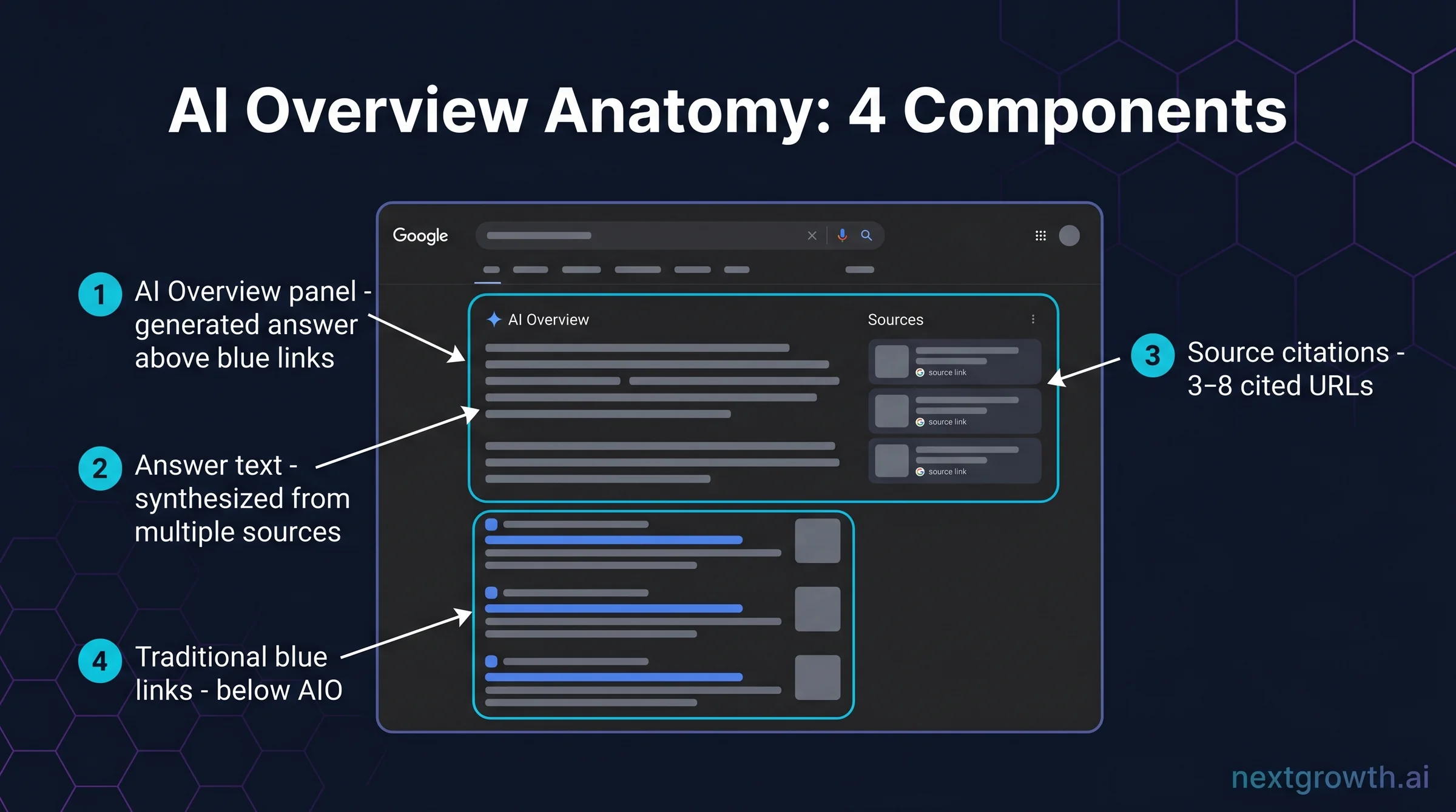
Google AI Overview is a feature that places an AI-generated summary at the top of the search engine results page (SERP) for queries where Google’s model thinks an AI answer adds value. It draws on Google’s Gemini model plus a “grounding” step that retrieves and references content from current web pages. The result is a short paragraph or two answering the query, followed by a “Sources” panel listing the websites the answer drew from.
Visually, AI Overview sits above the traditional 10 blue links. It looks like a featured snippet but is structurally different: featured snippets pull a single passage from one page; AI Overview synthesizes content from multiple pages into a new answer that no single page wrote. The Sources panel typically lists 3-8 cited URLs that you can click to read the original content.
The official Google name is “AI Overview” (singular). You’ll see the abbreviation “AIO” used widely in SEO industry conversation. Plural “AI Overviews” is also common but refers to the same feature.
How Google AI Overview Works
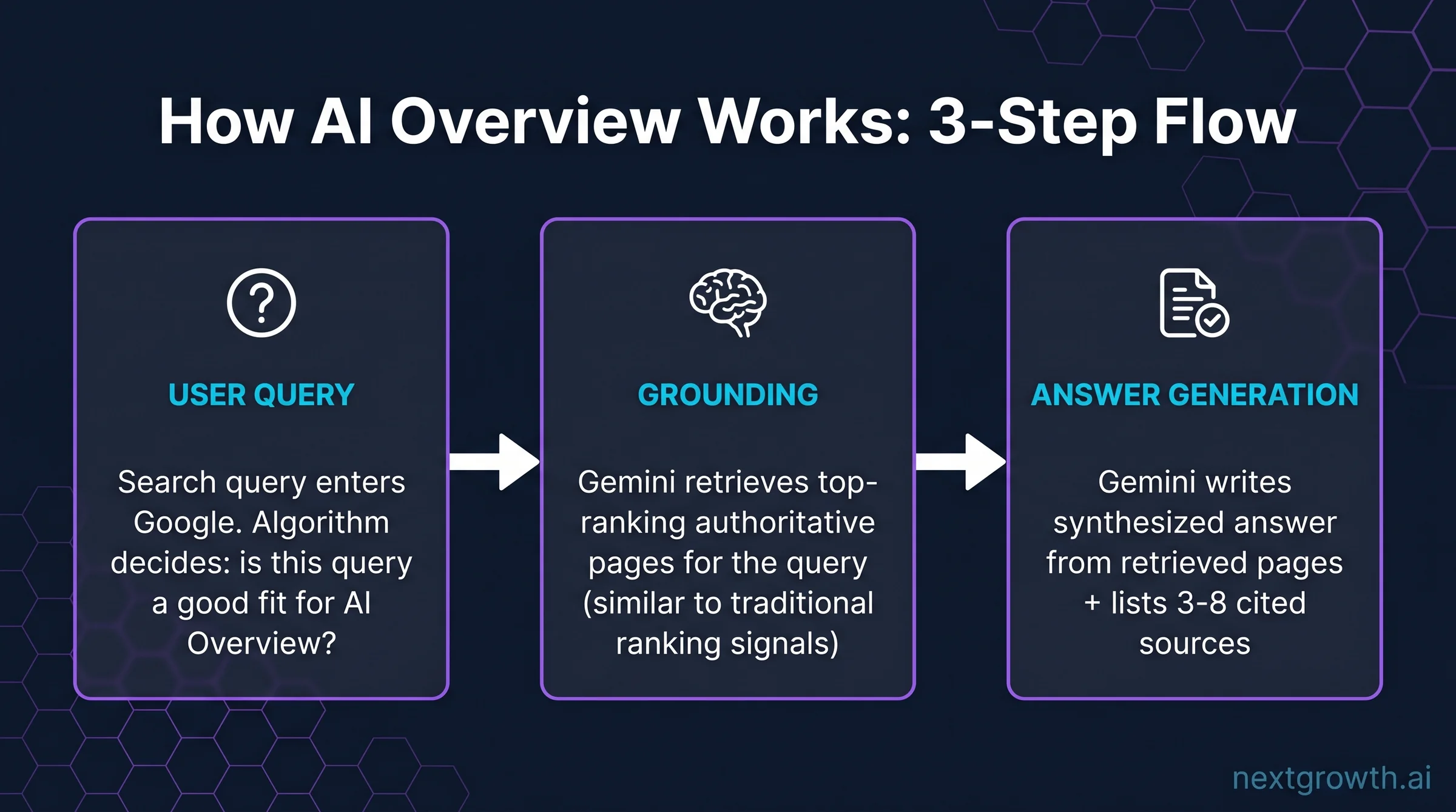
The mechanics underneath AI Overview combine two distinct steps:
Step 1: Triggering
When you search a query, Google’s algorithm decides whether the query is a “good fit” for an AI Overview. The decision is based on query type, intent signals, content availability, and quality thresholds. Informational queries (“how to,” “what is,” “best practices for”) trigger AI Overview more often than transactional or branded queries. Health and finance queries (which Google calls YMYL, Your Money or Your Life topics) have stricter trigger thresholds.
If the query doesn’t trigger an AI Overview, you see the traditional 10 blue links with no AI summary. If it does trigger, the next step begins.
Step 2: Grounding + answer generation
Google’s Gemini model generates the answer using a grounded retrieval approach: it first identifies which web pages are the most authoritative + relevant for the query (similar to traditional ranking signals), then writes the answer using content from those pages. The output is a synthesized summary, not a verbatim copy of any single source. Each generated answer includes a citation panel showing which pages contributed.
The grounding step is what distinguishes Google AI Overview from a pure LLM chatbot. ChatGPT or Claude can generate answers from training data alone; AI Overview always retrieves current web content first, then generates, ensuring the answer reflects current information rather than only the training-data snapshot. This is also why AI Overview answers can change as Google’s grounding model updates and as the web pages it pulls from change.
Google AI Overview vs Featured Snippets vs AI Mode
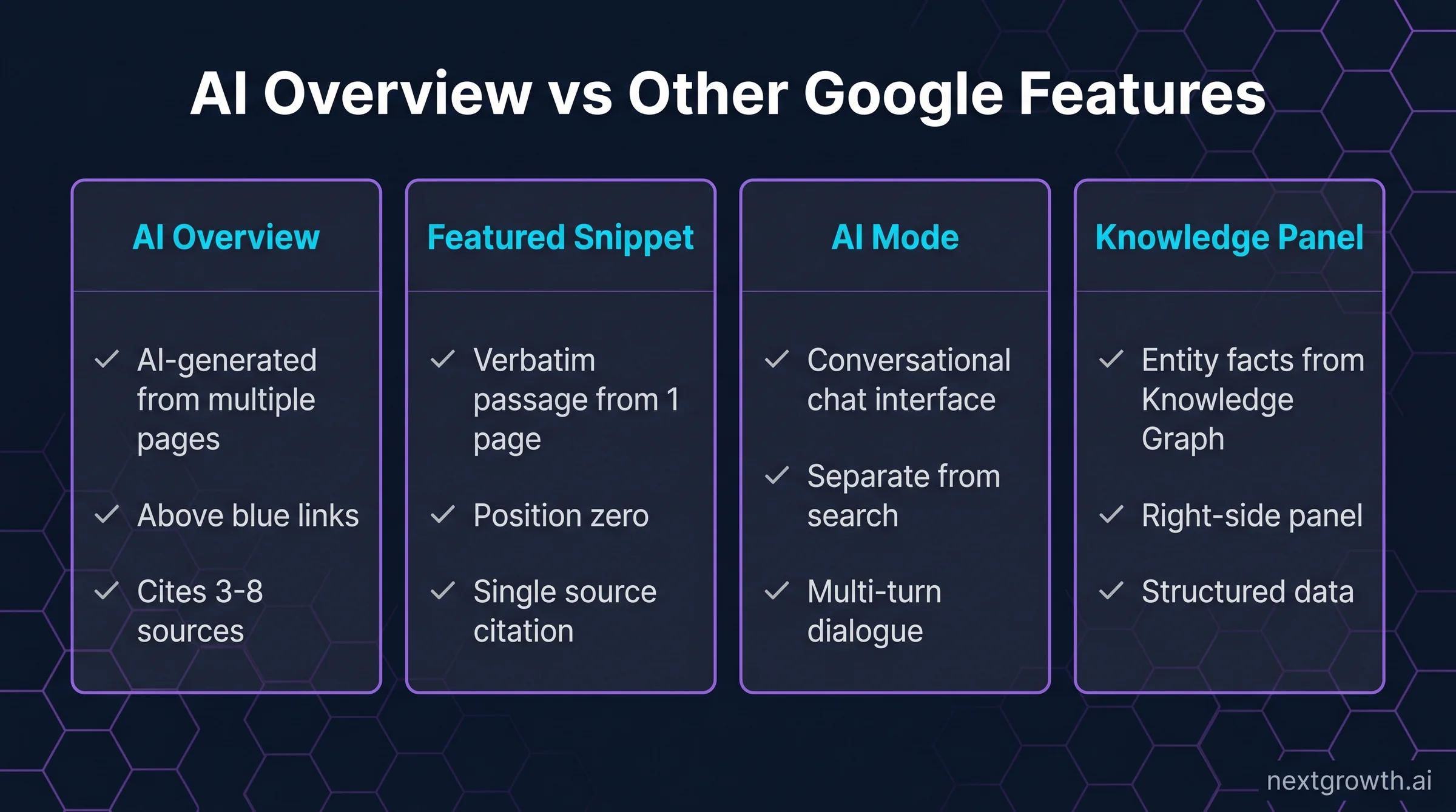
| Feature | What it is | How it differs from AI Overview |
|---|---|---|
| Featured snippet | A passage Google extracts from a single page and shows at position zero (above blue links) | Featured snippet = verbatim passage from one page. AI Overview = generated answer from multiple pages. |
| Knowledge Panel | Right-side panel with structured facts about a known entity (person, company, product) | Knowledge Panel = entity facts from Google’s Knowledge Graph. AI Overview = generated answer to a query. |
| AI Mode | Google’s conversational chat interface, separate from regular search | AI Mode = multi-turn chat (like ChatGPT). AI Overview = single answer panel above SERP. |
| ChatGPT search / Perplexity | Separate search products from non-Google companies | Different platforms. AI Overview is only inside Google search results. |
The most common confusion is AI Overview vs AI Mode: both Google features, both AI-generated, but structurally different products. AI Overview lives inside the traditional Google search results page (your normal Google search); AI Mode is a conversational interface you switch into deliberately. Optimizing for one doesn’t automatically optimize for the other.
Why Google AI Overview Matters for Organic Traffic
Three reasons AI Overview is reshaping SEO economics:
1. Click-through rate drops on the underlying blue links
When AI Overview appears, the organic CTR on positions 1-10 below it drops by 20-25% on average (Search Engine Land aggregate 2025-2026). Users get the answer in the panel and don’t click through. For some informational queries, the drop is steeper: some publishers have reported 40-50% CTR losses on queries where AI Overview now satisfies the query directly.
2. Citation in AI Overview can replace position 1 traffic
Conversely, being cited as a source in AI Overview is increasingly valuable. The Sources panel sends referral traffic to cited pages, and being one of the 3-8 cited sources for a high-volume query can drive more clicks than a position-1 blue-link ranking would have once AI Overview is competing for screen real estate above you. SEO strategy is shifting from “rank #1” to “rank #1 AND be cited in AI Overview.”
3. Visibility measurement gets a new vocabulary
Traditional SEO had one metric: rank position. AI Overview adds three: Trigger (does AIO appear for this query at all), Mention (does your brand name appear inside the answer), and Citation (is your domain in the Sources panel). These three signals need to be measured separately and optimized separately. Our companion guide on AI search visibility metrics: Trigger, Mention, and Citation explained goes deeper on the framework.
Which Queries Trigger Google AI Overview?
AI Overview triggers more often for some query types than others. Patterns observed across industry analyses:
- Informational queries (“how to,” “what is,” “best practices for”) (high trigger rate
- How-to queries with multi-step answers) high trigger rate
- Health and finance queries, stricter quality threshold; trigger if Google’s confidence is high, skip if low
- Branded queries (“Apple iPhone 15 specs,” “Nike running shoes”) (low trigger rate (Google sends users to the brand’s own page directly)
- Transactional queries (“buy red shoes,” “best price laptop”)) low trigger rate (Google prioritizes product listings and ads)
- Navigational queries (“facebook login,” “gmail”) (near-zero trigger (Google sends users to the destination)
- Local queries (“restaurants near me,” “plumber in San Diego”)) lower trigger (map pack dominates)
The implication for SEO planning: AI Overview matters most for informational top-of-funnel content. For transactional bottom-of-funnel content, traditional SERP ranking still dominates.
Can You Optimize Content for Google AI Overview?
Yes, the practice is called Generative Engine Optimization (GEO) or Answer Engine Optimization (AEO). The patterns that increase your chance of being cited in AI Overview overlap heavily with traditional SEO best practices, with some specific additions:
- Answer-first content structure: Open every section with a direct answer to the question it implies, rather than a setup paragraph. AI Overview’s grounding step extracts answer-shaped passages.
- FAQ schema markup: Question-answer pairs in structured data are highly extractable.
- Definition + example + stat density: Sections that contain a clear definition, a concrete example, and a numeric stat get cited more often than sections that have only one.
- Existing top-10 Google ranking: AI Overview almost always cites from pages already ranking on page 1. If you’re not ranked, you’re unlikely to be cited.
- Off-site brand authority: Being mentioned across multiple authoritative sites raises your overall extraction probability, especially for the Mention signal.
- Schema markup: Article, FAQPage, HowTo, and Organization schema make content machine-extractable.
For the deeper strategic playbook with a 5-step framework, see our AI search visibility guide. For the technical specifications of citation-friendly content, see our GEO best practices guide. For tools to measure your AI Overview citation rate, see the AI Overview rank tracker comparison.
Google AI Overview FAQ
When did Google launch AI Overview?
Google announced AI Overview at Google I/O 2024 (May 2024) and rolled it out broadly in US search later that year. Global expansion continued through 2025-2026 with country-by-country availability. The feature originally launched as “Search Generative Experience” (SGE) in beta in 2023 before rebranding to AI Overview at general launch.
Is Google AI Overview the same as “AI Overviews” (plural)?
Yes. The official Google name is “AI Overview” (singular), but plural “AI Overviews” is widely used in industry conversation. They refer to the same feature.
How do I see whether AI Overview is showing for my queries?
Three methods: (1) Manually search the query and look for the AI-generated panel above the blue links. (2) Check Google Search Console’s Performance report, the “AI Overview” filter (rolled out 2025) shows queries where AIO appeared above your existing rankings. (3) Use a paid AI search visibility tool like the ones in our AI Overview rank tracker comparison for continuous tracking across multiple queries.
Does Google AI Overview hurt my SEO traffic?
It can, depending on your traffic mix. Informational queries that previously sent traffic via featured snippet or blue-link clicks may see CTR drops of 20-25% when AI Overview now satisfies the query. Transactional and branded queries are largely unaffected because AI Overview triggers less often on them. Being cited as a source IN the AI Overview can offset the click loss by sending direct referral traffic.
What is the difference between AI Overview and AEO (Answer Engine Optimization)?
AI Overview is the Google feature; AEO is the optimization discipline that targets answer-engine surfaces broadly (Google AI Overview + ChatGPT + Perplexity + featured snippets + voice assistants). AEO is a superset of AI Overview optimization. For a deeper breakdown of the disciplinary differences, see our companion AEO vs GEO vs SEO explained guide.
Will Google AI Overview replace traditional SEO?
No, but it changes the optimization unit. Traditional SEO optimizes for rank position on the SERP. AI Overview adds a layer of optimizing for inclusion inside the AI-generated answer. The technical foundations (crawlability, schema, site speed, authority) overlap heavily between the two. Most SEO practitioners are integrating AI Overview optimization into existing workflows rather than treating it as a separate discipline.
📚 Continue learning (AI search visibility series
Now that you understand what is Google AI Overview and how it reshapes search economics, here are the natural next reads to complete the foundational vocabulary + start optimizing:
Sibling foundational guides (read these next)
- AEO vs GEO vs SEO explained) how AI Overview optimization fits within the 3 optimization disciplines (Answer / Generative / Search Engine)
- AI search visibility metrics: Trigger, Mention, Citation, the 3-signal measurement framework for AI Overview + ChatGPT + Perplexity tracking
Ready to act (commercial guides) For the tactical playbook on how to actually rank inside an AI Overview, see AI Overview SEO: 7 tactics to rank in 2026.
- AI search visibility playbook, 5-step strategic framework to win citations across ChatGPT + Perplexity + Gemini + Claude + AI Overview
- Best AI Overview rank tracker tools, 10 tools compared by AIO citation depth, refresh frequency, multi-engine coverage
This article is part of our broader pillar guide. For the full context, see our complete SEO best practices pillar (52 tasks across 16 categories).