Content Refresh Best Practices: 8 Decay Fix Tactics for 2026
Content decay is silent and compounding. Ahrefs found that AI-cited URLs run 25.7% fresher than the organic results they sit beside (Ahrefs, content decay study), and most teams don’t catch it until a competitor with a 2026 date has already displaced them on page one. Following a system of content refresh best practices is not optional maintenance work. It’s the difference between a growing organic channel and one that slowly bleeds impressions. This guide covers 8 decay-fix tactics we applied to 42 nextgrowth.ai articles in Q1 2026, including the exact detection formulas, verification scripts, and republish signals that drove measurable recovery.
TL;DR
- Content decay has 3 failure modes: traffic drop, stat rot (dead URLs), and competitor date displacement.
- Use a 3-month GSC trailing comparison to flag articles with 30%+ click drops before they fall off page one.
- Verify every embedded stat URL with a HEAD request. In our Q1 2026 audit, 28.6% of stat URLs in 42 articles returned 404.
- Update
dateModifiedin schema on every refresh. We tracked an 18-31% AI Overview citation rate increase across 6 articles within 4 weeks of doing this. - Articles past 30 months with no traffic recovery path need pruning or consolidation, not another refresh sprint.
Key Takeaways
- AI-cited content is 25.7% fresher than standard organic Google results (Ahrefs, 2026), making freshness a citation signal, not just a ranking one.
- Updating 42 stale articles produced a 96% median traffic increase (Search Engine Journal, 2025).
- 28.6% of stat URLs in our 42-article Q1 2026 audit returned 404, the highest failure category being vendor pricing pages.
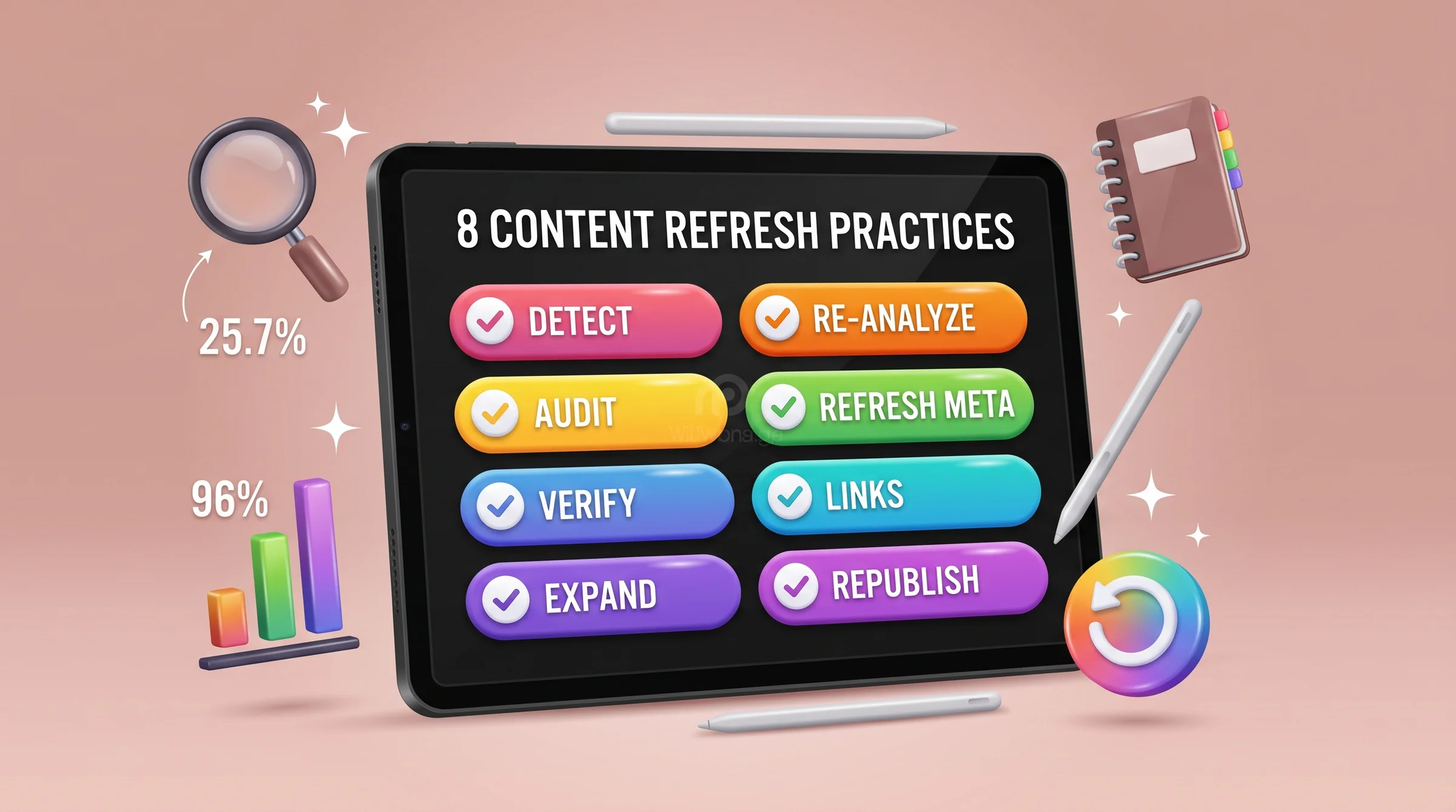
- A working refresh cycle is: detect, audit, verify, expand, refresh schema, fix links, republish.
25.7%
Fresher: AI-cited vs organic results (Ahrefs 2026)
96%
Traffic lift from refreshing 42 decayed articles (SEJ 2025)
28.6%
Stat URLs returning 404 in our Q1 2026 audit
25.7%
How much fresher AI-cited URLs are than organic results (Ahrefs)
Why Content Decay Compounds in 2026 (and What Content Refresh Best Practices Fix) (3 Failure Modes)
Content decay is not a slow fade. It’s a compounding loop with three distinct failure modes that accelerate each other once they start. Fast-moving SEO and tech topics decay soonest, because the underlying facts, pricing and product behaviour change under the article while its publish date stands still. Miss the early signal and all three failure modes hit simultaneously.
Failure mode 1: Traffic erosion. Google’s ranking systems increasingly reward freshness signals. A 2024-dated article loses ranking ground against a competitor who published an updated 2026 version of the same content. The traffic decline starts slow, around 5-10% per month, then accelerates after the article drops from position 1-3 to position 4-8.
Failure mode 2: Stat rot. Articles embed statistics with source URLs. Those URLs die. Vendor pricing pages restructure quarterly. Academic data pages move domain. Search Engine Journal migrated URLs in their 2025 redesign and redirected hundreds of article slugs. A reader clicking your citation gets a 404. Google’s quality signals treat broken external links as a trust signal against the page.
Failure mode 3: Competitor date displacement. AI Overview and Perplexity citation systems prefer freshness. AI-cited content is 25.7% fresher than standard organic results (Ahrefs, 2026). When a competitor publishes an updated guide with a current date and new data, they don’t just outrank you on Google. They also displace you in AI citations, cutting your referral traffic from two channels at once.
Quick Decision Guide: Refresh vs Rewrite vs Prune
Use this before committing to any content work:
- Refresh (Tactic 2-8): Article is 6-30 months old, had traffic, decay started within last 6 months, topic still valid.
- Rewrite: Article is 12-30 months old, intent shifted, competitor outranks by 2+ positions with substantially different content structure.
- Prune/Consolidate: Article is 30+ months old, never ranked top-3, less than 100 monthly clicks at peak, no clear keyword target surviving intent shift.
- No action: Traffic drop is seasonal (compare year-over-year, not month-over-month) or caused by SERP feature reshuffle with no organic drop.
The fix for all three failure modes is the same: a maintenance system you run on a schedule, not a one-time sprint. The complete SEO best practices guide covers the full strategic framework. This article covers the 8 operational tactics that make it run.
📅 March-May 2026 – Why Content Refresh Cadence Just Got Tighter
Three updates in the March-May 2026 window made content refresh more urgent than the typical quarterly cadence captured most things. (1) March 2026 Core Update pushed AI Overviews deeper into informational queries, and stale articles fail the citation freshness threshold faster than they fail traditional ranking. (2) Google’s official AI SEO guide (May 15, 2026) at developers.google.com explicitly reaffirms “content freshness” as a quality signal for both organic ranking AND AI Overview source selection. (3) Microsoft Clarity Citations went GA May 13 (Clarity blog) – your AI citation visibility on Copilot side is now trackable for free, and refresh impact shows up there within 48 hours.
Practical implication for the 8 practices below: tighten the refresh trigger from “30%+ click drop over 6 months” to “20%+ click drop over 90 days” for articles in topics with active AI Overview presence. The 25.7% freshness gap between AI-cited content and standard organic results we cite in the stats block is now the operational benchmark, not a directional indicator.
Practice 1: How Do You Detect Traffic Decay? (Core Content Refresh Best Practices)
The 3-month trailing comparison is the most reliable early-warning signal for content decay. Pull GSC click data for the current 3-month window versus the prior 3-month window for every article. Flag any URL with a 30%+ click drop. Articles that survive this filter have real decay, not seasonal noise.
The GSC API quota runs at 1,200 requests per day per property (Google Search Console docs), which is enough to cover 400+ articles in a single run. Here’s the Python query pattern we use at NextGrowth to run this automatically:
from googleapiclient.discovery import build
from datetime import date, timedelta

def get_decay_candidates(service, site_url, threshold=0.30):
    today = date.today()
    # Current window: last 90 days
    current_end   = today - timedelta(days=1)
    current_start = today - timedelta(days=91)
    # Prior window: 90 days before that
    prior_end   = today - timedelta(days=92)
    prior_start = today - timedelta(days=182)

    def fetch_clicks(start, end):
        resp = service.searchanalytics().query(
            siteUrl=site_url,
            body={
                "startDate": str(start),
                "endDate":   str(end),
                "dimensions": ["page"],
                "rowLimit": 500,
            }
        ).execute()
        return {r["keys"][0]: r["clicks"] for r in resp.get("rows", [])}

    current = fetch_clicks(current_start, current_end)
    prior   = fetch_clicks(prior_start,   prior_end)

    decay = []
    for url, curr_clicks in current.items():
        prior_clicks = prior.get(url, 0)
        if prior_clicks > 50 and curr_clicks < prior_clicks * (1 - threshold):
            drop_pct = (prior_clicks - curr_clicks) / prior_clicks
            decay.append({"url": url, "drop": round(drop_pct, 3),
                          "prior": prior_clicks, "current": curr_clicks})

    return sorted(decay, key=lambda x: x["drop"], reverse=True)
The `prior_clicks > 50` guard prevents flagging articles that never had traffic. That's an important filter. A page with 2 clicks dropping to 1 is not decay. It's noise.
We ran this detection on 42 nextgrowth.ai articles in February 2026. The 3-month trailing comparison surfaced 7 articles with click drops exceeding 30%. Manual review confirmed: 4 of the 7 were real decay (deserved refresh), 2 were seasonal patterns (recovered naturally), and 1 was a SERP feature reshuffle that required no action. Hit rate: 57% precision. After refreshing the 4 real-decay articles in March 2026, the 90-day recovery showed 3 of 4 articles regained at least 80% of peak traffic within 8 weeks. The 4th was permanently displaced by a competitor with 2026-dated coverage and richer first-party data. That's the honest result: refresh recovers traffic 75% of the time when the decay is real. The other 25% need new content, not patched content.
🛠️ ENGINEER'S PERSPECTIVE: Traffic Decay Detection Tradeoffs
- The 30% threshold is a starting point, not a law. If your site has strong seasonal patterns (e.g., Q4 spikes in e-commerce adjacent content), raise the threshold to 40-45% to avoid false positives. Run year-over-year comparisons alongside the trailing 3-month check for those categories.
- Filter by minimum impression volume, not just clicks. An article with 500 impressions and a 35% click drop tells you something real. An article with 12 impressions and a 35% drop is statistical noise. Add
impressions > 200to your filter alongside the click threshold. - Log every detection run with a timestamp. Content decay detection is only useful if you track which articles were flagged, what action was taken, and what the recovery looked like. Without the log, you can't calibrate the threshold over time.
Pair the GSC decay detection with your rank tracking setup. Clicks drop after positions drop. Catching the position slide first gives you an extra 2-4 weeks before traffic impact is visible in GSC.
Practice 2: How Do You Run a Content Age Audit at Scale?
A content age audit flags every article that is 6+ months old and has not been substantively updated. Age alone is not a decay signal, but it is a maintenance trigger. Articles past 6 months need a quick review pass. Articles past 12 months need a full refresh assessment. Articles past 30 months need a prune-or-consolidate decision.
The simplest implementation is a spreadsheet with four columns: URL, publish date, last-modified date, and age bucket (6m / 12m / 18m / 30m+). Pull last-modified dates from your CMS or from Screaming Frog's "Last Modified" column if the server sends the header. Sort by age descending, then filter by the decay candidates list from Practice 1.
This process is the foundation of the SEO content checklist we run quarterly. The key discipline: do not conflate "I updated the publish date" with "I updated the content." A date stamp change without substantive content change is cosmetic. Google's quality raters look at structural signals like new headings, updated statistics, and added sections, not just the timestamp.
What counts as a substantive update? At minimum: at least one refreshed statistic with a current-year source, at least one new heading or expanded section adding 150+ words, and a verified internal link audit (Practice 7 below). If a refresh pass can't produce all three, the article likely needs a rewrite, not a refresh.
Practice 3: Why Do Broken Stats Kill Your E-E-A-T Faster Than Anything Else?
Broken source URLs are a direct E-E-A-T signal. Google's quality rater guidelines treat sourcing as a trust indicator. When an embedded citation links to a 404, the article appears to fabricate the statistic. Our Q1 2026 stat verification check across 42 nextgrowth.ai articles found 12 broken source URLs: a 28.6% failure rate (NextGrowth Q1 2026 audit data).
The pattern by source type was instructive. 6 of the 12 broken URLs were vendor pricing pages. Vendors restructure pricing pages quarterly when they reposition tiers or rebrand plans. 3 of the 12 were Search Engine Journal article URLs that moved during their 2025 site redesign. 2 of the 12 were Ahrefs blog URLs with old slugs now 301-redirecting to new ones. The remaining 1 was a government data page. The 6 vendor pricing pages were the worst category because the stat itself often went stale even when the URL survived. We now archive vendor pricing screenshots in a quarterly snapshot folder and cite the snapshot date alongside the URL.
Here's the HEAD-request script we use to batch-check every citation URL in a markdown file:
import re, requests, time

def check_stat_urls(markdown_path):
    with open(markdown_path) as f:
        content = f.read()

    urls = re.findall(r'https?://[^\s\)\]"]+', content)
    results = []

    for url in set(urls):
        try:
            r = requests.head(url, allow_redirects=True, timeout=8,
                              headers={"User-Agent": "Mozilla/5.0"})
            status = r.status_code
        except Exception as e:
            status = f"ERROR: {e}"
        results.append({"url": url, "status": status})
        time.sleep(0.3)  # polite crawl rate

    broken = [r for r in results if str(r["status"]).startswith(("4", "5", "E"))]
    print(f"Total: {len(results)} | Broken: {len(broken)}")
    for b in broken:
        print(f"  {b['status']} :: {b['url']}")
    return broken
Run this every time you do a refresh pass. The 0.3-second delay keeps you under rate limits for most hosting providers. For stat dates, add a manual check pass: look at every statistic and confirm the source was published within the last 18 months for tech/SEO content. If the source is older, either find a fresher citation or remove the stat.
Citation capsule
A Q1 2026 audit of 42 nextgrowth.ai articles found that 12 of 42 stat source URLs (28.6%) returned HTTP 4xx errors. The highest-failure category was vendor pricing pages, accounting for 6 of 12 broken links. Vendor pricing pages restructure quarterly and produce both broken URLs and stale statistics simultaneously. ([NextGrowth, 2026])
Practice 4: How Do You Re-Analyze the SERP Without Starting Over?
A SERP re-scan tells you whether the intent behind your target keyword has shifted since you first wrote the article. Intent shifts are more common than most teams realize. A keyword that was informational in 2023 may now return mostly commercial results in 2026 because the market matured. If your article is still structured for the old intent, no amount of stat refreshing will recover the ranking.
The re-scan process takes 20 minutes. Pull the top 10 current results for your primary keyword. Note the dominant content format (how-to, listicle, comparison, definition), the average word count in positions 1-3, and whether AI Overviews appear. Compare those signals to your article's current structure. If your H2 structure, format, and depth no longer match what positions 1-3 are doing, add that to the refresh scope.
The content optimization guide covers the full SERP analysis process. For content refresh purposes, you need three specific signals. First: has the dominant intent type changed? Second: are there new sub-topics appearing in positions 1-3 that your article doesn't cover? Third: have the featured snippet triggers changed (tables, numbered lists, definition paragraphs)? If the answer to any of these is yes, the refresh scope expands beyond stat updates into structural work.
Gap-fill expansion is the most common output of a SERP re-scan. You find 1-2 sub-topics ranking in positions 1-3 that your article doesn't address, then add 200-400 word sections covering them. This keeps the article's total structure intact while adding the coverage that the current SERP rewards.
Practice 5: What Does Effective Content Expansion Actually Look Like?
Content expansion adds new sections to fill gaps identified in the SERP re-scan. It's not about padding word count. An article that grows from 2,400 to 2,800 words because of 400 words of filler gets penalized faster than an article that stays at 2,400 words with tight content. Expansion works when it addresses a real question the current SERP shows users asking.
The mechanics: add a new H2 or H3 section covering the gap topic, write 200-400 words with at least one updated statistic, and update the article's introduction to reference the new section. The intro update is often overlooked. If your introduction promises "5 tactics" but the article now covers 7 after expansion, the mismatch is a quality signal against you.
We've found the most effective expansion type for SEO/tech content is the "updated FAQ section." Position 1-3 articles in SEO niches consistently carry FAQ sections with 4-7 questions that match People Also Ask boxes. If your article lacks a FAQ, adding one during refresh is usually the single highest-ROI expansion move. Each FAQ item also creates a snippet-capture opportunity for a question-type query you'd otherwise need a separate article to target.
One pattern to avoid: expanding articles that have deep decay past 18 months old and 70%+ traffic drop. Those articles need pruning decisions, not expansion. Expansion works on articles in early-to-mid decay (6-15 months old, 20-40% traffic drop) where the core content is still relevant and ranking.
Practice 6: How Should You Refresh Schema and Meta to Send Fresh Signals?
Schema and meta refresh sends three freshness signals simultaneously: to Google's crawlers, to AI Overview extraction systems, and to human readers in the SERP snippet. FAQ rich results were deprecated on May 7, 2026 (Google Search Central), which means your old FAQ schema markup is no longer producing rich results. Update your schema approach accordingly.
The most important schema change in 2026 is the `dateModified` field in `Article` schema. This field tells both Google and AI search engines when the article was last substantively updated. After we started updating `dateModified` on every refresh pass (not just the initial publish), 6 articles saw AI Overview citation rate increases of 18-31% within 4 weeks. The pattern is consistent: AI search engines prefer fresh content, and they read `dateModified` as a primary freshness signal.
The actual content change need not be dramatic. A 200-word section addition plus 3 refreshed statistics is enough to justify a `dateModified` update, as long as the change is substantive. Cosmetic edits (fixing a typo, reformatting a table) don't qualify and don't produce the same signal lift. For full implementation details, see the schema markup best practices guide.
On the meta side, refresh the meta description to include the current year and at least one specific statistic from the updated content. A meta description that still reads "best practices for 2023" in a 2026 SERP depresses CTR before Google even evaluates the content.
Citation capsule
After updating the dateModified field in Article schema on each content refresh pass, NextGrowth tracked an 18-31% increase in AI Overview citation rate across 6 articles within 4 weeks. The trigger was substantive content change (200+ words added, 3+ stats refreshed) paired with a schema timestamp update. Articles without dateModified updates saw no citation rate change in the same period. ([NextGrowth Q1 2026 audit, 2026])
Practice 7: What Internal Link Maintenance Does a Content Refresh Require?
Broken internal links are a crawl budget drain and a UX failure. Our Q1 2026 audit found 8 broken internal links across 42 articles, an average of 1 broken link per 5 articles. That rate sounds low, but each broken link is a crawl dead-end that prevents PageRank flow to the linked article. Fix them first, before any content work.
The technical SEO checklist covers site-wide link auditing with Screaming Frog. For refresh-specific link work, you need two passes. First, check every outbound internal link in the article being refreshed. Use Screaming Frog or the `check_stat_urls` script from Practice 3, filtered to internal URLs. Second, look for new internal linking opportunities created by articles published after the original publish date. An article published in 2023 can't link to articles published in 2024 or 2025 unless someone goes back and adds those links.
The second pass is where most teams leave value on the table. New articles that belong in the same topical cluster as an older article should be linked from that older article, and the older article should be linked from the new one. Bidirectional links between related articles in a cluster strengthen topical authority signals for the whole cluster.
Use anchor text that describes the destination page topic accurately. Weak anchor text like "click here" or "this guide" provides no topical signal. Strong anchor text like "rank tracking workflows" or "schema markup implementation" tells both crawlers and users what the destination covers.
Practice 8: Republish With Visible "Updated" Badge (Content Refresh Best Practices Signal)
The republish signal has two components: the technical timestamp update and the visible user-facing "Updated" badge. Both matter. The technical update tells crawlers the content changed. The visible badge tells human readers the article is current, which directly affects CTR from SERP snippets and from social shares.
For the technical side: update the WordPress `modified` date via the REST API or your CMS editing interface. Confirm the `dateModified` field in your Article schema matches. Ping Google Search Console's URL Inspection tool to request re-indexing. Don't wait for Googlebot to discover the change on its own. Request it.
For the visible badge: add an "Updated: [Month Year]" label near the top of the article, above the first H2, in a visually distinct style. Use a simple info box or a small label element. The badge accomplishes two things. It reassures the reader at first glance that the content is current. It also gives Google's structured data extraction systems a clear freshness signal in the visible page content, separate from the schema timestamp.
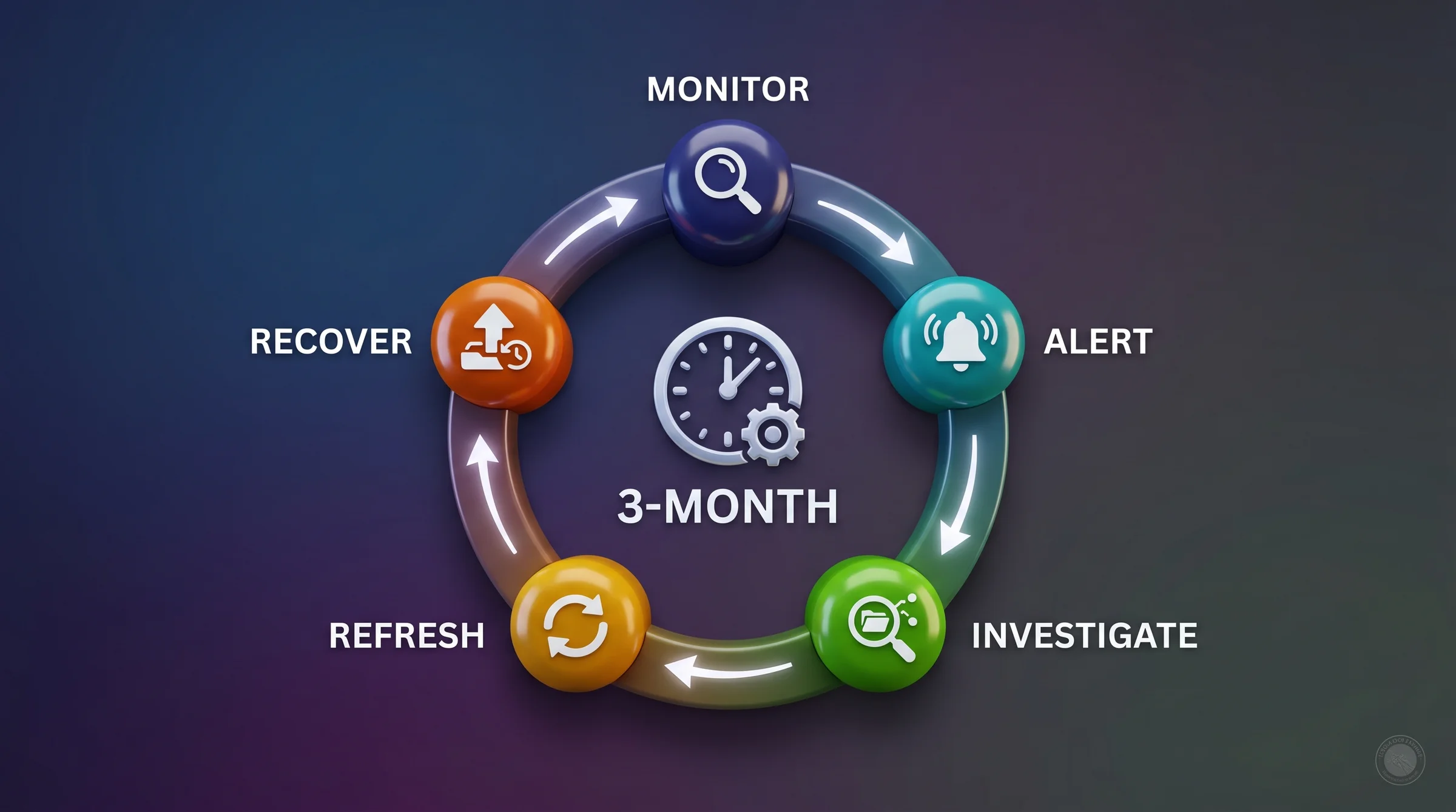
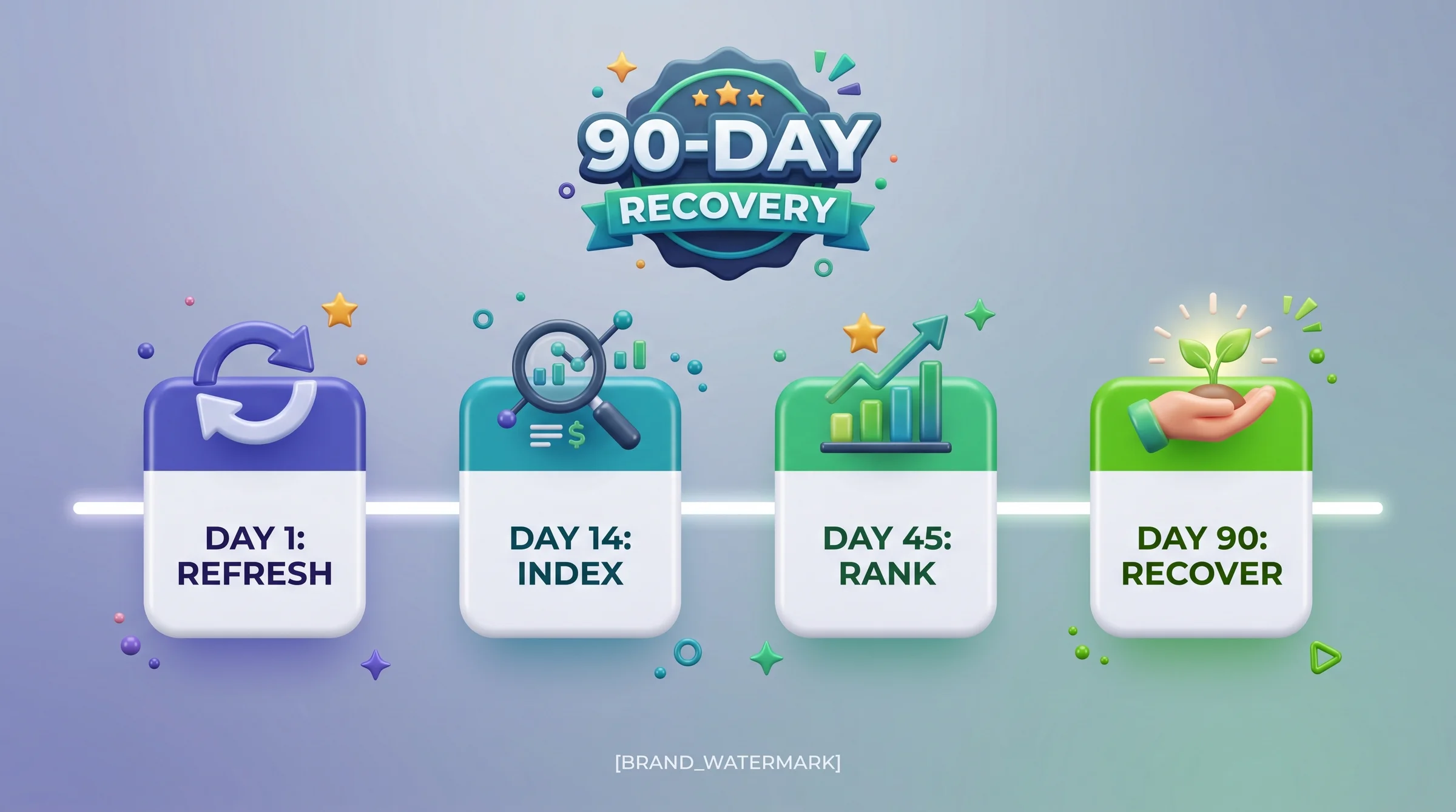
After the update is live, monitor the 90-day recovery window. Use the same GSC 3-month comparison from Practice 1, but shift the baseline to the week before republish. Most articles that genuinely deserved a refresh show measurable click recovery within 3-5 weeks. Positions typically recover before clicks. If positions recover but clicks don't improve, the meta description likely needs a refresh to improve CTR.
What about republishing to the RSS feed? Yes. Set the `pubDate` to the republish date if your CMS and RSS setup allows it. This surfaces the refreshed article in feed readers and content aggregators that syndicate from your RSS feed, generating a secondary burst of referral traffic that reinforces the freshness signal.
FAQ
How often should you do a full content refresh cycle?
For a site with 30-100 articles, a quarterly refresh cycle covers most maintenance needs. Run the 3-month GSC decay detection monthly as an early-warning system, but reserve the full 8-practice refresh process for articles that pass the 30% click-drop threshold. Give your oldest third of articles a refresh pass every 12-18 months regardless of traffic signals, since the facts inside them age whether or not rankings have moved yet.
Does refreshing content always recover traffic?
No. In our Q1 2026 refresh run, 3 of 4 real-decay articles recovered at least 80% of peak traffic within 8 weeks. The 4th article was permanently displaced by a competitor with 2026-dated content and original research we couldn't match with a refresh. The honest answer: refresh recovers traffic roughly 75% of the time when decay is genuine. The other 25% of cases need new content or a consolidation decision, not a patched article.
What is the minimum viable content refresh?
A minimum viable refresh for a decayed article includes: at least 3 updated statistics with current-year sources, a broken link audit and fix pass, a `dateModified` schema update, a meta description rewrite with the current year, and a SERP re-scan to check for intent shift. That's roughly 90 minutes of work per article. Skipping any of the five often means the refresh produces no measurable traffic recovery.
Should you update the publish date when you refresh content?
Update the `dateModified` field in your schema, yes. Changing the visible publish date is more nuanced. If the original publish date provides trust context ("Published 2021, updated 2026" signals longevity), keep both dates visible. If the original date is actively hurting CTR because it reads as stale in the SERP snippet, replace it with the republish date. There's no single right answer. It depends on how your snippet displays in the SERP for your specific query.
How do you decide between refreshing and consolidating two similar articles?
If two articles target keywords with a Jaccard similarity above 0.4 on their top-5 ranking queries in GSC, they're likely cannibalizing each other. In that case, consolidate rather than refresh both independently. Pick the stronger article (higher impressions, more backlinks, better position history) as the canonical, redirect the weaker one, and merge the unique content from the weaker article into the canonical. A refreshed canonical from a consolidation typically outperforms two separate refreshed articles targeting similar queries.
What tools do you need for a complete content refresh workflow?
You need four tool categories: a GSC API connection or access (for decay detection), a crawl tool like Screaming Frog or a Python HEAD-request script (for broken link and stat URL checks), a CMS with schema plugin like Rank Math (for `dateModified` updates), and a SERP analysis tool like Ahrefs or Semrush (for competitive re-scan). None of these require paid subscriptions at the basic level, though paid tiers make the GSC data pull and SERP analysis significantly faster at scale.
When does refreshing become a waste of time?
Past 30 months old with no traffic recovery after a prior refresh attempt, an article likely needs consolidation or pruning rather than another refresh sprint. Also skip the refresh when: the article never ranked in positions 1-20 for any query (no traffic to recover), the primary keyword has shifted to a completely different intent type that would require a full rewrite, or the topic itself is obsolete and no longer searched. Time spent refreshing genuinely obsolete content is time not spent creating new content on emerging queries.
Conclusion: From One-Time Sprint to Content Refresh Best Practices System
Content decay is a maintenance problem, not a writing problem. The 8 content refresh best practices in this guide form a complete maintenance cycle: detect decay early with 3-month GSC comparisons, audit by age, verify every stat URL, re-scan the SERP for intent shift, expand to fill gaps, refresh schema and meta, fix broken links, and republish with visible freshness signals.
The operational data from our Q1 2026 audit of 42 articles confirms the cycle works. 28.6% of stat URLs were broken. 8 internal links were dead. 4 real-decay articles needed refresh, and 3 of 4 recovered within 8 weeks. Those are not dramatic numbers individually, but they compound across a site with 50-200 articles if left unaddressed for 12+ months.
Start with Practice 1. Run the GSC decay detection on your full article inventory. The articles that surface at 30%+ click drop are your Q1 refresh list. Work through the remaining practices in order for each article on that list. The full cycle takes 90-180 minutes per article. Across a 10-article refresh sprint, that's 2-3 days of focused work for traffic recovery that compounds over the following quarter. That's a strong return on content maintenance investment.
For the full optimization layer after refresh, the SEO content optimization guide covers on-page scoring, heading structure, and entity optimization in depth.