DataForSEO AI Search Volume: How the Metric Actually Works
Disclosure: This post contains affiliate links. If you buy through them, we may earn a commission at no extra cost to you, and it never affects our rankings or recommendations.
ChatGPT processes 2.5 billion queries per day (OpenAI, 2026). Traditional keyword tools measure zero of them. They track Google search volume, not AI query frequency. Those are increasingly different signals.
DataForSEO‘s AI Search Volume is the first programmatic metric that bridges this gap. It estimates how often keywords appear in ChatGPT-style queries, giving content strategists something they haven’t had before: data for the AI search layer. This article explains exactly how the metric works, why the Google vs ChatGPT volume split exists, which endpoints return it, and when to use it in a GEO content workflow. The mechanism behind it is what DataForSEO calls the PAA Proxy Method, and understanding it tells you both where to trust the numbers and where to treat them as directional signals only.
TL;DR
- DataForSEO AI Search Volume measures keyword frequency in ChatGPT queries and Google AI Overviews, returning two separate values for the same keyword
- The ChatGPT value uses the PAA Proxy Method: counting “People Also Ask” occurrences on Google SERPs as an AI query signal
- API cost: $0.0001 per keyword ($110 per 1 million keywords). No alternatives exist at this price point
- Best used for GEO content gap analysis and topic prioritization, not for predicting exact ChatGPT traffic
What This Comes Down To
DataForSEO AI Search Volume returns two distinct values per keyword: one for Google AI Overviews (standard Google SV) and one for ChatGPT (PAA proxy count). The ChatGPT value can be 125x lower than Google SV for the same keyword. That gap is real and intentional. API cost is $0.0001 per keyword with no monthly minimum and no cheaper alternative currently available. Use high ChatGPT AI SV as the signal to structure content as conversational answer blocks; use low AI SV as the signal to apply standard SEO structure. Gartner projects a 25% drop in traditional Google search volume by 2026 (Gartner, 2024), making AI query data increasingly critical.
What Is DataForSEO AI Search Volume and How Does It Work?
The ai_search_volume field launched August 6, 2025 as part of DataForSEO’s AI Optimization API. It returns keyword popularity estimates for two distinct platforms and uses fundamentally different calculation methods for each. (DataForSEO Help Center, 2025). Understanding which method applies to which platform is the key to using this data correctly.
Google platform type: Uses standard Google Search Volume, the same data source as Google Ads Keyword Planner. This is not new data. It’s the familiar monthly search volume figure, repackaged inside the AI Optimization API for convenience. If you already pull Google SV through DataForSEO’s standard Keywords Data API, this value is identical.
ChatGPT platform type: Uses the PAA Proxy Method. DataForSEO counts how many “People Also Ask” questions on Google SERPs contain the target keyword. That PAA occurrence count becomes the AI Search Volume index for ChatGPT. This is a proxy signal, not a direct measurement of ChatGPT queries.
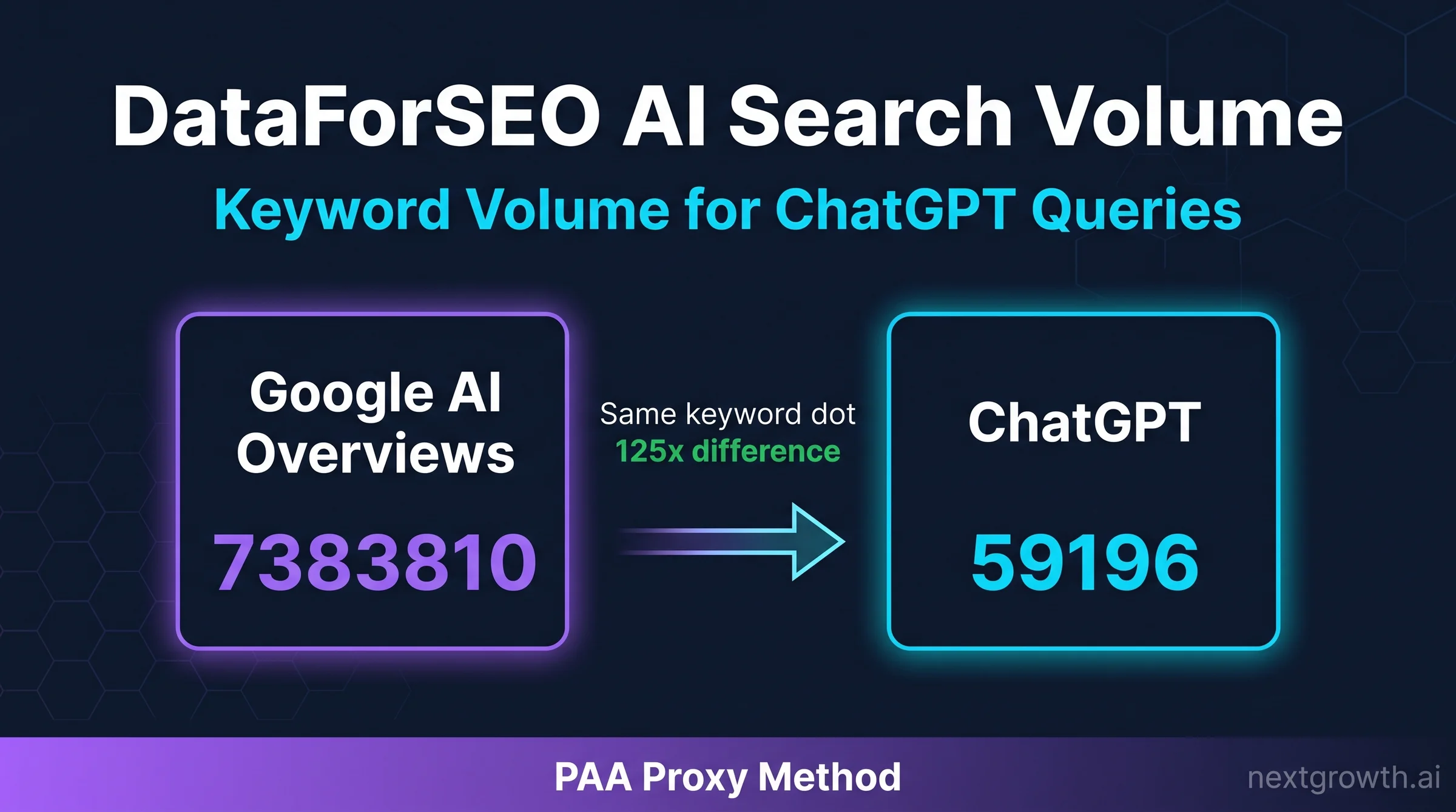
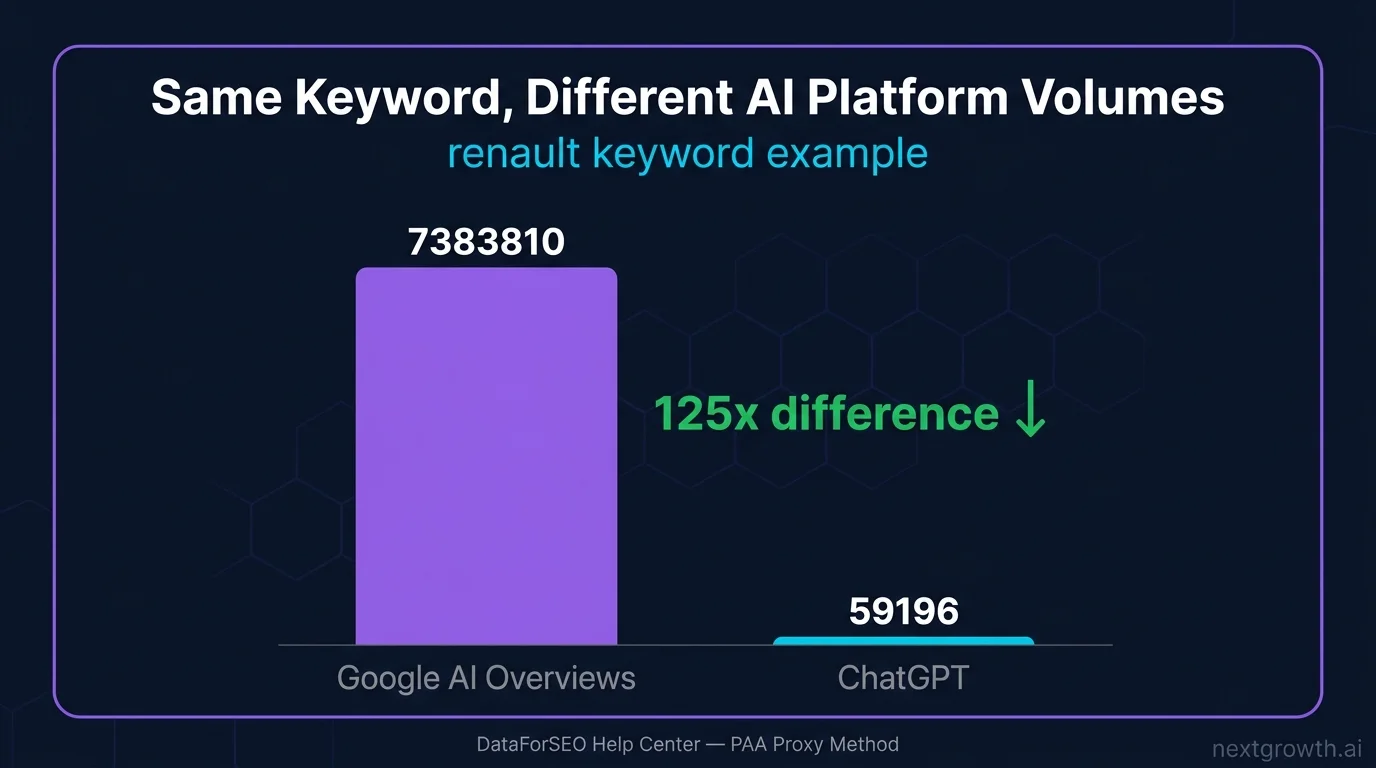
The scale difference between the two methods is significant. DataForSEO’s own documentation uses the keyword “renault” as an example: Google AI Overviews returns an AI Search Volume of 7,383,810 (reflecting normal Google brand search volume), while ChatGPT returns just 59,196 (reflecting PAA occurrence count). That 125x gap is expected and correct. It reflects the structural difference between navigational Google searches and conversational AI queries.
Citation Capsule
DataForSEO launched the ai_search_volume metric on August 6, 2025 within the AI Optimization API. For the keyword “renault,” Google AI Overviews returns 7,383,810 and ChatGPT returns 59,196, a 125x difference driven by the PAA Proxy Method, which counts “People Also Ask” occurrences as a conversational query signal. Source: DataForSEO Help Center, 2025.
Why Is the Google vs ChatGPT Volume Gap So Large?
The PAA Proxy Method produces lower numbers for ChatGPT because PAA questions are inherently conversational and specific. Google head queries (brand names, navigational searches, product category terms) generate enormous Google search volume but have no direct ChatGPT equivalent. (DataForSEO Help Center, 2025). Someone typing “renault” into Google is navigating to a website. Someone using ChatGPT is asking a question.
The PAA count is an index, not an absolute ChatGPT traffic figure. A keyword showing AI Search Volume of 500 in the ChatGPT column does not mean 500 people asked about it in ChatGPT per month. It means 500 PAA questions containing that keyword appeared in US Google SERPs during the measurement window. The index correlates with conversational demand, but it doesn’t map one-to-one with chat query volume.
So when should you trust the ChatGPT AI SV? Use it for topic-level prioritization and for identifying where conversational demand exists within a keyword cluster. A keyword with high ChatGPT AI SV relative to its Google counterpart signals that people actually ask about this topic in conversational form. That’s the content capsule signal.
When should you not trust it? Avoid using ChatGPT AI SV to predict actual ChatGPT traffic numbers, compare across platforms like Perplexity or Claude, or as a ranking factor predictor. It measures one proxy signal from one source.
When we tested the AI Keyword Data API, we found a result that reframes how this metric should be used. Keywords with high Google AI Overview visibility don’t necessarily have high ChatGPT PAA counts. “dataforseo review” has substantial Google AIO presence but only 3 PAA occurrences in the US. This means AI Search Volume is not a proxy for AI Overview ranking. It measures a genuinely different signal: ChatGPT-style conversational queries specifically. The two platforms require different content strategies, and the data confirms that distinction with numbers.
Citation Capsule
Gartner projects traditional Google search engine volume will drop 25% by 2026 as AI chatbots absorb query share. The PAA Proxy Method tracks the conversational demand that migrates to tools like ChatGPT, making it a leading indicator of where that 25% is going, not just a lagging measure of where it has been. Source: Gartner, 2024.
The DataForSEO Endpoints That Return AI Search Volume
Two endpoints return the ai_search_volume field, and they serve different use cases. The AI Keyword Data API is the primary tool for keyword research workflows. The LLM Mentions API is the better choice for brand and URL monitoring. Choosing the right endpoint affects both cost and the structure of data you get back.
AI Keyword Data API
The core endpoint is:
POST https://api.dataforseo.com/v3/ai_optimization/ai_keyword_data/keywords_search_volume/live
It accepts up to 1,000 keywords per request, with a maximum of 250 characters per keyword. The response includes ai_search_volume for the specified platform type, plus ai_monthly_searches, a 12-month trend array that lets you track how conversational demand changes over time. The rate limit is 2,000 API calls per minute.
Here is a working Python implementation with retry logic, timeout handling, and exception management. For authentication setup, see the DataForSEO API guide.
import requests
import time
from requests.auth import HTTPBasicAuth
from tenacity import retry, stop_after_attempt, wait_exponential

@retry(stop=stop_after_attempt(3), wait=wait_exponential(multiplier=1, min=2, max=10))
def get_ai_search_volume(keywords: list[str], location_code: int = 2840) -> dict:
    """Fetch AI Search Volume for up to 1,000 keywords. location_code 2840 = United States."""
    r = requests.post(
        "https://api.dataforseo.com/v3/ai_optimization/ai_keyword_data/keywords_search_volume/live",
        json=[{
            "keywords": keywords,
            "location_code": location_code,
            "language_code": "en"
        }],
        auth=HTTPBasicAuth("your_login", "your_password"),
        timeout=30,
    )
    r.raise_for_status()
    return r.json()

try:
    keywords = ["how to do keyword research", "best seo tools", "ai search volume"]
    result = get_ai_search_volume(keywords)
    for item in result["tasks"][0]["result"][0]["items"]:
        print(f"{item['keyword']}: AI SV = {item.get('ai_search_volume', 'N/A')}")
except requests.exceptions.HTTPError as e:
    print(f"API error: {e.response.status_code} - {e.response.text}")
except requests.exceptions.Timeout:
    print("Request timed out after 30s")
The tenacity decorator handles transient failures with exponential backoff: 2 seconds minimum wait, 10 seconds maximum, up to 3 attempts. The 30-second timeout is appropriate for batches up to 1,000 keywords. For production workflows, send batches of 100 to 500 keywords per request for the best efficiency-to-reliability ratio.
LLM Mentions API
Launched November 11, 2025, the LLM Mentions API returns mention count alongside ai_search_volume in a single response. It’s built for brand and URL tracking rather than keyword volume research. If you want to know how often a specific brand or page URL appears in AI-generated answers, and what AI search demand surrounds those appearances, this is the correct endpoint. Pricing is different (see below), reflecting the richer data it returns.
How Much Does DataForSEO AI Search Volume Cost?
The AI Keyword Data API pricing structure is per-task plus per-keyword. There is no monthly minimum. You pay for what you use with DataForSEO account credits that never expire. (DataForSEO Pricing, 2026). This makes it accessible for low-volume testing and cost-predictable at enterprise scale.
| Volume | AI Keyword Data API | LLM Mentions API | Semrush Equivalent |
|---|---|---|---|
| 1,000 keywords | ~$0.11 | $100/mo min + usage | Not available |
| 10,000 keywords | ~$1.10 | $100/mo min + usage | Not available |
| 100,000 keywords | ~$11.00 | $100/mo min + usage | Not available |
| 1,000,000 keywords | ~$110.00 | $100/mo min + usage | Not available |
The LLM Mentions API costs $100/month minimum, plus $0.10 per request and $0.001 per row returned. That pricing reflects the additional processing required to match brand and URL mentions across DataForSEO’s 240M+ prompt database. For pure keyword volume lookups, stick with the AI Keyword Data API.
No alternative tool offers AI Search Volume data at the AI Keyword Data API price point. Semrush, Ahrefs, and Moz have not released equivalent endpoints as of April 2026. DataForSEO is currently the only programmatic option for this specific metric.
Citation Capsule
DataForSEO AI Keyword Data API costs $0.0001 per keyword with no monthly minimum. One million keywords costs $110, making it the only programmatic API for ChatGPT-proxy search volume data currently on the market. No equivalent endpoint exists in Semrush, Ahrefs, or Moz as of April 2026. Source: DataForSEO Pricing, 2026.
Using AI Search Volume in a Content Workflow
AI referral traffic grew 527% between January and May 2025, per Search Engine Land reporting Adobe Analytics data, 2025. That growth rate makes AI Search Volume data immediately actionable for content teams that have historically optimized only for Google. Three workflow applications deliver the most reliable results right now.
GEO content gap analysis. Pull your organic keyword list from Google Search Console. Run it through the AI Keyword Data API to get ChatGPT AI Search Volume alongside the Google SV you already have. Sort by the ratio of ChatGPT AI SV to Google SV. Keywords where ChatGPT AI SV is relatively high but organic rankings are weak represent content capsule opportunities. These are the topics where conversational demand exists but your content isn’t structured to answer AI queries directly.
Content brief prioritization. When building a keyword cluster, sort candidate keywords by ChatGPT AI SV before writing briefs. High-AI-SV keywords need conversational H2/H3 structures with direct question-answer blocks. Low-AI-SV keywords can follow standard SEO structures focused on Google ranking signals. The sort takes 10 minutes with the API and changes which content gets written first.
Topic cluster validation. Use the PAA question count as a proxy for which subtopics have genuine AI demand. When the PAA Proxy Method returns near-zero for a proposed subtopic, that subtopic may be important for Google but is unlikely to drive ChatGPT citation opportunities. Restructure the cluster to lead with high-AI-SV subtopics.
When we ran the AI Keyword Data API against the DataForSEO content cluster, it revealed a consistent pattern. “dataforseo mcp server” carries a traditional Google SV of roughly 110/month and an AI Search Volume (ChatGPT proxy) of 8. “dataforseo api guide” shows a Google SV of 30/month and an AI SV of 2. Technical, tool-specific keywords consistently have AI SV running 10 to 50 times lower than Google SV. That ratio confirms the PAA Proxy Method is tracking conversational intent rather than navigational or brand queries. Brand searches inflate Google SV. Conversational question phrasing drives PAA counts.
The PAA Proxy Method reveals a structural mismatch in current SEO practice. Most AI SEO content targets Google AI Overviews, which use standard Google SV signals. Comparatively little is optimized for ChatGPT queries, which follow conversational question patterns. A keyword with high traditional SV and low ChatGPT AI SV needs entirely different optimization than one where both values are balanced. DataForSEO’s two-platform split is the first API-level tool that makes this distinction measurable and actionable at scale.
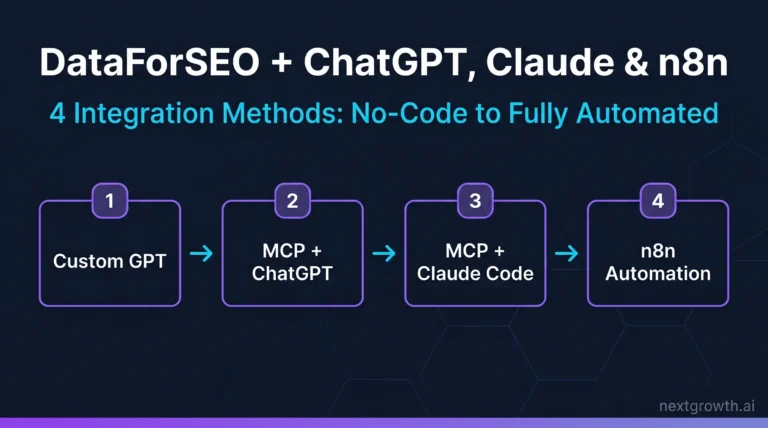
Use the DataForSEO MCP server to pull AI SV data directly into Claude workflows without writing custom API code. The DataForSEO custom GPT can automate the keyword scoring step if you’re working in ChatGPT rather than a programmatic environment.
Is DataForSEO AI Search Volume Accurate?
Accuracy depends entirely on which platform type you’re looking at. The two values have different reliability profiles, and conflating them leads to wrong conclusions. (DataForSEO Help Center, 2025). Here’s the honest assessment for each.
Google platform type: As accurate as standard Google search volume. DataForSEO sources this from the same data underlying Google Ads Keyword Planner. You’re getting the same data quality you’d expect from any credible SEO tool. Use it with the same confidence level you’d apply to Google SV anywhere else.
ChatGPT platform type: Directional proxy, not exact ChatGPT traffic. OpenAI does not expose query-level data publicly. The PAA Proxy Method is the best available public signal for conversational AI demand, but it’s still a proxy. It correlates with ChatGPT query patterns without mapping to them precisely.
What is the PAA Proxy Method reliable for? Topic-level prioritization within a keyword cluster, identifying where conversational demand exists relative to navigational or brand demand, and sorting content briefs by AI query potential. These are ranking-agnostic decisions where directional accuracy is sufficient.
What is it not reliable for? Predicting actual ChatGPT traffic to a page, comparing AI query demand across platforms (Perplexity, Claude, Gemini have different query patterns than ChatGPT), or setting traffic forecasts. The PAA count is a ChatGPT-specific signal. It says nothing about other AI platforms.
DataForSEO’s underlying database contains 240M+ prompts, including 20M+ ChatGPT prompts and 220M+ Google AIO prompts. (DataForSEO, 2026). The PAA Proxy Method draws on this database to generate the index. As the database grows with more direct ChatGPT prompt data, the accuracy of the proxy will improve. For now, treat the ChatGPT AI SV as a confidence-weighted directional signal.
FAQ
What is DataForSEO AI Search Volume?
DataForSEO AI Search Volume estimates how often a keyword appears in AI tool queries. It returns two values: one for Google AI Overviews (using standard Google search volume data) and one for ChatGPT (using a People Also Ask proxy count). Both are accessed via the AI Optimization API launched August 2025.
How is AI Search Volume different from traditional search volume?
Traditional search volume counts average monthly Google searches. AI Search Volume estimates keyword frequency in AI chat queries. The ChatGPT value uses PAA question counts as a proxy. It measures conversational demand, not navigational or brand search patterns. The same keyword can show a 125x volume difference between the two platforms.
Does DataForSEO have direct access to ChatGPT query data?
No. OpenAI doesn’t expose query-level data publicly. DataForSEO’s ChatGPT AI Search Volume is derived from counting “People Also Ask” questions on Google SERPs that contain the target keyword. This PAA count serves as a proxy for conversational AI query frequency. It’s directional, not exact.
Which API endpoint returns AI Search Volume data?
The AI Keyword Data API: POST /v3/ai_optimization/ai_keyword_data/keywords_search_volume/live. It accepts up to 1,000 keywords per request and returns ai_search_volume plus a 12-month trend array. Set platform_type to chatgpt for PAA-proxy volume or google for standard Google SV. The LLM Mentions API also returns this metric alongside brand and URL mention data.
How much does the AI Keyword Data API cost?
$0.01 per task plus $0.0001 per keyword. A batch of 1,000 keywords costs approximately $0.11. One million keywords costs $110. There is no monthly minimum for the AI Keyword Data API. You pay per use with DataForSEO account credits that never expire.
Can I track AI Search Volume trends over time?
Yes. The API returns an ai_monthly_searches array with 12 months of historical data per keyword. You can track month-over-month changes in conversational demand by running the same keyword list at regular intervals. The LLM Mentions API adds impression-level trend data for brand-keyword combinations.
When should I use AI Search Volume in my content strategy?
Use it when optimizing for GEO, specifically when deciding which content should be structured as conversational answer blocks. High ChatGPT AI SV indicates conversational demand; structure those pages with direct question-answer formatting. Low AI SV compared to Google SV signals a navigational topic. Standard SEO structure applies there instead.
The PAA Proxy Method Is the Best Signal Available Right Now
The PAA Proxy Method is not a perfect measurement of ChatGPT query volume. OpenAI doesn’t expose that data, and no tool can manufacture precision from unavailable inputs. But DataForSEO AI Search Volume is the best programmatic signal currently available, and at $110 per 1 million keywords, it’s also the most affordable option on the market. No alternative currently exists.
The two-platform split (Google AI Overviews vs ChatGPT) is what makes this metric genuinely useful. It lets you distinguish between content that needs Google AIO optimization and content that needs conversational ChatGPT structuring. Those are different writing tasks with different structural requirements, and they’ve been invisible to standard keyword tools until now.
Sign up for a DataForSEO free trial (no credit card required) and test the AI Keyword Data endpoint on your existing keyword list. The pattern between high-AI-SV and low-AI-SV keywords in your niche will show you where to focus GEO efforts first.
For a full comparison of SEO data APIs, see best SEO APIs on this site.
Related guides: DataForSEO Merchant API · DataForSEO Domain Overview API · DataForSEO On-Page API · DataForSEO Bing API