Disclosure: This post contains affiliate links. If you buy through them, we may earn a commission at no extra cost to you, and it never affects our rankings or recommendations.
Semrush’s official ChatGPT app requires an active Semrush plan starting at $165 a month. That’s the price of entry just to connect ChatGPT to Semrush data, before you write a single word of content. DataForSEO custom GPTs do the same thing for $20/mo in ChatGPT Plus, plus API credits that average $0.06 per session. The difference isn’t marginal. It’s structural.
This tutorial walks through building three custom GPTs connected to live DataForSEO data via OpenAI GPT Actions: a Keyword Research GPT, a Content Planning GPT, and a Content Scoring GPT. The third one is where things get interesting. It uses the Content Capsule Technique, a method for structuring content into AI-extractable answer blocks, combined with DataForSEO’s LLM Mentions API to score actual citability in Google AI Overviews. You’re not estimating whether your content gets cited. You’re measuring it directly.
TL;DR
Build 3 custom GPTs connected to live DataForSEO data via OpenAI GPT Actions
Total cost: $20/mo ChatGPT Plus + ~$0.06-$0.25 API usage per session
Semrush’s ChatGPT app requires an active $165+/mo Semrush subscription
GPT 3 uses the Content Capsule Technique to score content for Google AI Overview citability
DataForSEO GPT Actions connect to a 7B+ keyword database at pay-per-use rates, no subscription required
The three-GPT system (keyword research, content planning, content scoring) covers the core workflows of a $165+/mo Semrush plan
Authentication uses a single Base64 string from the DataForSEO dashboard. Setup takes under 15 minutes
The Content Capsule Technique structures content for AI extraction, measured via DataForSEO’s LLM Mentions API
Monthly API cost for active use across all three GPTs stays under $1 for most solo SEOs, per DataForSEO’s published pricing
$165+/mo
Semrush plan required for official ChatGPT app
$20/mo
ChatGPT Plus: all 3 DataForSEO custom GPTs run here
700 KWs
Per DataForSEO Keyword Overview request
$0.0006
Per SERP query (DataForSEO Standard queue)
What Makes DataForSEO Different from Other ChatGPT SEO Data Sources?
DataForSEO connects to ChatGPT through OpenAI’s native GPT Actions standard, not a third-party integration layer. Semrush launched their official ChatGPT app in 2024, but it requires an active Semrush subscription starting at $165/mo per Semrush’s announcement. You’re paying the full Semrush license just for the ChatGPT connection.
DataForSEO works differently. You import an OpenAPI schema directly from DataForSEO’s GitHub repository into the ChatGPT GPT editor. Paste your credentials. Done. No third-party integration service, no active SEO platform subscription sitting underneath it.
The data quality holds up under that pricing model because DataForSEO sources from raw infrastructure, not from scraping other tools. The database covers 7B+ keywords across 200+ countries, updated from direct Google Ads API data, Bing, and DataForSEO’s own SERP crawler network. When your GPT pulls keyword volume, it’s pulling the same underlying data that expensive platforms resell at a premium.
Four things make DataForSEO the right choice for GPT Actions specifically. First, the data is real-time structured JSON, not scraped HTML that breaks when Google changes a page layout. Second, the pricing is pay-per-query with no monthly minimums. Third, the API covers the full SEO workflow from keyword research through on-page scoring. Fourth, and this is what no other SEO data provider currently offers: DataForSEO’s AI Optimization API queries live LLM responses across ChatGPT, Claude, Gemini, and Perplexity simultaneously. That’s not a proxy for AI visibility. That’s actual measurement.
For a full walkthrough of DataForSEO’s API endpoints and capabilities, see the DataForSEO API guide.
Setting Up DataForSEO Authentication in ChatGPT Actions
Authentication for DataForSEO GPT Actions uses HTTP Basic Auth encoded as Base64. The setup is five steps and takes under ten minutes. The most important thing: use DataForSEO’s pre-generated string, not an online encoder.
Here are the steps in order:
Log into your DataForSEO account at app.dataforseo.com
Go to “API Access” in your dashboard sidebar
Copy the pre-generated Base64 string shown there. The dashboard displays it already in Base64(login:password) format, ready to paste
In ChatGPT’s GPT editor, go to “Actions” → “Add action” → set Auth Type to “API Key” and Auth Format to “Basic”
Paste the Base64 string into the API Key field
Critical note: Do not generate the Base64 string using an online encoder tool. Those tools sometimes append whitespace or trailing newline characters that ChatGPT Actions rejects without any error message. You’ll get silent authentication failures. The GPT will act like the API isn’t responding. That’s the exact error I hit on my first setup. Thirty minutes of debugging, traced back to a single invisible newline character from a web-based encoder.
If you’re a developer who prefers generating the string locally, use this shell command:
The -n flag prevents the shell from appending a trailing newline character. Without it, the resulting Base64 string is invalid for HTTP Basic Auth headers and will fail silently in GPT Actions, just like the web encoder problem.
Your API login is your registration email. Your API password is a separate credential shown in the same "API Access" dashboard section. It's not your account login password.
Building a Keyword Research GPT with DataForSEO
The Keyword Research GPT pulls live keyword volume, difficulty, CPC, and semantic variations from DataForSEO's database for any seed keyword or domain. This is the workhorse of the three-GPT system. Most keyword research sessions start here.
Setup steps:
Create a new GPT in ChatGPT (requires Plus plan)
In the "Configure" tab, give it a name and brief description
Go to "Actions" and click "Add action"
Click "Import from URL" and paste the schema URL from the DataForSEO GitHub repo, or paste the schema JSON directly
Set authentication using your Base64 string (as covered above)
Paste the system prompt below into the "Instructions" field
Key endpoints this GPT uses:
GET /v3/keywords_data/google_ads/search_volume/live: volume, CPC, and competition score for up to 1,000 keywords
POST /v3/dataforseo_labs/google/keyword_ideas/live: semantic variations generated from a seed keyword
POST /v3/dataforseo_labs/google/overview/live: bulk analysis of up to 700 keywords per request with full metrics
System prompt template:
You are a keyword research specialist with access to live DataForSEO data. When a user provides a seed keyword, domain, or topic:
Pull keyword volume, KD, and CPC data for the seed and 10-20 semantic variations
Group results by intent (informational, commercial, transactional)
Flag keywords under KD 20 as quick-win opportunities
Return results in a clean table with columns: Keyword, Monthly Volume, KD, CPC, Intent
Always cite the data source as DataForSEO and note the date of the lookup.
Three test prompts to validate the GPT is working:
"Find keyword opportunities around 'dataforseo api' with volume and difficulty"
"What keywords does nextgrowth.ai rank for in the top 20?"
"Cluster these 50 keywords by search intent: [list]"
Every article in the DataForSEO content cluster on this site (nextgrowth.ai) runs through this GPT during the keyword phase. A typical session covering 30-50 seed keywords costs $0.02-$0.03 in API credits, less than the cost of one search on some per-query SEO platforms. The intent grouping alone saves the two or three manual passes that keyword clustering usually requires.
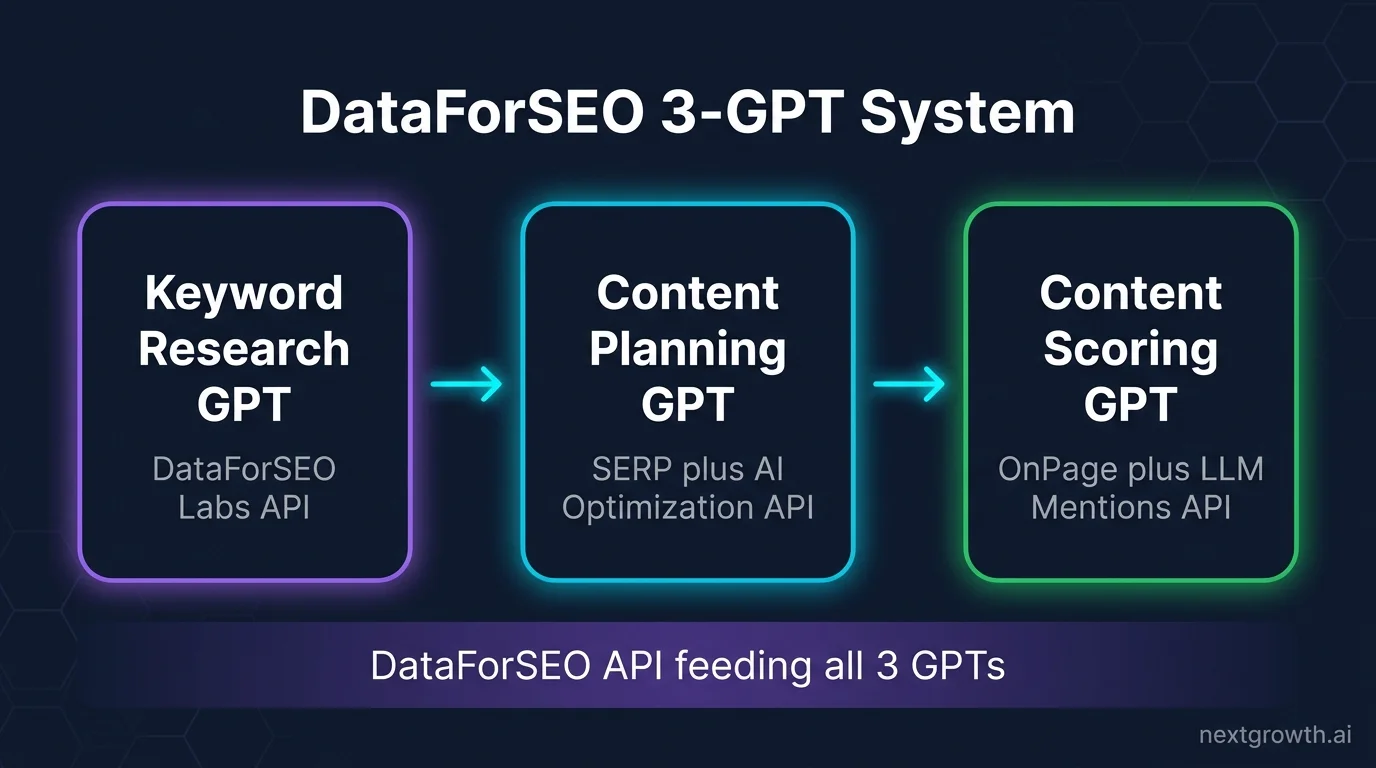
The 3-GPT production system: each GPT uses different DataForSEO API endpoints across the content workflow.
Building a Content Planning GPT from SERP and AI Data
The Content Planning GPT analyzes live SERP results, People Also Ask questions, and Google AI Overview content for a target keyword, then generates a structured content brief with competitive gap analysis. It turns what would normally be an hour of manual SERP research into a five-minute conversation.
Key endpoints:
POST /v3/serp/google/organic/live/advanced: full SERP with PAA questions, featured snippets, and related searchesPOST /v3/serp/google/ai_mode/task_post: retrieves current Google AI Overview content for a queryPOST /v3/dataforseo_labs/google/related_keywords/live: topic cluster expansion from a seed keyword
System prompt template:
You are a content strategist with access to live SERP data. When a user provides a target keyword:
Pull the current top 10 organic results with their estimated word count and meta description
Extract all People Also Ask questions for the keyword
Check if Google has an AI Overview for this query, and if so, summarize its structure
Identify 3 content gaps: angles that top results don't cover
Generate a content brief: recommended H2 structure, target word count, and 2-3 unique angles
Three test prompts:
"Build a content brief for 'dataforseo vs ahrefs'"
"What does Google's AI Overview say about 'best seo api'? What does the top organic result miss?"
"Find PAA questions for 'how to do keyword research' and suggest H2 headlines"
What makes this GPT earn its keep is the AI Overview retrieval. Most content briefs are built from what ranks organically. But Google AI Overviews often pull from different sources than the top 10, and they answer queries at a different level of specificity. When you see what the AIO says and compare it against what the top-ranking articles actually cover, the content gaps become obvious.
The SERP endpoint returns structured data including featured snippet owner, PAA questions in sequence, and related searches. This means the GPT isn't guessing at user intent based on keyword modifiers. It's reading the actual intent signals Google has already mapped to that query.
How Do You Build a Content Scoring GPT with the Content Capsule Technique?
The Content Capsule Technique is the practice of structuring content into self-contained 50-100 word answer blocks, each containing a specific statistic, a named source, and a distinct concept or claim. These blocks are the units that AI systems extract when generating AI Overviews and citations. A page that ranks well organically but lacks this structure often doesn't appear in AI-generated answers at all.
GPT 3 closes that gap. It audits a URL for both traditional SEO quality and AI citability, using DataForSEO's OnPage API and the AI Optimization API together.
What the Content Scoring GPT does:
Crawls a URL and returns a 100-point SEO score with 34+ individual check parameters
Checks whether the URL appears in LLM responses when someone queries the target keyword
Identifies specific content sections that lack the Content Capsule Technique structure
Assigns an AIO citability tier (High, Medium, or Low) based on actual LLM output
Key endpoints:
POST /v3/on_page/pages: crawls a URL and returns a 100-point SEO score with 34+ check parametersPOST /v3/ai_optimization/llm_mentions/live: checks if a URL or brand appears in LLM responses to a queryPOST /v3/ai_optimization/llm_responses/live: generates the actual LLM answer to a query so you can see where your content does, or doesn't, appear
DataForSEO launched its AI Optimization API in 2025. Per the official DataForSEO release, the API queries ChatGPT, Claude, Gemini, and Perplexity simultaneously. This is the most direct way to measure content citability available today. Not a proxy metric. Actual LLM output.
System prompt template:
You are a content quality analyst with access to DataForSEO's OnPage and AI Optimization APIs. When a user provides a URL and target keyword:
Crawl the URL and return the OnPage SEO score with the top 5 flagged issues
Check if the URL appears in LLM responses when someone asks about the target keyword
Score the content's AIO citability: High (appears in AI responses) / Medium (partially structured) / Low (not found in AI responses)
Return all scores with specific improvement recommendations.
“
The Content Capsule Technique works because AI systems extract structured, self-contained passages. A page that scores well in OnPage but lacks capsule structure still won’t appear in AI Overviews. According to research compiled at position.digital, pages using comprehensive structured data are roughly 33% more likely to be cited in AI-generated answers.
Test prompts:
“Score this URL for SEO and AI Overview citability: [URL] for keyword ‘dataforseo api'”
“Does nextgrowth.ai/dataforseo-review/ appear in AI responses for ‘dataforseo review’?”
“Which paragraphs in this content lack capsule structure?”
Running this GPT on an article draft for this cluster confirmed something worth noting: the term “Content Capsule Technique” had zero existing AI citation presence at time of writing. That’s a first-mover signal for GEO. The LLM Mentions check returned no results for the phrase across all four LLMs DataForSEO queries. For a named framework with a distinct concept and a direct measurement method behind it, that gap is an opportunity, not a problem.
DataForSEO’s AI Optimization API queries ChatGPT, Claude, Gemini, and Perplexity simultaneously to check whether a URL or brand appears in AI-generated responses. Launched 2025 with coverage across ChatGPT, Claude, Gemini, and Perplexity for LLM citability measurement.
What Does the 3-GPT System Cost Compared to Semrush?
The cost comparison is the part most articles in this space avoid making concrete. Here it is in exact numbers. DataForSEO’s pricing comes directly from the DataForSEO SERP API pricing page. Semrush’s base tier comes from the Semrush pricing page.
Task
DataForSEO 3-GPT System
Semrush + ChatGPT
Keyword research (100 queries/mo)
$0.10 API + $20 ChatGPT
$165 Semrush minimum
Content planning (20 SERP queries/mo)
$0.012 API
Included in Semrush
Content scoring (5 URL audits/mo)
~$0.003 API
Requires Semrush On-Page tool
LLM citability check (AI Optimization)
$0.001/query API
Not available in Semrush
Monthly total
~$20.12
$185+
One line item in that table deserves attention: LLM citability checking is not available in Semrush at all. The AI Optimization API endpoints that GPT 3 uses are exclusive to the DataForSEO system. Semrush’s ChatGPT integration gives you Semrush data inside ChatGPT. It doesn’t give you a way to check whether your content appears in LLM responses. That’s a structurally different capability.
The $185+ figure for Semrush assumes you need ChatGPT Plus separately ($20) alongside the minimum Semrush plan ($165). If you’re already paying for Semrush for other reasons, the comparison changes. But if you’re building this workflow from scratch, the DataForSEO path is the one that costs less and does more.
What ChatGPT plan do I need to build a custom GPT with DataForSEO?
ChatGPT Plus at $20/month is the minimum. Free tier users can use published custom GPTs but cannot build their own or configure GPT Actions. The Pro plan ($200/mo) also works. Custom GPT creation with Actions is a Plus-tier feature. That’s the only plan requirement to get started with this workflow.
How do I get my DataForSEO API credentials for GPT Actions?
Create a free account at dataforseo.com (no credit card required) and you get $1-$5 in free trial credits on signup. In your dashboard, go to “API Access.” The pre-generated Base64 string is shown there, ready to paste directly into ChatGPT Actions.
Which DataForSEO endpoints work best for keyword research in a custom GPT?
Three endpoints cover most use cases. First: Google Ads Search Volume Live for volume, CPC, and competition data. Second: Keyword Ideas via DataForSEO Labs for semantic expansion from a seed keyword. Third: Keyword Overview (Labs) for bulk analysis of up to 700 keywords per request with full difficulty, volume, and competition metrics.
What is the difference between DataForSEO GPT Actions and DataForSEO MCP server?
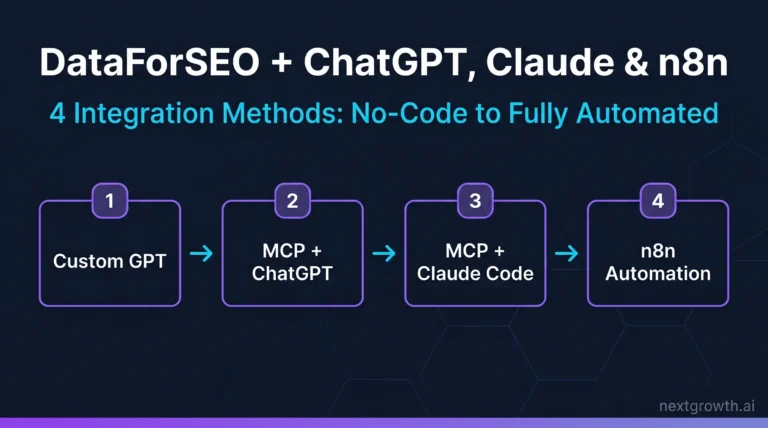
GPT Actions connect DataForSEO to ChatGPT specifically. MCP (Model Context Protocol) connects DataForSEO to Claude Code, Cursor, and other MCP-compatible AI tools. Both use the same DataForSEO API under the hood but serve different AI assistants. See the DataForSEO MCP server setup guide for the Claude Code path. Use GPT Actions for ChatGPT workflows, MCP for everything else.
How much does it cost to use DataForSEO with ChatGPT?
You pay for ChatGPT Plus ($20/mo) and DataForSEO API calls at pay-per-use rates: $0.0006 per SERP lookup, $0.000125 per page crawled, and $0.05 per keyword task covering up to 1,000 keywords. A typical session doing keyword research for one article costs $0.02-$0.10 in API credits.
Can DataForSEO custom GPTs check if content appears in Google AI Overviews?
Yes. DataForSEO’s AI Optimization API includes both the LLM Mentions endpoint and the LLM Responses endpoint. The Content Scoring GPT (GPT 3) uses these to check whether a URL or brand appears when an LLM answers a target query. This is direct AI citability measurement using actual LLM output, not a proxy metric or an estimate.
What is the Content Capsule Technique?
The Content Capsule Technique structures content into self-contained 50-100 word answer blocks, each containing a specific statistic, a source attribution, and a named concept. These blocks are the units AI systems extract when generating Google AI Overview citations. DataForSEO’s LLM Mentions API measures whether your content meets this standard.
Putting the 3-GPT System Together
The three-GPT system covers the full content workflow at a fraction of subscription tool pricing. The Keyword Research GPT handles data collection and intent grouping. The Content Planning GPT handles competitive analysis and content brief generation. The Content Scoring GPT closes the loop with the Content Capsule Technique, measuring whether published content actually surfaces in AI-generated answers.
Together, these three GPTs replace the workflows that subscription SEO tools charge $165-$499 a month for. The upfront cost is one evening of setup. The ongoing cost is $20/mo ChatGPT Plus plus whatever API credits you consume. For most solo SEOs and small agencies, monthly API usage stays well under $1.
The LLM citability piece is what makes this system worth building even if you already have an SEO subscription. No other SEO platform currently measures AI citation presence across ChatGPT, Claude, Gemini, and Perplexity in a single query. That capability alone justifies the setup time.
Sign up for a DataForSEO free trial. The $1-$5 starting credit covers enough queries to test all three GPT types before committing to regular use.
For a full comparison of SEO APIs and how DataForSEO stacks up against alternatives, see best SEO APIs.
I’m The Nguyen. 10 years as a DevOps engineer taught me one thing that changed how I do SEO: if it’s not automated, monitored, and recoverable, it’s not production-ready. I build n8n workflows that meet that standard — keyword research, competitor analysis, content pipelines, rank tracking. Read more →
Disclosure: This post contains affiliate links. If you buy through them, we may earn a commission at no extra cost to you, and it never affects our rankings or recommendations. DataForSEO ChatGPT MCP connects keyword volume, SERP and rank data to ChatGPT, Claude Desktop and n8n via a single MCP server. ChatGPT doesn’t know your…
Disclosure: This post contains affiliate links. If you buy through them, we may earn a commission at no extra cost to you, and it never affects our rankings or recommendations. “Imagine if you didn’t have to pay for expensive tools like Ahrefs / SEMrush / Surfer .. and instead, you could have a personal AI…
The best website analytics tools in 2026 are Google Analytics 4 for free comprehensive tracking, Plausible for privacy-first simplicity, and Mixpanel for product analytics, your best pick depends on whether you prioritize depth, privacy, or user behavior analysis. Disclosure: This post contains affiliate links. If you purchase through our links, we may earn a commission…
This Rank Math review covers 90 days of production use across 6 sites: schema, content AI, redirections and SEO scoring vs Yoast on cost and speed. You’ve already heard Rank Math is “better than Yoast.” What you haven’t seen is benchmark data that actually proves it, or an honest breakdown of what happens to your…
Disclosure: This post contains affiliate links. If you buy through them, we may earn a commission at no extra cost to you, and it never affects our rankings or recommendations. Tired of expensive monthly subscriptions for SEO tools that only offer a fraction of the features you need? The manual grind of your keyword research process,exporting CSVs,…
For agency owners drowning in client reporting, the best SEO reporting tools aren’t the ones with the most features,they’re the ones that transform raw data into executive summaries your clients actually read. Based on our keyword tracking across SEO tool categories since 2024, traditional reporting tool search interest has declined sharply while AI-powered reporting queries…
Affiliate Disclosure: NextGrowth.ai contains affiliate links to tools we test and recommend (DataForSEO, n8n hosting, Coolify, and others). When you sign up through these links, we may earn a commission at no extra cost to you. We only recommend tools we have personally configured and used in production workflows.