Replace SEO Tools with Claude Code + DataForSEO Stack
Disclosure: This post contains affiliate links. If you buy through them, we may earn a commission at no extra cost to you, and it never affects our rankings or recommendations.
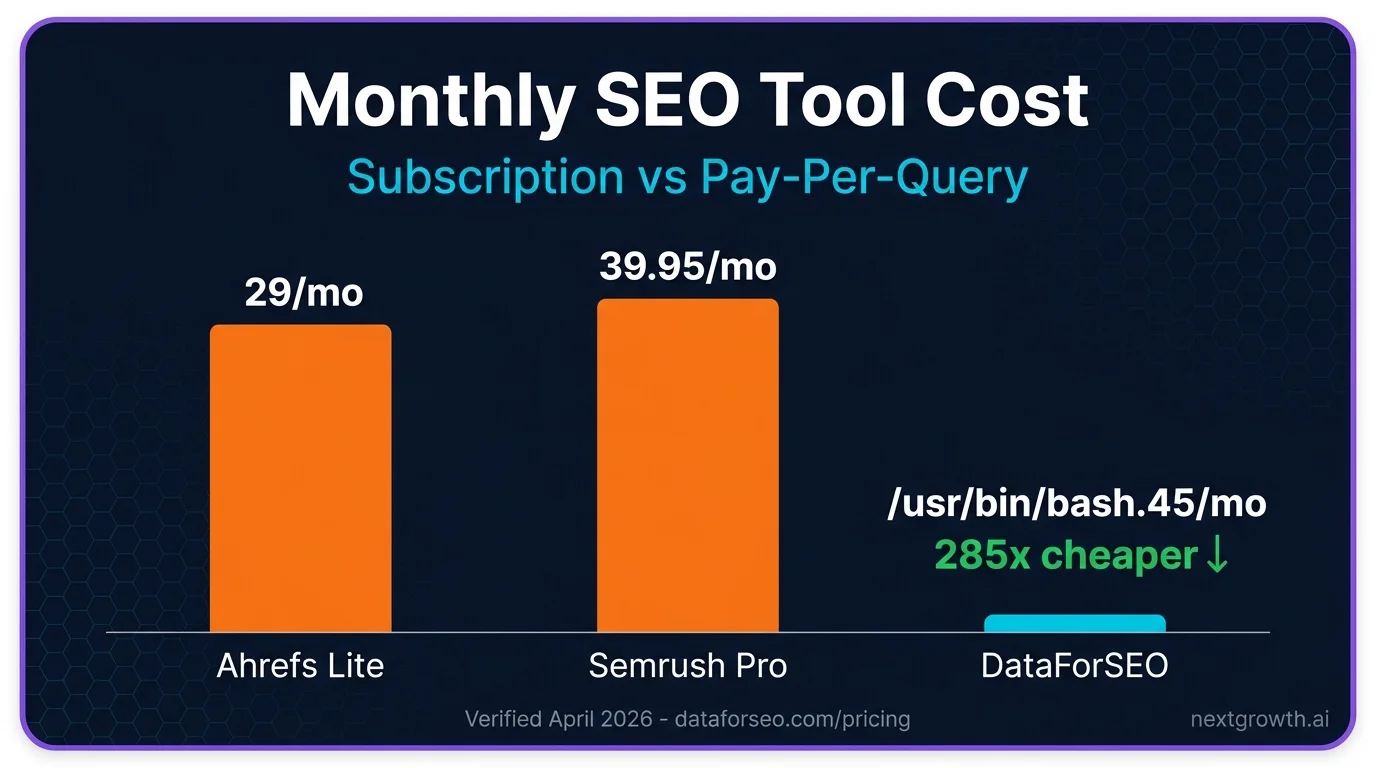
Replace SEO tools like Ahrefs and Semrush with a Claude Code + DataForSEO workflow that runs the same core audit at 99% lower cost. Ahrefs Lite costs $129 a month. A Claude Code + DataForSEO workflow runs the same core audit for $0.06. That gap exists because of what I call The Idle Capacity Tax: subscription SEO tools charge you 100% of their platform capacity every month, but the average SEO team uses roughly 20% of what they pay for. The rest sits idle while your credit card gets charged the same amount.
This article covers the exact stack that replaces Ahrefs and Semrush for query-based SEO workflows: DataForSEO’s pay-per-query API connected to Claude Code via the official MCP server. You get real SERP data, OnPage crawls, backlink checks, and keyword research at a fraction of the subscription cost. I’ll show you the setup steps, the real cost math across three usage scenarios, and an honest comparison of where DataForSEO matches up and where Ahrefs still leads.
TL;DR
- Ahrefs Lite costs $129/mo; a Claude Code + DataForSEO workflow costs $0.33-$0.45/mo for the same tasks
- DataForSEO gives full API access at a $50 deposit; Ahrefs locks API behind $1,499/mo Enterprise
- Claude Code MCP setup takes under 10 minutes via 3 official install methods
- Best for: solo SEOs, developers, and small agencies running programmatic workflows
What This Comes Down To
- Ahrefs Lite starts at $129/mo; the equivalent DataForSEO usage for a solo SEO costs $0.33/mo.
- DataForSEO’s SERP and keyword data is functionally equivalent to Ahrefs for rank tracking and research workflows.
- The MCP server connects DataForSEO to Claude Code in under 10 minutes using plain-English instructions.
- API access with Ahrefs requires a $1,499/mo Enterprise plan; DataForSEO requires only a $50 deposit.
- Content Explorer has no DataForSEO equivalent. Non-technical teams relying on visual dashboards should stay with Ahrefs.
Why You’re Paying for 80% You Don’t Use
The Idle Capacity Tax is the core problem with flat-rate SaaS SEO subscriptions. Every month, Ahrefs charges you the same $129 whether you ran 20 queries or 2,000. The platform includes keyword research, site audits, rank tracking, content gap analysis, competitor content explorer, historical SERP snapshots, broken link analysis, and more. Most teams touch three or four of those features regularly. The rest? Idle.
Think about how a typical freelance SEO actually works. You track a set of keywords weekly. You run a site audit on a new client at the start of an engagement. You check backlinks when something looks off. That might add up to 200 SERP lookups in a month, an occasional crawl of a few hundred pages, and a handful of backlink spot-checks.
Here’s what that costs on each platform. With Ahrefs, it’s $129, the Lite plan minimum (Ahrefs pricing page). With DataForSEO, the math looks different:
- 200 SERP lookups × $0.0006 = $0.12
- 300-page crawl (basic) × $0.000125 = $0.0375
- 5 backlink checks × $0.02 = $0.10
- Total: $0.26 (all sourced from DataForSEO SERP API pricing)
That’s $0.26 vs $129. The difference isn’t a discount. It’s the elimination of the Idle Capacity Tax: the cost of platform features you never open. Subscription pricing works great for vendors. Pay-per-query pricing works better for anyone with variable, focused usage patterns.
The SaaS model also doesn’t scale down. If you’re between clients for a month, Ahrefs still charges $129. DataForSEO charges whatever you queried, which might be $0. That asymmetry matters more than most people factor into their tool budget.
What Does the Claude Code + DataForSEO Stack Actually Replace?
The honest answer: most of what you actually use. Not everything. The table below maps the common Ahrefs and Semrush features to their DataForSEO equivalents with actual per-unit pricing.
| Ahrefs/Semrush Feature | DataForSEO Equivalent | Cost |
|---|---|---|
| Ahrefs SERP data | DataForSEO SERP API | $0.0006/query |
| Ahrefs Site Audit / Screaming Frog | DataForSEO OnPage API | $0.000125/page (basic crawl) |
| Ahrefs Backlinks | DataForSEO Backlinks API | $0.02/request |
| Semrush Keyword Magic Tool | DataForSEO Keywords Data API | $0.05/task (up to 1,000 KWs) |
| Manual orchestration / scripting | Claude Code + DataForSEO MCP | Plain-English instructions |
The orchestration row matters most. DataForSEO has always been powerful but required technical effort to use: Python scripts, API wrappers, manual JSON parsing. The MCP server changes that. Claude Code sits on top of the DataForSEO API and accepts plain-English instructions. You describe what you want; Claude handles the API calls and structures the output.
For a detailed walkthrough of all DataForSEO API modules, see the DataForSEO API guide.
Setting Up the DataForSEO MCP with Claude Code
DataForSEO offers three official methods to connect their MCP server to Claude Code. The full documentation is available in the official DataForSEO MCP documentation. Setup takes under 10 minutes with the remote server method.
Method 1: Remote MCP Server (Recommended for Most Users)
This is the simplest path. No local install, no dependency management. You add a configuration block to your .mcp.json file in your Claude Code project directory and provide your DataForSEO API credentials.
{
  "mcpServers": {
    "dataforseo": {
      "command": "npx",
      "args": ["-y", "mcp-remote", "https://mcp.dataforseo.com/mcp"],
      "env": {
        "DATAFORSEO_USERNAME": "[email protected]",
        "DATAFORSEO_PASSWORD": "your_api_password"
      }
    }
  }
}
Your DataForSEO username is the email address you registered with. Your API password is set in the DataForSEO dashboard under API access settings. It’s separate from your login password. Save the file, restart Claude Code, and the DataForSEO tools appear automatically in your available MCP servers.
Method 2: NPM Package (Best for Developers)
If you prefer a local install you control, use the NPM package:
npm install -g @dataforseo/mcp
After installation, configure your .mcp.json to point to the local binary path instead of the remote server URL. This method lets you pin to a specific package version and audit the source code before running.
Method 3: Local Server (Full Control)
Clone the official DataForSEO MCP GitHub repository, install dependencies with npm install, and run the server locally. This gives you the most control: inspect the source, modify behavior, and run it in an air-gapped environment if your compliance requirements demand it.
What You Get After Setup
After connecting via any method, Claude Code gains access to hundreds of DataForSEO tools across 9 modules: SERP, OnPage, Backlinks, Keywords Data, Business Data, App Data, Labs, Merchant, and Domain Analytics. You don’t need to know which module handles what. You describe your task in plain English and Claude Code routes the request to the correct API endpoint.
For the full step-by-step walkthrough with screenshots, see the DataForSEO MCP server setup guide.
The Full Cost Breakdown
Here’s the real-world cost math across three usage scenarios. All prices sourced from official DataForSEO pricing pages for SERP API and OnPage API. No estimates inflated or deflated. These are the actual per-unit rates at standard queue pricing.
| Task | Solo Freelancer | Small Agency | Mid-Size Agency |
|---|---|---|---|
| SERP tracking | 50 KWs × 4 wks × $0.0006 = $0.12 | 500 KWs × 4 wks × $0.0006 = $1.20 | 2,000 KWs × 4 wks × $0.0006 = $4.80 |
| OnPage crawl | 100 pages basic = $0.013 | 500 pages JS × $0.00125 = $0.625 | 2,000 pages JS × $0.00125 = $2.50 |
| Backlink checks | 5 domains × $0.02 = $0.10 | 20 domains × $0.02 = $0.40 | 50 domains × $0.02 = $1.00 |
| Keyword research | 2 tasks × $0.05 = $0.10 | 10 tasks × $0.05 = $0.50 | 20 tasks × $0.05 = $1.00 |
| DataForSEO total | $0.33/month | $2.73/month | $9.30/month |
| Subscription equivalent | Ahrefs Lite: $129/mo | Semrush Guru: $249.95/mo | Semrush Business: $499.95/mo |
The Semrush Business figure deserves a note: it’s the minimum plan that includes API access (Semrush pricing). So the real comparison for any mid-size agency that wants programmatic data access is $499.95/month vs $9.30/month. That’s where the Idle Capacity Tax hits hardest. You’re not paying for features. You’re paying for the right to access your own query results via API.
DataForSEO credits don’t expire. If you have a slow month, your balance carries forward. No use-it-or-lose-it pressure.
Is DataForSEO’s Data as Accurate as Ahrefs?
DataForSEO SERP data pulls real Google results in two modes: Live (immediate, slightly higher cost) and Standard queue (async, ~30 seconds, lower cost). Both return actual Google SERPs for the specified location, device, and language. For rank tracking and competitor SERP analysis, the data matches what you’d get pulling the page manually.
Keyword data comes from a database of 7B+ keywords across 69 countries and 35 languages, according to dataforseo.com/databases. That’s comparable in scope to the major subscription platforms for most research workflows.
According to DataForSEO’s own databases page, the Google Keywords Database contains 7B+ keywords across 69 countries and 35 languages, comparable in scope to the major subscription platforms for rank tracking, keyword research, and competitor gap analysis workflows.
Source: DataForSEO Databases page
Where Ahrefs is still ahead: backlinks. Ahrefs has spent over a decade building its backlink index, and the depth of historical link data, referring domain quality signals, and anchor text analysis is genuinely more mature. For most day-to-day SEO work (rank tracking, keyword gap analysis, on-page audits, competitor SERP monitoring), DataForSEO is functionally equivalent. For deep competitive backlink research across millions of domains, particularly for link building prospecting, Ahrefs remains the stronger choice.
Be honest with yourself about which category your actual work falls into. If you’re running weekly rank checks and monthly audits, DataForSEO covers you. If you’re doing large-scale link building campaigns where index depth matters, factor in Ahrefs’ backlink advantage.
For the detailed accuracy comparison across all data types, see the full DataForSEO review.
What Does Claude Code Actually Do in This Stack?
Claude Code is the orchestration layer between you and the DataForSEO API. After MCP setup, you don’t write API calls. You describe what you want in plain English, and Claude handles the endpoint selection, parameter formatting, API execution, and output structuring. Here’s what that looks like in practice.
We used exactly this workflow to research the content cluster for this site. The full research phase (competitor SERP analysis, keyword gap identification, and keyword database lookups across roughly 15 target terms) cost under $1 in API usage. That’s not an estimate. That’s the actual DataForSEO credit deducted from the account.
Three concrete examples of what you type after setup:
Audit request: “Audit the top 100 pages of nextgrowth.ai and flag pages with missing meta descriptions, thin content, and broken internal links.” Claude triggers the OnPage API, crawls the specified pages, and returns a structured report grouped by issue type. You get a table of URLs with flagged issues, not a raw JSON dump. Competitor gap: “What keywords does [competitor.com] rank for in positions 1-10 that nextgrowth.ai doesn’t?” Claude triggers the SERP API and the Labs intersection endpoint, pulls ranking data for both domains, and returns a prioritized gap list with search volume and difficulty data. This query used to require a Semrush Guru subscription or an Ahrefs Standard plan. Now it costs a few cents. Backlink velocity: “Show me the backlink velocity for [domain.com] over the last 6 months.” Claude calls the Backlinks API with appropriate date filters and returns a timeline of new referring domains, lost domains, and net change per month. You can ask follow-up questions in the same session (“which of those lost links were from high-authority domains?”) and Claude refines the query without you touching any API documentation.The pattern is the same across all three: you state the SEO task, Claude selects the correct DataForSEO module, executes the API call, and returns structured analysis. The friction between “I want to know this” and “here is the answer” collapses significantly compared to either a manual dashboard workflow or writing your own API scripts.
Who Should Switch, and Who Should Stay?
Not everyone should switch. Here’s the honest breakdown.
Switch to DataForSEO + Claude Code if:- You or your team can use Claude Code. No coding required after MCP setup, just plain-English instructions
- Your usage stays under roughly 5,000 keyword lookups and 10,000 pages crawled per month
- You need programmatic API access without paying $1,499/mo for Ahrefs Enterprise pricing-level Enterprise access
- You run n8n, Make, or custom Python scripts that need raw SEO data via API
- You’re a solo SEO or small agency where $129-$499/month in subscription costs represents real budget pressure
- Your team is non-technical and depends on visual dashboards, alerting systems, and point-and-click workflows
- You do competitive content research at scale. Ahrefs Content Explorer has no DataForSEO equivalent, and it’s genuinely valuable for finding link-worthy content angles
- You need client-facing reports that carry Ahrefs or Semrush branding for credibility
- Deep link building campaigns where index maturity matters for prospecting quality
The decision isn’t ideological. It’s a usage pattern question. High-volume dashboard users with non-technical teams get real value from Ahrefs’ product design. Query-based, programmatic, or API-dependent workflows get crushed by the Idle Capacity Tax that subscription pricing imposes.
For the full comparison across DataForSEO and other SEO API alternatives, see best SEO APIs.
FAQ
Is DataForSEO as accurate as Ahrefs?
For SERP and keyword data: functionally equivalent. DataForSEO pulls real Google results in Live or Standard queue mode, and its keyword database covers 7B+ keywords across 69 countries. For backlinks, Ahrefs’ index is larger and more mature, built over 10+ years. For most rank tracking and keyword research workflows, DataForSEO delivers accurate data at a fraction of the subscription cost.
Can I use DataForSEO without coding skills?
Yes. The DataForSEO MCP server connects directly to Claude Code, which means you issue plain-English instructions (“audit this URL,” “find keyword gaps vs [competitor]”) and Claude handles the API calls. No Python, no scripts, no JSON wrangling. The MCP setup takes under 10 minutes using the remote server method from the official DataForSEO MCP documentation.
How much does DataForSEO cost per month?
There is no monthly fee. You deposit a minimum of $50 in credits (they never expire) and pay per query: $0.0006 per SERP lookup, $0.000125 per page crawled (basic), $0.02 per backlink domain check. A typical solo SEO workflow runs $0.33-$0.45 per month in actual API usage. All pricing comes from DataForSEO SERP API pricing and DataForSEO OnPage API pricing.
How do I connect DataForSEO to Claude Code?
Add the DataForSEO MCP configuration to your .mcp.json file in your Claude Code project directory. The remote server method requires only your API credentials. No local install needed. DataForSEO’s official docs cover all three methods (remote, NPM, local). See this guide for step-by-step instructions with the exact configuration blocks.
What is the DataForSEO MCP server?
MCP (Model Context Protocol) is the standard that lets Claude Code connect to external APIs and tools. The DataForSEO MCP server exposes hundreds of DataForSEO tools across 9 modules (SERP, OnPage, Backlinks, Keywords, Labs, and more) so Claude Code can call them directly from your project context. No manual API calls required. Claude selects the right endpoint based on your plain-English instruction.
Does DataForSEO have a free trial?
Yes. Sign up and receive $1 in free credits with a personal email or $5 with a business email. No credit card required, according to the DataForSEO free trial documentation. The $5 credit covers approximately 8,300 SERP lookups in Standard queue mode. That’s enough to run a complete keyword research project and a competitor SERP analysis before you deposit anything.
What’s the real cost of Ahrefs API access?
This is the hidden pricing trap most comparisons skip. Ahrefs Lite ($129/mo) and Standard ($249/mo) plans do not include API access. To programmatically access Ahrefs data via API, you need the Enterprise plan at $1,499/mo, as documented in this Ahrefs Enterprise pricing. DataForSEO gives full API access starting from a $50 deposit. For anyone building programmatic workflows, the actual comparison is $1,499/mo vs $50 one-time minimum.
Conclusion
The Idle Capacity Tax is real, and it compounds every month you stay on a flat-rate subscription you don’t fully use. For solo SEOs and small agencies running query-based workflows, the math is straightforward: Ahrefs and Semrush charge for the whole product every month. DataForSEO charges for what you actually query.
Claude Code removes the last remaining friction in this setup. You no longer need to write API scripts or parse raw JSON. You describe what you want, the MCP server routes the request, and you get structured output.
The switch makes sense if you’re comfortable with Claude Code and your work is query-based rather than dashboard-dependent. If your team is non-technical, start with DataForSEO’s built-in dashboard (it exists and works well) and add Claude Code incrementally as your comfort with the workflow grows.
Sign up for the DataForSEO free trial first. The $1-$5 in free credits is enough to run a real audit and validate the workflow before committing your budget.
Related guides: DataForSEO Merchant API · DataForSEO Domain Overview API · DataForSEO On-Page API · Autonomous SEO Agents with DataForSEO