DataForSEO vs Bright Data: SERP API Compared (2026)
Disclosure: This post contains affiliate links. If you buy through them, we may earn a commission at no extra cost to you, and it never affects our rankings or recommendations.
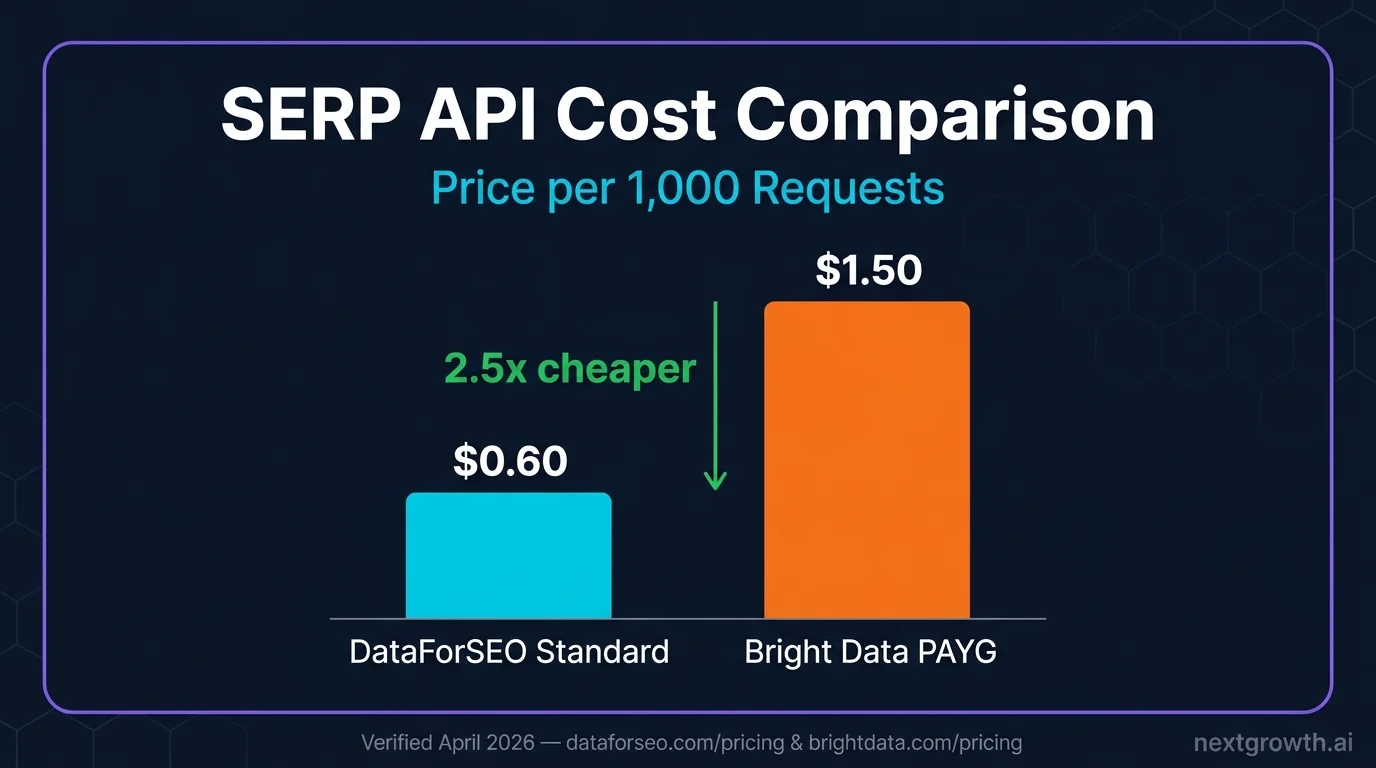
DataForSEO vs Bright Data: which SERP API delivers more for less? Production-tested cost, latency and country coverage compared head to head. Most teams searching for a SERP API get stuck on the same question: DataForSEO at $0.60/1K SERPs versus Bright Data at $1.50/1K PAYG, why does one cost 2.5x more and what do you actually get for it? The answer isn’t a simple “one is better.” These two products are built for fundamentally different buyers. DataForSEO is a purpose-built SEO data platform. Bright Data is a proxy infrastructure company that built a SERP API as one product among dozens.
I call this the SEO-vs-Infrastructure Split. It explains every meaningful difference between them: pricing model, data format, onboarding complexity, and who gets the best support experience. This comparison covers pricing across all tiers, response format (structured JSON vs raw HTML), speed, data storage, developer experience, and a clear decision framework. If you’re choosing between these two APIs for SEO tooling, rank tracking, or any data pipeline work, this gives you the real numbers.
TL;DR
- DataForSEO Standard queue costs $0.60/1K SERPs, 2.5x cheaper than Bright Data’s $1.50/1K PAYG rate.
- DataForSEO returns structured JSON with 60+ SERP types; Bright Data returns raw HTML with ~14 item types.
- Bright Data’s live response is ~0.89s vs DataForSEO Live at ~6s, choose BD only when real-time speed is non-negotiable.
- SEO teams and agencies: DataForSEO wins on every metric that matters. Enterprises needing multi-engine raw data: Bright Data wins.
What This Comes Down To
- DataForSEO Standard queue ($0.60/1K) costs 2.5x less than Bright Data PAYG ($1.50/1K) for batch SERP work
- DataForSEO returns structured JSON with 60+ SERP item types; Bright Data returns raw HTML with roughly 14 types
- Bright Data’s live response time (~0.89s) beats DataForSEO Live (~6s) for real-time use cases
- DataForSEO stores results for 30 days; Bright Data stores for 24 hours
- The SEO-vs-Infrastructure Split is the core framework: DFS built for SEO data consumers; BD built for proxy infrastructure with a SERP add-on
$0.60
DFS Standard / 1K
$1.50
Bright Data PAYG / 1K
60+
DFS SERP types
30 days
DFS result storage
What Separates DataForSEO from Bright Data?
The SEO-vs-Infrastructure Split is the single most useful frame for this comparison. DataForSEO was founded in 2015 specifically to serve SEO professionals who need structured, pre-parsed search data without building scraping infrastructure. Every product decision they’ve made since then flows from that mission. Bright Data (formerly Luminati Networks, rebranded in 2021) started as a residential proxy network and became the world’s largest proxy provider. Their SERP API is one item in a catalog that includes web unlocker, browser API, and dataset marketplace.
That origin difference is not just a marketing footnote. It shapes everything downstream.
When DataForSEO processes a SERP request, the response comes back as structured JSON with parsed result types already separated: organic results, featured snippets, local pack entries, People Also Ask boxes, shopping ads, image packs, knowledge graphs, and 50+ more. You get a data object you can drop directly into a database or workflow tool. No parsing code required.
When Bright Data processes a SERP request, you get the raw HTML of the search results page. You extract what you need from that HTML yourself. Bright Data’s web scraping IDE and pre-built scrapers help, but the core product still hands you a page source, not a data model.
This also shows up in setup complexity. DataForSEO uses HTTP Basic Auth with a base64-encoded login and password. You authenticate, send a request, retrieve results. No proxy zone configuration, no residential IP pool selection, no geo-targeting setup before you can run your first query. I got my first result from the DataForSEO API guide in under 10 minutes.
Bright Data requires creating a proxy zone with custom credentials, selecting your proxy type (datacenter, ISP, residential, or mobile), and routing requests through their infrastructure. That’s the right design for a proxy platform. It’s more setup than most SEO teams need for SERP data alone.
In practice, the SEO-vs-Infrastructure Split means DataForSEO onboards an SEO developer in an afternoon. Bright Data onboards a data engineer over a day or two. Neither is wrong. They just serve different people.
DataForSEO vs Bright Data: Pricing Breakdown
DataForSEO offers three delivery modes at three price points, with no monthly minimum on any of them (DataForSEO Pricing, April 2026). Standard queue costs $0.60/1K SERPs and returns results in about 5 minutes. Priority queue costs $1.20/1K and processes within roughly 1 minute. Live mode costs $2.00/1K and returns results synchronously in about 6 seconds. Credits purchased on DataForSEO never expire.
Bright Data’s SERP API pricing is structured around volume commitments (Bright Data Pricing, April 2026). PAYG costs $1.50/1K with no monthly minimum. Their 380K queries plan costs $499/month ($1.30/1K effective). The 900K plan costs $999/month ($1.10/1K). The 2M plan costs $1,999/month ($1.00/1K). All tiers return results at the same ~0.89 second response time.
| Provider / Tier | Price / 1K | Turnaround | Monthly Min |
|---|---|---|---|
| DataForSEO, Standard Queue | $0.60 | ~5 min | None |
| DataForSEO, Priority Queue | $1.20 | ~1 min | None |
| DataForSEO, Live Mode | $2.00 | ~6 sec | None |
| Bright Data, PAYG | $1.50 | ~0.89 sec | None |
| Bright Data, 380K plan | $1.30 | ~0.89 sec | $499/mo |
| Bright Data, 900K plan | $1.10 | ~0.89 sec | $999/mo |
| Bright Data, 2M plan | $1.00 | ~0.89 sec | $1,999/mo |
Source:
Pricing verified April 2026 from DataForSEO Google Organic SERP pricing page and Bright Data SERP API pricing page. DataForSEO Standard at $0.60/1K versus Bright Data PAYG at $1.50/1K represents a 2.5x price difference for batch SERP processing.
The critical strategic difference: Bright Data has no monthly minimum at PAYG rates, but every meaningful volume discount requires a committed monthly spend of $499 or more. DataForSEO has no monthly minimum at any tier. You pay $0.60/1K whether you run 1,000 queries or 1,000,000 in a month. For early-stage tools and seasonal workloads, that flexibility has real dollar value.
Does Bright Data Return the Same Data as DataForSEO?
No. This is the format split, and it matters more than the price difference for most SEO teams. DataForSEO parses every SERP response into structured JSON covering 60+ result item types: organic results, featured snippets, local pack entries, People Also Ask boxes, knowledge graphs, shopping ads, job listings, podcasts, image packs, top stories, Twitter carousels, hotel results, and many more. Bright Data returns the raw HTML page source. You get what a browser would render, and you extract what you need from that HTML yourself.
The engineering cost of parsing raw HTML is almost always underestimated. A basic Python parser for organic results takes 2-4 hours to write and test. A production-grade parser that handles localized SERPs (different languages, RTL layouts, regional SERP features), mobile vs desktop rendering differences, and Google’s A/B test variants takes weeks. Then it breaks every time Google changes their HTML structure, which happens multiple times per year.
DataForSEO absorbs all of that maintenance internally. When Google changes their SERP layout, DataForSEO updates their parser. You get the updated structured data with no changes to your code.
I’ve built n8n workflows that consume SERP data directly. Structured JSON maps to workflow node inputs with zero transformation. You reference items[0].organic and you have your ranked URLs. With raw HTML, you’d need a parsing middleware step between the API call and any downstream processing. For teams using n8n, Make, or any automation platform, this is a real productivity difference.
Bright Data does offer some pre-built parsers through their Web Scraper IDE. They cover common SERP features. But maintaining those for production use still sits with your team, not theirs.
Which API Is Faster?
Bright Data wins on raw response speed, and it’s not close: approximately 0.89 seconds average per query versus DataForSEO Live mode at approximately 6 seconds (DataForSEO API documentation, 2026). If you’re building a user-facing application where a human triggers a search and waits for results, Bright Data’s speed advantage is real.
But here’s the thing: most SEO workloads don’t need sub-second responses.
Rank tracking runs on a schedule. Content gap analysis is batch work. Competitor audits queue up overnight. For all of these jobs, a 5-minute Standard queue result from DataForSEO at $0.60/1K is identical in practice to a 0.89-second result at $1.50/1K. You’re not watching a loading spinner either way.
I call this “async affordability”: matching delivery speed to actual workflow requirements as a cost optimization lever. Most SEO teams default to live/real-time APIs because they assume faster is always better. It isn’t. Choosing DataForSEO Standard over Bright Data PAYG on a 100,000 SERP/month workload saves $90/month. That’s $1,080/year for accepting a 5-minute queue you were never going to watch anyway.
DataForSEO Priority queue ($1.20/1K, roughly 1 minute) closes most of the practical gap for anyone who genuinely needs near-real-time results without paying for synchronous Live mode. It’s the sweet spot for workflow tools that poll for results after a delay.
On reliability: DataForSEO publishes a 99.95% uptime SLA. Bright Data publishes 99.99%. The 0.04% difference is irrelevant for virtually every use case outside high-frequency financial data applications.
How Does Data Storage Compare?
DataForSEO stores task results for 30 days and lets you retrieve them by task ID at any point in that window (DataForSEO SERP API docs, 2026). Bright Data stores results for 24 hours. After that, they’re gone and you pay again to re-fetch.
This difference is easy to dismiss in a feature table and then discover the hard way in production.
Async workflows break. A downstream n8n node fails because an external API is rate-limiting. A webhook times out. A database write throws an error. When that happens with DataForSEO, you retry the retrieval call using the same task ID at no cost. When that happens with Bright Data, your 24-hour window may have closed. You pay for the SERP query again.
At 10,000 SERPs per week with a 5% retry rate (a conservative estimate for any real production pipeline), that’s 500 extra queries per week on Bright Data at $0.75 extra per week, or roughly $39 per year. Not catastrophic, but it’s also entirely avoidable. On DataForSEO, those 500 retries cost $0.
The 30-day window also enables asynchronous audit patterns that Bright Data can’t support. You can fire 10,000 SERP requests on Monday and have a secondary process retrieve and process them through Friday, without any race conditions or expiry concerns.
Is DataForSEO or Bright Data Easier to Use?
DataForSEO authentication uses HTTP Basic Auth with a base64-encoded login:password string. You include that in your request header and you’re live. No proxy zone, no IP pool selection, no region targeting before your first query. Their documentation includes full working code examples in Python, JavaScript, and PHP, plus a Postman collection (DataForSEO API docs, 2026).
Bright Data’s SERP API routes through their proxy infrastructure. Setup requires creating a proxy zone in their dashboard, configuring credentials, selecting your proxy type (datacenter, ISP, residential, or mobile), and then routing requests through the zone endpoint. That’s appropriate architecture for a proxy platform. For a team that just wants SERP data, it’s more configuration than the job requires.
Trial access: DataForSEO offers $5 in credits on signup, enough for 833 Priority queue SERP queries or over 8,300 Standard queue queries. Bright Data offers a 7-day free trial. DataForSEO’s credit-based trial lets you run real workloads without a time clock running. That’s a meaningful UX advantage when you’re evaluating whether the data format fits your pipeline.
Support quality matters too. DataForSEO publishes a 23-second median first response time with a 95.3% satisfaction rate (DataForSEO support page, 2026). Bright Data offers “a few minutes” response time across their support channels. Both teams are responsive. But when your pipeline is broken and you’re losing data, 23 seconds versus a few minutes is a material difference.
I’ve found DataForSEO faster to prototype with. The JSON response structure maps directly to what I need without any post-processing step. You can have a working proof-of-concept in an hour, which helps enormously when you’re evaluating a tool under deadline.
DataForSEO or Bright Data: Who Should Choose Which?
The SEO-vs-Infrastructure Split makes the decision straightforward once you know which category you’re in. Let me be direct about each side.
Choose DataForSEO When:
You’re building SEO tools, rank trackers, or content intelligence platforms. DataForSEO is purpose-built for this, and its 60+ structured SERP item types give you the data model you need without any custom parsing work. Every object is named, typed, and consistent across queries.
You’re processing batch or async queries. Rank tracking, content audits, competitor analysis, and content gap identification all fit the Standard queue model at $0.60/1K. There’s no reason to pay 2.5x more for real-time responses your workflow doesn’t need.
You want no monthly minimum with credits that never expire. DataForSEO’s pricing model is genuinely pay-as-you-go with no commitment pressure. For seasonal workloads or early-stage products, this matters.
Your team is small (1-5 engineers) and you can’t afford weeks of parsing infrastructure work. DataForSEO eliminates the parsing layer entirely. One less system to build, maintain, and debug.
You use n8n, Make, or any workflow automation tool that consumes JSON. The structured response maps directly to workflow node inputs. This is real-world time savings, not a theoretical benefit.
You need 30-day result storage for fault-tolerant async pipelines. With DFS, a failed downstream step means a free retry. With BD, it may mean paying again.
For a detailed look at the full API surface, the detailed DataForSEO review covers keyword data, backlinks, and on-page APIs beyond SERP.
Choose Bright Data When:
You need search engine coverage beyond Google. Bright Data’s SERP API covers Yandex, Baidu, Naver, DuckDuckGo, and more from a single account. DataForSEO focuses on Google, Bing, and YouTube. If your project requires non-Google engine data at scale, Bright Data covers that with one integration.
Your enterprise compliance requirements need a managed proxy network with rotation and CAPTCHA handling. Bright Data’s proxy infrastructure is enterprise-grade, SOC 2 compliant, and built for organizations with strict data governance policies.
You already use Bright Data’s proxy network for other data collection work. Consolidating on one billing account and one vendor relationship has real administrative value at the enterprise level.
Real-time responses under 1 second are genuinely non-negotiable for your application. If you’re building a user-facing feature that displays live SERP data on demand, Bright Data’s 0.89-second response is the right tool.
You need raw HTML for highly custom parsing. If your use case involves capturing non-standard or experimental SERP layouts that DataForSEO’s parser doesn’t yet support, raw HTML gives you maximum flexibility.
Your organization negotiates enterprise contracts and query volume is predictably 2 million or more per month. At that scale, Bright Data’s $1.00/1K rate approaches DataForSEO Standard pricing, and the enterprise contract structure becomes relevant.
For more options in this space, the best SEO APIs comparison covers DataForSEO, Bright Data, SerpAPI, and five other providers.
Source:
DataForSEO publishes a 23-second median first response time with 95.3% support satisfaction rate. Bright Data covers 70+ countries with proxy infrastructure including residential, ISP, datacenter, and mobile proxy types. Both figures sourced from vendor documentation, April 2026.
FAQ
Is DataForSEO cheaper than Bright Data?
Yes, for batch work. DataForSEO Standard queue costs $0.60/1K SERPs versus Bright Data’s $1.50/1K PAYG rate, 2.5x cheaper. For live real-time queries, Bright Data ($1.50/1K) is cheaper than DataForSEO Live mode ($2.00/1K), but DataForSEO Priority queue ($1.20/1K, roughly 1 minute) closes most of that gap. DataForSEO also has no monthly minimum, while Bright Data volume pricing requires committing $499 or more per month.
Does Bright Data return structured JSON like DataForSEO?
No. Bright Data returns raw, unparsed HTML by default, you build the parser yourself. DataForSEO parses SERP results into structured JSON covering 60+ result item types (organic results, featured snippets, local pack, PAA, knowledge graph, shopping ads, and more). For SEO workflows that need to ingest SERP data without a custom parsing layer, DataForSEO is the faster path to production.
Which SERP API is better for real-time data?
Bright Data wins on raw speed: approximately 0.89 seconds average response versus DataForSEO Live at approximately 6 seconds. If your application requires real-time SERP lookups (such as user-triggered search queries that need results in under 2 seconds), Bright Data has the edge. For background processing, rank tracking, and scheduled audits where a 1-5 minute queue is acceptable, DataForSEO Standard or Priority queue is 2.5x cheaper with no real-time trade-off.
Can Bright Data replace DataForSEO for SEO workflows?
Technically yes, but with significant extra engineering work. You’d need to build parsers for every SERP feature type you need, handle raw HTML edge cases across locales and devices, and rebuild the structured data model that DataForSEO provides out of the box. For most SEO teams, this engineering overhead costs more than the pricing difference. Use Bright Data when you have specific requirements that DataForSEO’s parsed output doesn’t meet.
Does DataForSEO support Yandex and Baidu like Bright Data?
DataForSEO focuses primarily on Google, Bing, and YouTube. Bright Data’s SERP API covers a broader set including Yandex, Baidu, Naver, and DuckDuckGo from a single account, an advantage if your use case requires non-Google search engine data. For the 95%+ of SEO teams working primarily with Google SERPs, DataForSEO’s coverage is sufficient.
What is the difference between DataForSEO Standard and Live modes?
DataForSEO offers three delivery modes. Standard queue ($0.60/1K) processes requests asynchronously with a 5-minute average turnaround. Priority queue ($1.20/1K) processes within about 1 minute. Live mode ($2.00/1K) returns results synchronously in roughly 6 seconds. Choose Standard for batch rank tracking and content audits. Choose Priority for near-real-time workflows. Choose Live only when the calling application can’t tolerate any delay, such as user-facing search features that must return results instantly.
Conclusion
The SEO-vs-Infrastructure Split is the only framework you need to make this decision. DataForSEO was built from the ground up for SEO data consumers: structured JSON with 60+ SERP item types, $0.60/1K Standard queue, 30-day result storage, no monthly minimum, $5 credit trial, and a 23-second median support response. Those choices are all expressions of the same product philosophy. Bright Data was built for proxy infrastructure at enterprise scale, and its SERP API inherits that DNA: raw HTML, sub-second responses, multi-engine coverage, and compliance-grade proxy management.
Both products are good at what they’re designed for. The mistake most teams make is choosing based on price alone, without asking which product architecture matches their actual workflow. For SEO tooling, rank tracking, and content data pipelines, DataForSEO is the right default. If your needs run beyond that, Bright Data earns its place.
Before committing to either, it’s worth reviewing the broader market. The DataForSEO alternatives comparison covers SerpAPI, Oxylabs, Apify, and others with current pricing.
For other head-to-head comparisons in the same decision space: DataForSEO vs SerpApi (the cheaper-API direct competitor at $0.60 vs $25/1K) or the 3-way DataForSEO vs Ahrefs vs Semrush (API-first vs SaaS-first SEO tools).