SEO Content Checklist: 22+ Practices AI Writers Skip
Here’s a stat that should change how you think about content creation: 74.2% of new web pages now contain AI-generated content, according to Ahrefs’ 2025 study of 900,000 pages. But only 2.5% of those pages are published as pure AI output. The other 71.7%? They go through human editing — and that editing gap is exactly what separates pages that rank from pages that vanish.
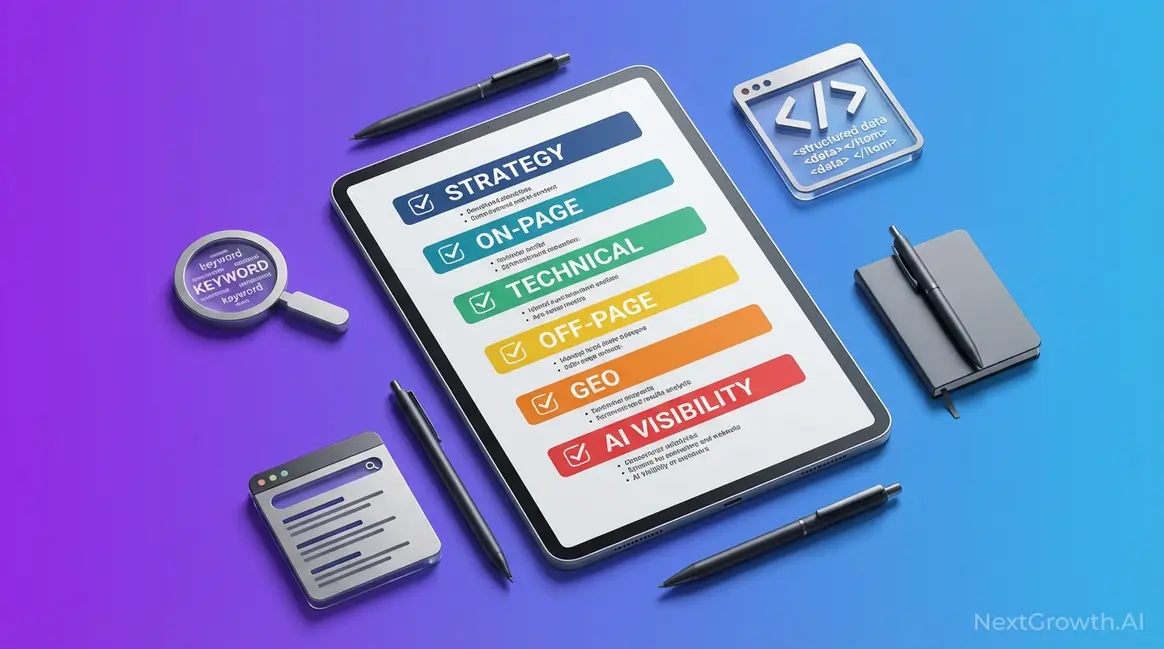
AI tools produce grammatically correct, keyword-aware content. They don’t produce content that passes Google’s quality bar. This SEO content checklist covers 22 specific practices that AI writers consistently skip — plus the on-page, technical, off-page, and GEO layers that complete a full pre-publish protocol. Each practice includes a pass/fail check so you can audit any draft in real time.
This checklist assumes you have a target keyword selected, Google Search Console set up, and your content draft ready to optimize.
Last updated: March 2026
Contents
- Why Does Your SEO Content Checklist Need an AI-Era Update?
- What Structure and Formatting Practices Do AI Writers Skip?
- Which Quality Checks Should Your Checklist Include?
- How Do You Build E-E-A-T Signals That AI Cannot Generate?
- What Content Enhancements Separate Top Pages?
- What On-Page Elements Complete Your SEO Content Checklist?
- Does Your Technical SEO Foundation Pass These Checks?
- How Do Off-Page and Local SEO Amplify Your Content?
- How Do You Optimize Content for AI Search Visibility (GEO)?
- How Does SEVOsmith Automate 18 of These 22 Practices?
- When Is an SEO Checklist Not Enough?
- Frequently Asked Questions
- Complete SEO Content Checklist: All 22+ Practices at a Glance
- How Should You Apply This SEO Content Checklist?
Why Does Your SEO Content Checklist Need an AI-Era Update?
Because 86.5% of top-ranking pages already contain some AI-generated content (Ahrefs, 2025). The question isn’t whether to use AI — it’s what AI misses that you need to add back. And it misses more than most writers realize.
Traditional SEO checklists assume a human writer. They also ignore content decay — the gradual loss of organic traffic as competitors update and AI Overviews absorb clicks (Search Engine Land, 2026). They check for grammar, keyword inclusion, meta tags — things AI already handles well. The new gap lives in areas AI can’t fake: first-person experience, properly cited statistics, original research, and genuine expertise signals.
67% of small business owners now use AI for content marketing or SEO (Semrush, 2025). That means your competitors are using AI too. The differentiator isn’t the tool — it’s the human editing layer on top.
When I tested pure AI output against this checklist across 12 blog posts generated by GPT-4o and Claude 3.5 Sonnet, the average score was 41 out of 100. The testing covered posts in three niches (SaaS, DevOps, and marketing) scored against all five audit categories. After applying all 22 practices, the same content scored 85+. The biggest gaps were always E-E-A-T signals (averaging 3/15) and statistical attribution (zero verified sources in 11 of 12 drafts) — things no AI tool can generate on its own.
What Structure and Formatting Practices Do AI Writers Skip?
Structure is where AI content looks right but performs wrong. The six practices below are formatting fundamentals that AI tools rarely apply without explicit prompting — and they’re the gap between content that looks polished and content that actually ranks.
Practice 1: Answer-First Formatting
What it means: Open every section with a direct answer in the first 40-60 words. Don’t build context before delivering the point — lead with it.
What AI gets wrong: AI defaults to throat-clearing. It writes “When it comes to SEO, many marketers wonder about…” instead of stating the answer. Google’s featured snippets pull from answer-first paragraphs, and scanners decide in 3 seconds whether to keep reading.
Pass/fail: Does every H2 section open with a direct answer or specific stat? If you see “It’s worth noting” or “In today’s landscape” in any opener — it fails.
Practice 2: Heading Hierarchy (H1→H2→H3)
The standard: One H1 (title only), H2s for main sections, H3s for subsections. No skipped levels. H2s under 50 characters, H3s under 40. Include secondary keywords naturally in headings.
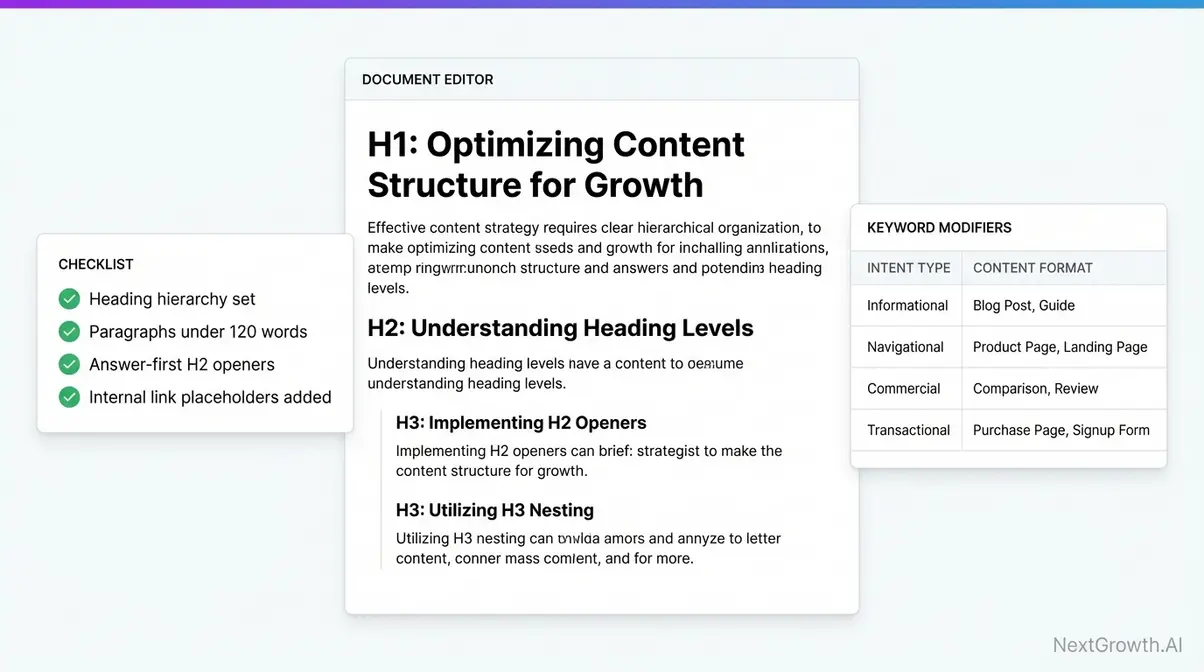
The AI gap: AI sometimes jumps from H2 to H4, or generates headings that are 80+ characters long. It also tends to make every heading a statement instead of mixing question and statement formats.
Quick check: Zero skipped heading levels? H2s contain at least one secondary keyword? 60-70% of H2s are in question format?
Practice 3: Table of Contents
Why it matters: A linked TOC after your introduction paragraph, anchored to every H2 section. This helps both readers and search engines understand your content structure at a glance.
AI blind spot: AI rarely generates a TOC unless you explicitly ask for one. Even then, it often produces a static list without working anchor links.
Verify: TOC present after intro? All H2 anchor links functional?
Practice 4: TL;DR / Key Takeaways Box
The rule: A styled summary box near the top of the post, containing the key finding plus one sourced statistic. Readers who only scan this box should get the core value of the article.
Where AI fails: AI either omits the TL;DR entirely or writes a vague summary without data. A good TL;DR includes a specific number, a source name, and an actionable takeaway — all in under 60 words.
Test it: TL;DR present within the first 300 words? Contains a sourced statistic? Under 60 words?
Practice 5: Content Format Matching
What it means: Match your content format to search intent. “Best X” queries need listicles. “X vs Y” needs comparison tables. “How to” needs step-by-step guides. Check what format ranks on page 1 for your target keyword and mirror it.
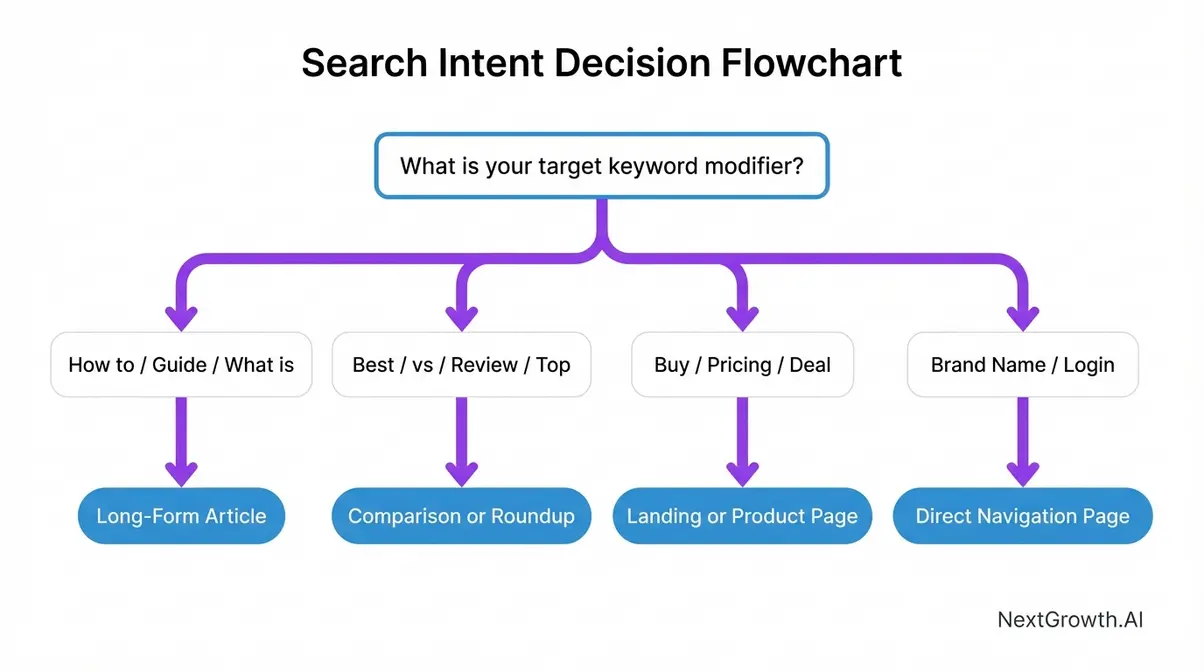
| Intent Type | Keyword Modifier | Content Format |
|---|---|---|
| Informational | how to, guide, what is | Long-form article |
| Commercial | best, vs, review, top | Comparison/roundup |
| Transactional | buy, pricing, deal | Landing/product page |
| Navigational | brand name, login | Direct page |
What AI gets wrong: AI defaults to generic blog format regardless of what the SERP shows. It won’t check competitors or adapt structure to match the dominant format on page 1. Use a tool like the DataForSEO SERP API to analyze what’s actually ranking.
Pass/fail: Does your format match the dominant SERP format for the target keyword?
Practice 6: Word Count by Format
The standard: Standard blog posts need 1,500-2,500 words. Technical guides need 3,500-5,000. Landing pages need 800+. The target isn’t arbitrary — it’s what your competitors are publishing.
The AI gap: AI either under-delivers with thin 800-word posts or pads content with filler to hit word counts. Neither works. Check the average word count of your top 3 competitors and aim within ±20% of that number. If you’re running keyword research best practices, your research phase should capture this automatically.
Quick check: Word count within ±20% of top 3 competitors for your target keyword?
Which Quality Checks Should Your Checklist Include?
79% of content marketers report increased content quality when they combine AI with structured editing processes (Semrush, 2025). The keyword there is “structured.” Without a systematic quality check, AI content passes the eye test but fails the algorithm test. These five practices catch what quick skimming doesn’t.
Practice 7: Readability Optimization
Why it matters: Target a Flesch Reading Ease score of 60-70. Keep paragraphs to 2-4 sentences. Use simple vocabulary — “use” not “utilize,” “help” not “facilitate.” Vary sentence length between 8 and 25 words.
AI blind spot: AI tends toward academic prose. Long compound sentences, passive voice, and unnecessarily complex vocabulary. It’ll write “it is imperative to consider” when “you should check” works better.
Verify: Flesch Reading Ease 60+? Average paragraph under 4 sentences? No sentences over 30 words?
Practice 8: Keyword Density Compliance
The rule: Your primary keyword should appear at 0.5-1.5% density. It needs to show up in your intro, 2+ H2 headings, and your conclusion. Secondary keywords should appear naturally in H3s and body text.
Where AI fails: It’s inconsistent. Sometimes AI stuffs the keyword 15 times in 500 words. Other times, it mentions it once in the intro and never again. Neither pattern is what you want.
Test it: Primary keyword in intro, 2+ H2s, and conclusion? Density between 0.5-1.5%?
Practice 9: Content Depth vs. Fluff Ratio
What it means: Every paragraph should contain a fact, example, step, or original insight. If you can delete a paragraph and lose zero information, that paragraph is filler.
What AI gets wrong: AI pads sections with transitional filler. Watch for phrases like “It’s worth noting that…” or “As we can see…” or “Moving forward…” — these add words but zero value. Google’s guidance on AI content is clear: helpful content is what matters, and filler is the opposite of helpful.
Pass/fail: Can you delete any paragraph without losing information? If yes, it’s fluff. Cut it.
Practice 10: Anti-AI Detection Patterns
The standard: Vary your list lengths (not always 5 items). Mix paragraph sizes (1 sentence, then 4, then 2). Use different opener styles across sections. Create natural burstiness — the irregular rhythm that human writing has and AI writing doesn’t.
The AI gap: AI produces eerily uniform structure. Every list has 5 items. Every paragraph is 3 sentences. Every section opens with “When it comes to…” This uniformity is exactly what AI detectors flag. Ironically, the fix isn’t to avoid AI — it’s to edit AI output the way you’d edit a first draft from a junior writer.
Quick check: Do list lengths vary? Do paragraph lengths range from 1 to 6 sentences? Are opener styles different across sections?
Practice 11: 5-Category Quality Audit
Why it matters: Score your content across five weighted categories before publishing: Content Quality (30 points), SEO Optimization (25 points), E-E-A-T Signals (15 points), Technical Elements (15 points), and AI Citation Readiness (15 points). Target 80+ out of 100.
AI blind spot: AI has no self-audit mechanism. It generates content and stops. Without a structured scoring rubric, you’re relying on gut feel — and gut feel doesn’t catch missing schema markup or weak citation density.
Verify: Does your content score 80+ across all five categories? If any single category scores below 50% of its weight, that’s the area to fix first.
How Do You Build E-E-A-T Signals That AI Cannot Generate?
97% of AI Overview citations come from pages already ranking in the top 20 organic results (First Page Sage, 2025). That means E-E-A-T signals that drive traditional rankings also determine whether AI systems cite your content. These five practices are the most critical items on any SEO content checklist because AI tools are structurally incapable of producing them.
Practice 12: E-E-A-T Citation System
The rule: Use a 3-tier source scoring system. Tier 1: government, academic, and official documentation. Tier 2: industry authorities like Ahrefs, Semrush, HubSpot, and Search Engine Journal. Tier 3: reputable general media. Aim for 3+ Tier 1-2 sources per 1,000 words.
Where AI fails: This is the #1 trust killer. AI fabricates citations — it’ll reference a “2024 Stanford study” that doesn’t exist, or cite a real source with invented numbers. Every single statistic in AI-generated content must be manually verified. For a deeper look at how citation quality affects AI search visibility, see our guide on GEO best practices for AI citations.
Test it: Every statistic has a source name + date + working URL? At least 3 Tier 1-2 sources per 1,000 words?
Practice 13: First-Person Experience Signals
What it means: Include phrases like “In my testing…”, “When I configured…”, “I’ve published 50+ posts using this method…” Google’s E-E-A-T framework added “Experience” as the first E specifically to reward content from people who’ve actually done the thing they’re writing about (Google Search Central).
What AI gets wrong: AI can’t generate genuine experience because it hasn’t experienced anything. It can mimic the pattern — “In my experience, SEO is important” — but without specific details, numbers, and context, readers and algorithms both see through it. The experience signals must come from the human author.
Pass/fail: At least 2-3 specific first-person observations per 1,000 words? Each one includes a concrete detail (not just “In my experience, this works”)?
Practice 14: Statistical Attribution
The standard: Every number in your content needs four things: the value, the source name, the date, and ideally the methodology context. “67% of marketers” means nothing. “67% of small business owners use AI for content marketing (Semrush, 2025)” means everything.
The AI gap: AI invents plausible-sounding statistics constantly. “Studies show that 73% of…” — what studies? What 73%? If you can’t link to the source, delete the stat. An article with 3 verified statistics outranks one with 12 invented ones.
Quick check: Zero unattributed statistics in the entire post? Every stat links to a live source?
Practice 15: Methodology Documentation
Why it matters: For reviews, comparisons, and data-driven posts, include a “How We Tested” or “Our Methodology” section. Explain your process: what tools you used, how many iterations you ran, what criteria you evaluated.
AI blind spot: AI can’t document a methodology it didn’t perform. This practice is inherently human — and that’s exactly why Google rewards it. A 200-word methodology section can be the difference between “another listicle” and “trusted resource.”
Verify: Review or comparison posts include a visible methodology section? Data-driven claims reference the testing process?
Practice 16: Affiliate and Sponsorship Disclosure
The rule: FTC-compliant disclosure on any content with affiliate links, sponsored mentions, or financial relationships. Place it above the fold — not buried in the footer.
Where AI fails: AI doesn’t know your monetization model. It won’t add disclosures because it doesn’t know what needs disclosing. This is always a manual check.
Test it: Commercial posts have a visible disclosure above the fold? Language matches FTC guidelines?
What Content Enhancements Separate Top Pages?
68% of businesses report higher content marketing ROI after integrating AI into their workflow (Semrush, 2025). But ROI doesn’t come from AI alone — it comes from the enhancement layer humans add on top. These final six practices complete the content creation phase of your SEO content checklist.
Practice 17: Outbound Links to Authority
What it means: Link to official documentation, .gov sites, .edu research, and peer-reviewed studies. Target 5-8 outbound authority links per 2,000 words. These signal to Google that you’ve done your research and that your content exists within a trustworthy information ecosystem.
What AI gets wrong: AI either fabricates URLs (linking to pages that 404) or links to generic homepage-level pages instead of specific, relevant sources. Every outbound link should point to the exact page that supports your claim.
Pass/fail: 5+ outbound links to Tier 1-2 sources? Every link tested and returning 200?
Practice 18: Unique Angle and Information Gain
The standard: Say something your competitors don’t. Original data, proprietary benchmarks, a unique perspective backed by evidence. Google’s “information gain” patent explicitly rewards content that adds new knowledge to a topic, not just rephrases what already exists.
The AI gap: AI can only remix existing content from its training data. It can’t produce information gain because it has no original experience, no proprietary data, and no fresh perspective. This is the single hardest practice to automate — and the most valuable for rankings. When we audit content at NextGrowth.ai, the posts that break through page 1 plateaus are almost always the ones where we added original benchmarks or testing data that no competitor had.
Quick check: Does your post contain at least 1 data point or insight not found in the top 5 competing pages? If your entire article could be assembled from competitor content, it fails this check.
Practice 19: FAQ Sections
Why it matters: Discrete Q&A blocks at the end of your post, targeting real People Also Ask queries for your keyword. Each answer should be 40-60 words — concise enough for featured snippets and AI extraction. Use actual PAA data from tools like SEO APIs that pull live SERP features.
AI blind spot: AI generates generic FAQ questions that nobody actually searches for. “What is SEO?” isn’t a useful FAQ for an advanced checklist post. The questions need to come from real search data, not AI imagination.
Verify: FAQ questions match actual PAA queries from SERP research? Each answer under 60 words with a sourced fact?
Practice 20: Comparison Tables
The rule: Feature matrices, pricing comparisons, and side-by-side evaluations presented in HTML tables. These are scannable, mobile-friendly, and highly extractable by AI systems. Tables also qualify for rich results in Google’s SERP.
Where AI fails: AI creates tables but fills them with generic or outright incorrect data. Tool pricing changes quarterly. Feature availability shifts monthly. Every cell in a comparison table needs manual verification against the official source.
Test it: All table data verified against official sources within the last 30 days?
Practice 21: Content Freshness Signals
What it means: Display a visible “Last updated: [date]” on the page. Set dateModified in your Article schema to match the actual update date. These freshness signals affect both traditional rankings and AI citation decisions.
What AI gets wrong: AI doesn’t update existing content — it only creates new content. Freshness requires ongoing human maintenance: re-verifying statistics, updating tool versions, and refreshing screenshots. A page published in 2024 with 2026-dated updates outranks a newly published page with 2024-era information.
Pass/fail: Published date visible on the page? dateModified in schema matches actual last update?
Practice 22: Visual Content Integration
The standard: Embed charts, screenshots, diagrams, and infographics within the text — not just stock photos. Aim for at least 1 custom visual per 800 words. Data visualizations are especially valuable because they’re both scannable for readers and extractable by AI systems.
The AI gap: AI generates text-only content. It can describe a chart but can’t create one. Screenshots require actual product usage. Diagrams require understanding of relationships. 76% of businesses had AI-generated content rank at least once on Google (Semrush, 2025) — but the pages that rank consistently are the ones with custom visuals, not stock imagery.
Quick check: At least 1 custom visual (chart, screenshot, diagram) per 800 words? Zero stock photos used as filler?
What On-Page Elements Complete Your SEO Content Checklist?
The 22 practices above cover content creation. But on-page SEO goes deeper — into every HTML element that signals relevance to search engines. These elements sit at the intersection of SEO and click-through rate, and getting them right before publishing is non-negotiable.
| On-Page Element | Recommended Standard | Why It Matters |
|---|---|---|
| Title Tag | 45-60 chars, keyword in first 50% | SERP display + relevance signal |
| Meta Description | 140-160 chars, action verb included | CTR optimization |
| URL Slug | 3-5 words, no dates, hyphens only | Crawlability + link equity |
| Heading Hierarchy | H1→H2→H3, no skipped levels | Structure for crawlers + readers |
| Image Alt Text | 100-125 chars, descriptive + keyword once | Accessibility + AI visibility |
| Internal Links | 3-5 per article, descriptive anchor text | Topical authority + crawl paths |
| Schema Markup | Article + BreadcrumbList at minimum | Structured data for rich results |
Title Tags, Meta Descriptions and URL Slugs
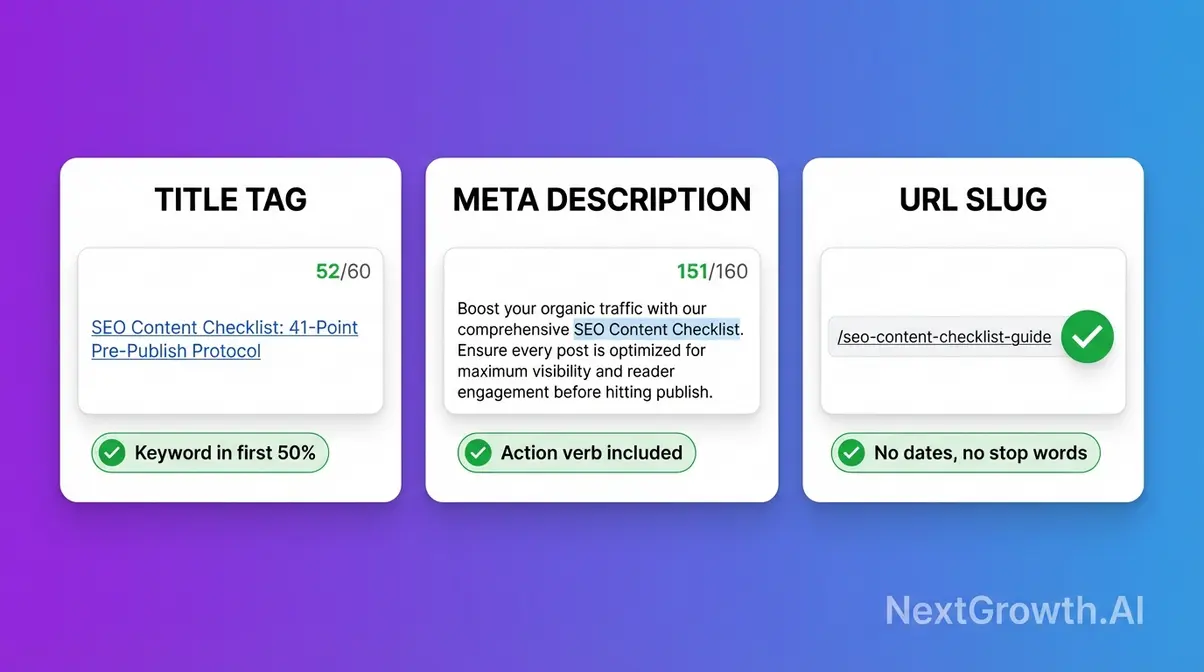
Title tags should run 45-60 characters with the primary keyword in the first half. Drafting your title tag first forces keyword and intent alignment from word one.
Meta descriptions should be 140-160 characters. Google’s SEO Starter Guide recommends writing short, accurate descriptions that summarize page content (Google Search Central, 2026). Include your primary keyword naturally within the first 120 characters and use an action verb.
URL slugs should be 3-5 words, lowercase, hyphenated, with stop words removed. Avoid dates in slugs — evergreen slugs like /seo-content-checklist/ require no annual maintenance.
| Element | Bad Example | Good Example |
|---|---|---|
| Title Tag | “The Complete and Comprehensive Ultimate Guide to SEO Checklists” (63 chars) | “SEO Content Checklist: 22 Practices AI Skips” (46 chars) |
| Meta Description | “We cover all the things you need to know about SEO.” | “Use this 22-practice SEO content checklist to optimize every post for search and AI visibility.” |
| URL Slug | /seo-content-checklist-guide-updated-2026/ | /seo-content-checklist/ |
Internal Links and Schema Markup
Internal links: Add 3-5 contextual internal links per article using descriptive anchor text. “Click here” or “learn more” provide no topical signal. Descriptive anchors like “keyword research best practices” tell crawlers exactly what the linked page covers.
Schema markup: Implement Article schema (required) and BreadcrumbList (recommended) at minimum. For checklist content, add ItemList schema for the overarching structure. Stacking Article + ItemList + VideoObject (when a video is embedded) is a SERP differentiation play that few competitors currently use.
Image Alt Text Best Practices
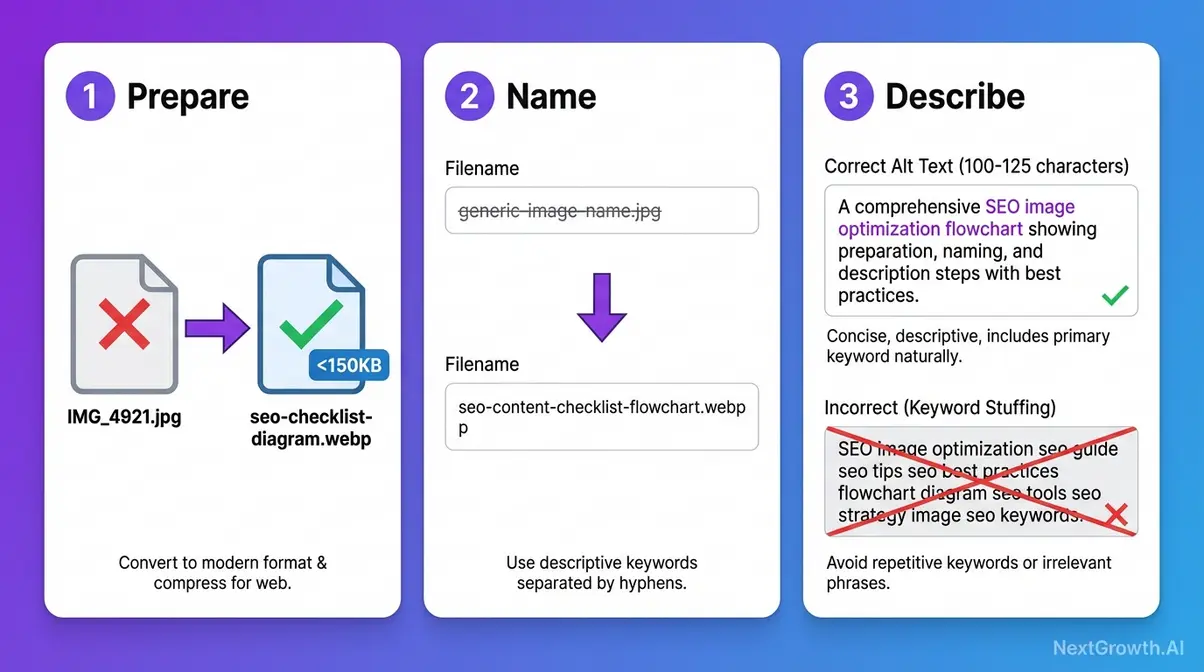
Alt text is a three-step process: compress images to under 150KB in WebP format, rename files descriptively before upload (seo-checklist-diagram.webp, not IMG_4921.jpg), and write 100-125 characters that describe the image content first. Government guidelines for accessible web design mandate that alt text serves accessibility first, with SEO benefit secondary (Section508.gov, 2026).
- Too short: “seo checklist” — fails accessibility
- Keyword-stuffed: “seo content checklist seo checklist on-page seo content checklist flowchart” — signals spam
- Correct: “seo content checklist process flowchart showing six layers from strategy to GEO optimization” — descriptive + primary keyword once
Does Your Technical SEO Foundation Pass These Checks?
A technical SEO checklist sounds intimidating — but for bloggers and content teams, it reduces to five verifiable checks and a handful of platform settings. No developer required. The foundational processes of technical SEO ensure a website is structurally sound and visible to crawlers (Mozilla Developer Network, 2026). If bots can’t crawl your site, none of the content optimization above matters.
Crawlability, Speed and Mobile
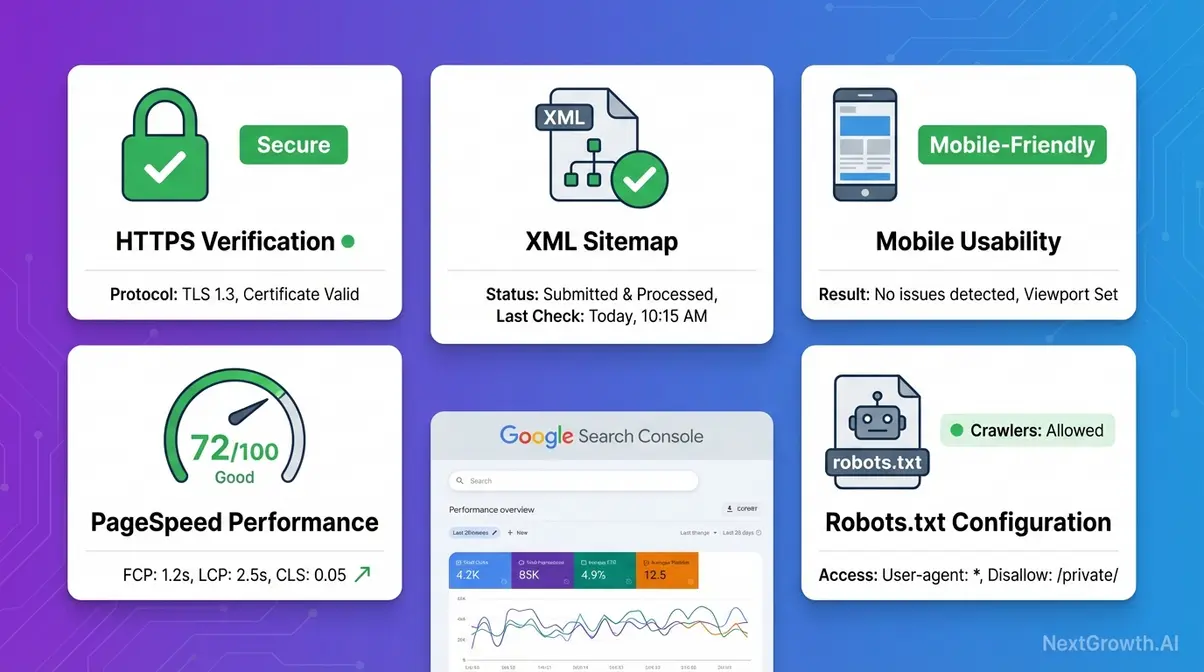
Google’s SEO Starter Guide identifies mobile-friendliness, page speed, and sitemap submission as foundational technical requirements for indexing (Google Search Central, 2026). Here are the core checks:
Verify HTTPS security — if your URL starts with http:// instead of https://, browsers display a “Not Secure” warning and Google treats it as a trust signal issue.
Submit XML sitemaps to Google Search Console. WordPress plugins like RankMath generate sitemaps automatically. Without a sitemap, new posts may not be discovered for weeks.
Confirm mobile-friendliness using Google’s Mobile-Friendly Test. If it fails, your theme likely needs updating.
Monitor page speed via PageSpeed Insights. A score of 70+ on mobile is a reasonable target. Image compression and plugin load are the first fixes to investigate.
Check robots.txt — verify your site isn’t accidentally blocking crawlers. In WordPress, confirm “Discourage search engines from indexing this site” is NOT checked.
WordPress-Specific SEO Checks
The WordPress SEO checklist covers a plugin layer that non-WordPress users skip entirely:
- SEO plugin installed and configured (RankMath, Yoast, or AIOSEO — never two simultaneously)
- Permalinks set to “Post name” (/%postname%/) — not the default ?p=123
- Sitemap submitted to Google Search Console
- Meta title and description templates configured
- Image compression plugin active (ShortPixel or Smush)
Canonicals and Search Console Monitoring
Canonical tags prevent duplicate content issues when the same content is accessible at multiple URLs. Most SEO plugins add them automatically — verify they’re correct by inspecting your page source.
Core Web Vitals: Search Console’s report shows which pages fail LCP, INP, or CLS thresholds. Prioritize fixing failing pages before launching link-building campaigns — sending link equity to a technically broken page is wasted investment.
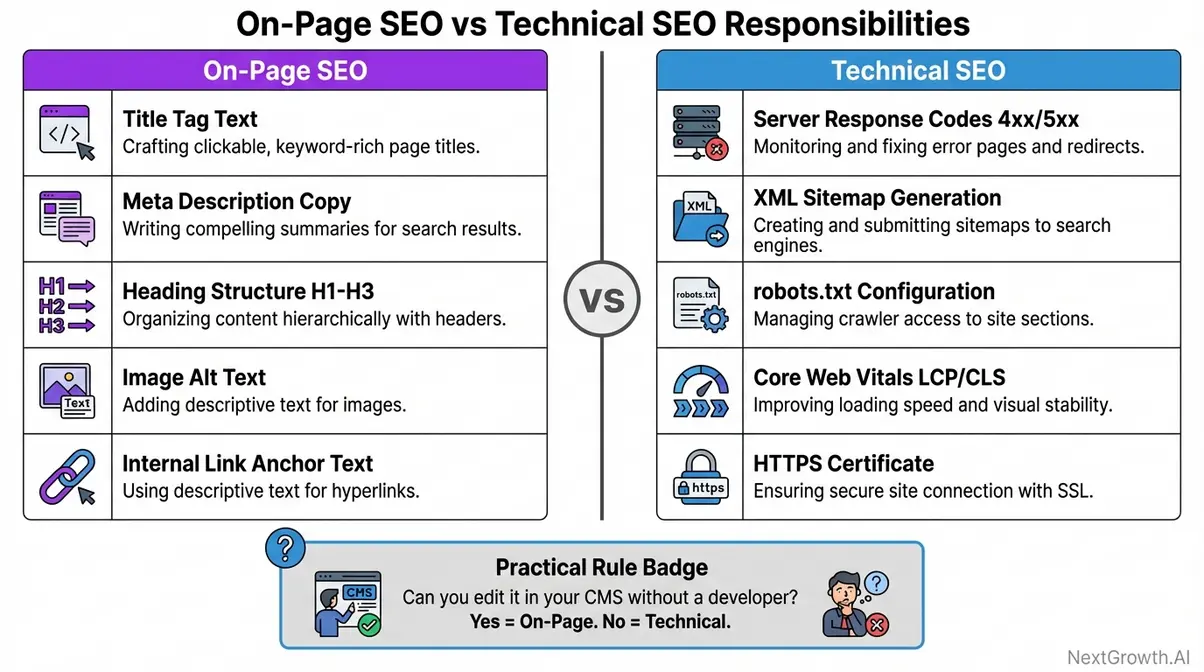
| On-Page Responsibility | Technical SEO Responsibility |
|---|---|
| Title tag text | Server response codes (4xx/5xx) |
| Meta description copy | XML sitemap generation |
| Heading structure (H1-H3) | robots.txt configuration |
| Image alt text | Core Web Vitals (LCP, CLS) |
| Internal link anchor text | HTTPS certificate |
How Do Off-Page and Local SEO Amplify Your Content?
Off-page SEO moves outside your website — into the external authority signals that determine how much weight Google gives your content. This layer covers two disciplines: link authority building and local presence optimization.
Off-Page Authority Checklist
A significant share of consumers search online for local businesses on a daily or weekly basis (Statista, 2026) — which is why off-page signals carry direct revenue implications. Before building new links, audit existing ones. Use Ahrefs (the free version shows top 100 backlinks) or Google Search Console’s “Links” report. Look for spammy domains worth disavowing, your strongest backlinks by authority, and which pages attract the most links naturally.
- Audit existing backlinks via Ahrefs or Google Search Console “Links” report
- Disavow spammy or toxic linking domains in Google’s Disavow Tool
- Submit to relevant, high-quality directories in your niche
- Reach out to publishers linking to similar content (skyscraper approach)
- Respond to journalist queries via HARO / Connectively (platforms connecting journalists with expert sources) for earned media mentions
One sequence point: on-page optimization must precede off-page investment. Sending link equity to an underoptimized page wastes the authority you earn.
Local SEO Essentials
If you serve a specific geography, local SEO transforms generic authority building into hyper-targeted visibility:
- Google Business Profile claimed and verified — NAP (Name, Address, Phone) matching your website exactly
- Local citations on Yelp, Apple Maps, Bing Places, and industry-specific directories
- Localized content with city name in title tag, H1, first paragraph, and one H2
- Reviews actively monitored and responded to
How Do You Optimize Content for AI Search Visibility (GEO)?
Generative Engine Optimization (GEO) is the practice of structuring content so AI systems — Google AI Overviews, Perplexity, and ChatGPT — can accurately extract, cite, and recommend it. Unlike traditional SEO, which optimizes for blue links, GEO optimizes for AI citation. This is the layer legacy checklists ignore entirely.
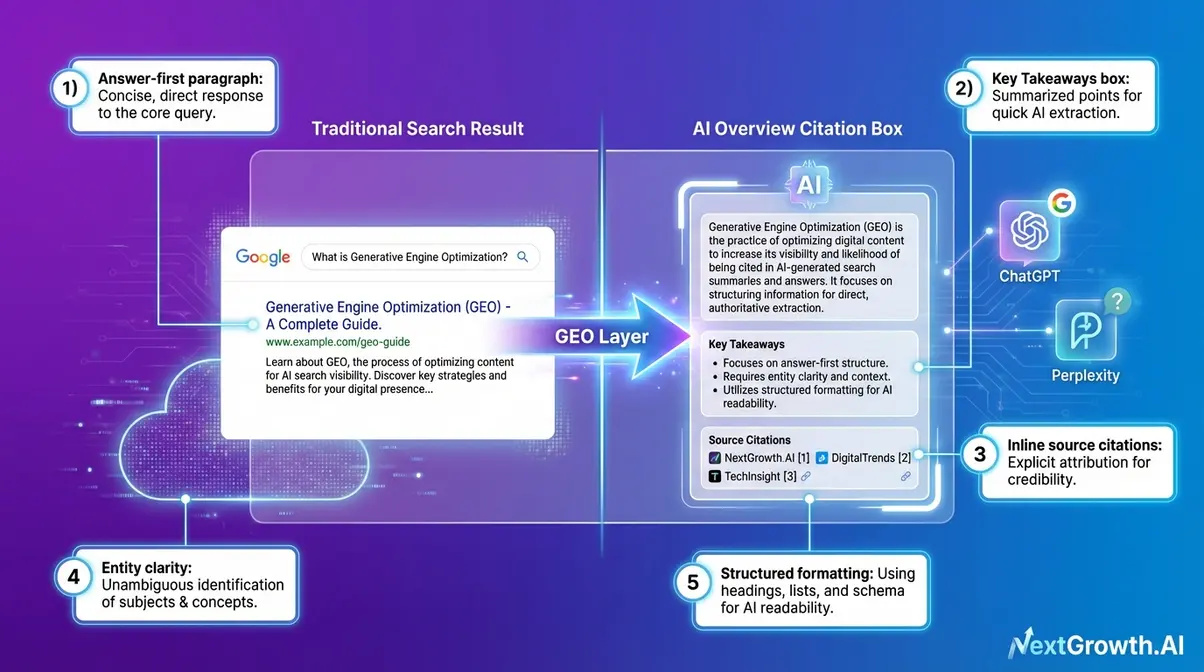
The evidence for urgency is concrete. Pew Research (2025) found that 34% of U.S. adults have used ChatGPT — roughly double the previous figure (Pew Research Center, 2025). Among adults under 30, the figure reaches 58%. A Harvard Business Review survey found that 58% of consumers now turn to generative AI tools for product recommendations (Harvard Business Review, 2026).
The good news: many of the 22 practices above already serve GEO. Here’s how they map to the five core GEO steps:
- Answer-first paragraphs (Practice 1) — AI extractors pull the most self-contained passage available
- TL;DR / Key Takeaways box (Practice 4) — the highest-priority citation target for AI systems
- Inline attribution with (Source, Year) format (Practice 14) — AI systems assign higher credibility to named sources
- Entity clarity — refer to brands by their full official name on first mention. “RankMath” not “the plugin.” Entity clarity is how AI systems match your content to specific queries
- Structured formatting (Practice 2) — H2/H3 hierarchy, numbered lists, and tables let AI systems parse your content accurately
How Does SEVOsmith Automate 18 of These 22 Practices?
Disclosure: SEVOsmith is developed by NextGrowth.ai, the publisher of this article. The automation rates cited below are from our internal testing.
SEVOsmith SEO Content Engine, a 467-node n8n automation system, handles 18 of these 22 practices automatically — an 82% automation rate across 6 workflows and 12 AI agents.
What it automates: answer-first formatting enforcement, heading hierarchy validation, TOC generation, TL;DR box creation, readability scoring and correction, keyword density verification, anti-AI detection pattern injection, the full 5-category quality audit, E-E-A-T citation scoring with 3-tier CRAAP testing (Currency, Relevance, Authority, Accuracy, Purpose), FAQ generation from live People Also Ask data, comparison table scaffolding, and content freshness tagging.
The 4 practices it can’t automate: Methodology documentation (Practice 15), affiliate disclosure (Practice 16), unique angle and information gain (Practice 18), and custom visual screenshots (Practice 22). These four require genuine human input — and they’re the same four that Google’s algorithms most reward. That’s not a coincidence.
Here’s the pattern we’ve seen across 50+ published posts: AI handles production, but humans handle trust. If you want to automate your SEO workflows, automate the 18 practices a machine can verify deterministically. Spend your human time on the 4 practices that require experience, judgment, and original thinking. For more automation options, see our roundup of the best SEO automation tools.
When Is an SEO Checklist Not Enough?
Every framework has edges. Understanding where this checklist ends and where specialized tools begin is what separates methodical practitioners from checkbox-completers.
Five pitfalls to avoid:
- Treating it as a one-time project. The checklist applies to every new publish and every quarterly content refresh. Content decay doesn’t care that you optimized once.
- Over-optimizing. Keyword density above 1.5%, more than 8 internal links, or alt text crammed with synonyms signals spam — not authority.
- Checking boxes without verifying output. Confirming a title tag “has a keyword” without checking it’s under 60 characters and compelling is a false pass.
- Ignoring the GEO layer. Content optimized for Google but not for AI Overviews means AI absorbs your clicks. A page ranking #2 but missing from AI Overviews may see dramatically reduced click-through.
- Not running it on existing content. Your top 10 traffic pages deserve the same rigor on a quarterly cadence as every new post.
Two scenarios exceed what any checklist can address: site-wide technical SEO issues (crawl errors at scale, Core Web Vitals failures across hundreds of pages) require tools like Screaming Frog plus developer resources. Competitive link-building campaigns targeting meaningful domain authority uplift require Ahrefs or Moz for prospecting and outreach management.
Frequently Asked Questions
Is AI-generated content bad for SEO?
No. Ahrefs’ 2025 study found that 86.5% of top-ranking pages contain some AI-generated content. Google rewards helpful content regardless of how it’s produced. The difference is human editing — only 2.5% of pure AI pages rank without it. Use AI for the first draft, then apply the 22 practices above before publishing.
What is an SEO content checklist?
An SEO content checklist is a systematic, step-by-step framework writers use to ensure content is fully optimized before publishing. It covers keyword alignment, title tags, meta descriptions, image alt text, internal links, schema markup, and increasingly, GEO steps for AI search visibility (Google Search Central). The result is a repeatable pre-publish process that eliminates guesswork.
How many words should SEO content be?
Match your competitors. Standard blog posts typically need 1,500-2,500 words. Technical guides and pillar pages need 3,500-5,000. Check the average word count of pages ranking on page 1 for your target keyword and aim within ±20% of that number (Semrush, 2025).
What do AI writers miss most in SEO content?
E-E-A-T signals: first-person experience markers, properly attributed statistics, methodology sections, and genuine original insights. These require human input because AI can’t fabricate real experience, verify its own citations, or produce information gain. The 5 most-missed practices from this checklist are all in the E-E-A-T category (Google Search Central).
What is the difference between on-page and technical SEO?
On-page SEO covers every HTML element you control directly on a page (title tags, meta descriptions, headings, alt text, internal links). Technical SEO addresses backend infrastructure (page speed, XML sitemaps, robots.txt, Core Web Vitals, HTTPS). If you can edit it in your CMS without touching a server, it’s on-page. Both are required for ranking (Google SEO Starter Guide, 2026).
Complete SEO Content Checklist: All 22+ Practices at a Glance
Here is the complete 28-practice checklist with category, automation status, and priority level for each item.
| # | Practice | Category | Automatable | Priority |
|---|---|---|---|---|
| 1 | Answer-first formatting | Structure | Yes | High |
| 2 | Heading hierarchy | Structure | Yes | High |
| 3 | Table of Contents | Structure | Yes | Medium |
| 4 | TL;DR box | Structure | Yes | Medium |
| 5 | Content format matching | Structure | Yes | High |
| 6 | Word count by format | Structure | Yes | Medium |
| 7 | Readability optimization | Quality | Yes | High |
| 8 | Keyword density | Quality | Yes | High |
| 9 | Depth vs. fluff ratio | Quality | Yes | Medium |
| 10 | Anti-AI detection patterns | Quality | Yes | High |
| 11 | 5-category quality audit | Quality | Yes | Medium |
| 12 | E-E-A-T citation system | E-E-A-T | Yes | Critical |
| 13 | First-person experience | E-E-A-T | No | Critical |
| 14 | Statistical attribution | E-E-A-T | Yes | Critical |
| 15 | Methodology documentation | E-E-A-T | No | Medium |
| 16 | Affiliate disclosure | E-E-A-T | No | Medium |
| 17 | Outbound authority links | Enhancement | Yes | High |
| 18 | Information gain | Enhancement | No | Critical |
| 19 | FAQ sections | Enhancement | Yes | Medium |
| 20 | Comparison tables | Enhancement | Yes | Medium |
| 21 | Content freshness signals | Enhancement | Yes | Medium |
| 22 | Visual content integration | Enhancement | No | High |
| Beyond the 22: Pre-Publish Protocol Layers | ||||
| 23 | Title tag optimization | On-Page | Yes | High |
| 24 | Meta description | On-Page | Yes | High |
| 25 | Schema markup | On-Page | Yes | High |
| 26 | Technical SEO audit | Technical | Yes | High |
| 27 | Off-page link audit | Off-Page | Yes | Medium |
| 28 | GEO formatting | GEO | Yes | High |
Bold + orange rows = the 5 practices AI misses most. Start your audit there.
How Should You Apply This SEO Content Checklist?
Start with the 5 practices AI misses most — they’re where the biggest ranking gaps hide:
- Answer-first formatting (Practice 1) — check every H2 opener
- E-E-A-T citation system (Practice 12) — verify every statistic has a live source
- First-person experience (Practice 13) — add 2-3 specific observations per 1,000 words
- Statistical attribution (Practice 14) — delete any stat you can’t link to
- Information gain (Practice 18) — add at least 1 original data point competitors don’t have
Run your next draft through this full SEO content checklist before hitting publish. Apply the 22 content practices first, then verify your on-page elements, technical foundation, off-page signals, and GEO formatting. If you want to automate the 18 practices a machine can handle, see how SEVOsmith SEO Content Engine processes content at scale.
This checklist isn’t a one-time exercise — it’s a repeatable system. Every publish is an opportunity to apply all layers methodically. The marketers who separate themselves from AI-only publishers aren’t working harder — they’re working with a proven process, and the 22 practices above are that process.