

Keyword Research Best Practices: 12-Step SEO Checklist (2026)
96.55% of all web pages get zero traffic from Google (Ahrefs, 2023). Zero. Not low traffic — none at all.
The difference between the 3.45% that actually get visitors and the rest? They start with keyword research. Not the “plug a word into a tool and pick the highest volume” kind. The kind that accounts for AI Overviews reducing clicks by 34.5%, 58.5% of searches ending without a single click to any website, and search intent shifting faster than ever.
Most keyword research guides treat it as a one-time task you do before writing. That approach stopped working when AI Overviews started appearing on 30% of SERPs. What follows are 12 keyword research best practices that treat it as what it actually is in 2026: a continuous, strategic process.
96.55% of pages get zero Google traffic because they skip keyword research fundamentals (Ahrefs, 2023). These 12 keyword research best practices account for AI Overviews eating 34.5% of clicks and 58.5% zero-click searches. Covers SERP pre-analysis, intent classification, keyword clustering, seed keyword discovery, KD benchmarking, and 7 more steps — with 9 of 12 fully automatable. Start with practices 1–4 for the fastest impact.
Contents
- Why Does Keyword Research Still Matter in 2026?
- Practice 1 — How Do You Find the Right Seed Keywords?
- Practice 2 — How Do You Classify Search Intent?
- Practice 3 — How Do You Analyze SERPs Before Writing?
- Practice 4 — What Is Keyword Clustering and Why Does It Matter?
- Practice 5 — How Do You Find Content Gaps?
- Practice 6 — Why Should You Target Long-Tail Keywords?
- Practice 7 — How Do You Assess Keyword Difficulty Accurately?
- Practice 8 — How Do You Mine People Also Ask Questions?
- Practice 9 — How Do You Reverse-Engineer Competitor Keywords?
- Practice 10 — How Do You Prevent Keyword Cannibalization?
- Practice 11 — Why Does Trend Direction Matter More Than Volume?
- Practice 12 — How Do You Map Keyword Research Best Practices to Topical Authority?
- How Do You Optimize Keyword Research Best Practices for Voice Search?
- What Tools Should You Use for Keyword Research?
- What Common Keyword Research Mistakes Should You Avoid?
- How Does SEVOsmith Automate Keyword Research?
- How Do You Use AI for Keyword Research?
- When Does This Approach Not Apply?
- Frequently Asked Questions
- Your Keyword Research Best Practices Checklist for 2026
Why Does Keyword Research Still Matter in 2026?
Organic search still drives 53% of all website traffic (BrightEdge), making keyword research the foundation of any content strategy worth running. But the rules have changed dramatically since the last time you probably read a “keyword research guide.”
Here’s the situation. 58.5% of US Google searches now end without a click to any website (SparkToro/Datos, 2024). Position 1 organic CTR dropped 32% year-over-year — from 28% to 19% — because AI Overviews now sit above the traditional results (First Page Sage, 2025). Featured snippets still command 42.9% CTR, the highest of any SERP position. That gap between 42.9% and 19% tells you everything about where keyword research should focus.
Keyword research isn’t dead. Bad keyword research is dead. The old approach — sort by volume, pick the biggest numbers, write and pray — produces that 96.55% zero-traffic outcome. The 12 practices below account for zero-click searches, AI Overviews, and the intent shifts that define how search actually works right now.
Practice 1 — How Do You Find the Right Seed Keywords?
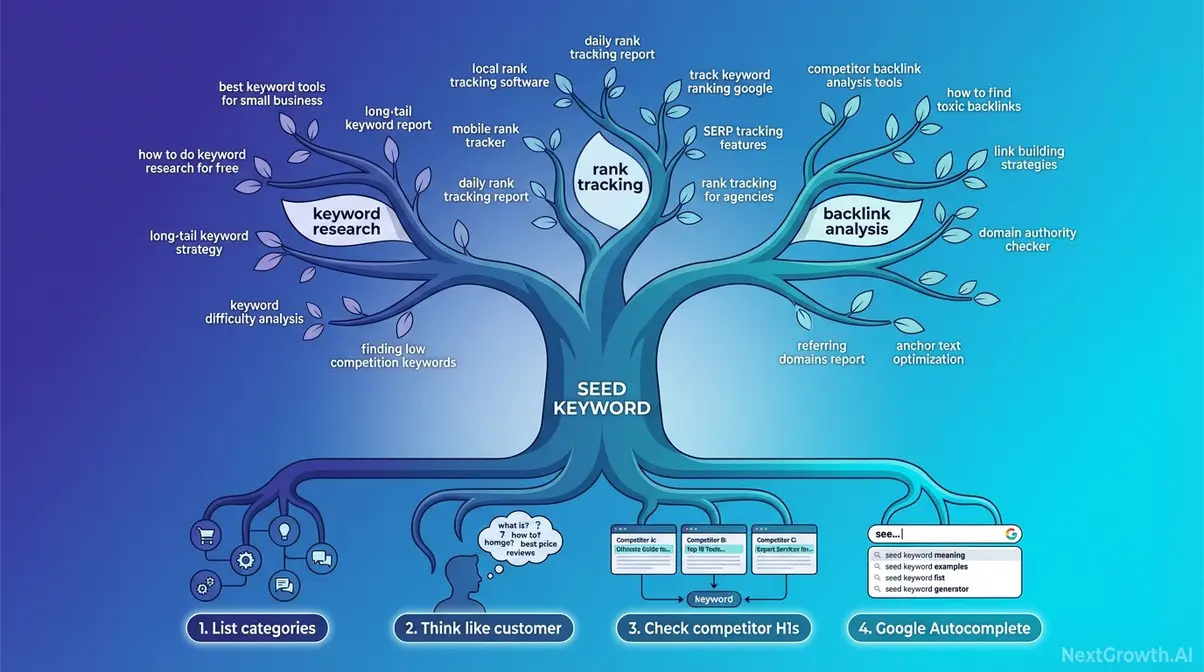
Every keyword strategy starts from seed keywords — the broad, 1-2 word topic terms that act as the trunk of your keyword tree. 94.74% of all keywords get 10 or fewer monthly searches (Ahrefs, 2021), which means your seed selection determines whether you expand into profitable long-tail territory or waste months on dead ends.
Seed keywords are terms like “keyword research,” “email marketing,” or “running shoes.” Every long-tail variation, every cluster spoke, and every piece of content you publish traces back to one of these foundational terms. Getting them right determines whether your entire strategy expands in a profitable direction.
The 4-Step Seed Keyword Discovery Exercise
Use this exercise to find your seeds before opening any tool:
- List your product or service categories — write down the 3-5 core topics your site covers, using the plainest language your customer would use, not industry jargon.
- Think like your target customer — ask what they would type into Google on their first search, before they know your brand name or product terminology.
- Check competitor homepage H1s — scan the H1s and primary navigation labels on 3-5 competitor sites for the vocabulary they’ve chosen to lead with.
- Enter seed keywords into Google Autocomplete — type each term and note the 8-12 related suggestions that surface, paying attention to modifiers like “how,” “best,” “vs.,” “for beginners,” and “cost.”
Here’s how three seed keywords from the SEO niche expand in practice:
| Seed Keyword | Variations Surfaced | Intent Classification |
|---|---|---|
| keyword research | keyword research tools, how to do keyword research, keyword research for beginners | Mixed: Informational + Commercial |
| rank tracking | best rank tracker, rank tracking software, free rank tracking | Commercial |
| backlink analysis | how to analyze backlinks, backlink checker free, backlink analysis tool | Informational + Commercial |
Google Keyword Planner remains the best free tool for extracting seed keyword data and related query volumes directly from Google’s search index. It requires no paid subscription and gives you volume data straight from the source.
Practice 2 — How Do You Classify Search Intent?
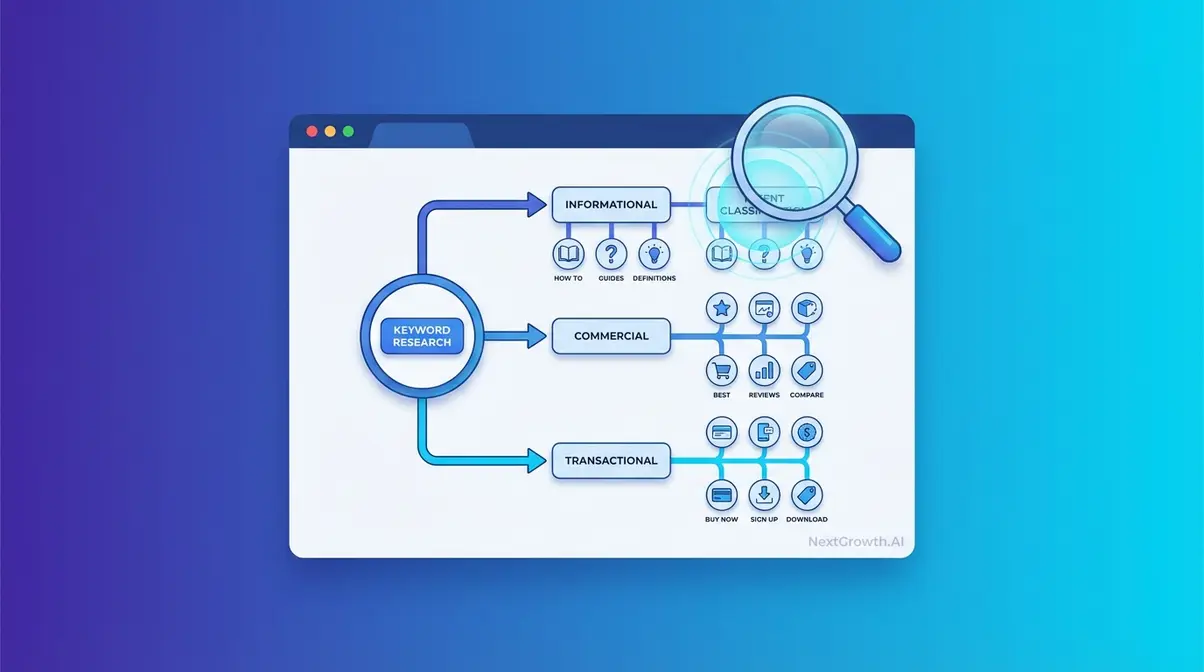
Every keyword maps to one of four search intents: informational, commercial, navigational, or transactional. Publishing a product page for an informational query — or an educational guide for a transactional one — is the single most common reason good content fails to rank. According to one analysis, commercial queries trigger ChatGPT’s web search 53.5% of the time (Quattr, 2025), making them high-value targets for both traditional rankings and AI citations.
Intent classification isn’t guesswork. Look at what currently ranks for the keyword. If Google shows comparison articles and review posts, the intent is commercial. If it shows definitions and explainers, it’s informational. The SERP is the answer key.
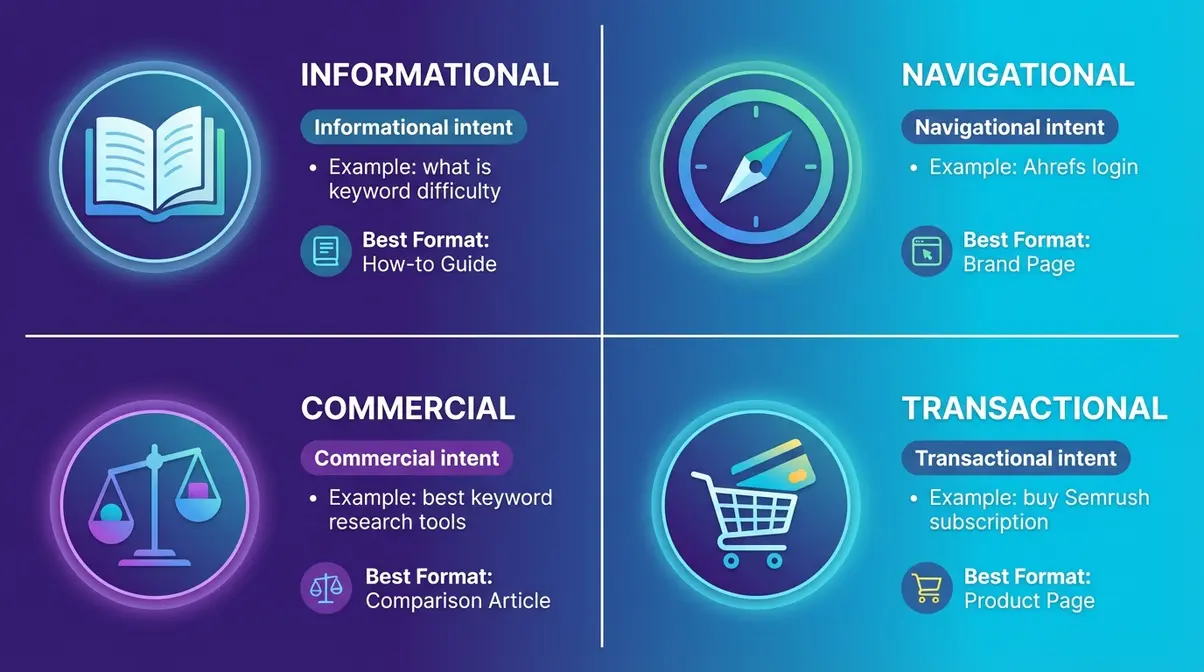
| Intent | Example Query | Best Content Format | AI Citation Potential |
|---|---|---|---|
| Informational | “what is keyword clustering” | Guide, explainer | High (Perplexity) |
| Commercial | “best keyword research tools” | Listicle, comparison | High (ChatGPT) |
| Navigational | “Semrush keyword tool” | Landing page | Low |
| Transactional | “buy Ahrefs subscription” | Product page | Low |
How Do You Match Keywords to Intent?
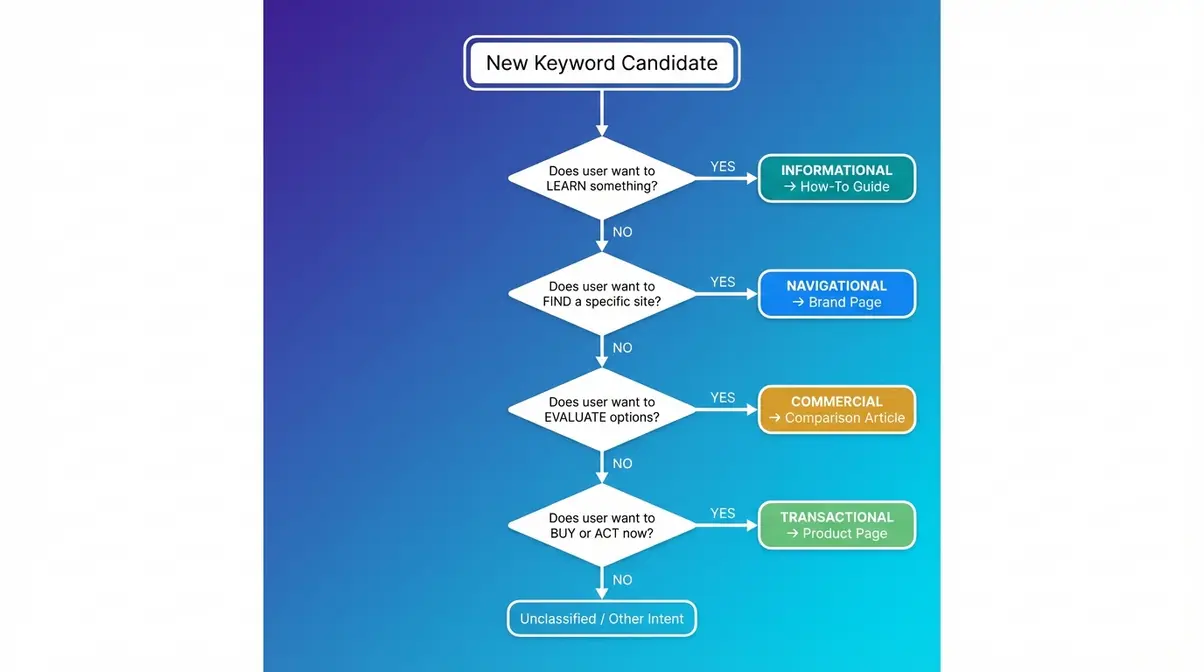
The Intent-First Filter — classify intent before opening any tool — is the methodology that separates quick wins from long-term ranking authority. Run every candidate keyword through these four diagnostic questions:
- Does the user want to learn something? — Informational intent. Create a how-to guide, explainer, or definitional article.
- Does the user want to find a specific website? — Navigational intent. Only relevant if the target is your own brand.
- Does the user want to evaluate options? — Commercial intent. Create a comparison article, roundup, or “best X for Y” guide.
- Does the user want to buy or sign up right now? — Transactional intent. Serve this with a product page or conversion-optimized landing page.
When intent is ambiguous — as it often is for terms like “best SEO tools” — the resolution is simple: look at the current top 3 results. Their format tells you what Google has decided the intent is. The SERP is always the ground truth.
Notice the AI citation column in the table above. If you’re optimizing for both Google and AI search engines, commercial and informational keywords are where citations happen. Don’t waste GEO effort on navigational or transactional queries. For more on what can and can’t be automated in SEO workflows, see our guide on automating SEO workflows.
Practice 3 — How Do You Analyze SERPs Before Writing?
Always analyze page 1 results before writing a single word. Approximately 30% of Google keywords now trigger AI Overviews (SE Ranking, 2025), which reduce clicks to websites by 34.5%. The SERP itself tells you what Google considers the correct answer format — and whether your content has a realistic chance of earning clicks at all.
Too many content teams jump straight from keyword selection to writing. They skip the step that would tell them whether a listicle, how-to guide, or comparison page is what Google wants to show. The result? Content that’s well-written but formatted wrong for the query. Google already answered this question for you — it’s right there on page 1.
What Should You Look for in SERP Analysis?
Run through this six-point checklist for every target keyword:
- Content format — Are the top 5 results listicles, guides, tool pages, or something else? Match the dominant format.
- Word count range — If the top results average 4,000 words, don’t publish 800. If they average 1,200, don’t write 6,000.
- Domain authority — Are positions 1-3 owned by DR 80+ sites? That changes your timeline (not necessarily your strategy).
- Featured snippet format — Paragraph, list, or table? This dictates how you structure your answer-first content.
- PAA presence — People Also Ask questions become your H2 headings and FAQ content.
- AI Overview trigger — If an AI Overview appears, evaluate whether enough click-through remains to justify targeting the keyword.
How Do You Automate SERP Analysis?
Manual SERP checking works for 10 keywords. It doesn’t work for 500. The DataForSEO SERP API lets you pull structured SERP data programmatically — content types, featured snippets, PAA questions, AI Overview presence — for hundreds of keywords in a single batch. We use it to pre-qualify every keyword before it enters our content calendar.
Practice 4 — What Is Keyword Clustering and Why Does It Matter?
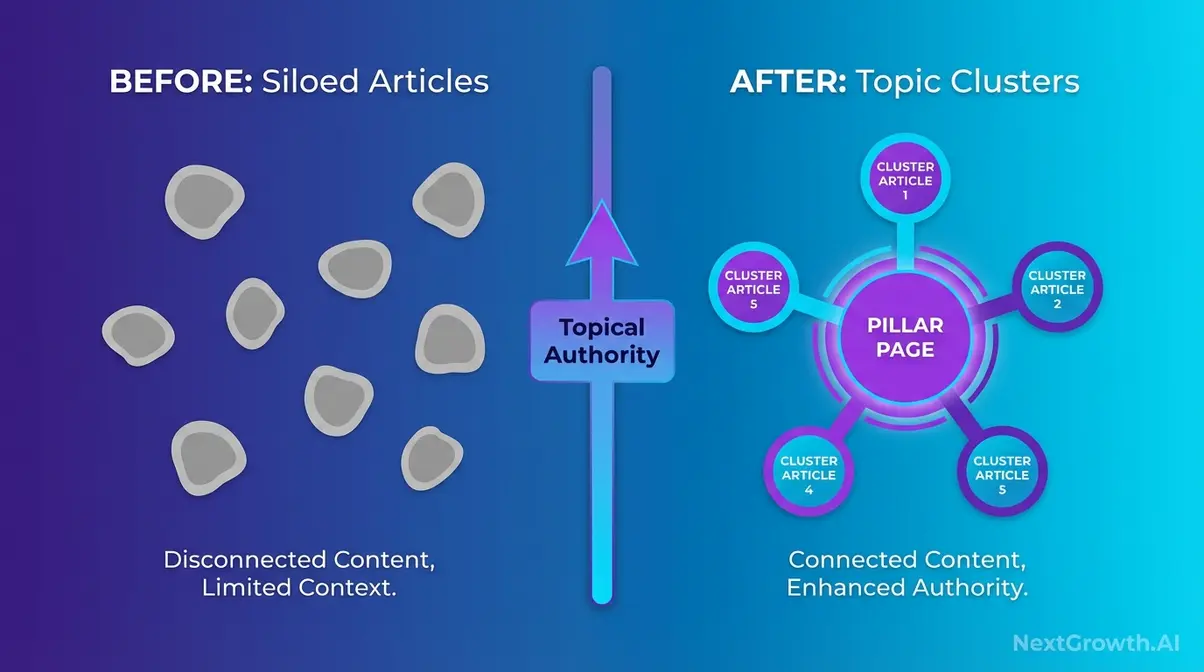
Topical authority — how comprehensively a site covers a given subject — is a core ranking factor, and keyword cannibalization remains a persistent site architecture problem for sites that grow content without a topical mapping strategy (Yoast, 2026). Keyword clustering groups related keywords by SERP overlap so one page targets an entire semantic cluster instead of a single phrase. It’s the difference between writing 10 thin articles for 10 similar keywords and writing one strong piece that ranks for all of them.
When we built NextGrowth.ai’s content strategy, we grouped 340 seed keywords into 28 topic clusters. The clustered approach drove measurably more organic sessions than our previous random-topic publishing — where each article targeted a keyword in isolation without considering how topics connected to each other.
How Do You Build Keyword Clusters?
- Collect seed keywords — Start with 50-200 keywords related to your core topics.
- Pull SERP results for each — Use DataForSEO or manual searches to get the top 10 URLs for every keyword.
- Group by URL overlap — If two keywords share 3+ URLs in their top 10, they belong in the same cluster.
- Assign pillar vs spoke — The broadest keyword becomes the pillar page. Specific sub-queries become spoke articles.
- Map your content calendar — Publish the pillar first, then spokes, linking each spoke back to the pillar.
Building a Topic Cluster: Worked Example
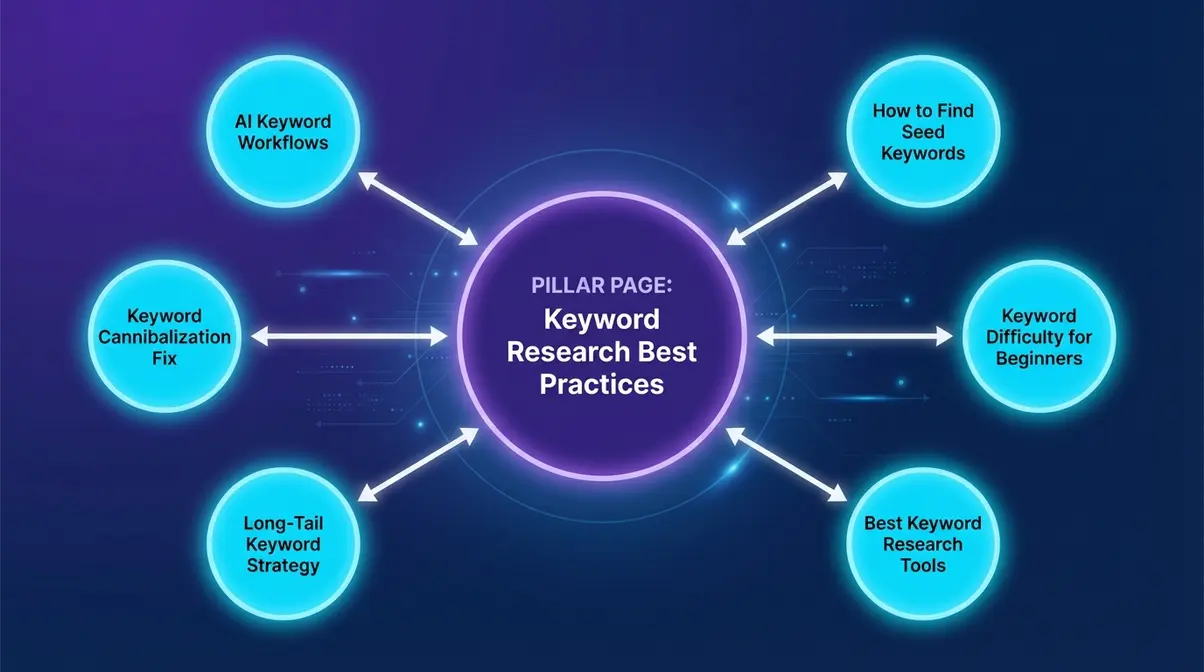
Here’s a real cluster using “keyword research” as the pillar, mapped to five spokes with intent classifications:
- Pillar: “Keyword Research Best Practices” (Informational — methodology)
- Spoke 1: “How to Find Seed Keywords” (Informational — discovery process)
- Spoke 2: “Keyword Difficulty for Beginners” (Informational — metric explanation)
- Spoke 3: “Best Keyword Research Tools Comparison” (Commercial — tool evaluation)
- Spoke 4: “Long-Tail Keyword Strategy Guide” (Informational — tactical execution)
- Spoke 5: “Keyword Cannibalization: Audit and Fix” (Informational — problem resolution)
The internal linking rule is bidirectional: every cluster article links back to the pillar using relevant anchor text, and the pillar links forward to each cluster article at contextually appropriate moments. This structure signals to Google that the pillar is the authoritative hub.
Tools like DataForSEO’s keyword grouping endpoint automate the SERP-overlap grouping step. For the full range of SEO automation tools available, we’ve compared 13 platforms head to head.
Practice 5 — How Do You Find Content Gaps?
Content gap analysis identifies queries your competitors rank for but you don’t. It’s the fastest path to traffic growth because you’re targeting demand already validated by competitor performance — not guessing what might work.
Think of it this way. Your competitors have spent months (or years) testing which keywords drive traffic. Their ranking data is essentially a free research report on what works in your niche. Content gap analysis reads that report.
The Content Gap Analysis Process
- Identify 3-5 direct competitors — Sites ranking for your target topics, not just business competitors. If a blog consistently appears on the same SERPs you’re targeting, it’s a content competitor.
- Export their top organic keywords — Use the DataForSEO API competitor intersection endpoint or any major SEO tool.
- Filter by your missing positions — Remove keywords you already rank for. What’s left is your gap.
- Prioritize by volume x difficulty inverse — High volume + low difficulty = write first. Low volume + high difficulty = write later (or never).
Focus especially on keywords where competitors rank in positions 4-20. These are their weakest rankings — the spots where better content can overtake them fastest.
Practice 6 — Why Should You Target Long-Tail Keywords?
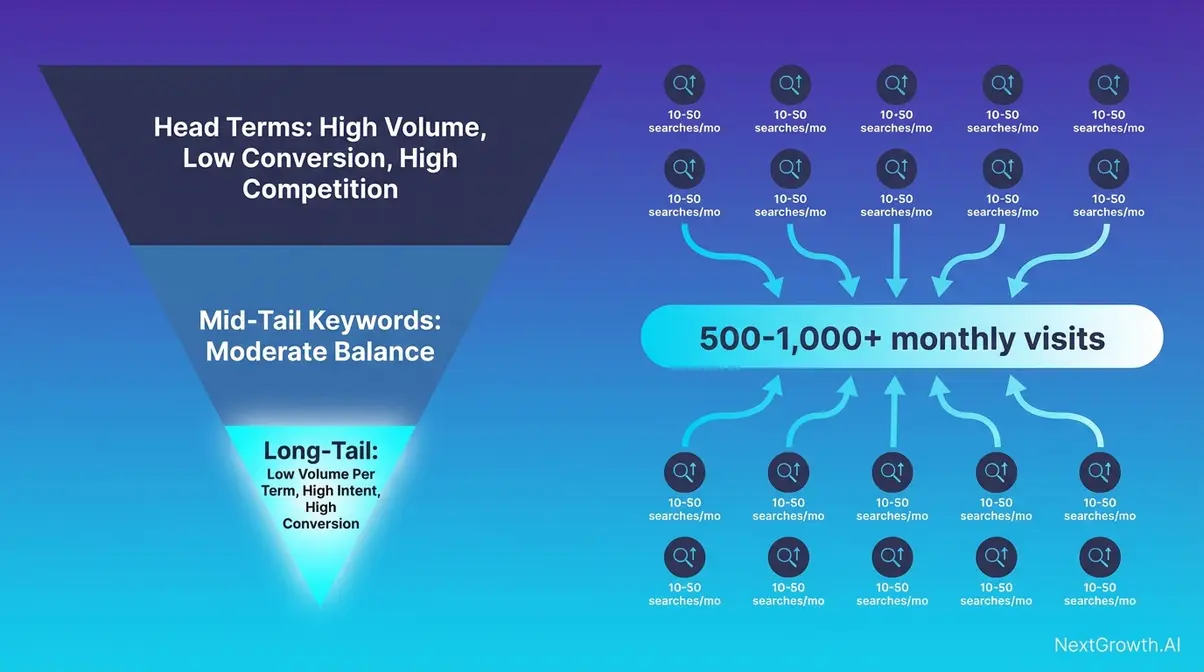
The majority of search queries are long-tail in nature, with lower individual volumes but cumulatively significant traffic and higher purchase intent (Ahrefs, 2026). And 94.74% of all keywords get 10 or fewer monthly searches. The math is clear: most SEO wins come from the long tail, not from head terms with 50,000 monthly searches and impossible competition.
Long-tail keywords — typically three or more words with specific intent — convert better too. Someone searching “best keyword research tool for small agencies 2026” is closer to a decision than someone searching “keyword research.” The specificity signals intent.
Three Methods for Finding Long-Tail Keywords
- Google Autocomplete suffix variations — Type your seed keyword and add modifiers like “for beginners,” “vs,” “how to,” “best,” “without,” or “free.” Note every suggestion that appears.
- “People Also Ask” mining — The PAA box on any SERP surfaces question-based long-tail keywords that users are actively asking. Collect these for your content calendar.
- Competitor keyword gap analysis — In Ahrefs or Semrush, run a Keyword Gap report to find terms your competitors rank for in positions 1-20 that your site doesn’t appear for at all. These are pre-validated targets with confirmed search demand.
What Is the 80/20 Rule for SEO?
Roughly 80% of organic traffic opportunity comes from long-tail queries that individually have modest volume but collectively outpace head term performance. This is the 80/20 rule for SEO — focus 80% of your keyword targeting effort on the long-tail clusters where intent is precise and competition is manageable, not on the 20% of head terms that attract the most tool attention.
The most common mistake this principle prevents: building an entire content calendar around 3-5 high-volume head terms while ignoring the long-tail cluster that drives actual qualified traffic.
Here’s what many teams miss: “zero volume” keywords often drive real traffic. Ahrefs’ own data shows that keywords with estimated zero monthly volume still generate clicks. And 15% of daily Google searches are entirely new queries never seen before (Google, reaffirmed 2024). Long-tail targeting catches these emerging queries before competitors even notice them.
The aggregation principle is where long-tail strategy gets genuinely powerful: individual long-tail keywords may generate 10-50 monthly searches, but a cluster of 20 related terms within a single well-structured article can collectively drive 500-1,000+ monthly visits. Volume per keyword is almost irrelevant when you optimize for cluster traffic potential rather than individual term performance.
For programmatic long-tail expansion at scale, the best SEO APIs offer suggestion and related keyword endpoints that turn 50 seed keywords into 500 long-tail variants in minutes.
Practice 7 — How Do You Assess Keyword Difficulty Accurately?
Keyword difficulty scores from tools are estimates based on backlink profiles of current top-ranking pages. They don’t account for your specific domain authority, topical relevance, or content quality — the three factors that actually determine whether you can rank. A KD score of 75 might be achievable for a site with deep topical authority, and a KD of 25 might be worthless if the keyword triggers AI Overviews with no click-through.
KD Benchmarks by Site Authority
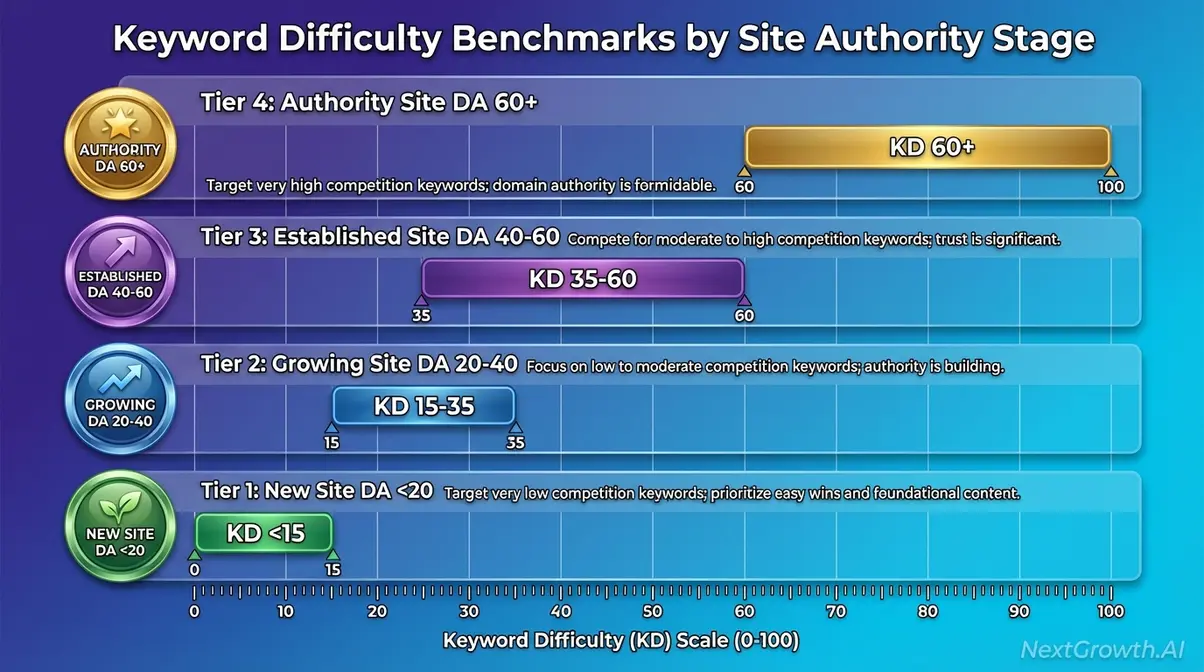
The practical rule we’ve found effective after analyzing keyword difficulty benchmarks across multiple site authority tiers: your average KD target should sit within 10 points above your site’s current Domain Authority. Here are the benchmarks:
| Site Authority Stage | DA Range | Target KD Range | Rationale |
|---|---|---|---|
| New site (0-6 months) | DA < 20 | KD < 15 | Minimal backlink profile; only low-competition queries are winnable |
| Growing site (6 mo-2 years) | DA 20-40 | KD 15-35 | Building authority; can compete for moderate-difficulty terms with strong content |
| Established site (2+ years) | DA 40-60 | KD 35-60 | Sufficient authority to challenge competitive terms with cluster support |
| Authority site | DA 60+ | KD 60+ | Competitive keywords become winnable with supporting cluster architecture |
The Priority Score Framework
Instead of filtering keywords by raw difficulty score alone, calculate a priority score that accounts for your specific situation:
Priority Score = (Monthly Volume x Intent Value) / (KD Score x DR Gap)
| Factor | How to Calculate | Example |
|---|---|---|
| Monthly Volume | From any keyword tool | 2,400 |
| Intent Value | Commercial = 3, Informational = 1 | 1 (informational) |
| KD Score | Tool-provided difficulty | 35 |
| DR Gap | Avg top-5 DR minus your DR (min 1) | 15 |
| Priority Score | (2400 x 1) / (35 x 15) | 4.57 |
Higher priority scores mean better opportunities. For a full breakdown of how DataForSEO calculates difficulty and how it compares to alternatives, read our DataForSEO review.
Practice 8 — How Do You Mine People Also Ask Questions?
People Also Ask boxes appear on approximately 80% of Google SERPs, and PAA visibility grew 34.7% on mobile between February 2024 and January 2025 (Semrush/Advanced Web Ranking, 2025). Mining PAA gives you the exact questions your audience types into Google — validated demand, not speculation.
PAA questions serve double duty. First, they become your H2 headings. Question-format headings directly mirror how users query AI search engines, which means higher GEO citability for AI search. Second, they feed your FAQ schema — giving you rich result eligibility for questions Google has confirmed people actually ask.
PAA Mining Workflow
- Search your target keyword on Google and expand every PAA question.
- Click each PAA question — Google loads 2-3 more related questions each time. Expand until you stop seeing new ones.
- Extract unique questions — Remove duplicates. You’ll typically get 15-30 unique questions from one seed keyword.
- Assign to your content — Best questions become H2 headings. Second-tier questions become FAQ items. The rest inform your content depth.
At scale, DataForSEO’s PAA endpoint extracts these questions programmatically for hundreds of keywords. We use it to pre-load every article outline with validated questions before writing begins.
Practice 9 — How Do You Reverse-Engineer Competitor Keywords?
Your competitors have already validated which keywords drive traffic in your niche. Reverse-engineering their organic keyword portfolio reveals proven opportunities you can target with better content — without the months of trial and error they went through.
The key distinction: competitors for keyword research aren’t necessarily your business competitors. They’re the sites that consistently appear on the same SERPs you’re targeting. A blog run by one person might be your biggest content competitor if they rank for the same queries.
Competitor Keyword Extraction Steps
- Identify 3-5 content competitors — Search your top 10 target keywords. Note which domains appear most frequently in the top 20.
- Export their top organic keywords — Use DataForSEO, Ahrefs, or Semrush. Sort by traffic value.
- Cross-reference with your gap analysis (Practice 5) — Overlap tells you which keywords competitors have proven but you haven’t targeted yet.
- Prioritize using your difficulty framework (Practice 7) — Focus on keywords where competitors rank 4-20. These are their weakest positions — and your best opportunities.
For the API approach to competitor analysis, our DataForSEO API guide walks through the competitor intersection endpoint step by step.
Practice 10 — How Do You Prevent Keyword Cannibalization?
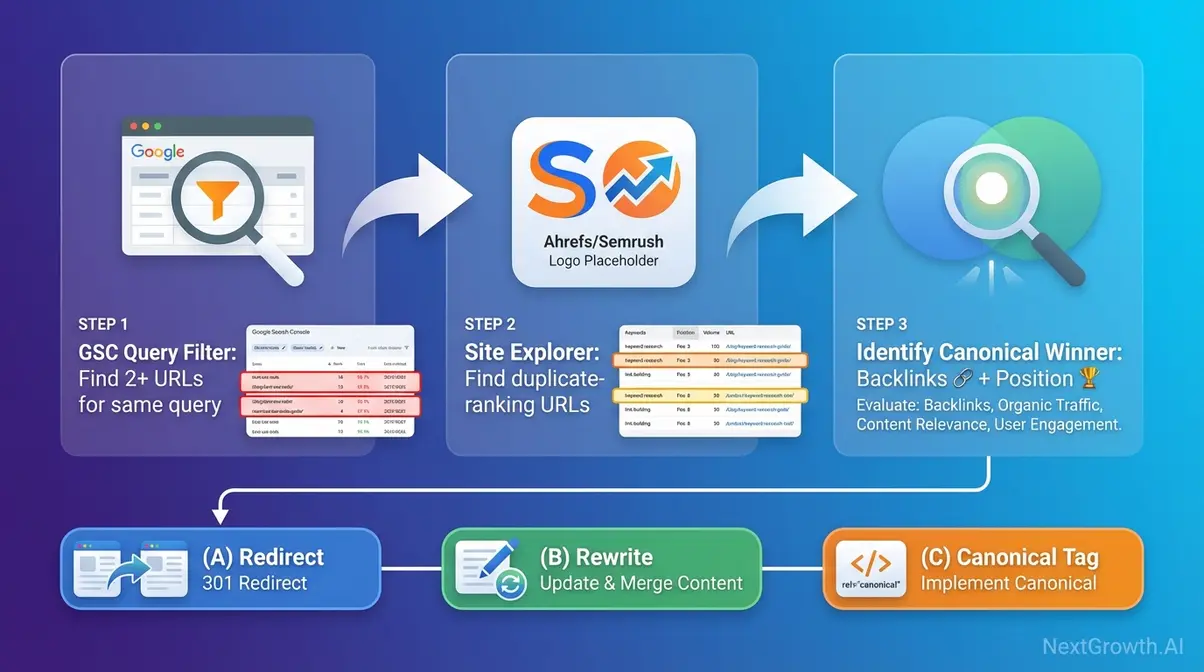
Keyword cannibalization happens when two or more pages on your site target the same primary keyword. Google splits authority between them, and neither ranks as well as a single focused page would. We’ve seen pages jump 5-15 positions after consolidating cannibalized content.
How to Detect Cannibalization
Run this 3-step audit to identify cannibalization on your site:
- Google Search Console filter — Navigate to Performance, filter by a specific query, and examine which URLs generate impressions. If 2+ pages appear for the same query, you have a cannibalization signal.
- Ahrefs or Semrush site explorer — Run Site Explorer, go to Organic Keywords, and filter for keywords where your domain ranks 2+ different URLs in positions 1-30.
- Top-10 conflict review — Spot-check the most frequently conflicting pages and identify which URL is the canonical “winner” based on backlinks, average position, and engagement metrics.
Three Fixes for Cannibalization
In order of preference:
- Merge — Combine both pages into one piece. Redirect the weaker URL to the stronger one.
- Redirect — If one page is clearly inferior, 301 redirect it to the better page.
- Differentiate — Adjust one page’s target keyword to a related but distinct term. Change the title, H1, and content focus.
Prevention: maintain a keyword-to-URL map. A simple spreadsheet with columns for primary keyword, URL, and secondary keywords catches conflicts before you publish. Yoast’s keyword cannibalization guide identifies cannibalization as a persistent site architecture problem — particularly for sites that grow content without a topical mapping strategy.
Practice 11 — Why Does Trend Direction Matter More Than Volume?
A keyword with 5,000 monthly searches declining 20% year-over-year is a worse investment than one with 1,000 monthly searches growing 50%. Current volume measures the past. Trend direction predicts the future. And the future is where your content will rank — three to six months from now, not today.
Google Trends is free and directional. It won’t give you exact search volume, but it shows relative interest over time. That’s what you need for trend analysis — the slope of the line, not the Y-axis value.
Watch for two types of trends:
- Seasonal trends — “best holiday gifts” spikes in November. Plan content three months ahead of the peak.
- Structural trends — “AI SEO tools” has grown 300%+ YoY while “manual SEO audit” has declined steadily. Structural shifts signal where to invest long-term content.
Use trend data to sequence your content calendar. Publish rising-trend content first — it compounds as search demand grows.
Practice 12 — How Do You Map Keyword Research Best Practices to Topical Authority?
Google rewards sites that demonstrate thorough coverage of a topic. 15% of daily Google searches are entirely new queries never seen before (Google, reaffirmed 2024), and topical authority is how you capture these emerging searches without having to target each one individually. The algorithm recognizes depth across a subject and extends trust to new pages within established topic clusters.
Topical authority mapping means planning your pillar + spoke content architecture before writing individual posts. Choose 3-5 pillar topics aligned with your expertise. Map 5-8 spoke articles for each pillar. Interlink everything.
What Are the 3 C’s of SEO?
Clustering directly addresses the 3 C’s of SEO, which serve as a useful diagnostic framework for measuring topical readiness:
- Content: Thorough coverage of a topic — clusters force you to build out sub-topic depth, not just publish a pillar and stop.
- Crawlability: Internal links help search engines discover and index all related pages — a cluster with strong internal linking is far easier for Googlebot to navigate.
- Citations: External signals confirm your site’s authority — topically focused sites attract more relevant backlinks because publishers naturally cite the most thorough resources.
Here’s how this works in practice. NextGrowth.ai’s SEO Automation cluster uses best SEO automation tools as the pillar page. Spoke articles include can SEO be automated, best SEO APIs, DataForSEO review, and several others. Each spoke links to the pillar and to related spokes. The cluster builds authority that no single article could achieve alone.
For more on how topical authority connects to AI search visibility, see our guide on the Citation-First Hierarchy for AI search.
How Do You Optimize Keyword Research Best Practices for Voice Search?
Voice search usage among US adults continues to grow, with 70% of voice queries using natural conversational language rather than typed shorthand (DemandSage, 2026). As voice and AI search grow, keyword research must account for how people speak — not just how they type. “Best keyword tool” typed into Google becomes “Hey Google, what’s the best tool for doing keyword research?” spoken into a phone.
Voice search optimization starts in keyword research. Target question-format phrases pulled from PAA mining (Practice 8). Write answer-first paragraphs that voice assistants can extract directly. And optimize for featured snippets — they command 42.9% CTR (First Page Sage, 2025) and are what voice assistants read aloud as the answer.
Voice Search Optimization Workflow
- Extract conversational queries — Take your PAA questions from Practice 8 and rewrite them in natural spoken language. “What is keyword clustering” becomes “How does keyword clustering work and why should I use it?”
- Write speakable answer blocks — For each conversational query, write a 40-60 word answer that sounds natural read aloud. No jargon-heavy compound sentences. Voice assistants read featured snippets verbatim — if your answer sounds awkward spoken, it won’t get selected.
- Test with text-to-speech — Paste your answer-first paragraphs into a TTS tool. If anything sounds robotic or confusing when spoken, rewrite it. This five-minute check catches problems no SEO tool will flag.
The connection to GEO is direct. The same answer-first formatting that wins AI citations wins voice search. If your content opens each section with a clear, quotable statement, both AI search engines and voice assistants can extract it. One optimization serves two channels.
What Tools Should You Use for Keyword Research?
According to Forrester Research, generative AI platforms are reshaping the SEO market as brands adapt their targeting strategies for AI-assisted search queries (Forrester, 2026). But adopting AI tools without a structured workflow creates a new risk: generating keyword ideas that sound plausible but have zero measurable search demand.
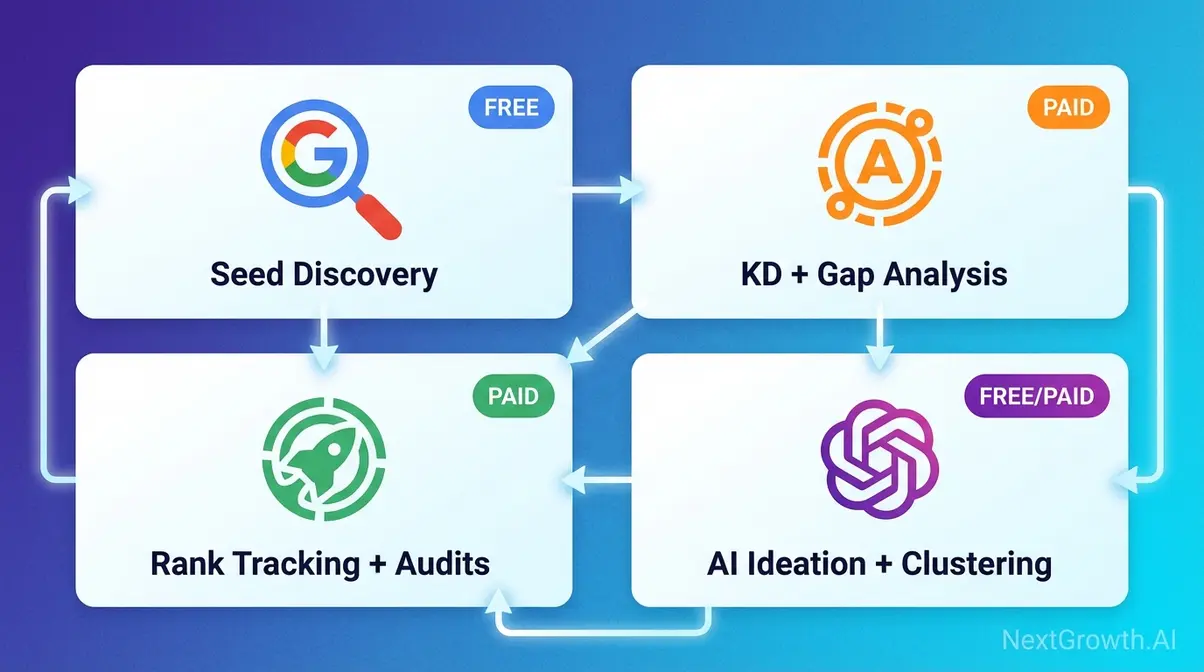
Use free tools first to build your initial list, then validate with one paid tool before committing to a content plan.
| Tool | Best For | Free? | Starting Point |
|---|---|---|---|
| Google Keyword Planner | Seed discovery, first-party volume data | Free with Google account | Initial brainstorming |
| Ahrefs | KD benchmarking, competitor gap analysis, backlink research | Paid ($99+/mo) | Authority-competitive analysis |
| Semrush | SERP position tracking, site audits, keyword clusters | Paid ($119+/mo) | Ongoing monitoring |
| ChatGPT | Ideation, cluster mapping, FAQ generation | Free / Paid ($20/mo) | Brainstorming before tool use |
Google Ads vs. Organic SEO Keyword Research
The keyword research process differs significantly between paid and organic channels. Understanding the difference prevents a common mistake: building organic strategy from Ads data alone.
| Dimension | Google Ads | Organic SEO |
|---|---|---|
| Keyword matching | Broad/Phrase/Exact match modifiers control impression triggers | Semantic relevance determines ranking without explicit match types |
| Competition signal | CPC bids + Quality Score determine ad rank | Content quality + backlink authority determine organic rank |
| Traffic speed | Immediate — traffic starts the moment budget is live | 3-6 months to build; compounds over time without ongoing spend |
One critical warning: high CPC values don’t correlate with organic difficulty. A keyword can have a $15 CPC (heavy paid competition) while carrying a KD of 12 (thin organic content). Treating paid competition as a proxy for organic difficulty leads to systematically avoiding winnable organic targets.
For marketers running both channels, start with Google Keyword Planner for volume data. Export high-intent Commercial and Transactional keywords for Ads targeting; route Informational keywords to your content calendar.
What Common Keyword Research Mistakes Should You Avoid?
Systematic keyword research ranks among the top strategic priorities for professional marketers worldwide (Statista, 2026). Yet even teams running structured research fall into predictable traps. Here are the five most damaging mistakes — each silently suppresses rankings long after the content is published.
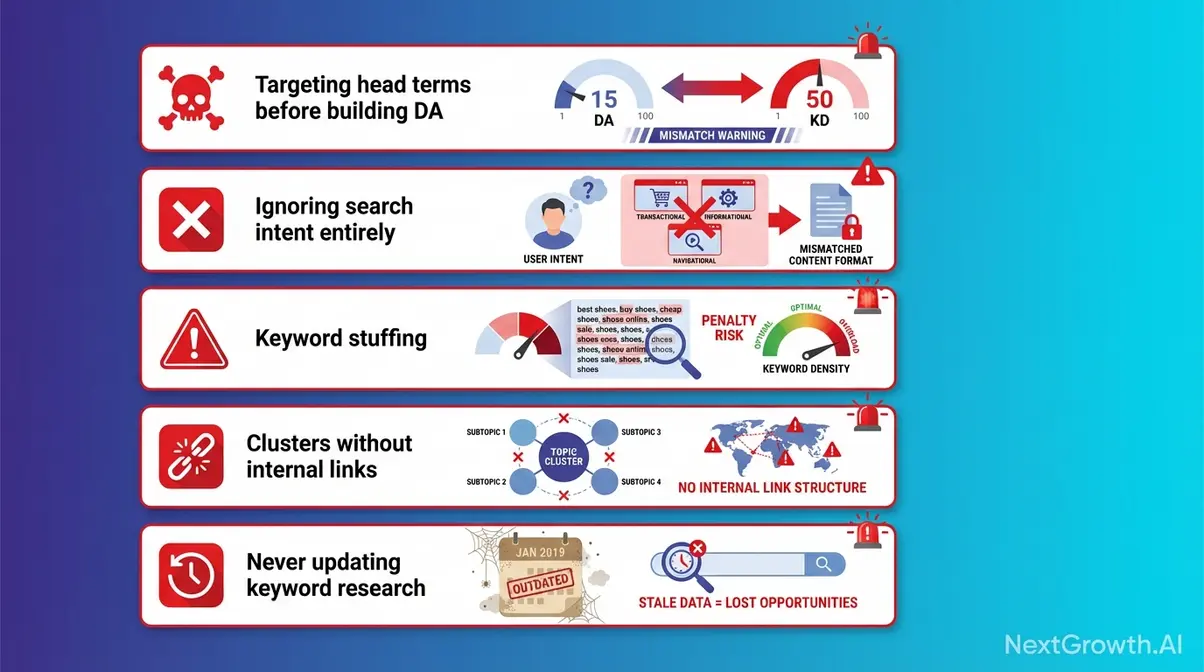
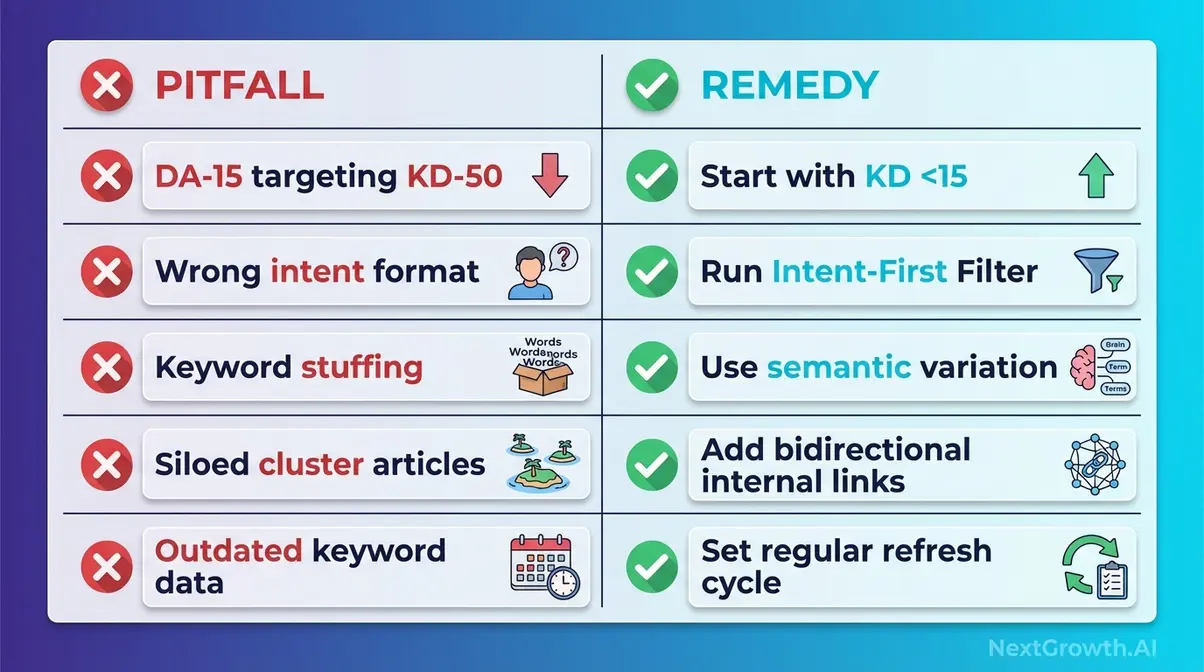
- Targeting head terms before building domain authority. A DA-15 site targeting KD-50 keywords will rank on page 5 indefinitely, generating no traffic and no reinforcing engagement signals. Start with KD < 15 and build your authority baseline first.
- Ignoring search intent entirely. Publishing a commercial product page to compete for “what is keyword research” (informational) is a structural mismatch Google’s algorithm penalizes. The format has to match the intent.
- Keyword stuffing. Forcing exact-match phrases into content at unnatural density triggers readability problems and activates modern spam detection. Semantic variation — covering the topic thoroughly — outperforms exact-phrase repetition.
- Building clusters without internal links. Topic clusters without bidirectional internal linking are just siloed articles with a shared theme. The authority-concentration benefit only activates when Google can crawl the connection through actual anchor-linked references.
- Never updating keyword research. Strategies built on outdated data miss entirely new query patterns, AI-driven search behavior shifts, and algorithm changes. Quarterly refreshes are the minimum.
How Does SEVOsmith Automate Keyword Research?
SEVOsmith’s 467-node n8n workflow automates 9 of the 12 keyword research best practices in this checklist. The keyword research phase runs in the first 8 minutes of a 31-minute article pipeline — from seed keyword to published, SEO-optimized article with no manual research steps in between.
| # | Practice | SEVOsmith Component | How It Works |
|---|---|---|---|
| 1 | Seed Discovery | DataForSEO suggestions | Expands seed keywords to long-tail variants |
| 2 | Intent Classification | AI Agent classifier | Auto-tags informational / commercial / transactional |
| 3 | SERP Analysis | DataForSEO SERP endpoint | Pulls top 10 results, analyzes content type + AIO presence |
| 4 | Keyword Clustering | DataForSEO grouping | Groups by SERP overlap, assigns pillar vs spoke |
| 5 | Content Gap Analysis | Competitor intersection | Identifies missing keyword opportunities |
| 6 | Long-Tail Targeting | DataForSEO suggestions | Expands seed keywords to long-tail variants |
| 7 | Difficulty Assessment | DataForSEO difficulty | Scores and filters by rankability for your DR |
| 8 | PAA Mining | DataForSEO PAA endpoint | Extracts questions, assigns to H2 headings |
| 9 | Competitor Analysis | DataForSEO competitors | Reverse-engineers competitor keyword portfolios |
| 10 | Cannibalization | Manual audit | Not yet automated |
| 11 | Trend Analysis | Manual (Google Trends) | Not yet automated |
| 12 | Topical Mapping | Content strategy agent | Maps pillar/spoke architecture from clusters |
The three manual practices — cannibalization auditing, trend analysis, and voice search fine-tuning — account for roughly 15% of the total research effort. Automating the other 85% means a content team can research and outline 30 articles per month instead of 5.
For a full technical breakdown of how the pipeline works, see the SEVOsmith content engine overview.
How Do You Use AI for Keyword Research?
Generative AI platforms are reviving the SEO market as brands adapt targeting strategies for AI-assisted search queries (Forrester, 2026). ChatGPT can generate 50+ keyword ideas in 60 seconds — but without search volume validation, those ideas remain unverified hypotheses, not strategic targets.
Critical framing: ChatGPT generates ideas, not data. Every output must be verified in Ahrefs, Semrush, or Google Keyword Planner before targeting.
Here are 8 AI-assisted keyword workflows you can run today:
- Seed keyword brainstorming — Ask ChatGPT to generate 20 seed keywords for your niche using plain customer language, not industry jargon. Use case: expand your initial topic list before opening any tool.
- Intent classification at scale — Paste a list of 20-50 keywords and ask ChatGPT to classify each as Informational / Commercial / Navigational / Transactional with a one-line rationale. Use case: run your raw keyword export through the Intent-First Filter at scale.
- Long-tail expansion — Ask for 30 long-tail variations of a confirmed seed keyword, grouped by modifier type (how-to, best, vs., for beginners, cost, without). Use case: build a long-tail cluster from a single validated term.
- Cluster mapping — Paste 50 keywords and ask ChatGPT to group them into pillar + spoke clusters, naming the pillar topic and 4-6 spoke subtopics for each group. Use case: convert a flat keyword list into a hub-and-spoke architecture.
- Competitor gap identification — Describe your site’s topic coverage and ask ChatGPT to identify subtopics a competitor likely covers that you haven’t addressed. Use case: surface uncovered territory in your existing strategy.
- FAQ/PAA question generation — Ask for 20 questions a beginner would ask about your topic, formatted as natural spoken questions. Use case: build FAQ sections and voice search targets.
- Title and meta variation — Provide your target keyword and ask for 10 H1 title variations across different formats (how-to, listicle, question, year-specific, benefit-led). Use case: A/B test title formats before publishing.
- Zero-volume query identification — Ask ChatGPT to generate 20 highly specific, niche questions about your topic that are unlikely to appear in keyword tools but represent genuine user curiosity. Use case: capture the estimated 15% of daily searches that are brand-new queries no tool has indexed yet.
After generating AI output, run the top 10 resulting keywords through Google Keyword Planner or Ahrefs to confirm search volume, KD, and SERP intent. AI ideation connects to strategic reality only through this validation step.
When Does This Approach Not Apply?
These 12 practices work for most content-driven sites, but two scenarios require a different playbook:
E-commerce with thousands of product pages. Manual cluster mapping doesn’t scale to 5,000 product variants. Category-level keyword targeting requires programmatic SEO rather than the pillar/spoke model described in Practice 4. Pair keyword research with programmatic page templates and faceted navigation optimization instead.
Brand-new sites in highly competitive niches. Even KD < 20 keywords can be unwinnable without an initial backlink foundation. If your site has DA under 10 competing against DA-60+ domains, content quality alone won’t break page 1. Pair keyword research with a dedicated link-building and digital PR strategy rather than relying on content volume to drive early rankings.
The KD benchmark table in Practice 7 tells new sites to target KD < 15. This section extends that honesty — when even KD < 15 isn’t enough, the missing ingredient is domain authority, not better keyword research.
Frequently Asked Questions
What is the first step in keyword research?
Start with seed keyword discovery — identifying the 3-5 broad topic terms your target customers would search for. From there, classify the intent behind each term before evaluating volume or difficulty. Many teams skip straight to tools, but understanding user intent first prevents you from building content in a format Google doesn’t want for that query. This intent-first approach reduces wasted effort significantly.
How many keywords should I target per page?
One primary keyword plus 3-5 semantically related secondary keywords per page. Keyword clustering (Practice 4) ensures related terms support rather than compete with each other. Going beyond one primary keyword per page splits your ranking potential across all of them. Use the cluster architecture to give each keyword its own dedicated page within a connected hub.
How often should you update your keyword research?
Quarterly at minimum. 15% of daily Google searches are entirely new queries never seen before (Google, reaffirmed 2024). Keyword opportunities shift constantly — especially in fast-moving niches. Set a quarterly refresh cycle that includes trend analysis, competitor re-checks, and cannibalization audits to keep your strategy aligned with actual search behavior.
Can you use ChatGPT for keyword research?
Yes — ChatGPT accelerates keyword brainstorming by generating seed ideas, classifying intent, expanding long-tail variations, and mapping clusters in minutes. However, it can’t access real-time search volume or KD data. The most effective workflow combines ChatGPT for rapid ideation followed by validation in Ahrefs, Semrush, or Google Keyword Planner. Never target an AI-generated keyword without confirming measurable demand in a first-party data source.
What is the golden rule of SEO?
Create content that matches searcher intent more completely than any competing page. Search engines evaluate quality through behavioral signals — dwell time, CTR, return visits — alongside technical signals like page speed and backlink authority. Content that satisfies intent wins featured snippets, earns natural backlinks, and compounds ranking strength over time. This applies to keyword research and every other SEO discipline: intent-match is the single principle that governs every ranking decision Google makes.
What are the 4 types of SEO?
The four main types of SEO are On-Page, Off-Page, Technical, and Local — and keyword research directly informs strategy for all four. On-Page SEO covers content optimization including keyword placement, intent matching, and internal linking. Off-Page SEO builds external authority through backlinks and brand mentions. Technical SEO addresses crawlability, site speed, structured data, and Core Web Vitals. Local SEO targets geography-specific queries for businesses serving regional customers.
Your Keyword Research Best Practices Checklist for 2026
Here are all 12 practices in checklist form. Start with practices 1-4 for the fastest impact on your content strategy:
- Discover seed keywords (product categories, customer language, competitor H1s, autocomplete)
- Classify search intent for every target keyword
- Analyze SERPs before writing (check format, AIO, PAA, snippet type)
- Group keywords into semantic clusters
- Run content gap analysis against 3-5 competitors
- Target long-tail keywords (94.74% of keywords get 10 or fewer searches)
- Assess keyword difficulty using KD benchmarks matched to your DA
- Mine People Also Ask questions for H2s and FAQ schema
- Reverse-engineer competitor keyword portfolios
- Audit for keyword cannibalization (site:search and GSC check)
- Analyze trend direction, not just current volume
- Map topical authority with pillar + spoke architecture
The 3.45% of pages that get Google traffic don’t get lucky. They start with keyword research best practices that account for how search actually works in 2026 — zero-click reality, AI Overviews, and intent-driven content architecture. These 12 practices are the playbook. Start with Practice 1 today: list your seed keywords, classify their intent, and check whether the SERPs still offer click-through opportunity. Everything else builds from there.