7 Best Rank Trackers With AI Overview Tracking (2026)
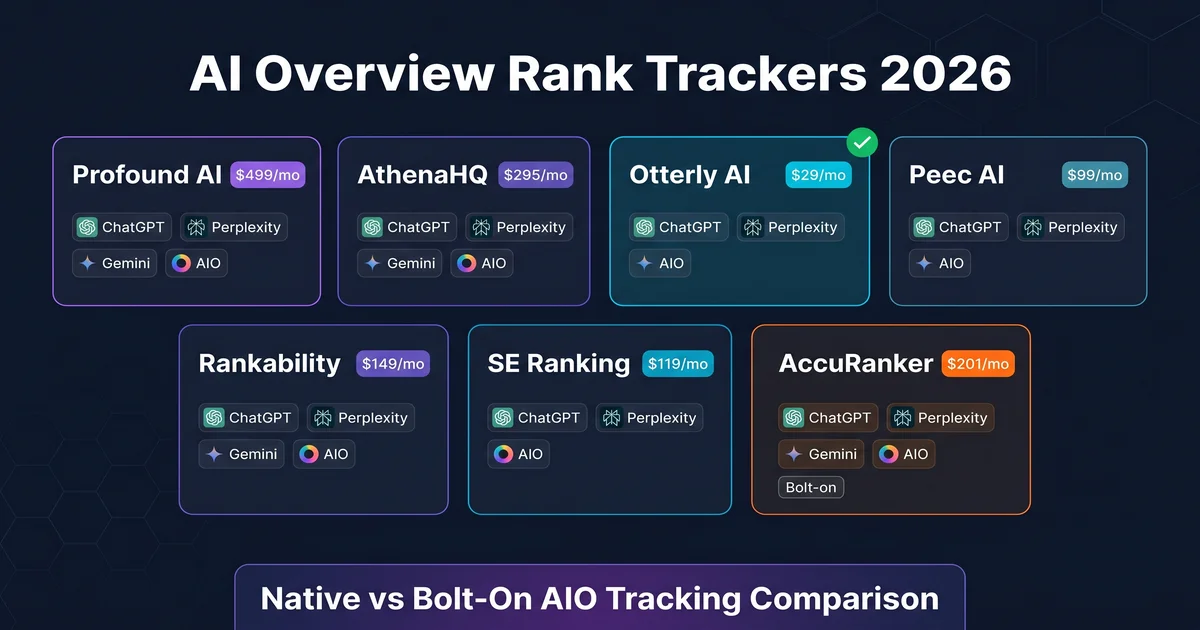
Most tools marketing “AI Overview tracking” in 2026 only detect whether an AI Overview appears for a keyword. Detecting presence is not tracking. A rank tracker with AI Overview tracking that actually delivers should extract the citation source URL, measure prompt-level visibility, cover 5+ AI engines (Google AIO, AI Mode, ChatGPT, Perplexity, Gemini), and report share of voice over time. Only 4 of the 7 tools in this roundup clear that bar. The $499/mo Profound AI leads on citation depth; the $29/mo Otterly AI tracks more AI engines than the $201/mo AccuRanker at one-seventh the price.
This article is the AI engine coverage matrix that traditional rank tracker roundups skip: specialized AIO-first tools, integrated SEO+AIO platforms, and the AccuRanker-tier legacy trackers that added AI Overview detection as an afterthought. The goal is to stop you from paying $200-500/mo for a bolted-on AI feature when a $30-100/mo specialized tool delivers deeper visibility on the engines you actually need.
TL;DR
- Profound AI leads enterprise AIO citation intelligence at $499/mo+ with a Series B $35M war chest and multi-platform coverage.
- AthenaHQ tracks the widest AI engine set (7 engines including Grok) starting at $295/mo Starter tier.
- Otterly AI at $29/mo is the cheapest serious AIO tracker with Share of AI Voice metrics.
- SE Ranking AI Visibility at $119/mo is the best integrated traditional SEO plus AI Overview stack.
- AccuRanker’s bundled partial AIO at $201/mo is the shallowest in this list; buy it only if you need on-demand refresh plus AIO as a bonus.
- Verdict: Most 2026 agencies need TWO tools: specialized AIO tracker ($29-99/mo) plus traditional rank tracker. Single-tool solutions are a compromise.
$29/mo
Otterly AI entry (10 prompts)
$119/mo
SE Ranking AI Visibility
7 engines
AthenaHQ max coverage
$499/mo
Profound AI Lite (enterprise)
Contents
- What Makes a Rank Tracker “AI Overview Ready” in 2026?
- How Do the 7 AIO Rank Trackers Compare on Engine Coverage?
- #1 Profound AI: Why Is It the Enterprise AIO Citation Leader?
- #2 AthenaHQ: Does It Have the Widest AI Engine Coverage?
- #3 Otterly AI: Is $29/mo the Cheapest Serious AIO Tracker?
- #4 Peec AI: When Does a Multi-Platform Brand Monitor Win?
- #5 Rankability: Why Do Content Teams Pick It for AIO?
- #6 SE Ranking AI Visibility: Best Integrated SEO + AIO Tracker?
- #7 AccuRanker: Is Bundled Partial AIO Enough?
- Verdict: Which Rank Tracker With AI Overview Tracking Wins?
- FAQ
- What’s the difference between AI Overview tracking and AI keyword tracking?
- Which rank tracker tracks ChatGPT citations natively?
- Do I need a specialized AIO tool or is an integrated rank tracker enough?
- Is AccuRanker’s AI Overview tracking worth the price in 2026?
- What’s the cheapest AI Overview rank tracker?
- Which AI engines should I prioritize tracking in 2026?
- How often do AI Overviews change compared to traditional rankings?
- Key Takeaways
What Makes a Rank Tracker “AI Overview Ready” in 2026?
A rank tracker with AI Overview tracking that actually delivers agency-grade visibility needs four capabilities. First, detection of AIO presence for a keyword is table stakes. Second, extraction of the citation source URLs cited by the AI Overview, so you can see which pages are being referenced. Third, prompt-level tracking across multiple AI engines (Google AIO, AI Mode, ChatGPT, Perplexity, Gemini, Claude, Copilot), not just Google alone. Fourth, share-of-voice metrics over time so you can measure whether your content is gaining or losing AI visibility week over week.
Apply the Native vs Bolt-On Test before shortlisting any tool. Native AIO tracking means the platform was built for AI search visibility from day one. Citation extraction, prompt-level tracking, and share-of-voice are first-class product features. Bolted-on AIO tracking means a traditional rank tracker added AIO detection as a module, often with limited engine coverage, no citation source extraction, and no prompt-level data. The price gap between native and bolt-on is smaller than you’d expect: $29-295/mo for native specialized tools vs $119-500/mo for bolted-on integrated platforms.
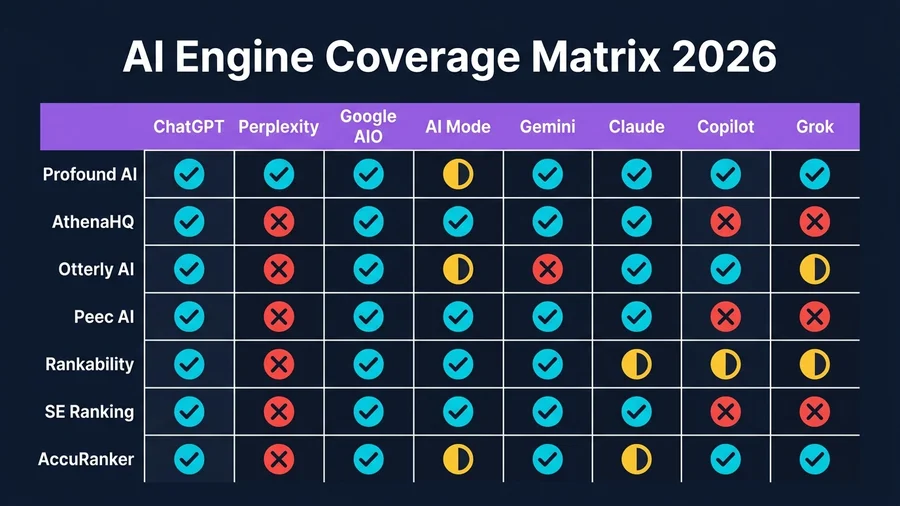
The AI Engine Coverage Matrix is the second framework you need. Each tool in this roundup tracks a different subset of AI search engines. Google AI Overview is table stakes. AI Mode (Google’s dedicated AI search experience) is newer and not every tool has caught up. ChatGPT and Perplexity are the largest consumer AI search platforms. Gemini, Claude, Copilot, and Grok complete the 2026 relevant set. Before buying, map your required engines to each tool’s actual coverage.
Why does this matter in 2026? AI Overviews are the single most volatile search feature of the year. Cited sources can shift within days, not months. Agencies reporting AI visibility to clients monthly need tools that track changes at the prompt level and across engines, not tools that just flag whether AIO appeared for a keyword.
Source:
Pricing and engine coverage data verified from vendor pages and 2026 industry roundups: Rankability AI visibility tools roundup, Otterly.ai AI search monitoring roundup, and AIclicks AI Overview trackers review.
How Do the 7 AIO Rank Trackers Compare on Engine Coverage?
The AI Engine Coverage Matrix at a glance reveals the structural gap between specialized AIO-first tools and bolted-on rank trackers.
| Tool | Entry Price | Engines Tracked | Native vs Bolt-On |
|---|---|---|---|
| Profound AI | $499/mo | 5-10 engines | Native |
| AthenaHQ | $295/mo | 7 (ChatGPT, Perplexity, AIO, AI Mode, Gemini, Claude, Copilot, Grok) | Native |
| Otterly AI | $29/mo | 3 (Google AIO, ChatGPT, Perplexity) | Native |
| Peec AI | €99/mo (~$99) | 4+ (ChatGPT, Perplexity, AIO, answer engines) | Native |
| Rankability | $149/mo | 5 (ChatGPT, Perplexity, AIO, Gemini, Claude) | Native (content-integrated) |
| SE Ranking | $119/mo | 5 (ChatGPT, Perplexity, Gemini, AIO, AI Mode) | Integrated (SEO + AIO) |
| AccuRanker | $201/mo | 1-2 (partial Google AIO) | Bolt-on |
#1 Profound AI: Why Is It the Enterprise AIO Citation Leader?
Profound AI is the enterprise-grade rank tracker with AI Overview tracking for agencies that need the deepest citation intelligence. Lite pricing starts at $499/mo with Enterprise pricing custom. The platform was built from day one as a Generative Engine Optimization (GEO) platform, not a rank tracker with AIO added as a module. The Native vs Bolt-On Test scores Profound at the highest possible tier: citation source URL extraction, prompt-level visibility tracking across 5-10 AI engines depending on plan, and read/write optimization capabilities that go beyond monitoring.
The capital position matters for enterprise buyers. Profound raised a $35M Series B led by Sequoia, signaling venture conviction that AIO tracking is a durable market. The platform ingests millions of citations, crawler visits, and prompts, giving it the data depth that smaller specialized tools can’t match. For agencies reporting AI visibility to enterprise clients with multi-million dollar brand stakes, that depth is often the deciding factor.
Where Profound falls short: the $499/mo entry price rules out most small and mid-sized agencies. Traditional SERP rank tracking isn’t a first-class feature, so agencies using Profound still need a second tool for classic rank reports. The learning curve is steep for teams not already fluent in GEO concepts.
Who should choose Profound AI: Enterprise SEO/GEO agencies managing brand citation exposure across multiple AI platforms for Fortune 1000 clients. Agencies with dedicated AIO practice leads. Organizations that treat AI search optimization as a standalone service line, not a bolt-on to SEO.
#2 AthenaHQ: Does It Have the Widest AI Engine Coverage?
AthenaHQ has the widest AI engine coverage in this roundup: ChatGPT, Perplexity, Google AIO + AI Mode, Gemini, Claude, Copilot, and Grok. That’s 7 distinct AI engines tracked natively from the Starter tier at $295/mo (credits-based). No other tool at this price tier covers Grok or Copilot alongside the core set.
The Native vs Bolt-On Test places AthenaHQ firmly in the native category. It’s a dedicated Generative Engine Optimization platform with an Action Center for diagnosing and fixing AIO visibility gaps. Agencies report that the Action Center is the most actionable output of any tool in this list, moving beyond pure measurement into concrete content optimization tasks. Competitor impersonation alerts detect when competitor reporting setups get cited in queries where your brand is absent, and ROI traffic analytics connect AI visibility to downstream conversion metrics.
The credits-based pricing model at Starter requires careful capacity planning. Running out of credits mid-month is a common agency complaint, so scale up to higher tiers if your monitored keyword count is volatile. Enterprise pricing is custom and negotiable.
Where AthenaHQ falls short: at $295/mo, it’s a premium product. Smaller agencies running AIO tracking as a bolt-on service line need to justify the cost per client. Traditional SERP rank tracking is not a feature, so you’ll still need a classic rank tracker like Nightwatch or AccuRanker alongside it.
Who should choose AthenaHQ: Agencies that need multi-engine AI coverage including emerging platforms like Grok and Copilot. Teams that want diagnose-plus-fix Action Center workflows. Mid-market to enterprise agencies with AIO as a recurring client deliverable.
#3 Otterly AI: Is $29/mo the Cheapest Serious AIO Tracker?
Otterly AI starts at $29/mo for 10 tracked prompts, scaling to $989/mo for 1,000 prompts. This is the cheapest serious rank tracker with AI Overview tracking in this roundup by a wide margin. Otterly’s Native vs Bolt-On Test result is native: the platform is purpose-built for AI search monitoring, with Google AIO, ChatGPT, and Perplexity as tracked engines.
The standout feature is the Share of AI Voice metric, which quantifies what percentage of relevant AI responses mention your brand versus competitors. This is the single most actionable metric for AI visibility reporting. Paired with the Brand Visibility Index KPIs, Otterly delivers the reporting depth you’d expect at a 5-10x higher price point.
The prompt-credit model is the constraint. At $29/mo you get 10 prompts. That sounds small, but 10 well-chosen prompts tracking core brand queries across 3 AI engines produces meaningful agency data. For a small agency tracking 2-3 clients’ core brand queries, the Starter tier is viable. Above 50-100 tracked prompts, pricing scales quickly toward the $989/mo top tier.
Where Otterly falls short: no coverage of Gemini, Claude, Copilot, or Grok. If your agency needs broad engine coverage, Otterly’s 3-engine scope is a structural limit. No traditional SERP rank tracking.
Who should choose Otterly AI: Small agencies, freelancers, or in-house SEO teams doing their first AIO tracking project. B2B SaaS marketers monitoring brand citations in ChatGPT and Perplexity for core product queries. Teams testing AIO tracking ROI before committing to a higher-priced specialized tool.
#4 Peec AI: When Does a Multi-Platform Brand Monitor Win?
Peec AI at €99/mo (approximately $99 USD) positions itself as a specialized platform built from the ground up for AI search monitoring. The platform covers ChatGPT, Perplexity, Google AIO, and other answer engines, with share-of-voice plus sentiment analysis as differentiating features.
The Native vs Bolt-On Test result is solidly native. Peec was not a retrofit of an existing SEO tool; it was designed for AI search visibility from inception. The sentiment analysis layer is unique in this price tier and matters for brands tracking how AI engines portray their products and services beyond simple citation presence.
Where Peec wins for agencies: at ~$99/mo, it sits between Otterly’s budget tier and Rankability’s content-integrated tier with stronger brand monitoring features than either. For agencies with clients focused on reputation management alongside traditional SEO, Peec’s sentiment layer delivers insights competitors miss.
Where Peec falls short: Euro-based pricing creates FX friction for US agencies. Engine coverage is comparable to Otterly at similar price point but without Otterly’s prompt-credit flexibility. No traditional SERP rank tracking.
Who should choose Peec AI: European agencies serving EU clients. Agencies with brand reputation management as a core service line. Teams that want sentiment analysis layered on top of citation tracking.
#5 Rankability: Why Do Content Teams Pick It for AIO?
Rankability at $149/mo (Core tier) is the rank tracker with AI Overview tracking that best serves SEO content teams. The platform covers ChatGPT, Perplexity, Google AIO, Gemini, and Claude (5 engines) with native integration into Rankability’s Content Optimizer and keyword research workflows. The promotional line “close gaps instead of exporting CSVs” captures the differentiator accurately.
The Native vs Bolt-On Test places Rankability in native territory, with the important caveat that Rankability is a broader SEO platform that added AIO tracking as a core feature, not a bolt-on. The integration with content optimization tooling is the winning angle: when AIO tracking identifies a gap (your brand isn’t cited for a priority query), the tool hands off directly to content brief generation and gap closure workflows. Content teams stop exporting data to spreadsheets and start producing targeted content.
Where Rankability falls short: at $149/mo Core, it’s the mid-tier of this list. Engine coverage is strong (5 engines) but not the widest. Agencies not using the rest of the Rankability suite may find the integration advantage less valuable than the raw tracking data.
Who should choose Rankability: Content-led SEO agencies where the AIO tracking data must flow directly into content production workflows. Teams already using or considering Rankability’s Content Optimizer. Agencies wanting AIO tracking with built-in “what do we write next?” actioning.
#6 SE Ranking AI Visibility: Best Integrated SEO + AIO Tracker?
SE Ranking’s AI Visibility Tracker at $119/mo delivers the best integrated traditional SEO plus AIO tracking in this roundup. It covers ChatGPT, Perplexity, Gemini, Google AIO, and AI Mode (5 engines) as an integrated feature with no separate add-on cost on eligible plans.
The Native vs Bolt-On Test result is nuanced: SE Ranking is an established all-in-one SEO platform, but AI Visibility was built as a first-class product feature, not a bolted-on module. The “No cited” feature reveals competitor mentions where your brand is absent, which is the single most actionable AIO metric for content strategy teams. If a competitor is cited for 40% of your priority prompts and you’re cited for 5%, that gap analysis drives the next quarter of content work.
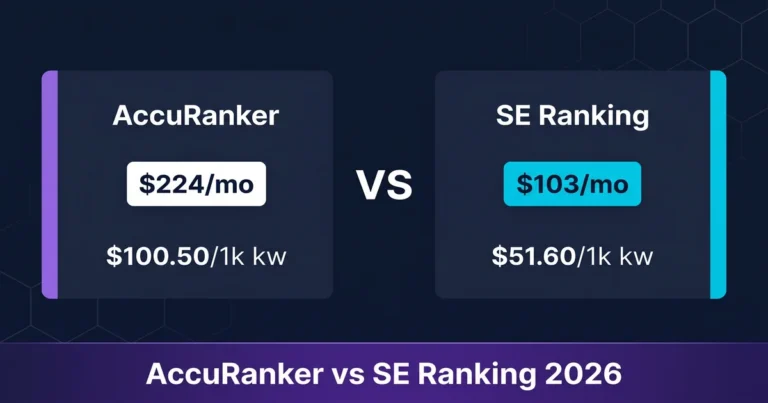
For existing SE Ranking users, the AI Visibility Tracker is the most cost-effective path to native AIO coverage. See our AccuRanker vs SE Ranking comparison for the broader platform comparison. For agencies choosing between SE Ranking and AccuRanker specifically for AIO tracking, SE Ranking wins decisively on AI engine coverage breadth at a lower price.
Where SE Ranking falls short: the AIO tracking depth doesn’t match specialized tools like Profound or AthenaHQ at the enterprise tier. Citation source extraction is less granular than dedicated GEO platforms.
Who should choose SE Ranking AI Visibility: Agencies that want one tool for classic rank tracking and AIO visibility. Teams currently using SE Ranking who want to add AIO without onboarding a second vendor. Mid-market agencies balancing cost, coverage, and single-dashboard simplicity.
#7 AccuRanker: Is Bundled Partial AIO Enough?
AccuRanker Professional (see our AccuRanker pricing review) at $201/mo annual (2,000 keywords) bundles partial Google AI Overview coverage at no additional cost on existing plans. The Native vs Bolt-On Test places AccuRanker firmly in bolt-on territory: AIO detection was added as a feature module, not a first-class product commitment. Engine coverage is limited to partial Google AIO only. No ChatGPT, Perplexity, Gemini, Claude, Copilot, or Grok tracking.
So why is AccuRanker in this roundup at all? One reason: for agencies already paying for AccuRanker for its core strength (on-demand refresh, clean UI for bulk keyword management, accurate traditional SERP data), the bundled AIO coverage is a no-cost bonus. It’s the shallowest AIO tracking on this list but it’s bundled. See our AccuRanker alternatives for cheaper and deeper options.
Compare this to the alternative: buying AccuRanker for its traditional strengths and adding Otterly AI’s $29/mo Starter tier for serious AIO tracking. Total monthly: $230. You get true rank tracking plus dedicated AIO monitoring. That stack beats AccuRanker’s bolt-on AIO at the same price, with 10x the AIO depth.
Where AccuRanker falls short: AIO coverage is partial, Google-only, and less transparent about citation source extraction than any native tool in this list. For agencies where AIO tracking is the primary requirement, AccuRanker is not the answer.
Who should choose AccuRanker for AIO: Agencies already committed to AccuRanker for on-demand refresh and traditional rank tracking who want partial Google AIO coverage as a bonus. Agencies with clients where Google AIO is the only AI engine of interest. Not recommended as a standalone AIO solution.
Verdict: Which Rank Tracker With AI Overview Tracking Wins?
Applying the Native vs Bolt-On Test and the AI Engine Coverage Matrix to your specific agency profile produces different winners at different tiers.
For enterprise agencies with Fortune 1000 brand clients: Profound AI at $499/mo+ is the citation intelligence leader. Pair with a traditional rank tracker like Nightwatch or AWR.
For multi-engine coverage needs (Grok, Copilot, Claude): AthenaHQ at $295/mo covers the widest engine set. Pair with a traditional rank tracker.
For budget-constrained agencies needing serious AIO tracking: Otterly AI at $29/mo entry tier is the clear winner. Scale to higher tiers as prompt volume grows.
For European agencies with brand reputation priorities: Peec AI at €99/mo balances coverage, sentiment analysis, and price.
For content-led SEO agencies: Rankability at $149/mo integrates AIO findings directly into content workflows.
For agencies wanting one tool for SEO + AIO: SE Ranking at $119/mo is the most cost-effective integrated solution. Best for teams that prioritize single-dashboard simplicity over maximum AIO depth.
The two-tool stack verdict: Most 2026 agencies are best served by stacking a specialized AIO tool ($29-99/mo for Otterly or Peec) with a traditional rank tracker ($32-150/mo depending on keyword volume). Total stack cost: $60-150/mo for deeper AIO coverage and full rank tracking than any single bolted-on “integrated” solution delivers at $200-500/mo. For agency-specific rank tracker comparisons beyond AIO, see our white-label rank tracking for agencies roundup.
Warning
AI Overview tracking is the most volatile pricing category in 2026 SEO tools. Several tools in this roundup launched pricing changes in Q1 2026 and may shift again by Q3. Verify pricing directly on vendor sites before committing to multi-month contracts. Beta-labeled features (several on this list) can change scope without notice.
FAQ
What’s the difference between AI Overview tracking and AI keyword tracking?
AI Overview tracking monitors whether AI search engines (Google AIO, ChatGPT, Perplexity, etc.) cite your content for specific queries and which source URLs they cite. AI keyword tracking is a different feature that uses AI to suggest keyword opportunities or generate content briefs. Most tools marketing “AI features” offer AI keyword tracking, not AI Overview tracking. The Native vs Bolt-On Test helps distinguish real AIO tracking from AI-assisted SEO features dressed up with AI Overview branding.
Which rank tracker tracks ChatGPT citations natively?
Six of the seven tools in this roundup track ChatGPT citations natively: Profound AI, AthenaHQ, Otterly AI, Peec AI, Rankability, and SE Ranking AI Visibility. AccuRanker does not track ChatGPT; its bundled AIO coverage is Google-only. For dedicated ChatGPT citation tracking on the smallest budget, Otterly AI at $29/mo is the clear winner.
Do I need a specialized AIO tool or is an integrated rank tracker enough?
The integrated-tool approach (SE Ranking at $119/mo, AccuRanker at $201/mo) is enough if you need basic AIO presence detection and your traditional SEO workflow is the primary use case. Specialized tools (Profound, AthenaHQ, Otterly, Peec) are required if you need citation source URL extraction, deep prompt-level tracking, or multi-engine coverage beyond Google AIO. The smart 2026 agency stack pairs a specialized AIO tracker ($29-99/mo) with a traditional rank tracker ($32-150/mo) for under $150/mo total.
Is AccuRanker’s AI Overview tracking worth the price in 2026?
AccuRanker’s bundled partial AIO coverage at $201/mo Professional is worth it only if you’re already using AccuRanker for its traditional strengths (on-demand refresh, clean bulk keyword UI). As a standalone AIO solution, AccuRanker is the shallowest option in this roundup. A $230/mo stack of AccuRanker plus Otterly AI Starter delivers significantly better AIO depth than AccuRanker alone at the same total budget.
What’s the cheapest AI Overview rank tracker?
Otterly AI at $29/mo for 10 tracked prompts is the cheapest serious rank tracker with AI Overview tracking in 2026. It covers Google AIO, ChatGPT, and Perplexity with native Share of AI Voice metrics. For agencies below 10-20 tracked prompts, Otterly’s Starter tier delivers reporting depth that costs 5-10x more on integrated SEO platforms.
Which AI engines should I prioritize tracking in 2026?
Google AI Overviews and AI Mode are table stakes given Google’s dominant search market share. ChatGPT and Perplexity are the highest-ROI additions because they have the largest dedicated AI search audiences outside Google. Gemini, Claude, Copilot, and Grok are emerging engines worth tracking if your clients serve enterprise or developer audiences where those platforms have pockets of adoption. Start with 3 engines (AIO + ChatGPT + Perplexity) and expand coverage as client demand justifies.
How often do AI Overviews change compared to traditional rankings?
AI Overviews are the most volatile search feature in 2026. Cited sources can shift within days, not weeks or months. Traditional SERP rankings for established sites change slowly, with most movement happening at position transitions (page 2 to page 1, top 3 vs top 10). AIO citations can rotate entirely within a 7-day window as the underlying LLM context and indexing updates. Plan for more frequent reporting cycles on AIO than on traditional rank tracking.
Key Takeaways
- Native AIO tracking beats bolt-on AIO tracking at every agency tier. Specialized tools built for AI search visibility deliver deeper citation data than traditional rank trackers with bolted-on AIO modules.
- Otterly AI at $29/mo is the best entry point for any agency starting AIO tracking. 3-engine coverage with Share of AI Voice metrics.
- Profound AI and AthenaHQ lead the enterprise tier for agencies with Fortune 1000 brand clients or wide engine coverage needs.
- The 2-tool stack beats single-tool solutions for most 2026 agencies: specialized AIO tracker + traditional rank tracker totals under $150/mo and delivers deeper AIO coverage than any integrated $200-500/mo platform.
- AccuRanker’s bundled partial AIO is the shallowest option in this roundup. Worth it only as a bonus when you’re already using AccuRanker for on-demand refresh and traditional rank tracking.
- AI Engine Coverage Matrix is the shortlisting framework. Map your required engines to each tool’s actual coverage before evaluating on price or features.
- For the broader rank tracker market beyond AIO-specialized tools, see our best rank tracking tools comparison.