
SEVOsmith: AI-Citable Content Engine Setup Guide 2026
You’re reading the SEVOsmith v1.5.0 guide. SEVOsmith v2.2.0 is now available, 5 specialized sub-workflows, 467 nodes, Shopify publishing, multi-language support, and Cloudflare R2 caching. Read the v2.2.0 guide →
The SEO landscape has fundamentally shifted. ChatGPT Search, Google AI Overviews, and Perplexity are no longer just answering questions,they’re citing sources. If your content isn’t being referenced by these AI systems, you’re invisible in the zero-click era.
After running 200+ content campaigns and analyzing what gets cited versus what gets ignored, I built SEVOsmith,a completely autonomous n8n workflow that produces AI-citable articles at scale. This isn’t another “AI content generator.” It’s a forensic engineering system that researches, writes, audits, and self-corrects until every piece meets verifiable quality thresholds.
Building AI content at scale requires the right underlying tools. See our breakdown of the best AI content writer tools to understand which models and platforms SEVOsmith integrates with.
In this deep-dive, I’ll show you exactly how SEVOsmith works under the hood: the 9-zone architecture, the 13 specialized AI agents, the self-healing audit loop, and the visual asset pipeline that makes content stand out. Whether you’re a marketing team scaling from 5 to 50 articles monthly or an agency managing multiple client campaigns, this guide will show you how to build production-grade content automation.
Why “SEVOsmith”? The name is a fusion of SEvO (Search Everywhere Optimization) and the suffix -smith (as in blacksmith or wordsmith). It represents a fundamental shift in philosophy: we aren’t just “generating” text; we are forging authority. Just as a smith hammers raw metal into precision tools, this system takes raw data and engineers it into durable, high-quality content designed to dominate the entire search ecosystem,from Google to AI Overviews.
What SEVOsmith v1.5.0 Does
A 321-node, 13-agent n8n automation that turns a Google Sheet row into a published WordPress draft in 18 ‐ 25 minutes. Three workflows. Nine execution zones. A deterministic audit loop that catches what LLMs miss,exact keyword counts, stat density, anchor text,and fixes it before anything publishes. API cost: $1.02 ‐ $1.88 per article. One-time purchase, runs on your own infrastructure. No monthly SaaS fees.
Contents
- Who Is This System Perfect For?
- Why Do Traditional Content Pipelines Fail?
- What Is the SEVOsmith Forensic Architecture?
- What Are the 9 Execution Zones in SEVOsmith?
- Zone 1: Input & Configuration
- Zone 2: Deep Research & Intelligence
- Zone 3: Competitor Intelligence, Negative Space Analysis
- Zone 4: Content & SEvO Strategist, The Master Blueprint Architect
- Zone 5: Strategic Linking Intelligence
- Zone 6: Article Outline & Content Generation
- Zone 7: Automated Audit & Revision Loop
- Zone 8: Visual Asset & Metadata Generation
- Zone 9: Final Delivery & Documentation
- How Do You Deploy SEVOsmith from Zero to Production?
- Frequently Asked Questions
- 1. What’s the total cost per article (including all APIs)?
- 2. Do I need coding or technical skills to use SEVOsmith?
- 3. How long does initial setup take for someone new to n8n?
- 4. What do I get when I purchase this workflow?
- 5. How does SEVOsmith compare to human-written content?
- 6. Does SEVOsmith support languages other than English?
- 7. What types of content does it handle best?
- 8. Can I customize the agent prompts and workflows?
- 9. Can I run multiple articles in parallel?
- 10. How often are updates released?
- 11. Can I use this for content refreshes/updates (not just new articles)?
- Build Your Citation Engine,Or Watch Competitors Build Theirs
Who Is This System Perfect For?
Before diving into the technical architecture, let’s be clear about who this system serves:
Content Agencies & Marketing Teams scaling production (20-100+ articles/month):
- You need consistent quality without hiring 10 writers
- You want to eliminate expensive SaaS tools ($129-399/month subscriptions)
- You require complete audit trails for client reporting
- You need to productize content creation with documented processes
In-House Content Operations looking to replace manual workflows:
- You’re tired of coordinating freelancers across research, writing, and editing
- You want full control and transparency (no black-box AI tools)
- You need compliance documentation for regulated industries
- You want to own your content infrastructure, not rent it
SEO Consultants & Strategists who need strategic depth at scale:
- You create content strategies for clients but hate manual execution
- You need to document the research foundation behind every recommendation
- You want to demonstrate ROI with measurable quality scores
- You’re comfortable with technical setup and want maximum control
Technical Content Teams producing developer documentation or technical guides:
Ready to get started? Follow our SEVOsmith v2.2.0 setup guide for step-by-step configuration.
- You need code examples, diagrams, and technical accuracy
- You want literal visualizations (architecture diagrams, not stock photos)
- You require version control and audit trails for content
- You have API budget and technical resources
Why Do Traditional Content Pipelines Fail?
The Death of ‘Publish and Pray’ SEO
For the last decade, SEO operated on a predictable model: optimize for keywords, earn backlinks, rank in position 1-3, capture organic traffic. That playbook is obsolete. Neil Patel declared at INBOUND 2024 that ‘Content is King’ has been dethroned,not by better content, but by content saturation. When billions of pieces of content are published daily across social, blogs, and video platforms, incremental improvements to keyword density don’t move the needle.
Simultaneously, AI-powered answer engines have fundamentally changed user behavior. Users bypass the ’10 blue links’ and expect synthesized, immediate answers. Google AI Overviews, ChatGPT Search, and Perplexity aggregate multiple sources to generate a single response. If your content isn’t one of the 3-5 sources cited, you might as well not exist.
The New Ranking Algorithm: E-E-A-T as Infrastructure
Google’s E-E-A-T framework,Experience, Expertise, Authoritativeness, Trustworthiness,was originally designed for human quality raters. But AI models have operationalized these principles as algorithmic gatekeepers. LLMs cannot inherently discern truth; they rely on proxy signals:
- Structured data (schema.org markup)
- High-authority external citations (edu, gov, trusted industry sources)
- Semantic density (comprehensive coverage of topic clusters)
- Content freshness (recent publication/update dates)
- Cross-platform brand signals (YouTube, podcasts, LinkedIn mentions)
Google’s official helpful content guidelines make clear that treating E-E-A-T as a checklist is insufficient. It must be engineered into your production pipeline,every article must programmatically inject citations, verify data accuracy, and link into a topical authority graph. Manual processes cannot enforce this at scale. You need infrastructure.
What Is the SEVOsmith Forensic Architecture?
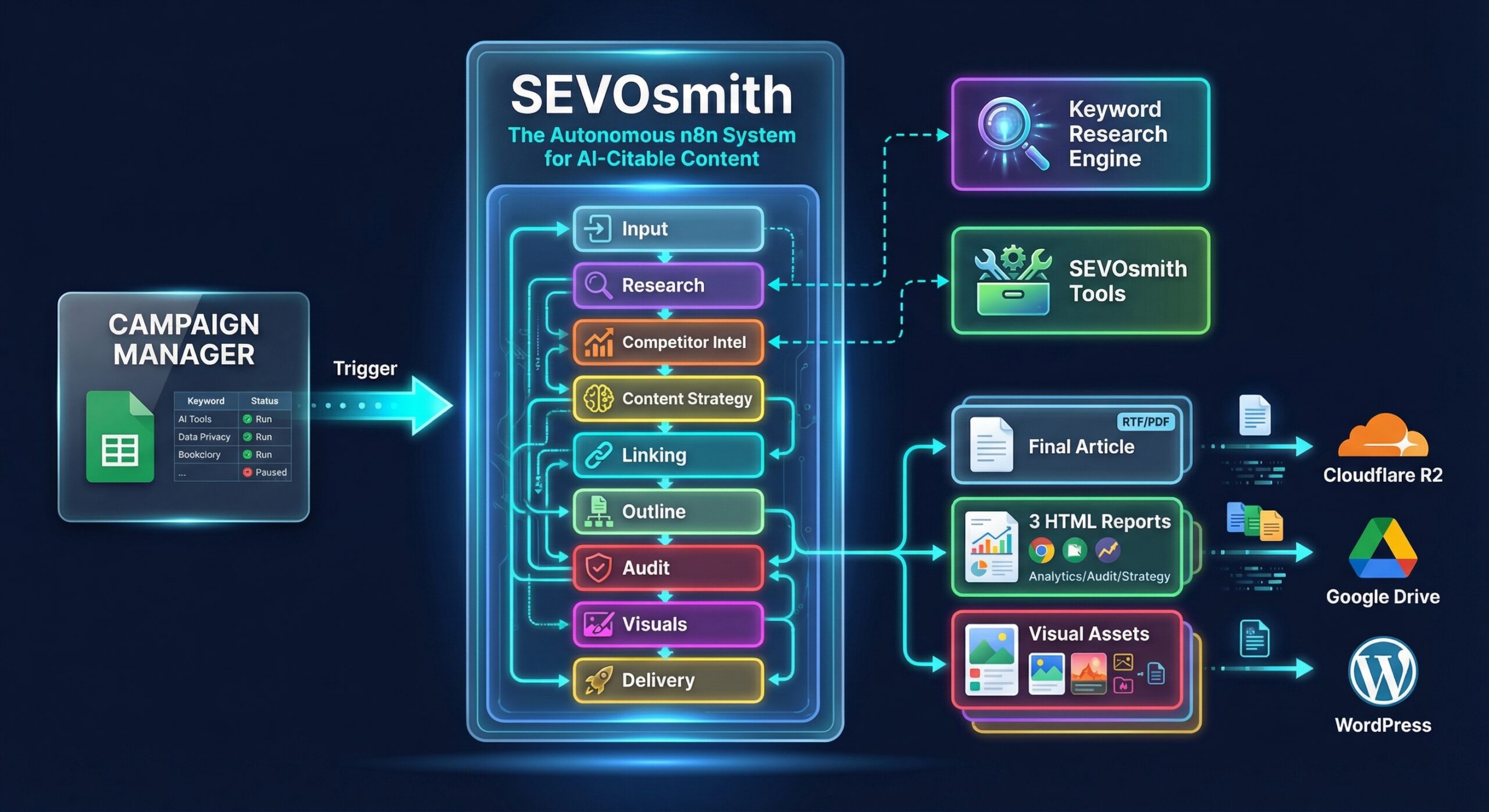
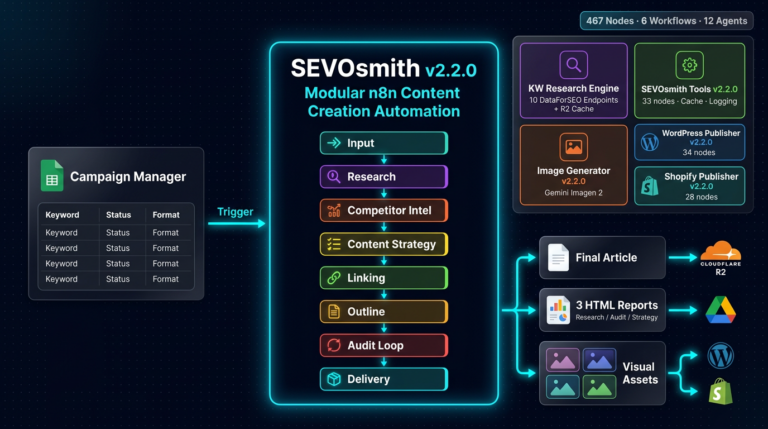
SEVOsmith operates as a hub-and-spoke architecture where a central orchestrator (the “Hub”) delegates specialized tasks to autonomous agents (the “Spokes”), then aggregates their outputs into a unified Master Blueprint. This design mirrors microservices patterns in cloud infrastructure: modular, fault-tolerant, and horizontally scalable.
- System Scale: 321 nodes across 3 workflows | 13 AI agents | 9 execution zones
- Performance: 18-25 minutes per article | API cost: $1.20-1.88 per article
Technology Stack
SEVOsmith combines best-in-class AI models with production-grade infrastructure:
AI & Language Models
- Google Gemini 2.5 Pro and Gemini 2.5 Flash – Primary LLMs powering all 13 autonomous agents (audience analysis, competitor intelligence, content strategy, writing, quality assurance, metadata generation). Gemini 2.5 Flash handles lighter parsing tasks for speed and cost efficiency.
- Gemini 3 Pro Image Preview – Multimodal image generation for featured images, section visuals, and branded assets.
- Perplexity AI – Deep web research and real-time fact-checking.
- Claude Sonnet 4.5 (via OpenRouter) – High-reasoning tasks including SEO Article Reviser and Production Brief Architect, where nuanced rewriting and strategic depth are required.
Data & Research
- DataForSEO API – 9 parallel endpoints providing forensic keyword intelligence:
- SERP analysis (Google organic, AI Mode detection, YouTube)
- Keyword metrics (volume, difficulty, search intent, related keywords)
- AI optimization data and topic cluster generation
- 1,007 location/language combinations for global coverage
- Firecrawl API – Web scraping for sitemap extraction and competitor content analysis
Infrastructure & Orchestration
- Google Sheets – Campaign management interface and real-time status tracking
Publishing & Integration
- WordPress API – Automated post creation, media upload, metadata management
- Google Drive / Cloudflare R2 – HTML report storage and cloud file hosting
- Gmail API – Completion notifications and stakeholder alerts
- Supabase – Optional execution logging and performance analytics (optional)
Cost Breakdown
| Technology | Cost per Article | Purpose |
|---|---|---|
| DataForSEO | $0.07-0.08 | 9 parallel research endpoints |
| Google Gemini 2.5 Pro | $0.80-1.50 | 10+ AI agent calls (varies by length) |
| Gemini 3 Pro Image Preview | $0.15-0.30 | 3-8 image generations |
| Google Drive | $0 | Free tier storage |
| Total | $1.02-1.88 | Complete production pipeline |
Why this stack?
- Gemini 2.5 Pro and Gemini 2.5 Flash: Long context window (2.5 Pro) for complex research synthesis; Gemini 2.5 Flash for lightweight parsing tasks, 60% cost savings vs Claude/GPT-4
- DataForSEO: Only API with native AI Mode detection (critical for zero-click era), comprehensive 9-endpoint coverage vs competitors’ 3-4
- n8n self-hosted option, complete observability for debugging, no vendor lock-in, with 40,000+ active self-hosted instances worldwide.
Core Components
Main Orchestrator Workflow
The central nervous system that coordinates all 9 execution zones. Routes data between agents, manages error handling, and tracks execution state. Handles strategic decisions like “Should this article have a Limitations section?” or “How many H3 images should we generate?”
Keyword Research Engine (sub-workflow)
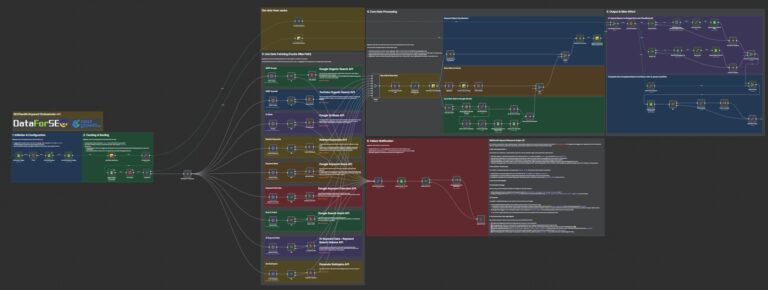
A specialized research pipeline that fetches data from 9 parallel dataForSEO API sources (SERP data, People Also Ask, keyword metrics, related keywords, search intent, AI Overview presence, topic clusters) in 2-3 minutes. This isn’t a simple API call,it’s a forensic data collection system that captures everything Google knows about a keyword.
SEVOsmith Tools (sub-workflow)
A shared utility library used across multiple zones. Contains reusable functions. Think of this as a “standard library” that prevents code duplication,any agent needing to fetch a sitemap or validate a URL calls these pre-built tools.
This technology stack enables SEVOsmith to operate as production-grade infrastructure,not a simple content generator, but an engineered system combining AI intelligence with DevOps reliability.
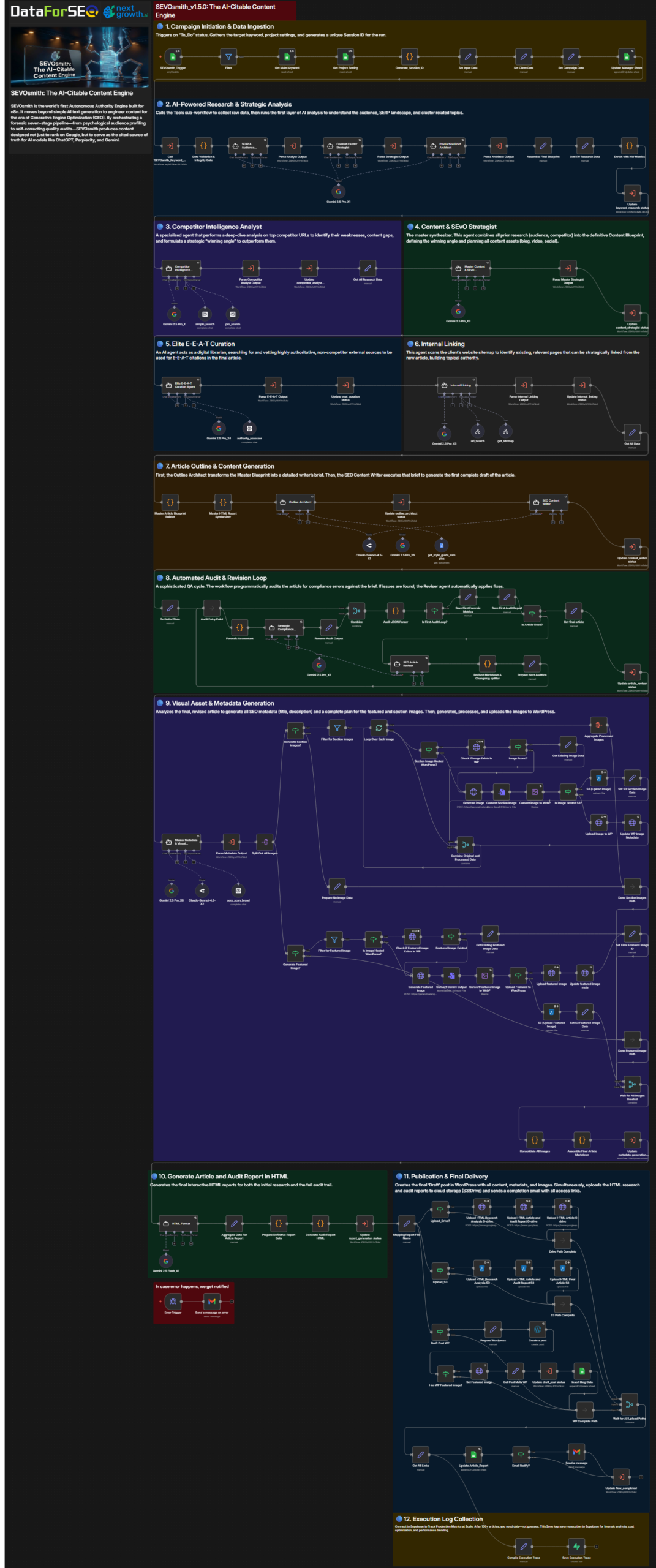
From Keyword to Published Article: Live Examples
The best way to understand SEVOsmith’s output quality is to see it yourself. Below are actual articles generated by the system,unedited except for minor brand-specific adjustments. Each article was produced using the complete 9-zone workflow: forensic keyword research, competitor analysis, strategic planning, E-E-A-T curation, autonomous writing, code-based QA, and visual asset generation. Notice the citation depth, structural consistency, and strategic gap exploitation.
Example1: Keyword “lavender essential oil“
- 📊 View research report: https://drive.google.com/file/d/10IBb_qEy7ebJli2dpfE5TGb5DG0JAFNW/view?usp=sharing
- 🔍 View audit trail and final article: https://drive.google.com/file/d/1fbgDadFbQnICFJK-tT1VoHsh4vERpB4a/view?usp=sharing
Example 2: 6 month old golden retriever
- 📊 View research report: https://drive.google.com/file/d/1a1oWCHSvI3ICAdhWuXTqmVL1mfSOPTcY/view
- 🔍 View audit trail and final article: https://drive.google.com/file/d/1DuczI9YSUagcUrJP0kcfuXEV1TbG65Pd/view
The current Gumroad release is SEVOsmith v2.2.0. This page documents the v1.5.0 architecture. If you’re purchasing for the first time, you’ll receive v2.2.0, read the v2.2.0 guide for the updated architecture and setup instructions.
Where to get SEVOsmith engine workflow?
This workflow is offered on Gumroad to help support its continued development and to allow for optional tips. Your support is greatly appreciated!
Disclosure: SEVOsmith is a paid product created and sold by NextGrowth.ai. This page is the official product page by the creator.
SEVOsmith: The Autonomous n8n System for AI-Citable Content
What Are the 9 Execution Zones in SEVOsmith?
SEVOsmith operates across 9 distinct zones, each handling a specific phase of content production.
Zone 1: Input & Configuration
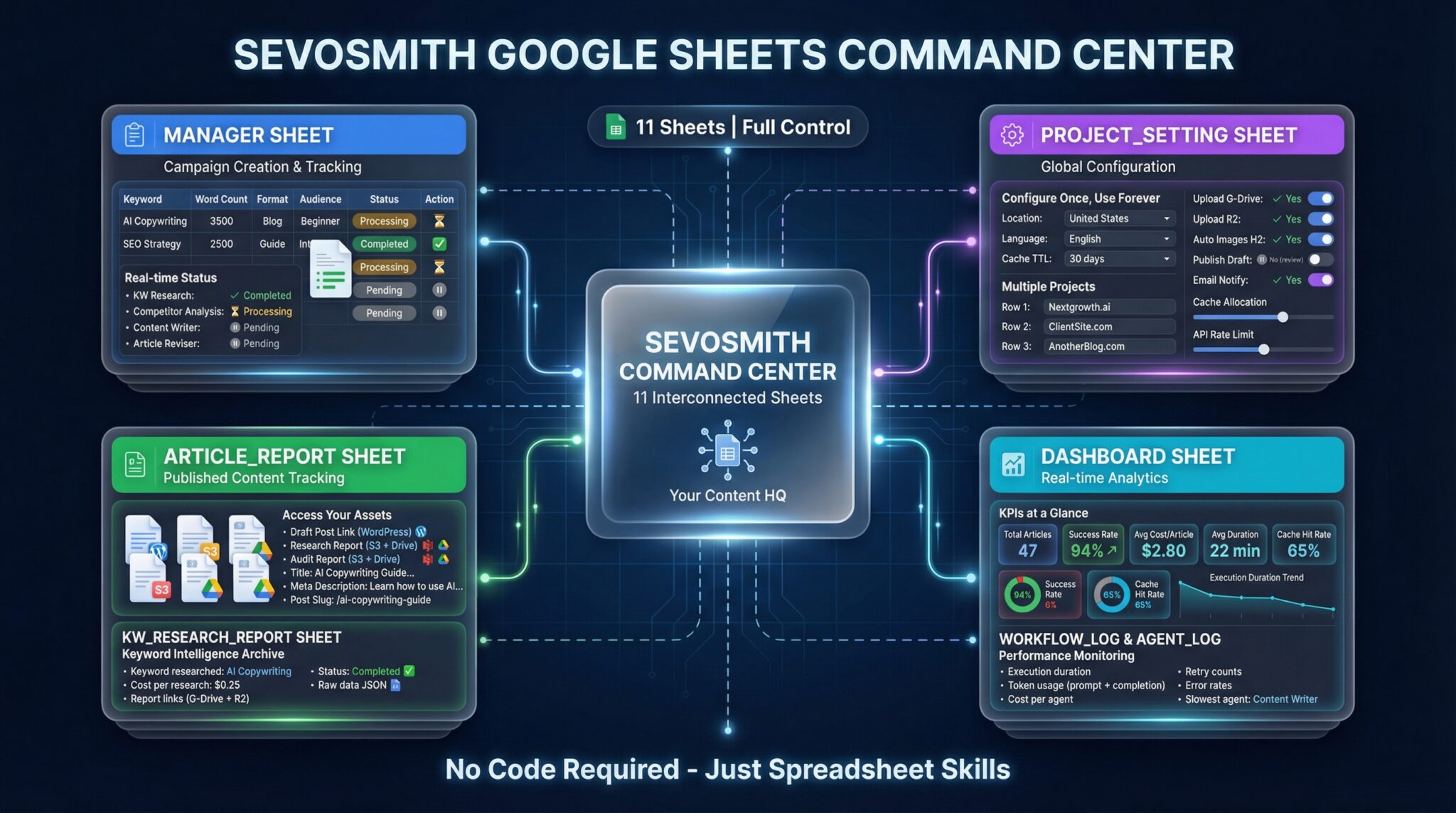
SEVOsmith is operated via Google Sheets,not the n8n UI. This is a deliberate design decision: marketing managers shouldn’t need to understand workflow nodes or JSON structures. They input campaign parameters into a spreadsheet, and the system handles everything else.
The SEVOsmith Content Planner consists of 11 interconnected sheets, each serving a specific function.
What Zone 1 produces: A unique Session ID, normalized keyword, validated project configuration, and all credential lookups, packaged into a single data object passed to every downstream zone. No zone touches the spreadsheet after this point.
Zone 2: Deep Research & Intelligence
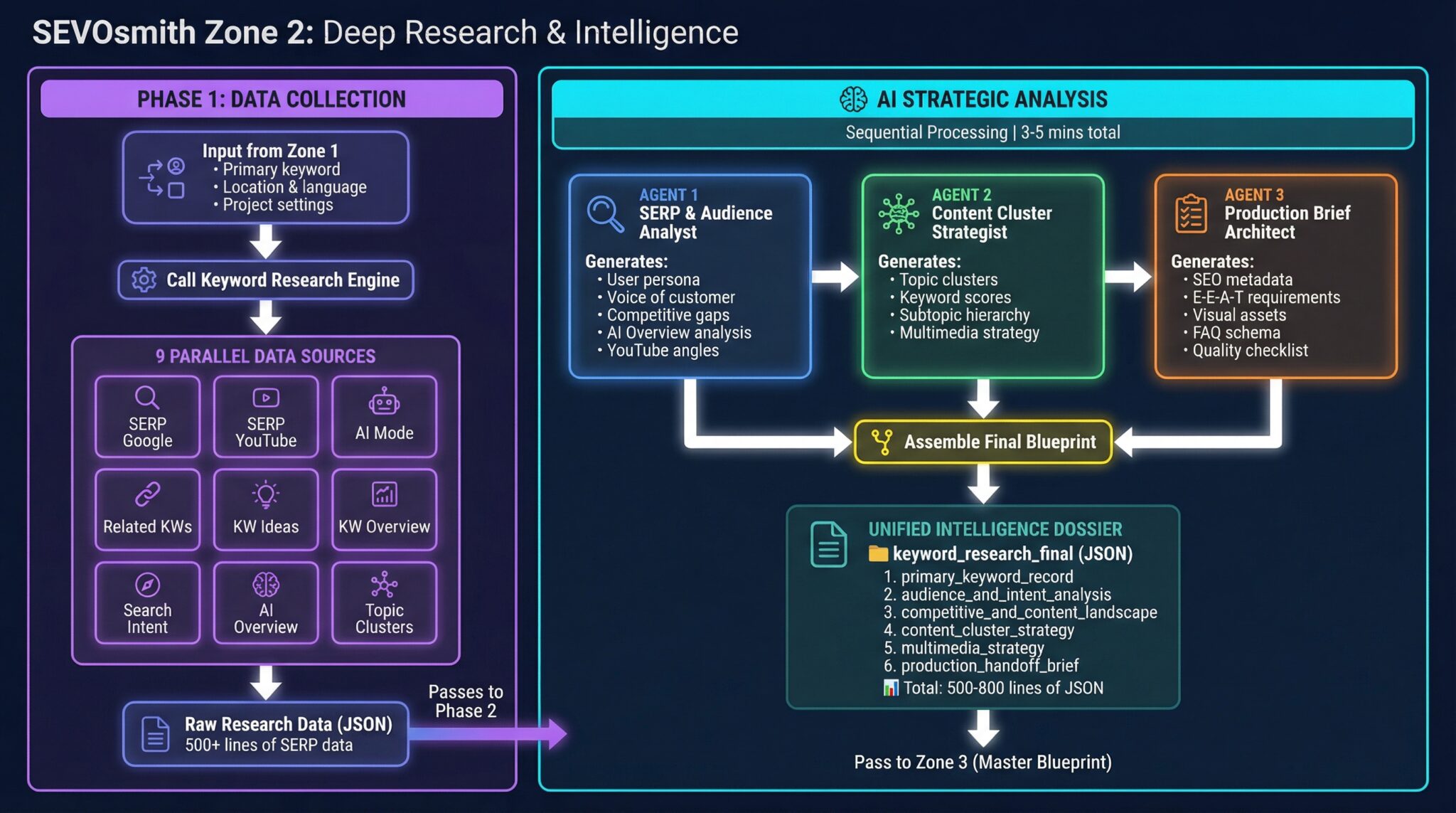
Zone 2 transforms raw keyword data into strategic intelligence by answering three critical questions: Who exactly is searching (psychological user profiles from People Also Ask patterns), what gaps exist in current content (forensic competitor analysis), and what specifically to create (mathematical opportunity scoring + exact production specs). The Keyword Research Engine queries 9 live sources, then three AI agents analyze in parallel,all using one shared model for efficiency. Result: 500-800 lines of actionable intelligence that eliminates guesswork.
Zone 3: Competitor Intelligence, Negative Space Analysis

Zone 3 solves the core problem of passive competitive analysis. Instead of simply reporting “Competitor A ranks #1,” the Competitor Intelligence Analyst performs forensic gap analysis on the top 5 ranking pages, tallies their structural weaknesses (outdated content, missing visuals, no actionable templates), executes targeted “gap probe queries” to find underserved questions, and outputs a specific “Winning Angle”,a data-backed strategy to outperform them. You’re not rewriting existing content; you’re filling verified market voids that competitors left open.
Zone 4: Content & SEvO Strategist, The Master Blueprint Architect
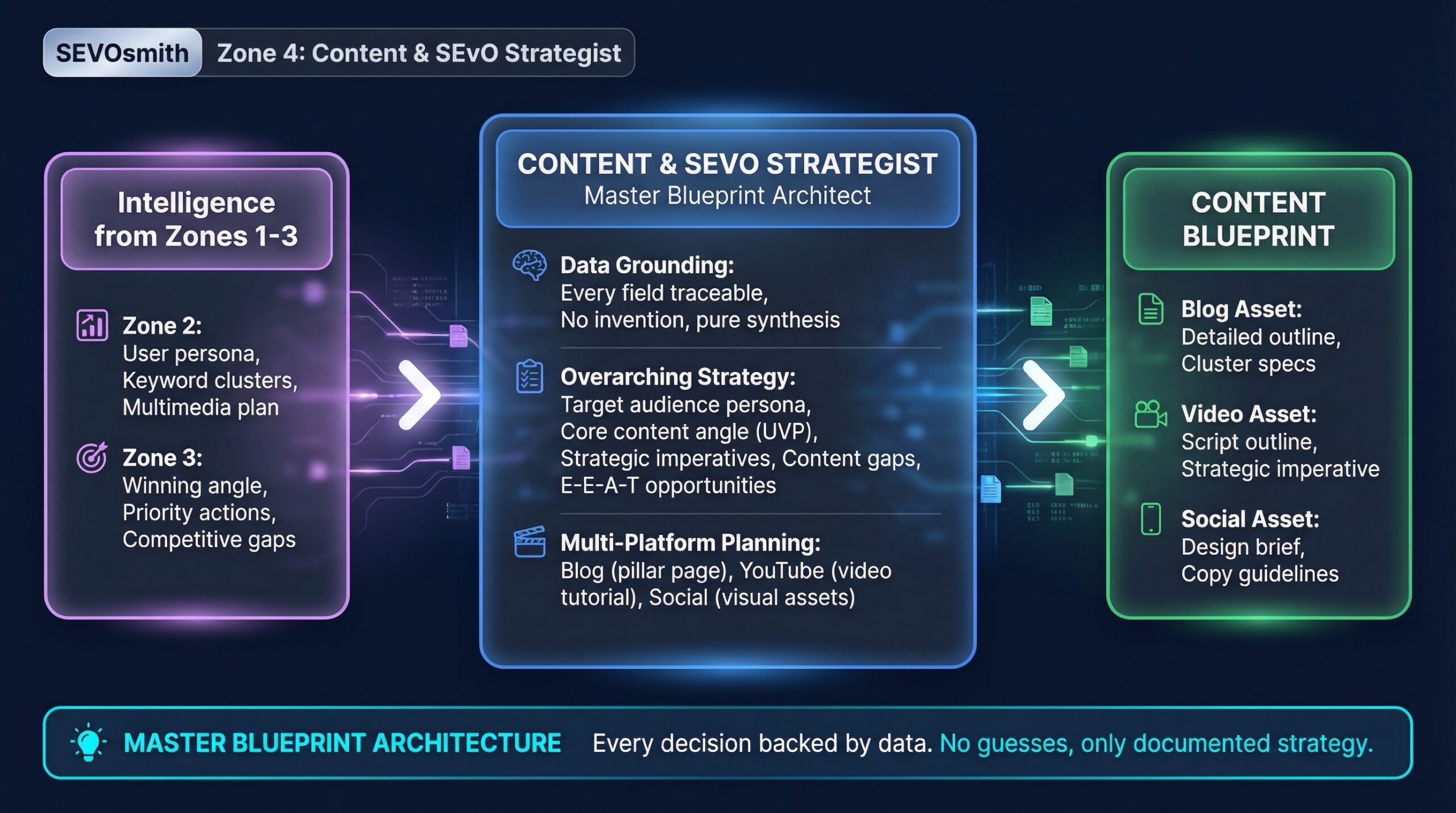
Zone 4 is the master synthesizer that transforms all prior research into a single, comprehensive Content Blueprint. The Content & SEvO Strategist receives intelligence from Zones 1-3 (audience profiles, keyword clusters, competitive gaps) and architects a complete production plan: the winning content angle, multi-platform asset strategy (blog, YouTube, social), detailed content outlines with cluster-level specifications, and binary acceptance criteria. Every decision is backed by research data, not guesses.
Zone 5: Strategic Linking Intelligence
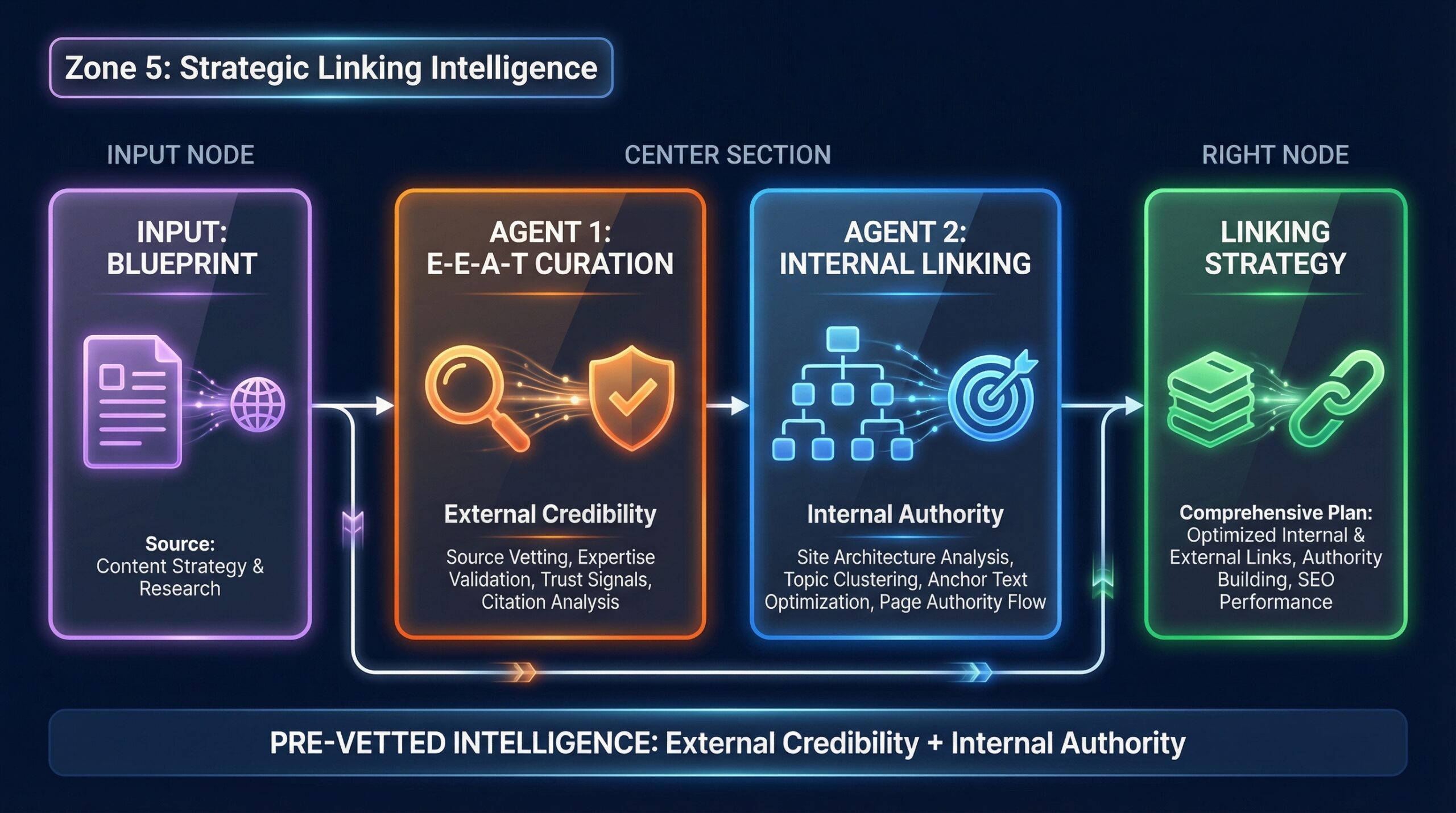
Zone 5 deploys two specialized agents that handle the final credibility and SEO infrastructure: the Elite E-E-A-T Curation Agent searches for and vets highly authoritative external sources (government sites, academic research, official documentation) that will be cited in the article, while the Internal Linking Analyst scans the client’s sitemap to identify existing pages that should be strategically linked to build topical authority. Together, they ensure the content has both external credibility signals and internal SEO architecture,not as an afterthought, but as engineered components of the production blueprint.
The Problem
External Citations: Writers waste time searching during production, find random low-quality sources, accidentally cite competitors, and have no citation context,just raw URLs.
Internal Linking: Added as afterthought with random keyword matching, missing topical authority opportunities, and no documented strategy.
Result? Weak E-E-A-T signals and disconnected internal structures that fail to establish authority.
The Solution: Pre-Vetted Linking Intelligence
Zone 5 generates two strategic linking reports before writing begins, eliminating research time and ensuring both credibility and SEO architecture.
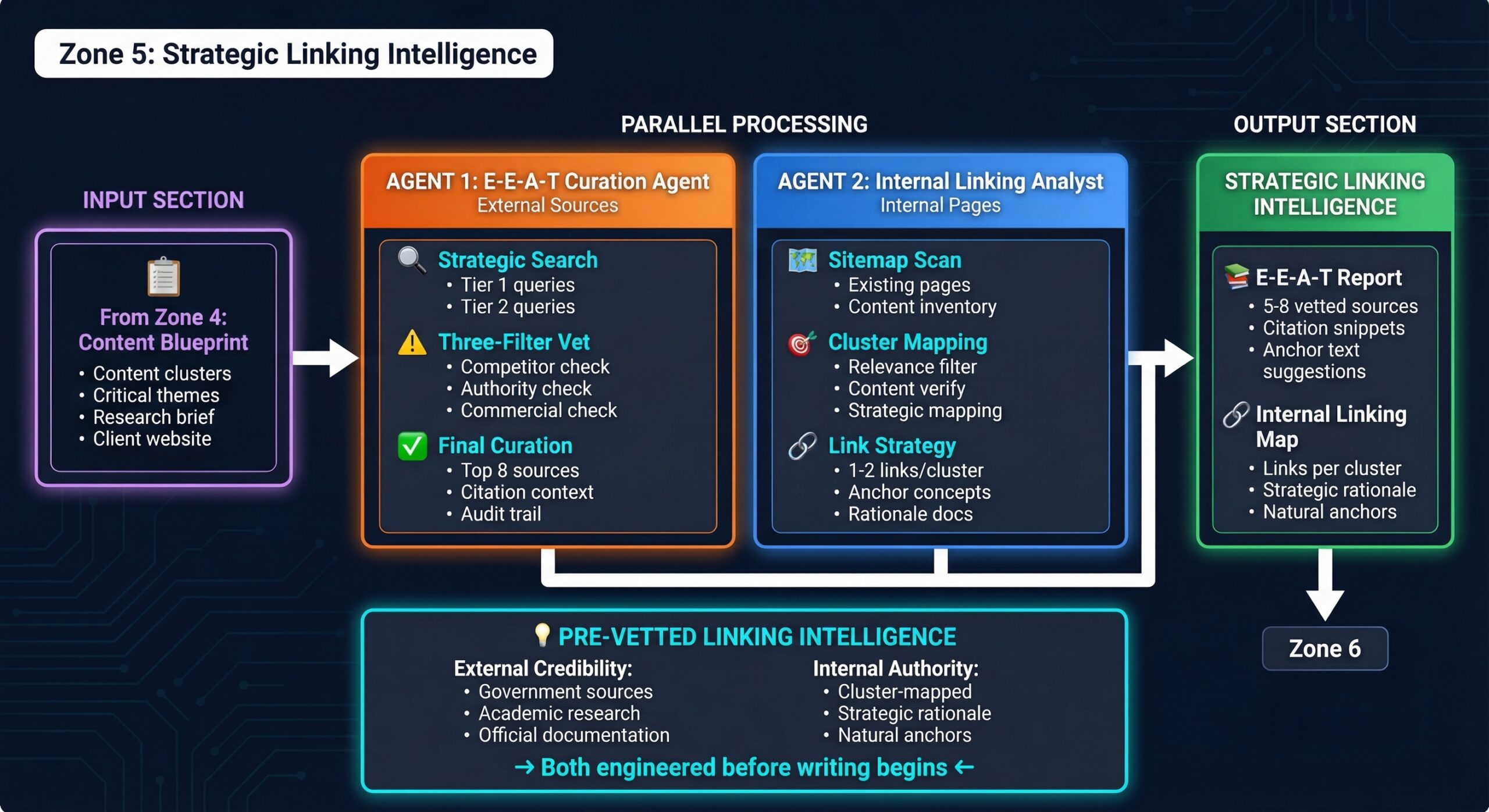
Agent 1: Elite E-E-A-T Curation Agent
Mission: Discover and vet highly authoritative, non-commercial external sources
Process:
- Strategic Search Planning
- Tier 1: Gap probe queries (underserved angles)
- Tier 2: Critical themes (core coverage)
- Three-Filter Vetting System
- Filter 1: Competitor check (reject competitor domains)
- Filter 2: Authority check (reject blogs, content farms)
- Filter 3: Commercial check (reject e-commerce, product pages)
- Final Curation (Top 8 Sources)
- Prioritizes: Government, academic, peer-reviewed, official documentation
- All decisions logged with reasoning
What It Generates (up to 8 sources):
- Citation Context Snippet: Exact fact/statistic to cite
- Example: “Government study found 67% of businesses report $10K+ annual savings”
- Suggested Anchor Text: Natural contextual anchor
- Example: “according to recent government research on automation ROI”
- Complete Audit Trail: Every URL discovered, decision made, reasoning documented
Agent 2: Strategic SEO Internal Linking Analyst
Mission: Identify existing client pages for strategic internal linking
Process:
- Asset Inventory
- Scans client sitemap (once)
- Identifies conceptual pillars from content clusters
- Candidate Filtering
- Initial shortlisting by cluster relevance
- Pre-verification filter (removes
/category/,/tag/, pagination) - Content verification (confirms page answers cluster questions)
- Strategic Mapping
- Maps 1-2 most relevant links per cluster
- No forced linking if none truly relevant
What It Generates (per cluster):
- Suggested Links (1-2 per cluster):
- URL to existing page
- Anchor Text Concept: Natural, descriptive (not spammy)
- Strategic Rationale: Why this link supports this cluster
Business Impact
E-E-A-T Curation Benefits:
- 60 minutes saved (no citation research during writing)
- Higher authority (only official/academic sources)
- Better credibility (specific statistics ready to cite)
- No competitor linking (automated filter)
- Audit trail (documented decisions)
Internal Linking Benefits:
- Topical authority (cluster-mapped linking)
- Better UX (logical “next steps”)
- SEO boost (link equity distribution)
- Time saved (no post-writing link hunting)
- Documented strategy (clear rationale)
Combined Results:
- Articles rank faster (E-E-A-T + internal signals)
- Writers focus on writing, not research
- Consistent quality (no random sources)
- Measurable linking strategy
This is linking intelligence: both external credibility and internal architecture engineered before writing begins.
Zone 6: Article Outline & Content Generation
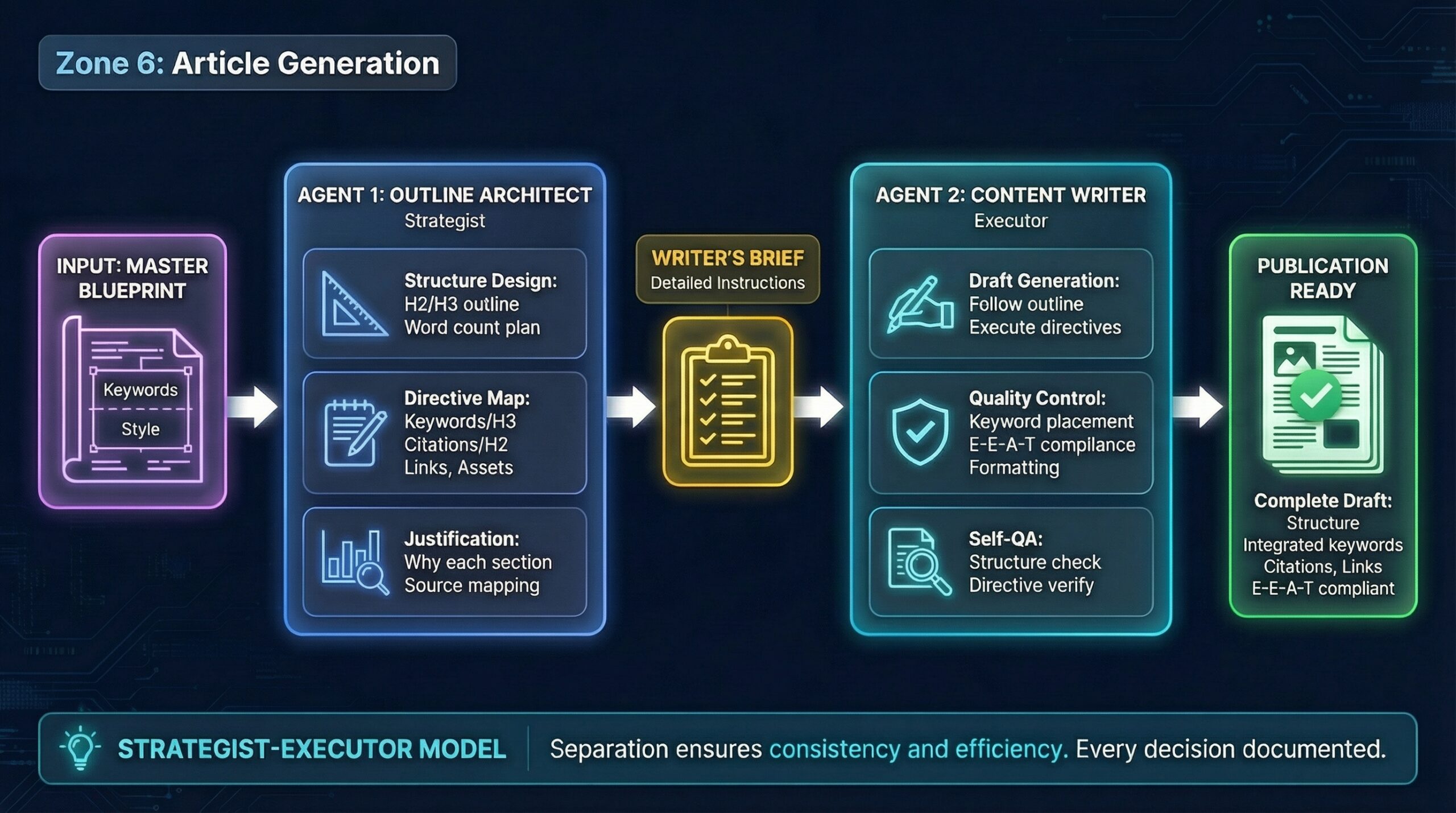
Zone 6 transforms the strategic blueprint into publication-ready content through two sequential agents: the Outline Architect creates a detailed writer’s brief with H2/H3 structure, word count allocations, and per-section directives (keywords, citations, internal links, visual assets), then the SEO Content Writer executes that brief to generate the complete first draft. Every structural decision is documented with rationale, every directive is traceable to research data, and every sentence follows E-E-A-T compliance rules,producing content that’s both strategically sound and publication-ready.
Zone 7: Automated Audit & Revision Loop
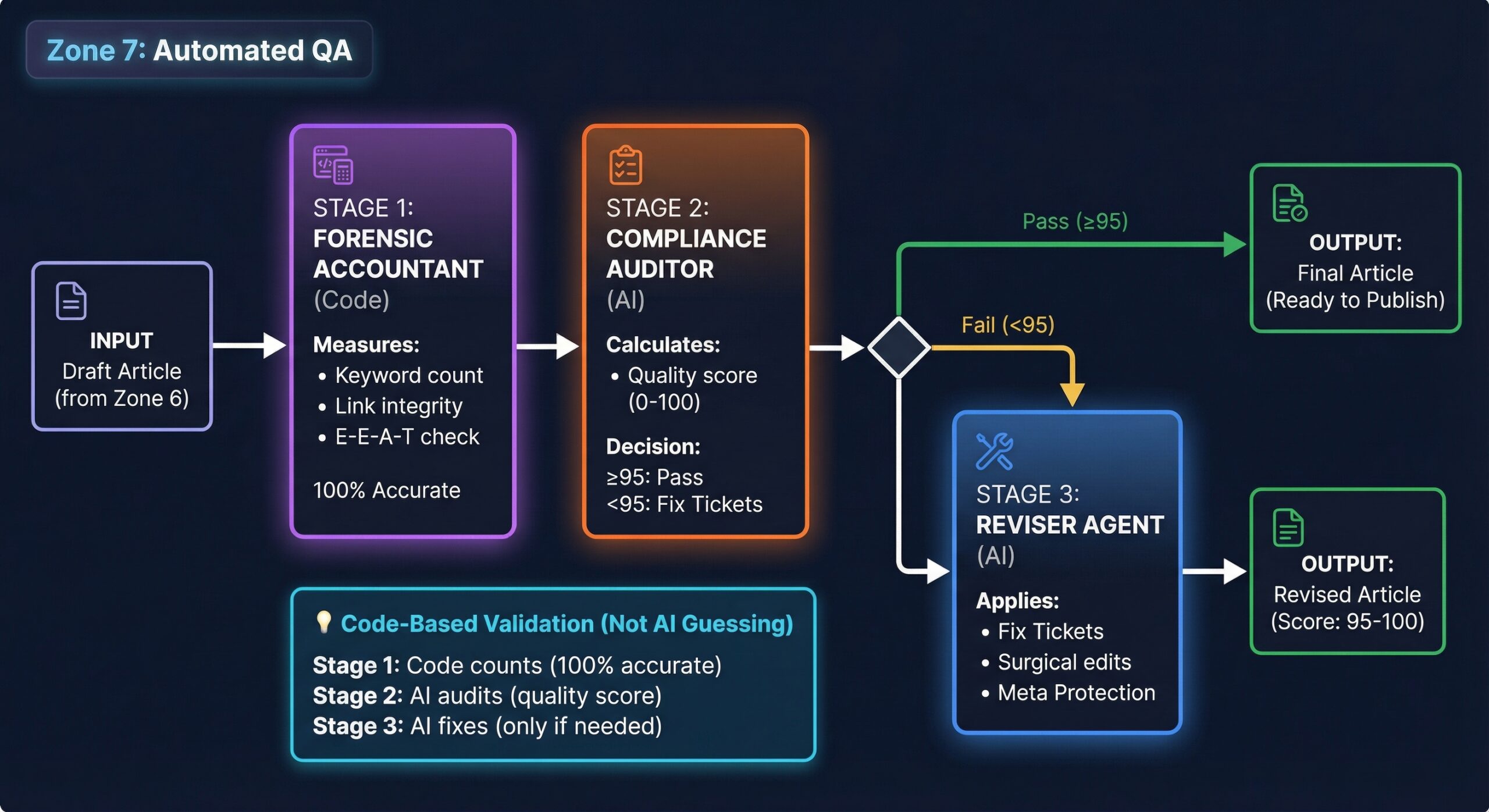
Zone 7 ensures mathematical compliance through a three-stage validation pipeline: the Forensic Accountant uses strict code (not AI) to measure metrics with 100% accuracy (keyword density, link integrity, formatting), the Compliance Auditor compares the draft against the Master Blueprint and calculates a quality score (0-100), and if score < 95, the Reviser Agent auto-triggers to surgically repair specific issues via Fix Tickets. This eliminates 2-3 hours of manual editorial review per article by catching AI counting errors and consistency failures that human QA can’t scale.
Zone 8: Visual Asset & Metadata Generation
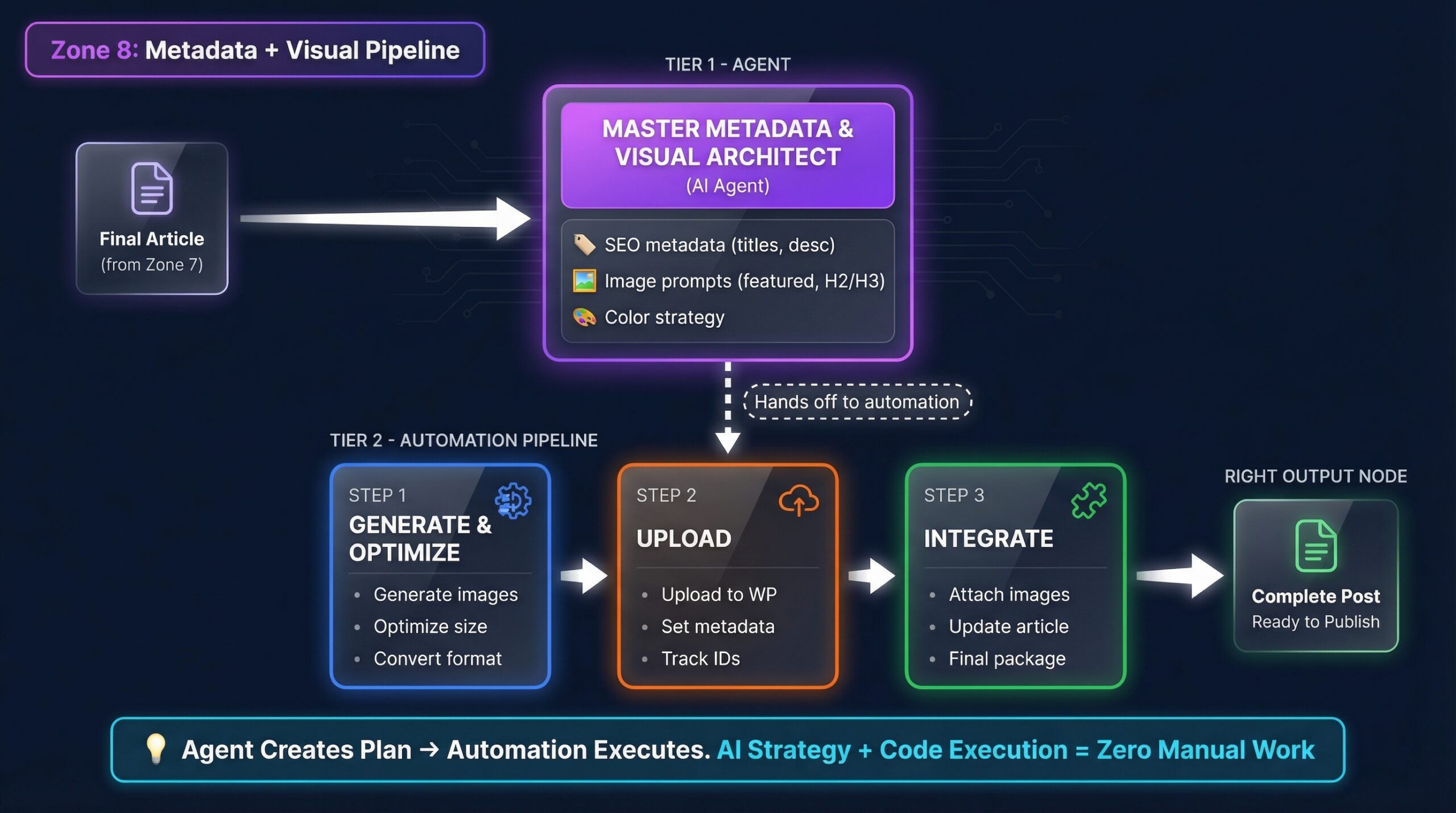
Zone 8 packages the article for publication by generating click-optimized SEO metadata and a complete visual asset plan. The Master Metadata & Visual Architect analyzes live SERP data to create CTR-focused titles (5 options scored 0-100), descriptions (3 options with keyword integration strategy), and an evergreen URL slug, then generates detailed image prompts for the featured image, H2 section images, H3 subsection images (using smart distribution logic), and any SEVO assets detected in the article,all with topic-appropriate colors, brand watermarking, and comprehensive text labels for actionable content.
Zone 9: Final Delivery & Documentation
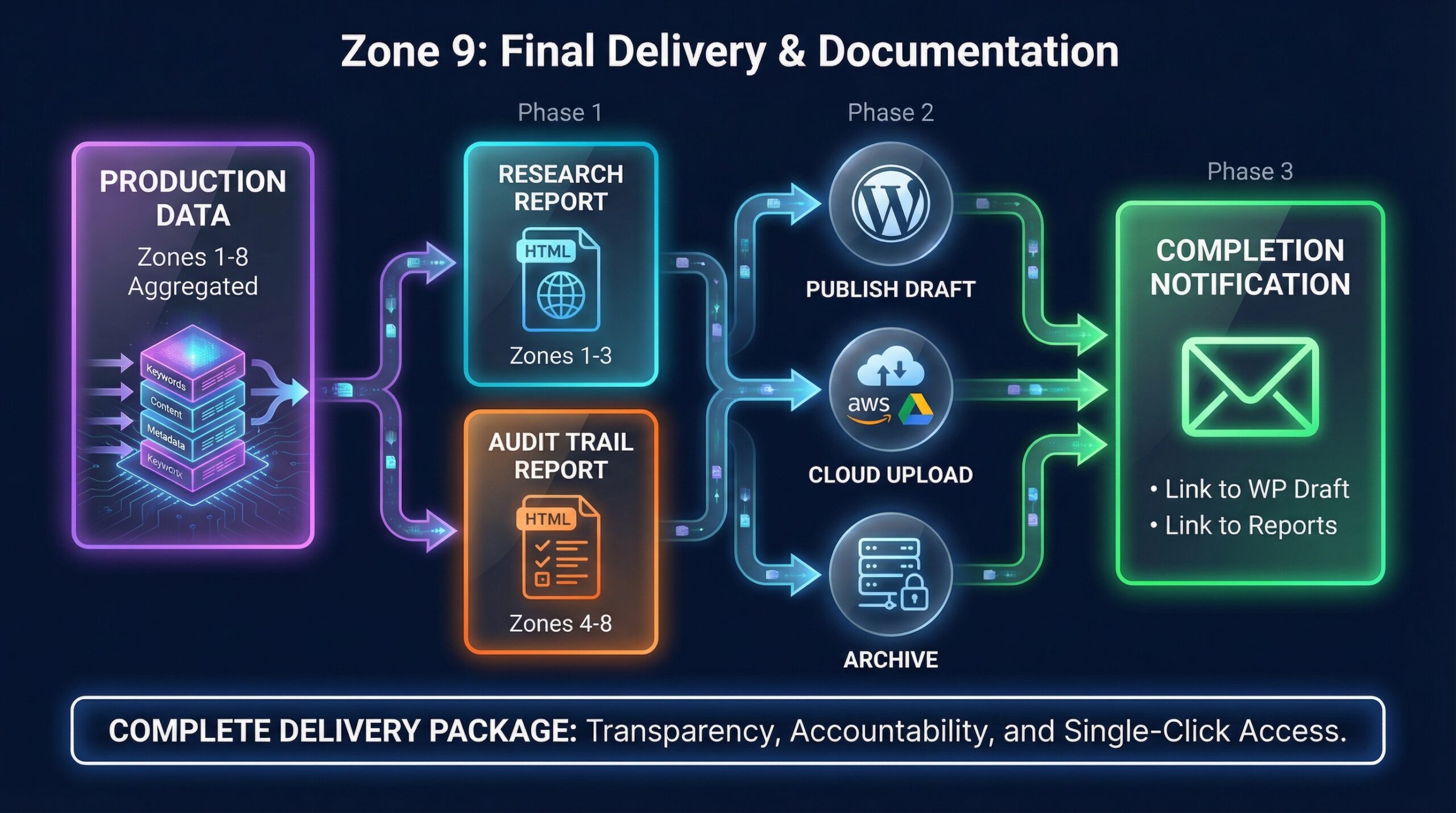
Zone 9 completes the production pipeline by generating comprehensive HTML reports and publishing all deliverables. The system creates two interactive HTML reports (Research Report capturing Zones 1-3 intelligence and Audit Trail Report documenting Zones 4-8 execution), publishes a Draft post in WordPress with complete content and metadata, uploads HTML reports to cloud storage (S3/Google Drive), and sends a completion email with all access links. This is the final handoff,transforming the entire production process into a single-click delivery package with full documentation and ready-to-publish content.
How Do You Deploy SEVOsmith from Zero to Production?
What’s Included in the v1.5.0 Agency Bundle
- Three Production-Grade JSON Workflows: The Orchestrator and Tools sub-workflows
- Google Sheets Command Center: Pre-engineered Manager Sheet with Campaign Trigger dashboard and Global Project Settings
User Guide ‐ Complete Setup & Usage
Ready to deploy SEVOsmith? We’ve created a comprehensive step-by-step installation guide that walks you through the complete setup process,from creating API accounts to publishing your first AI-citable article.
Complete SEVOsmith Setup Guide: From Zero to First Article
Frequently Asked Questions
1. What’s the total cost per article (including all APIs)?
Per-article API costs: $1.02-1.88 (DataForSEO $0.07, Gemini 2.5 Pro $0.80-1.50, Gemini 3 Pro Image Preview $0.15-0.30, Google Drive $0). Cost varies by article length (2,500 words: lower end | 4,000 words: higher end) and image count. Monthly infrastructure: $20-50 for n8n Cloud or $0 for self-hosted. Average: $1.35-1.50 per article for complete production (research → writing → QA → visuals → delivery). No hidden fees, pay APIs directly.
2. Do I need coding or technical skills to use SEVOsmith?
No coding required, but basic technical comfort helps. You need: n8n basics (30-min learning curve), JSON editing (changing config values), API concepts (copying credentials), and WordPress familiarity. You don’t need: JavaScript/Python, database management, server admin (if using n8n Cloud), or prompt engineering expertise (all prompts provided). If you can set up WordPress plugins and understand this documentation, you have sufficient skills.
3. How long does initial setup take for someone new to n8n?
First-time users: 2-4 hours (install n8n 15min, import workflows 5min, configure credentials 30-45min, connect Redis 15min, test run 60-90min, review output 30min). Experienced n8n users: 30-60 minutes (import 5min, credentials 20min, variables 5min, test 10-30min). What slows setup: DataForSEO account approval, understanding zone architecture, WordPress authentication, first-run debugging. Recommendation: Block off half a day for first setup. Video walkthrough and priority support included.
4. What do I get when I purchase this workflow?
You receive: 3 n8n workflow files, 6 months free updates, 30-day priority support, private community access, 30 minutes video tutorials. NOT included: n8n platform ($20/month or self-hosted), API accounts (you pay directly), Redis server, ongoing support after 30 days. Delivery: Instant digital download (ZIP file).
5. How does SEVOsmith compare to human-written content?
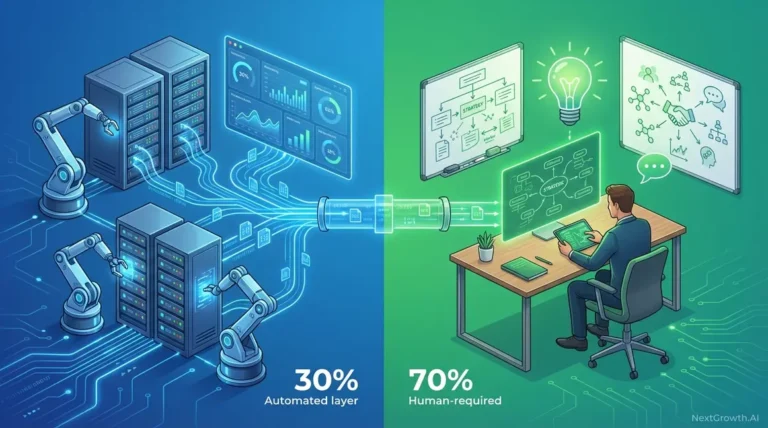
SEVOsmith excels at: consistency (100% E-E-A-T compliance), speed (18-25min vs 4-6 hours), data accuracy (forensic research + code-based QA), SEO optimization (exact keyword counts), comprehensive coverage (identifies 5-8 clusters). Humans still better at: brand voice nuance, original insights, controversial topics, creative storytelling, deep industry expertise. Recommended hybrid: SEVOsmith generates 95/100 first draft (18-25min), human editor polishes for brand voice (30-45min). Final: 98/100 quality, 60-70 minutes total vs 6-8 hours pure human.
6. Does SEVOsmith support languages other than English?
Yes, supports 40+ languages across 100+ country-language combinations via parameter. Fully supported: European (English, Spanish, French, German, Italian, Portuguese, Dutch, Polish, Romanian, Czech, Danish, Finnish, Greek, Hungarian, Norwegian, Swedish + 9 more), Asian (Chinese Simplified/Traditional, Japanese, Korean, Vietnamese, Thai, Indonesian, Hindi, Bengali, Urdu, Malay, Tagalog), Middle Eastern (Arabic, Hebrew, Turkish), Other (Russian, Ukrainian). All AI content generated in target language. Keyword research uses language-specific DataForSEO endpoints. Cost: No additional fees. Multi-language: Run same workflow with different settings.
7. What types of content does it handle best?
Best (90-95/100 quality): How-to guides, informational deep-dives, listicles, product/service reviews, comparison articles. Good (85-90/100): Industry analysis, case study summaries. Struggles with (70-80/100, needs heavy editing): Opinion pieces, narrative storytelling, investigative journalism, highly technical niche content requiring domain expertise. Excellent for blog posts (1,500-4,000 words). Not designed for: social media posts, emails, ad copy (use dedicated tools instead).
8. Can I customize the agent prompts and workflows?
Yes, full customization supported. You can edit: all 13 agent system prompts (tone, style, output format), workflow logic (add/remove zones, modify connections), configuration variables (word count, keyword density, brand voice), visual asset settings (colors, styles, fonts). Harder to customize: core 9-zone architecture, Redis caching logic, error handling. Use cases: agency white-labeling, industry specialization, brand voice matching. Risk: Significant prompt changes can break quality output. Recommended: Small incremental changes with testing. Customization guide included with safe modification zones.
9. Can I run multiple articles in parallel?
Yes, designed for parallel execution with no resource conflicts. n8n Cloud: 2 concurrent (Starter) to 5 concurrent (Pro). Self-hosted: Limited only by RAM (2GB = ~2 articles, 8GB = ~8-10 articles). Performance: 5 parallel executions = 12-15 articles/hour. API limits: DataForSEO allows ~400 articles/day. Real-world: Agency producing 150 articles/month runs 5 articles every 2 hours throughout day. Key insight: Bottleneck isn’t SEVOsmith,it’s human review capacity (can your team approve 30 articles/day?).
10. How often are updates released?
Patch updates (bug fixes): 1-2/month, free for 6 months, automatic email notification, drop-in replacement. Minor updates (new features): Quarterly, free for 6 months, may require minor reconfiguration. Major updates (breaking changes): Annually, discounted upgrade (50% off) for existing customers, requires full reimport. Recent example: v1.5.0 added Zone 9, enhanced Zone 8 visuals, multi-language support (free). After 12 months: $49/year renewal for updates, or continue using purchased version forever (perpetual license). Backward compatible: v1.X updates won’t break existing setup. Average: 8-10 free updates per year.
11. Can I use this for content refreshes/updates (not just new articles)?
Current v1.5.0 is optimized for fresh content creation only. Native content refresh support was shipped in SEVOsmith v2.2.0, paste any existing post URL into the Old Post URL column in the Manager tab and the Content Writer reads and rewrites the existing article rather than generating from scratch. Workaround for now: Run SEVOsmith normally to generate updated article, then manually copy new sections into existing article to preserve good content. This hybrid approach lets you use SEVOsmith’s research and writing capabilities while maintaining control over what gets updated. Future update will include: existing article analysis, gap identification, selective section regeneration, and WordPress update (not full rewrite). For now: Best for new articles.
Build Your Citation Engine,Or Watch Competitors Build Theirs
The content game has changed. ChatGPT Search, Google AI Overviews, and Perplexity don’t rank content,they cite it. If you’re not getting cited, you’re invisible.
The Math Is Simple
Traditional approach: $2,000-4,500/month for writers. Hope they understand E-E-A-T. Manually audit citations. Cross fingers.
SEVOsmith: $300/month API costs. 20+ AI-citable articles. Automated E-E-A-T compliance. Code-based quality assurance. Complete audit trails.
The difference: $2,000-4,200/month saved. Zero hope required.
What You Get
SEVOsmith v1.5.0 includes: 3 n8n workflows (321 nodes), 13 AI agent prompts, complete documentation, 6 months free updates, 30-day priority support, private community access.
One-time purchase. Perpetual license. No monthly fees.
The Real Question
Can you engineer E-E-A-T compliance at scale while AI redefines quality standards?
Manual processes can’t keep up. SaaS tools are shallow. Agencies are expensive.
The zero-click era rewards the cited,not the ranked.
Your competitors are building citation engines right now. Are you?