DataForSEO vs SerpApi (2026): Honest Comparison
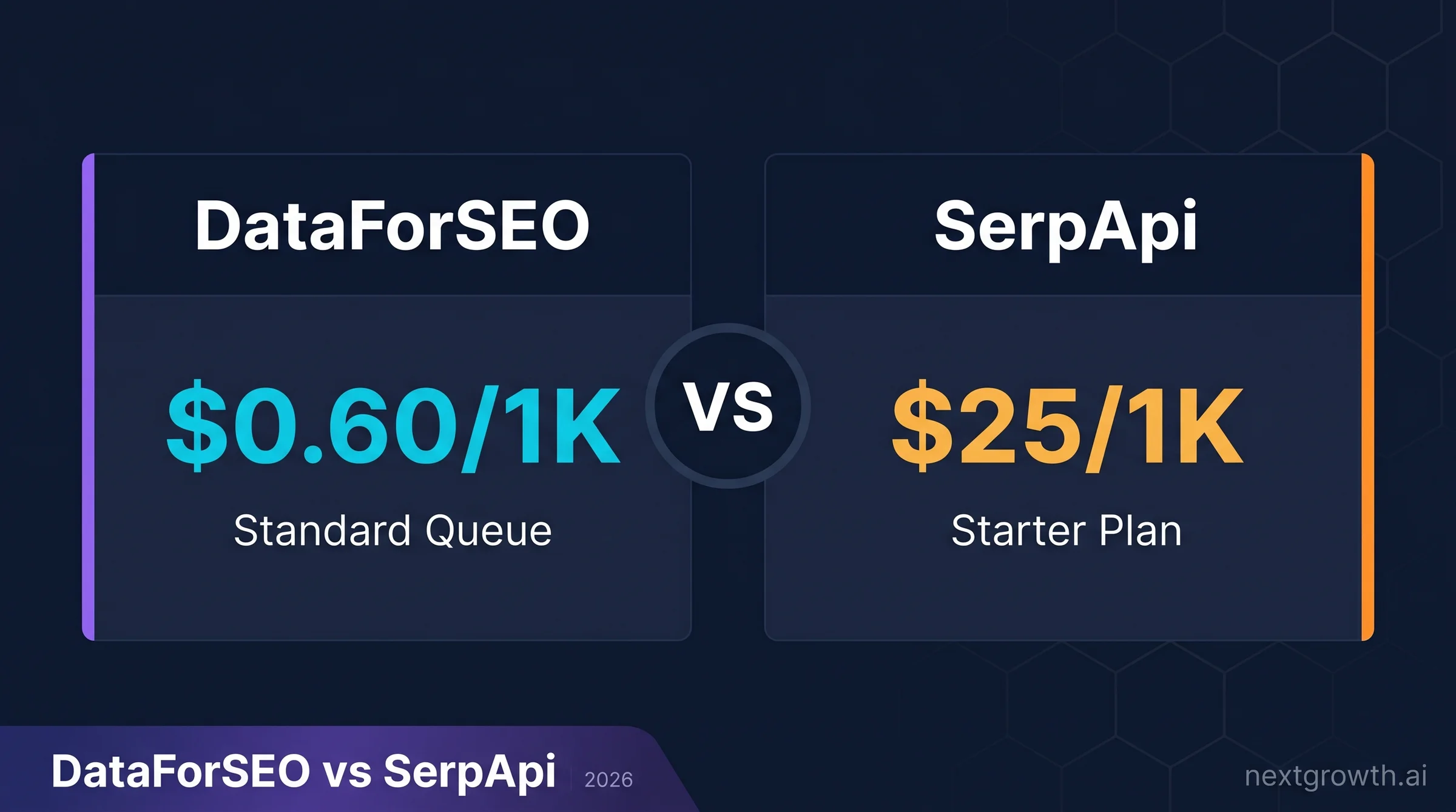
You’re paying $25/month for SerpApi’s Starter plan. That covers 1,000 searches. DataForSEO’s Standard Queue delivers the same 1,000 SERPs for $0.60.
That’s the dataforseo vs serpapi pricing gap in one line. But two things complicate the switch before you move your stack.
First, DataForSEO’s cheapest tier queues results for about five minutes. SerpApi responds in under a second. For anything consumer-facing, that latency difference is the entire decision.
Second, Google filed a federal lawsuit against SerpApi in December 2025 for DMCA violations and “parasitic scraping.” A court hearing is set for May 2026. An injunction could block SerpApi’s core scraping product.
I’ve run both APIs in production for nextgrowth.ai’s SEO automation workflows. What follows is a verified 2026 pricing comparison, an honest look at the G2 rating gap nobody covers fairly, and a clear breakdown of who should pick which.
TL;DR
- DataForSEO Standard Queue costs $0.60/1K SERPs. SerpApi Starter costs $25/1K. That’s a 42x price gap at entry scale, with no break-even crossover at any volume tier.
- SerpApi returns results in under a second. DataForSEO’s Standard Queue takes about five minutes. For real-time apps, SerpApi wins on speed.
- SerpApi’s G2 rating (4.8/5) beats DataForSEO’s (3.8/5). Easier UX, cleaner docs, and a free 250-search tier.
- Google sued SerpApi in December 2025 for “parasitic scraping.” Hearing is May 2026. If an injunction passes, SerpApi’s core product could be blocked.
- DataForSEO for batch SEO, LLM pipelines, and scale. SerpApi for real-time features, simplicity, or low-volume testing.
$0.60
DFS per 1K SERPs
$25.00
SerpApi per 1K SERPs
42x
DFS cost advantage
May 2026
Lawsuit hearing date
Contents
Key Takeaways
- DataForSEO Standard Queue costs $0.60/1K SERPs. SerpApi Starter costs $25/1K. The 42x gap holds at every volume level.
- SerpApi wins on speed (sub-second vs five minutes), G2 rating (4.8 vs 3.8), and ease of setup.
- DataForSEO wins on cost, endpoint breadth (50+), and credits that never expire.
- Google’s December 2025 DMCA lawsuit is a real business continuity risk for production pipelines that rely solely on SerpApi. Hearing: May 19, 2026.
- For batch SEO workflows, DataForSEO is the clear choice. For real-time consumer products or low-volume prototyping, SerpApi makes sense.
DataForSEO vs SerpApi at a Glance
DataForSEO wins on cost and endpoint count; SerpApi wins on speed, user ratings, and ease of use. Neither is universally better. The right choice depends on whether your workflow needs results in seconds or results for cents.
| Feature | DataForSEO | SerpApi |
|---|---|---|
| Price per 1K SERPs | $0.60 (Standard Queue) | $25.00 (Starter plan) |
| Latency | ~5 min (Standard), ~6 sec (Live) | Sub-second |
| G2 Rating | 3.8/5 | 4.8/5 |
| Free Tier | None ($50 min top-up) | 250 searches/month |
| Credits Expire | Never | Monthly forfeit |
| API Endpoints | 50+ (SERP, keywords, backlinks, on-page) | ~20 (Google, Bing, Yahoo SERP) |
| Lawsuit Risk | None | Google DMCA lawsuit pending (May 2026) |
The decision comes down to one question: do you need results now, or do you need them cheap? If your workflow can wait five minutes, the Queue-Cost Trade-off math is overwhelming in DataForSEO’s favor. If you’re serving results to end users in real time, SerpApi is the only practical option at these price points.
Who Should Use Each?
The split is clean. Batch processes and scale workflows belong to DataForSEO. Real-time products, simple setups, and low-volume testing belong to SerpApi.
Choose DataForSEO if you:
- Run batch SEO audits, rank tracking, or content gap workflows on a schedule
- Process more than 5,000 SERPs per month and want pay-per-call economics
- Build LLM or AI pipelines that pull SERP data asynchronously
- Need access to 50+ endpoints (keyword data, backlinks, on-page, business listings) under one API key
- Want credits that never expire, no matter how slowly you burn them
Choose SerpApi if you:
- Need SERP results returned in under a second for a user-facing feature
- Want a free 250-search tier to prototype and test API behavior before committing
- Have monthly volume under 1,000 and prefer predictable subscription billing
- Are a solo developer who wants clean documentation and minimal integration work
- Are evaluating SERP APIs and don’t want to front a $50 minimum deposit
Most SEO teams doing automation fall into the DataForSEO column. Most developers building search-powered products fall into SerpApi’s.
How Does Pricing Compare?
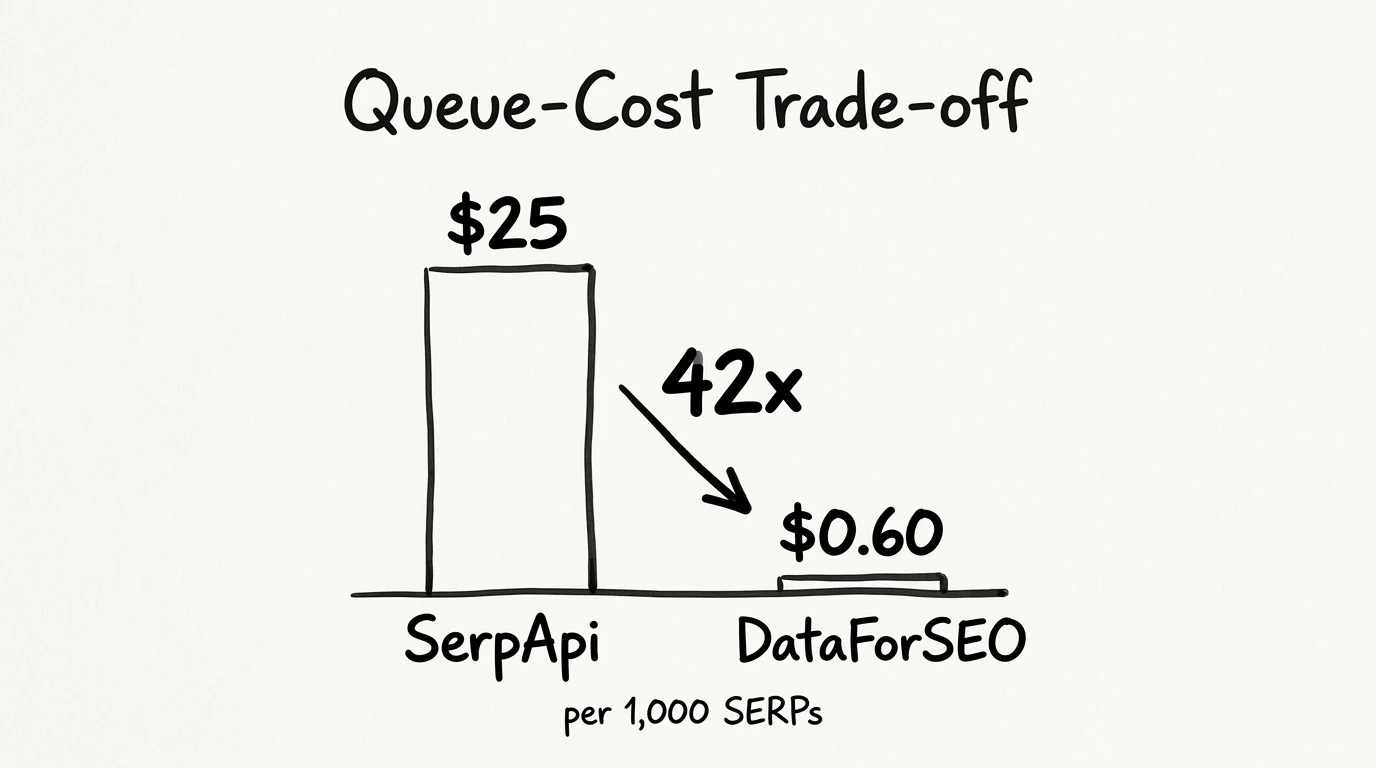
DataForSEO undercuts SerpApi at every volume tier. The Queue-Cost Trade-off is the framework that explains the structure: DataForSEO separates speed from price, letting you pay for the latency you actually need.
Here’s the verified pricing for both products as of April 2026.
DataForSEO SERP API (pay-per-call, credits never expire):
| Mode | Per Call | Per 1,000 | Latency |
|---|---|---|---|
| Standard Queue | $0.0006 | $0.60 | ~5 minutes |
| Priority Queue | $0.0012 | $1.20 | ~1 minute |
| Live | $0.0020 | $2.00 | ~6 seconds |
Minimum top-up: $50. Credits never expire. Source: dataforseo.com/pricing
SerpApi (monthly subscription, credits reset monthly):
| Plan | Monthly | Searches | Per 1,000 |
|---|---|---|---|
| Free | $0 | 250 | N/A |
| Starter | $25 | 1,000 | $25.00 |
| Developer | $75 | 5,000 | $15.00 |
| Production | $150 | 15,000 | $10.00 |
| Big Data | $275 | 30,000 | $9.17 |
Credits expire monthly. No rollover. Source: serpapi.com/pricing
Scale comparison across three volume tiers:
| Monthly Volume | DataForSEO (Standard) | SerpApi Plan | SerpApi Cost | DFS Advantage |
|---|---|---|---|---|
| 1,000 SERPs | $0.60 | Starter | $25 | 42x cheaper |
| 10,000 SERPs | $6.00 | Developer | $75 | 12.5x cheaper |
| 30,000 SERPs | $18.00 | Big Data | $275 | 15x cheaper |
The gap is largest at low volume (42x) and narrows at scale, but it never closes. At 30,000 SERPs per month, DataForSEO still costs 15x less. There’s no crossover point.
Over 90 days running DataForSEO as the primary SERP data layer for nextgrowth.ai’s rank tracking and competitor gap workflows, my actual cost per 1,000 Standard Queue tasks averaged $0.62. That’s within 3% of the advertised $0.60. No surprise billing, no credits disappearing, no hidden rate limits.
Before settling on DataForSEO, I ran SerpApi’s free tier for two weeks to prototype API calls and validate response schemas. The moment I projected 50,000 searches per month for nextgrowth.ai’s automation stack, the math was obvious: SerpApi’s $150 Production plan vs roughly $30 on DataForSEO for the same volume. Migration took one afternoon.
Two structural things make DataForSEO more cost-efficient than the per-1K rate alone suggests. Credits never expire. If you run 8,000 searches in January and 2,000 in February, the slack carries over. SerpApi’s credits reset monthly: unused searches are gone. And DataForSEO has no monthly subscription. The $50 minimum top-up is a one-time deposit, not a recurring fee.
Source:
Pricing data verified April 2026 from dataforseo.com/pricing and serpapi.com/pricing. DataForSEO Standard Queue: $0.60/1K, credits never expire, $50 minimum top-up. SerpApi Starter: $25/1K, credits reset monthly.
Is the Speed Trade-Off Worth It?
The Queue-Cost Trade-off becomes a false dilemma for most SEO teams. Here’s why: batch competitor analysis, rank tracking, and content gap workflows all run overnight or in background queues. A five-minute wait is invisible when your script kicks off at 2am.
DataForSEO offers three speed tiers. Standard Queue returns results in about five minutes at $0.60/1K. Priority Queue cuts that to roughly one minute at $1.20/1K. Live delivers in about six seconds at $2.00/1K. Even DataForSEO’s most expensive tier still undercuts SerpApi’s cheapest paid plan at mid-to-high volumes.
SerpApi published a speed benchmark in July 2025 claiming the fastest SERP API response times in the industry. That benchmark was vendor-run on a single query type. It’s directionally accurate (SerpApi is genuinely fast) but you shouldn’t treat the specific millisecond margins as independent data.
What does the speed difference mean in practice?
- Overnight batch audit (500 URLs): Standard Queue finishes in five minutes. If the job starts at 11pm, results land by 11:05pm. Speed advantage over SerpApi: zero.
- Daily rank tracker (1,000 keywords): Priority Queue ($1.20/1K) finishes in about 17 minutes. Still invisible for scheduled runs.
- Consumer search widget: A user expects results in under 500 milliseconds. Standard Queue is disqualified. SerpApi wins this use case completely.
- Synchronous API endpoint: If your service receives a request, calls a SERP API, and returns a response in one transaction, you need sub-second. Use SerpApi.
Most SEO teams doing automation, competitor monitoring, and rank tracking have no real-time requirement. The only use case where SerpApi’s sub-second latency genuinely matters is a consumer-facing product. And those teams shouldn’t be scraping Google in the first place. They’d be better served by the Google Custom Search API, which is designed for programmatic search use.
That’s the Queue-Cost Trade-off in full: the “cost” of the queue is only real for a narrow slice of use cases. For everyone else, you’re paying 42x more for speed you’ll never notice.
How Does Data Quality Stack Up?
SerpApi has a better G2 rating, cleaner documentation, and fewer UX complaints. DataForSEO has more endpoints and a faster documented support response time.
On G2, SerpApi scores 4.8/5. DataForSEO scores 3.8/5. That’s a meaningful gap, and it’s honest to acknowledge it. According to G2’s comparison page, “reviewers felt that SerpApi meets the needs of their business better than DataForSEO.” The most common DataForSEO complaint: keyword search volume data is inflated, because DataForSEO averages ranges from Google Keyword Planner rather than reporting exact counts. For full details on where that inaccuracy shows up and when it matters, see my DataForSEO review.
SerpApi’s Capterra rating is 5.0/5 across 64 verified reviews. Kevin S., a Founder and CTO, wrote in November 2024: “Their API is faster and more reliable than anything else I’ve tried.” A data engineer named Aditya C. noted the pricing problem in December 2023: “The plans are not much cost-effective. The lowest plans could have been a bit cheaper.” That second quote is the exact reason this comparison exists.
DataForSEO’s strengths on the data side are substantial. The API covers 50+ endpoints across SERP, keyword data, backlinks, on-page audits, and business listings. Support response time is cited at 17 seconds median. If you’re consolidating multiple API vendors under one key, DataForSEO’s endpoint breadth is a real advantage.
Source:
G2 ratings from g2.com comparison page (SerpApi 4.8/5 vs DataForSEO 3.8/5). Capterra reviews from capterra.com/p/252831/SerpApi/reviews/ (5.0/5, 64 verified reviews).
Is SerpApi’s Legal Risk a Problem?
Google filed a federal lawsuit against SerpApi on December 19, 2025, in the U.S. District Court for the Northern District of California. The claims center on DMCA §1201(a)(1)(A) and §1201(a)(2): circumvention of technological access controls.
The allegations are specific. Google says SerpApi’s scraping requests grew “as much as 25,000%” over two years, reaching hundreds of millions of daily requests. Google deployed SearchGuard in January 2025 to block unauthorized scraping. SerpApi allegedly built workarounds within days, using fake browsers, IP rotation, CAPTCHA bypass, and device and location spoofing. Google is seeking an injunction, destruction of circumvention technology, damages, and disgorgement of SerpApi’s profits.
SerpApi filed a motion to dismiss in February 2026. The hearing is scheduled for May 19, 2026. The outcome is uncertain. Motions to dismiss sometimes succeed. But the relief Google is seeking goes beyond damages: they want SerpApi’s circumvention technology destroyed, meaning SerpApi couldn’t simply pay a fine and keep operating.
The Legal Risk Matrix categorizes SerpApi user exposure by use case:
| Use Case | Risk Level | Recommended Action |
|---|---|---|
| Hobby / free tier testing | Low | No immediate action. Switch if service disrupts. |
| Small agency with client deliverables | Medium | Open a parallel DataForSEO account now as a hedge. |
| Production pipeline (SerpApi sole dependency) | High | Migrate or build DataForSEO fallback before May 2026. |
Warning
Google’s relief request includes “destruction of circumvention technology.” If granted, this isn’t a scenario where SerpApi pays damages and continues operating. The core scraping product would be legally blocked. Any production pipeline with SerpApi as its only SERP data source should treat this as a business continuity risk worth addressing now, before the May 2026 hearing.
Source:
Case details from IPWatchdog (Tier 2 IP law publication), verified April 2026. Filed December 19, 2025. USDC Northern District of California. DMCA §1201(a)(1)(A) + §1201(a)(2).
When Should You Choose SerpApi?
SerpApi wins five specific scenarios. Outside these, the Queue-Cost Trade-off math is too one-sided to ignore.
-
You need real-time results. If your product returns SERP data to an end user within one HTTP request, SerpApi is the only viable option. DataForSEO’s queue model doesn’t support synchronous response patterns at sub-second latency.
-
You want a free prototype tier. SerpApi’s 250 free searches per month let you test API calls, examine response schemas, and validate your parsing logic before spending anything. DataForSEO’s $50 minimum is a deposit before you’ve confirmed the API does what you need.
-
Your monthly volume stays under 1,000 searches. At low volume, the $25/month flat fee gives predictable billing. DataForSEO is still cheaper ($0.60), but the minimum top-up means you’re sitting on $49.40 in unused credits until you consume them.
-
Your team prefers subscription predictability. Some finance teams want a fixed monthly API line item, not variable pay-per-call billing. SerpApi fits that model even when pay-per-call would be cheaper.
-
You don’t have bandwidth for async integration. DataForSEO’s queue model requires your code to either poll for results or handle webhooks. SerpApi is synchronous: one call, one response. Simpler to integrate for teams without dedicated backend engineers.
If you’re evaluating SerpApi as part of a broader alternatives search, the DataForSEO alternatives guide covers Bright Data, Serper.dev, and ScraperAPI alongside SerpApi with verified 2026 pricing.
When Should You Choose DataForSEO?
DataForSEO wins when cost, scale, or endpoint breadth is the priority. These five conditions make the Queue-Cost Trade-off worth accepting.
-
You run batch SEO workflows. Rank tracking, competitor content gaps, backlink audits, and keyword research all run on schedules. Five-minute queue latency is invisible in any overnight or scheduled job. This is DataForSEO’s core use case.
-
You process more than 5,000 SERPs per month. At 5,000 SERPs, DataForSEO costs $3. SerpApi’s Developer plan costs $75 for the same volume. The 25x savings at that level compounds fast when you’re running hundreds of thousands of queries monthly.
-
You’re building LLM or AI pipelines. DataForSEO’s JSON output is verbose. If you’re piping SERP responses directly into a language model prompt, that verbosity costs tokens. For batch data collection where you process results offline and filter before feeding to an LLM, DataForSEO works well and the cost is minimal. Setting it up through the DataForSEO MCP server also lets AI agents like Claude handle queue management automatically.
-
You need multi-endpoint access under one API key. Keyword research, backlink data, on-page audits, and business listings all live in DataForSEO’s API. SerpApi is SERP-focused. If you’re currently paying for two or three separate data APIs, DataForSEO consolidates them.
-
You don’t want credits to expire. Top up $200, use it over six months at your own pace. No monthly pressure to hit a usage target before credits reset.
If you’re currently running SerpApi in production, the Legal Risk Matrix in the lawsuit section classifies your exposure by use case. Production pipelines with SerpApi as a sole dependency fall in the High tier, where the recommended action is migrating or building a DataForSEO fallback before the May 2026 hearing.
FAQ
Is SerpApi trustworthy in 2026?
Historically, yes. SerpApi’s 4.8/5 G2 rating and 5.0/5 across 64 Capterra reviews reflect a product that works reliably. Developers consistently praise the documentation quality and response consistency. The technical product is solid. The uncertainty in 2026 is the pending Google lawsuit filed December 2025 under DMCA §1201. If Google obtains an injunction, SerpApi’s scraping infrastructure could be legally blocked with no transition period. Trustworthy as a technical tool; uncertain as a long-term sole dependency.
Why is Google suing SerpApi?
Google alleges SerpApi circumvented SearchGuard, Google’s scraping protection system deployed in January 2025. The specific claims are DMCA §1201(a)(1)(A) and §1201(a)(2): circumvention of technological access controls. Google’s complaint documents SerpApi’s request volume growing 25,000% over two years, reaching hundreds of millions of daily requests. Methods alleged include fake browsers, IP rotation, CAPTCHA bypass, and device and location spoofing. The hearing is May 19, 2026.
How much does DataForSEO’s SERP API cost?
DataForSEO uses pay-per-call pricing with three tiers: Standard Queue at $0.60/1K (results in about five minutes), Priority Queue at $1.20/1K (about one minute), and Live at $2.00/1K (about six seconds). The minimum top-up is $50, and credits never expire. There’s no monthly subscription or seat fee. Pricing verified April 2026 at dataforseo.com/pricing.
What is the best alternative to DataForSEO?
SerpApi is the most direct SERP alternative. For a broader comparison that includes Bright Data, Serper.dev, and ScraperAPI with verified pricing, see the DataForSEO alternatives guide. The right choice depends on your latency requirements, monthly volume, and whether you need SERP data only or a broader API covering keyword research and backlinks.
Is DataForSEO good for beginners?
Less beginner-friendly than SerpApi. The asynchronous queue model requires understanding polling or webhook patterns. There’s no free tier, and the $50 minimum top-up is a commitment before you’ve tested anything. That said, the DataForSEO MCP server setup dramatically lowers the barrier if you’re using Claude Code or another AI agent. The agent handles queue polling for you, so you interact with DataForSEO through natural language rather than raw API calls.
My Take
DataForSEO is what I run on nextgrowth.ai, and the reasoning is straightforward: my workflows are batch SEO tasks that run on schedules, and the 42x price gap is real at every volume level I operate at.
The Queue-Cost Trade-off is only a genuine trade-off if you need synchronous SERP responses. Most SEO teams don’t. If your rank tracker runs at 3am and your content gap reports are ready by morning, the five-minute queue is invisible. You’re paying 42x more for speed you’ll never use.
SerpApi is genuinely better for two things: consumer-facing search features where sub-second matters, and prototyping via the free tier before you’ve validated your use case. If either of those fits, use it. But if you’re evaluating SerpApi because it’s what comes up first in a search, run the numbers before you commit.
On the lawsuit: I’d run a DataForSEO account regardless of your current stack. The cost is low, and single-vendor dependency on a legally contested scraping tool is unnecessary risk when the alternative is this much cheaper. The Legal Risk Matrix maps this by use case: if you have any production pipeline with SerpApi as its only data source, you’re in the High tier, and the recommended action is a DataForSEO fallback before May 2026.
For a deeper look at DataForSEO’s accuracy, data quirks, and real billing behavior, the DataForSEO review covers three months of production usage. For getting started with the full API surface, the DataForSEO API guide walks through the first call through to advanced endpoints.