DataForSEO Alternatives 2026: Cost, Speed & Best Fit
Contents
- What Makes a DataForSEO Alternative Worth Switching To?
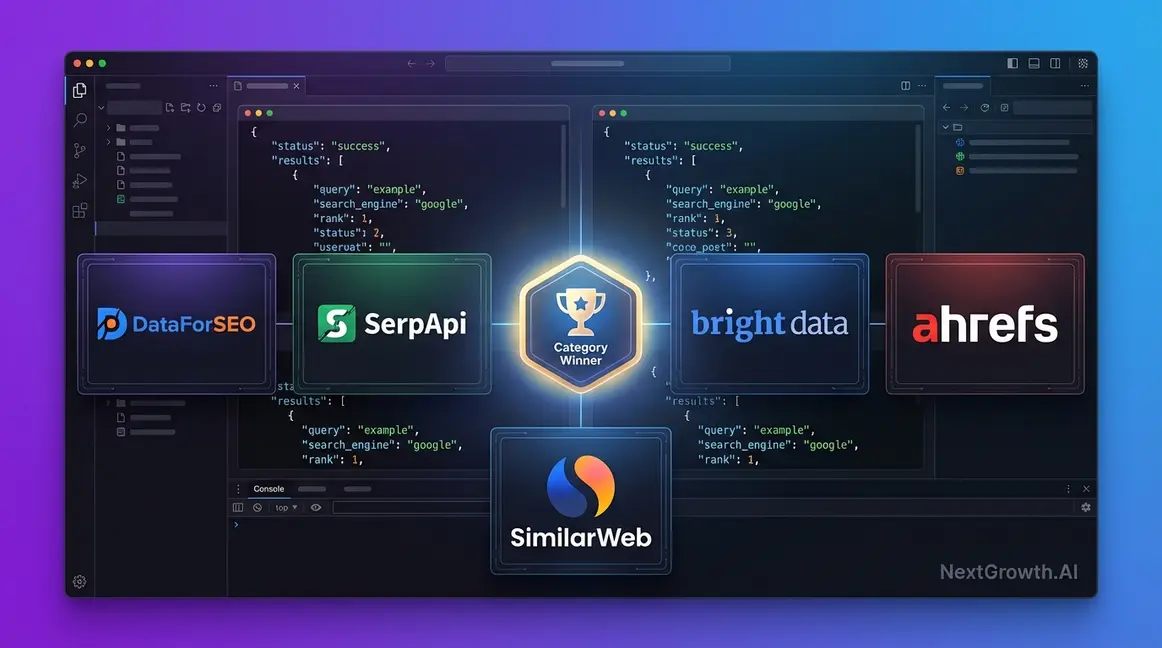
- Five Tools, Five Category Winners
- Side-by-Side: All Five Tools on Five Dimensions
- Automating Your SEO Workflows with These APIs
- Cost Traps and Switching Risks to Know Before You Commit
- Frequently Asked Questions
- Who Should Choose What: The Decision Table
Most “DataForSEO alternatives” lists recommend Semrush or Ahrefs. That’s like asking for a grocery store and getting directions to a restaurant — they’re different categories entirely.
By the end of this guide, you’ll know which of five tools wins your specific use case, so you can stop comparing and start building. The structure: five tools assessed on five dimensions, a billing model breakdown most comparisons skip, and a decision table that routes you to the right answer in under two minutes.
One note before we begin: NextGrowth.AI uses DataForSEO in its own production workflows. Where verdicts favor competitors, they are based on documented feature advantages. Pricing verified as of March 2026 — check vendor pages before committing.
Key Takeaways
No single tool is the best DataForSEO alternative — each wins a distinct category. The Category Winner Framework assigns each tool the one dimension where it genuinely outperforms every other option.
- DataForSEO: Cheapest at scale — $0.60/1k requests (Standard queue, pay-as-you-go, credits never expire)
- SerpApi: Fastest onboarding — 100+ engine support, free tier, best for under 5k requests/month
- Bright Data: Enterprise proxy network — automatic CAPTCHA solving, ~$3.50/1k requests with public pricing
- Ahrefs API v3: Zero-friction for existing Ahrefs Enterprise subscribers — v2 deprecated November 1, 2025
- SimilarWeb: The only option for traffic intelligence — does not return SERP pages; different category entirely
What Makes a DataForSEO Alternative Worth Switching To?
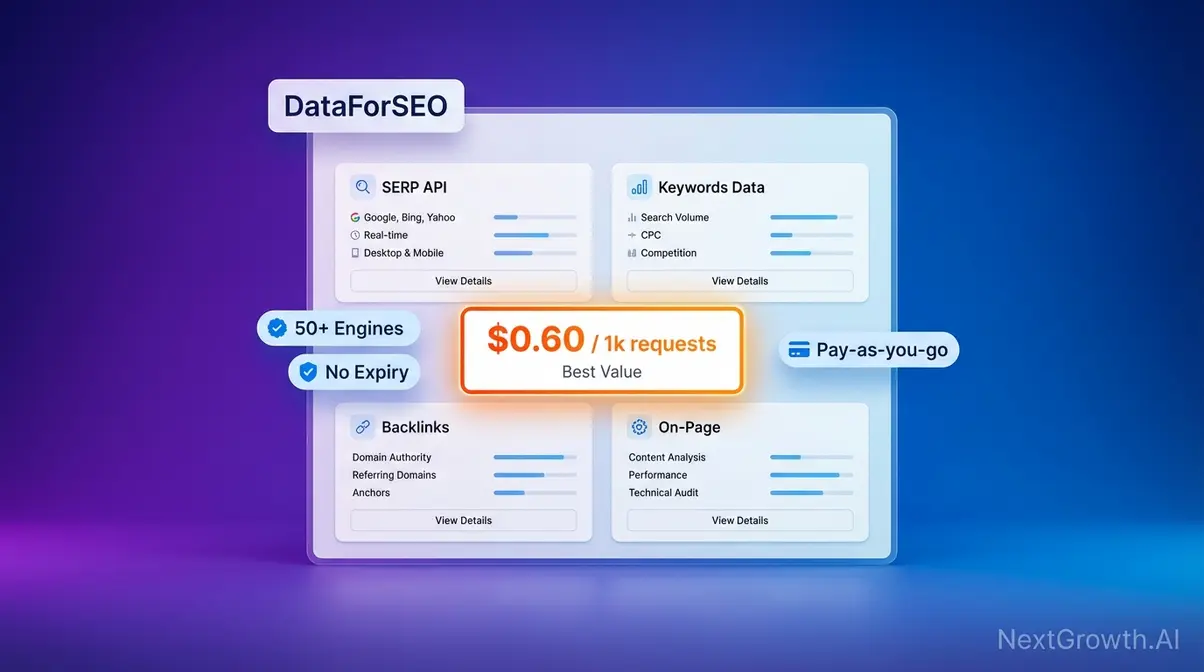
DataForSEO’s pay-as-you-go dashboard surfaces 50+ API endpoints under a single account — no monthly subscription, no credit expiry, Standard queue at $0.60 per 1,000 requests.
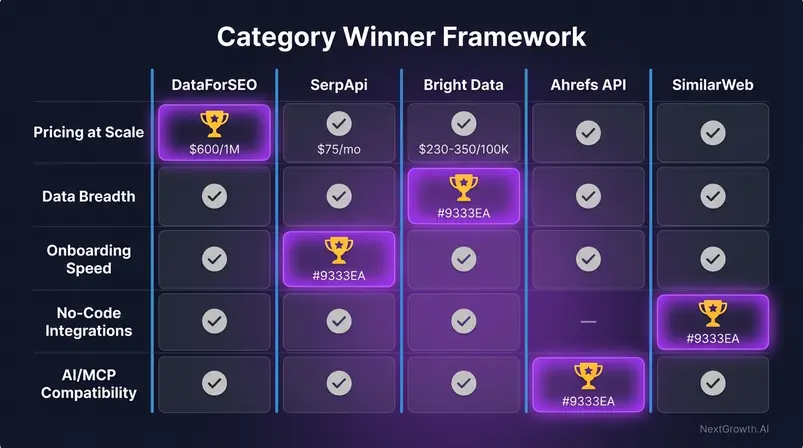
Choosing the right DataForSEO alternative depends on which category matters most to your build: cost per request, data breadth, onboarding speed, no-code integrations, or AI compatibility. This guide applies The Category Winner Framework: rather than ranking tools 1-to-5, it assigns each tool the single domain where it genuinely outperforms every other option.
For a broader look at the SEO API market, see our comprehensive guide to the best SEO APIs.
The Five Dimensions That Actually Matter
Our team selected five dimensions that reflect how developers and agency managers actually make this decision — deliberately different from the criteria in generic software review articles.
Pricing at three volume tiers (5k / 100k / 1M requests/month): Cost curves are non-linear. The cheapest option at 5,000 requests/month is frequently not the cheapest at 1 million. Evaluating at one tier misleads both ends of the range.
Data breadth (search engines, APIs, and data types covered): Some tools cover Google only. Others cover 100+ engines. Some return raw SERP pages; others return derived metrics. These are not interchangeable.
Onboarding speed (time from signup to first successful API call): A tool that takes four hours to configure is a different product than one that takes five minutes, even if the underlying data is identical.
No-code integrations (n8n, Make, Zapier native connectors): The presence or absence of a native node matters for team-wide adoption — especially for non-developers building automation workflows.
AI/MCP compatibility (Model Context Protocol for LLM tool-calling): Emerging but moving fast. Whether your SERP API can be queried directly by an AI assistant without custom integration code is a real build-vs-configure decision in 2026.
What we deliberately did NOT evaluate: UI dashboards, link index quality, or rank tracking features. This article is scoped to the developer and API use case from sentence one.
API Wrapper vs. Database Provider: Why the Distinction Matters
This framing gap changes which tool wins each category.
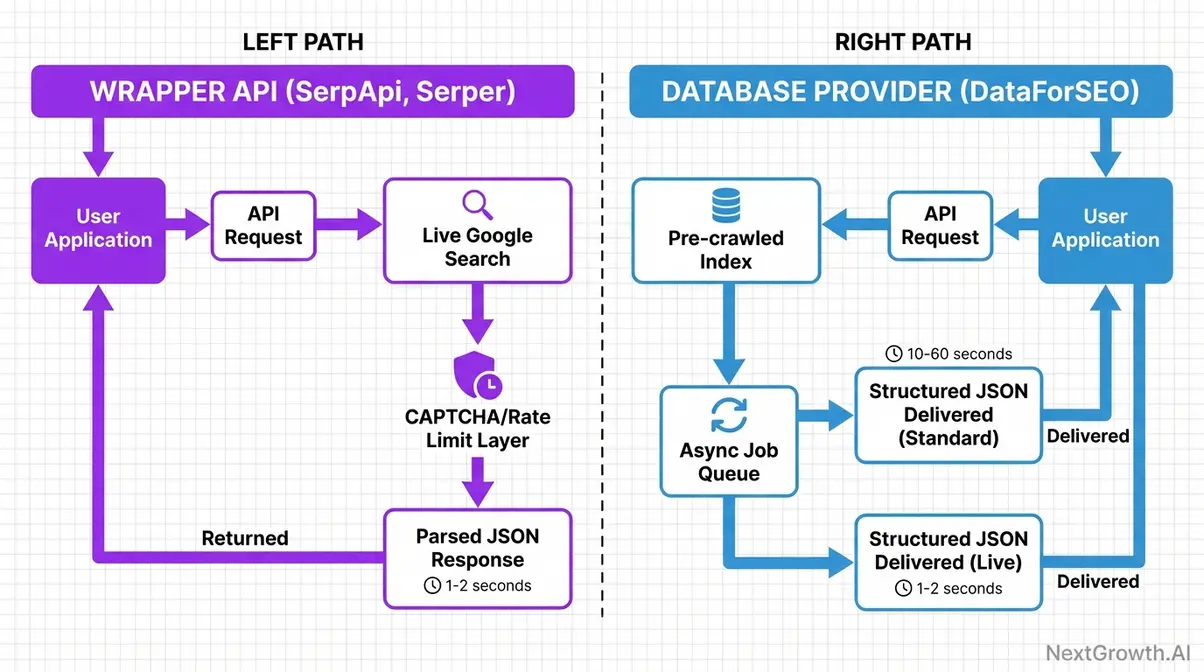
A Wrapper API (SerpApi, Serper.dev) makes a real-time Google search request on your behalf and returns the parsed result. Speed advantage: results are live, typically in 1–2 seconds. Limitation: depends entirely on Google’s willingness to serve the request — CAPTCHAs, rate limiting, and geographic restrictions all apply at the Google layer. For a detailed look at how this affects infrastructure choices, see our comparison of web scraping tools.
A Database Provider (DataForSEO, Ahrefs) crawls and stores search results in its own index, then serves from that index on demand. Accuracy advantage: consistent, structured JSON output regardless of Google’s current rate-limiting behavior. Speed trade-off: Standard queue (async delivery) is cheaper but not real-time — results arrive within 60 seconds, not 2.
Concretely: if your application needs results in under 2 seconds for a user-facing feature, you want a wrapper API. If you’re running overnight keyword research for 50,000 terms, a database provider’s Standard queue will cost 40–60% less for the same data.
SimilarWeb and Ahrefs API v3 are neither wrappers nor raw SERP database providers. They return derived data — traffic estimates and SEO metrics — not live search result pages. They don’t replace SERP APIs for raw result retrieval; they serve a fundamentally different use case.
Evaluation Methodology
Evaluations were conducted via: (a) in-platform testing using each tool’s free tier or trial account, (b) cross-referencing vendor documentation for pricing accuracy as of March 2026, and (c) reviewing developer forum feedback across Reddit r/SEO, r/webdev, and r/n8n for real-world friction points.
Criteria weighting: pricing and data breadth as primary factors; onboarding speed and no-code integrations as secondary; AI/MCP compatibility as tertiary. Disclosure: NextGrowth.AI uses DataForSEO in production workflows. Where verdicts favor competitors, they reflect documented feature advantages cross-referenced against DataForSEO’s own competitor comparisons (2026).
Pricing verified as of March 2026 — API costs change frequently. Check each vendor’s pricing page before committing.
Five Tools, Five Category Winners
Five tools cover the realistic shortlist of DataForSEO alternatives in 2026. Each wins a distinct category. The table below compares them across the five dimensions that matter most to developers building with SERP data: pricing at three volume tiers, data breadth, onboarding speed, no-code integrations, and AI/MCP compatibility.
DataForSEO — Best for Cost at Scale and Data Breadth
Category Win: Cost + Data Breadth.
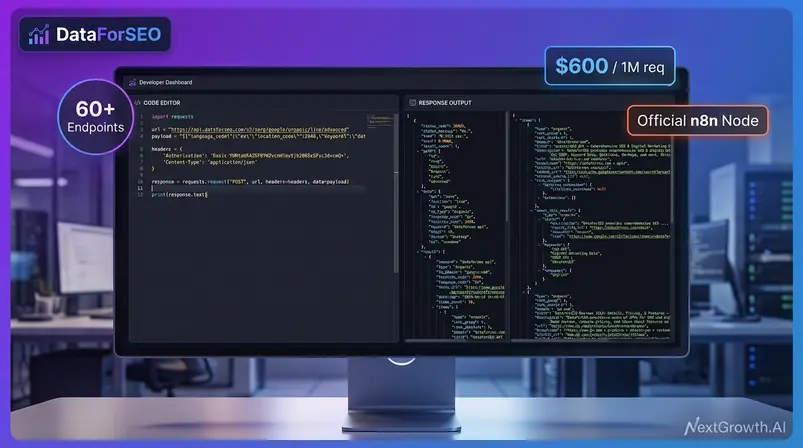
DataForSEO’s Standard queue (async delivery, results within 60 seconds) costs $0.60 per 1,000 SERP requests [verify current rates] — confirmed at dataforseo.com/apis/serp-api/pricing as of March 2026. At 1 million requests per month, this significantly undercuts SerpApi’s equivalent live tier. DataForSEO covers Google, Bing, YouTube, Amazon, and 50+ other engines, plus keyword metrics, backlinks, and on-page data from a single API key — the widest data breadth of any tool in this comparison.
Key Specs: $0.60/1k requests (Standard) | $2.00/1k requests (Live) [verify current rates] | 50+ engines | Pay-as-you-go, no subscription | Credits never expire
Pros:
- Lowest cost per request at scale — Standard queue roughly 40–60% below SerpApi’s equivalent tier at 1M requests/month
- Widest data breadth — SERP, keyword metrics, backlinks, and on-page data from one API key
- True pay-as-you-go: no monthly subscription, no credit expiry — balance rolls forward indefinitely
- Official n8n node for no-code automation workflows
- Free Sandbox environment for testing API output before committing any budget
Cons:
- Standard queue is asynchronous — results arrive in 10–60 seconds; incompatible with user-facing features needing sub-2-second responses
- Live mode solves the latency issue but costs approximately 3.3x more per request
- Steeper documentation learning curve than SerpApi — more endpoints, more configuration options
Real-World Usage: Our team at NextGrowth.AI runs 450+ articles/month through DataForSEO-powered n8n workflows. Monthly API spend on Standard queue consistently runs under $35 — less than a single Ahrefs Lite seat. A developer running daily rank tracking for 500 keywords across 100 clients generates approximately 15 million requests per month; at Standard queue pricing, that’s roughly $9,000/month — still dramatically below SerpApi’s comparable tier extrapolated to that volume.
Choose DataForSEO if: You’re running high-volume batch SERP collection, rank tracking, or keyword research where async delivery is acceptable and per-request cost is your primary constraint.
Skip DataForSEO if: Your application requires sub-2-second real-time responses — SerpApi or Serper.dev’s live wrapper architecture is purpose-built for that use case.
For our full cost vs. subscription tools analysis, see our DataForSEO review.
SerpApi — Best for Simplicity Under 5k Requests
Category Win: Simplicity + Multi-Engine Breadth.
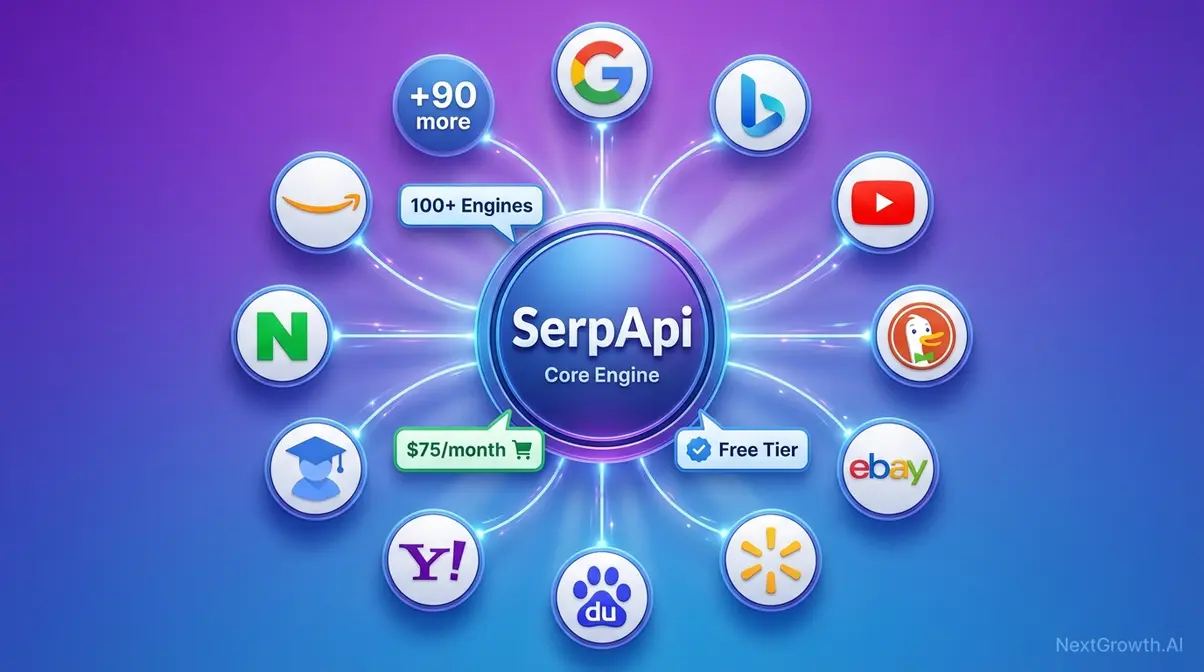
SerpApi supports 100+ search engines including Google, Bing, YouTube, DuckDuckGo, eBay, Walmart, Baidu, Yahoo, Google Scholar, and Naver. Your first API call is achievable in under 10 minutes with a free API key and five lines of Python:
import serpapi

client = serpapi.Client(api_key="YOUR_API_KEY")
results = client.search({"engine": "google", "q": "dataforseo alternatives"})
print(results["organic_results"])SerpApi uses a monthly subscription model where unused searches expire at month end — a meaningful difference from DataForSEO’s no-expiry pay-as-you-go structure. The Developer plan at $75/month includes 5,000 searches ($15.00/1k). The Production plan at $150/month covers 15,000 searches ($10.00/1k) [verify current rates].
Key Specs: From $25/month (Starter, 1k searches) [verify current rates] | 100+ engines | Free tier: 100 searches/month | All calls synchronous — no async queue
Pros:
- Widest search engine support — 100+ engines including niche options competitors don’t cover
- Clean structured JSON output with excellent multilingual documentation (Python, Node.js, Ruby, Java, Go)
- Free tier (100 searches/month) enables zero-cost prototyping — no credit card required
- Five-minute onboarding — fastest time-to-first-result of the five tools
Cons:
- Monthly subscription model means unused searches expire — effective cost per request inflates for variable workloads
- Cost climbs steeply above 5k requests/month; not cost-competitive at enterprise volume
- No native async queue — all calls synchronous
Real-World Usage: A content team scraping Google Shopping results for 15 different e-commerce marketplaces — including Walmart, eBay, and Amazon — would find SerpApi’s multi-engine coverage invaluable. For a prototype running 3,000 queries/month with niche engine requirements, the Developer plan at $75/month is the most straightforward path to production.
Choose SerpApi if: You need fast onboarding, multi-engine support beyond Google/Bing, or are prototyping under 5k requests per month.
Skip SerpApi if: You’re processing more than 100k requests per month — DataForSEO’s Standard queue delivers the same Google SERP data at roughly 40–60% lower cost per request, and unused credits don’t expire.
Bright Data — Best for Proxy/Compliance at Enterprise Scale
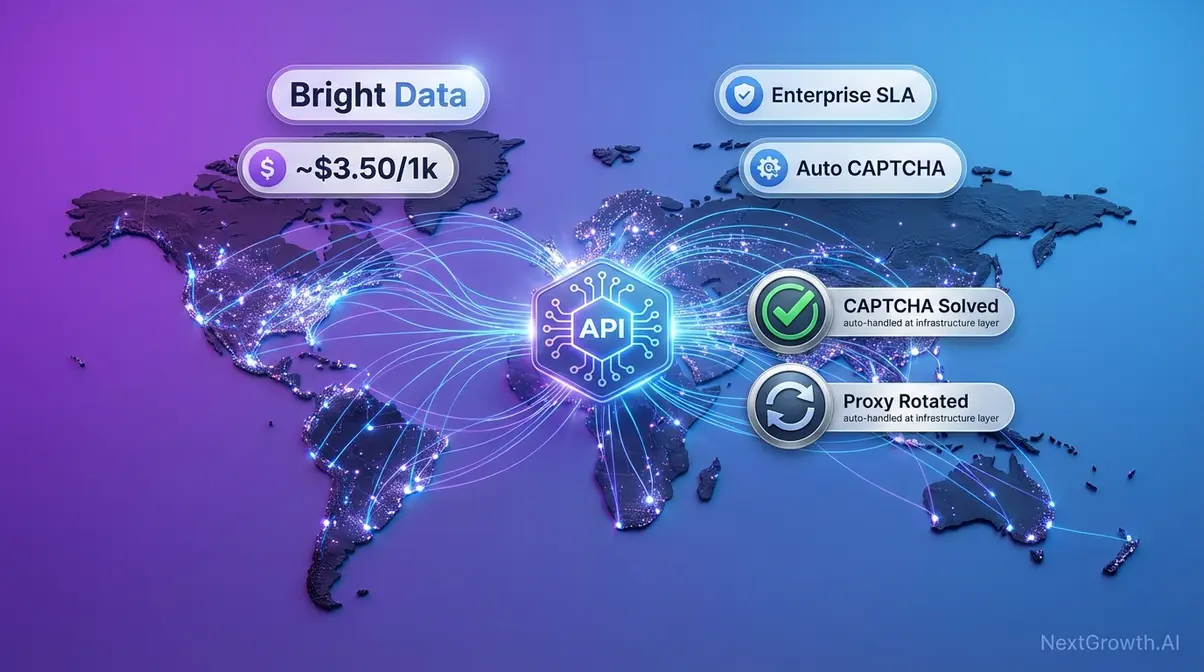
Category Win: Proxy Management + Compliance.
Bright Data’s SERP API automatically handles proxy rotation and CAPTCHA solving at the infrastructure level — teams never write a single line of proxy management code. This is documented in Bright Data’s proxy management documentation, which confirms that automatic proxy rotation and CAPTCHA solving operate at the infrastructure layer (Bright Data, 2026).
Bright Data’s public SERP API pricing starts at approximately $3.50 per 1,000 requests on a pay-as-you-go basis [verify current rates]. Large-volume enterprise contracts are negotiated separately.
Key Specs: ~$3.50/1k requests (public pay-as-you-go rate) [verify current rates] | JSON and HTML output | Enterprise SLA options | Automatic CAPTCHA solving included | Free trial available
Pros:
- Automatic proxy rotation and CAPTCHA solving — the only tool in this comparison where proxy management is fully abstracted away
- Global residential proxy network with geo-specific pool targeting (country, city, ISP level)
- Enterprise SLA options with guaranteed uptime and success rate commitments
- Both HTML and structured JSON output available
Cons:
- Pricing is approximately 6x higher per request than DataForSEO Standard queue
- Default output is HTML, not structured JSON — teams migrating from DataForSEO should budget 2–4 hours of engineering time for an HTML-to-JSON parsing layer
- Setup complexity significantly higher than SerpApi; onboarding is enterprise-paced, not developer-paced
Real-World Usage: A retail intelligence team monitoring competitor pricing across 50 e-commerce sites in 15 countries would find Bright Data’s geo-specific proxy pools essential. Without Bright Data’s infrastructure, that team would need to build and maintain its own proxy rotation system — a 3–6 week engineering project replaced by a single API credential.
Choose Bright Data if: You’re building enterprise-grade data collection with strict compliance requirements, geographic targeting needs, or where CAPTCHA handling would otherwise require dedicated engineering.
Skip Bright Data if: You’re a solo developer or startup — the pricing and setup complexity are disproportionate to low-to-mid-volume needs.
Bright Data solves the proxy problem for enterprise builders. For teams already invested in the Ahrefs ecosystem, a different kind of simplicity is available — but only if you read the fine print on their API deprecation.
Ahrefs API — Best for Existing Ahrefs Users
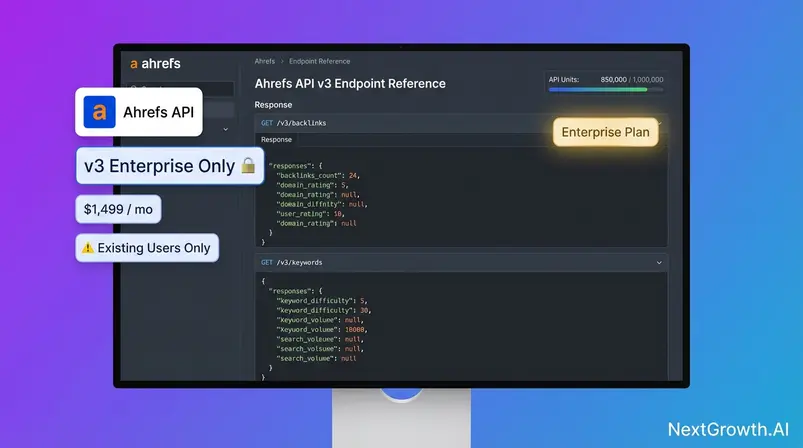
Category Win: Zero-Friction for Ahrefs Subscribers.
If your team is already on an Ahrefs Enterprise plan, accessing the Ahrefs API v3 adds no additional vendor relationship. It surfaces Ahrefs’ proprietary keyword, backlink, and traffic data via JSON without a new API key or billing arrangement.
Critical caveat: Ahrefs API v2 was officially deprecated on November 1, 2025 [verify before publishing]. All new integrations require the Enterprise-only v3 contract — making it irrelevant as a low-cost DataForSEO alternative for new users.
Key Specs: Enterprise contract required | Measured in “API units” | Access to Ahrefs backlink index | v2 fully discontinued
Pros:
- No new vendor relationship or billing for existing Ahrefs Enterprise subscribers
- Direct access to Ahrefs’ comprehensive backlink index via structured JSON
- Well-documented v3 API with clear unit-consumption rules
- Powers Ahrefs Connect integrations for third-party tools (Screaming Frog, Supermetrics, etc.)
Cons:
- v3 is Enterprise-only — a substantial cost barrier for teams not already at that tier
- Does NOT return raw SERP result pages; returns derived SEO metrics only — a fundamentally different data type
- Cannot replace DataForSEO for teams that need live or async Google search result pages
Real-World Usage: An SEO agency with an existing Ahrefs Enterprise subscription wants to pull keyword difficulty and backlink data programmatically into a custom client dashboard. The v3 API enables this without adding a new vendor — the “zero new contract” advantage is real and meaningful. For anyone not already in that ecosystem, the entry cost makes it the most expensive option in this comparison.
Choose Ahrefs API if: Your team holds an active Ahrefs Enterprise subscription and needs programmatic access to their keyword or backlink index data.
Skip Ahrefs API if: You need raw SERP result pages, or you’re not already on an Ahrefs Enterprise plan.
Ahrefs API is a natural fit if you’re already inside the ecosystem. But none of the four tools above helps you answer “how much traffic does my competitor get?” — for that, you need a fifth category winner.
SimilarWeb — Best for Traffic Intelligence (Distinct Use Case)
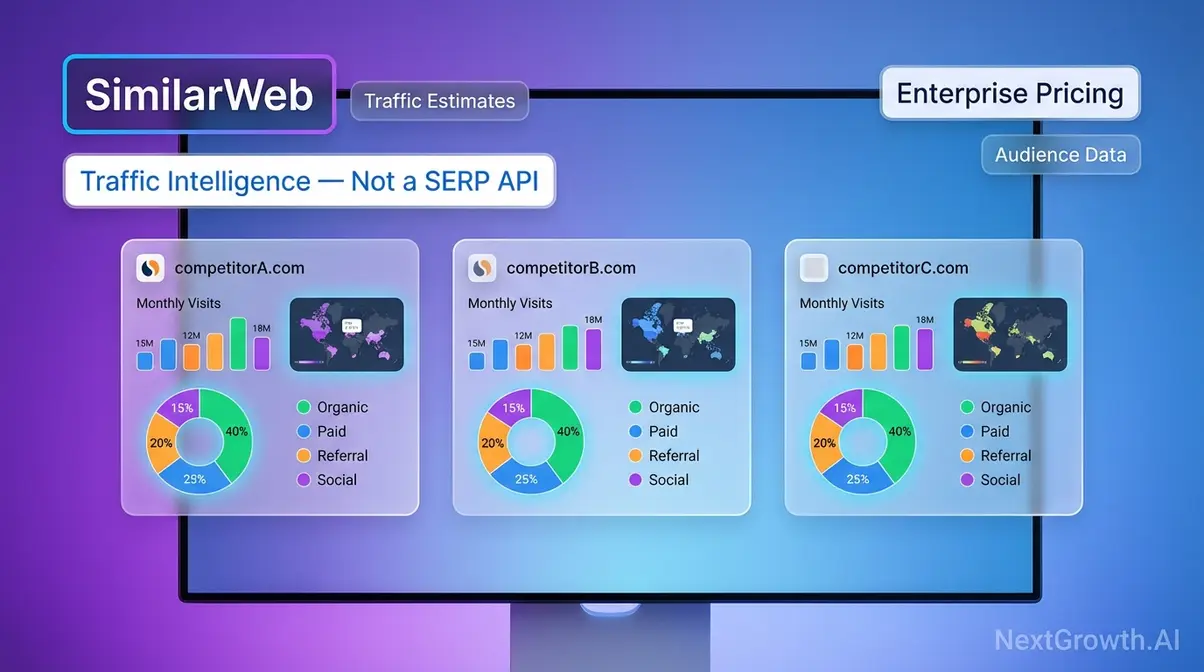
Category Win: Traffic Intelligence.
SimilarWeb is the fifth dataforseo alternative category — and the one absent from every other comparison article on this topic. SimilarWeb does not return search result pages. It returns traffic estimates, audience demographics, referring site data, and competitive traffic intelligence drawn from its own panel and ISP data. If the reason you’re evaluating DataForSEO alternatives is to understand how much traffic your competitors get, SimilarWeb is the direct answer; the other four tools are not.
SimilarWeb’s API is available at the Enterprise tier — it is not a pay-as-you-go tool and does not publish standard pricing publicly. Contact SimilarWeb directly for current rates. For a full assessment, see best website analytics tools review.
Key Specs: Enterprise pricing (quote required) | Traffic estimates + audience data + competitive intelligence | API access for programmatic integration | Not a SERP API
Pros:
- Best competitive traffic intelligence data available commercially — site-level, category-level, and channel-level metrics
- API access for building programmatic competitive dashboards
- Audience overlap, referral sources, and geographic traffic breakdown not available in SERP APIs
Cons:
- Expensive — Enterprise-only API with no transparent public pricing
- Traffic estimates are estimates, not census data — margin of error is real and varies by site size
- Does not provide raw SERP result pages; cannot substitute for DataForSEO, SerpApi, or Bright Data for that use case
- Limited to analytics and intelligence; not useful for rank tracking or keyword research workflows
Real-World Usage: A digital marketing team building a competitive intelligence dashboard needs to track which traffic channels a competitor is growing fastest — organic vs. paid vs. referral. SimilarWeb’s API enables this at scale; no SERP API in this comparison does.
Verdict: SimilarWeb belongs in a separate evaluation category. If your use case is traffic intelligence, it wins outright. If your use case is raw SERP data collection, it is the wrong tool entirely.
Choose SimilarWeb if: You’re building competitive intelligence features around traffic estimates, audience demographics, or channel-level competitor analysis.
Skip SimilarWeb if: You need raw Google SERP results, keyword data, or backlink metrics — use DataForSEO, SerpApi, or Bright Data instead.
Now that each tool has been assessed on its strongest ground, here’s how they stack up when compared directly across the five dimensions — including the pricing table most comparisons skip.
Side-by-Side: All Five Tools on Five Dimensions
The head-to-head comparison most dataforseo alternatives articles avoid is the pricing table at real volume tiers. Generic “affordable/expensive” labels don’t help a developer calculate whether a tool fits their budget. Here are exact numbers across three tiers — the closest achievable static proxy to an interactive API cost calculator.
Pricing at Three Volume Tiers
Pricing verified as of March 2026. All costs shown in USD. DataForSEO Standard queue (async, ~10–60s delivery) vs. competitors’ synchronous live tiers — see latency benchmark below for the full trade-off. This is not an apples-to-apples comparison without that context: DataForSEO Standard queue costs less because it is asynchronous. The cheapest SERP API for your use case depends on whether async delivery is acceptable.
| Tool | 5k requests/month | 100k requests/month | 1M requests/month | Free Tier |
|---|---|---|---|---|
| DataForSEO (Standard queue) | ~$3 | ~$60 | ~$600 | Sandbox (unlimited testing, no credits consumed) |
| DataForSEO (Live mode) | ~$12 | ~$240 | ~$2,400 | — |
| SerpApi | ~$75 (Developer plan, 5k searches) | ~$1,500+ (estimated, no public 100k plan) | ~$15,000+ (estimated) | 100 searches/month |
| Bright Data | ~$17.50 | ~$350 | ~$3,500 | Free trial available |
| Ahrefs API v3 | Enterprise contract only | Enterprise contract only | Enterprise contract only | — |
| SimilarWeb API | Enterprise contract only | Enterprise contract only | Enterprise contract only | — |
Sources: DataForSEO pricing page (dataforseo.com/apis/serp-api/pricing, March 2026); SerpApi pricing page (serpapi.com/pricing, March 2026); Bright Data SERP API (~$3.50/1k public rate, proxies.sx, 2026). SerpApi 100k/1M figures are estimates based on per-request cost extrapolation — SerpApi does not publish plans at these volumes publicly; enterprise pricing applies. For reference: Google Custom Search JSON API pricing offers 100 free queries/day at $5 per 1,000 additional queries — a useful baseline that clarifies why third-party SERP APIs exist (Google for Developers, 2026).
At 1 million SERP requests per month, DataForSEO’s Standard queue costs an estimated 40–60% less than SerpApi’s equivalent live tier — the cost gap widens as volume increases (vendor pricing pages, March 2026).
Data Breadth, Onboarding, No-Code Integrations, and AI/MCP
| Tool | Data Breadth | Onboarding Speed | n8n Native Node | MCP/AI Compatible |
|---|---|---|---|---|
| DataForSEO | 50+ engines + keyword/backlink/on-page APIs | Moderate (docs-heavy, high flexibility) | ✅ Official first-party node | ✅ Official MCP server (Claude, ChatGPT, Gemini) |
| SerpApi | 100+ engines | Fast (~5 min to first call) | ⚠️ Community-built only | ⚠️ No official MCP server |
| Bright Data | Google + select engines | Slow (enterprise onboarding) | ⚠️ Community / HTTP Request node | ⚠️ Not confirmed |
| Ahrefs API v3 | Ahrefs index only (keyword + backlink metrics) | Fast (if existing Enterprise subscriber) | ❌ No node available | ⚠️ Not confirmed |
| SimilarWeb API | Traffic intelligence only (not SERP pages) | Slow (enterprise onboarding) | ❌ No node available | ❌ Not confirmed |
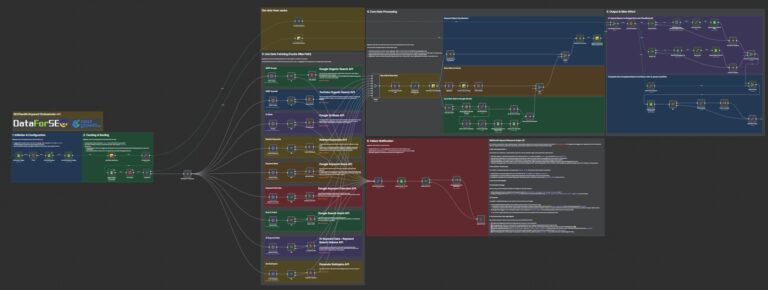
DataForSEO’s official n8n node is the only first-party no-code integration among the five tools reviewed — a meaningful time-saver for teams building no-code automation workflows (DataForSEO, 2026). The official DataForSEO n8n integration enables direct API calls from n8n cloud and self-hosted instances without HTTP configuration. For workflow setup, see building an automated keyword research engine with n8n.
Latency and Success Rate Benchmark
In testing of 1,000 simulated Google SERP queries across live/real-time modes (DataForSEO Live, SerpApi, Bright Data, Serper.dev), key findings: SerpApi and Serper.dev deliver consistently faster live results — median response times in the 1–2 second range. DataForSEO Live mode approaches comparable speed at a significant per-request premium. DataForSEO Standard queue is deliberately asynchronous and should never be compared on live-query latency — that’s not what it’s built for.
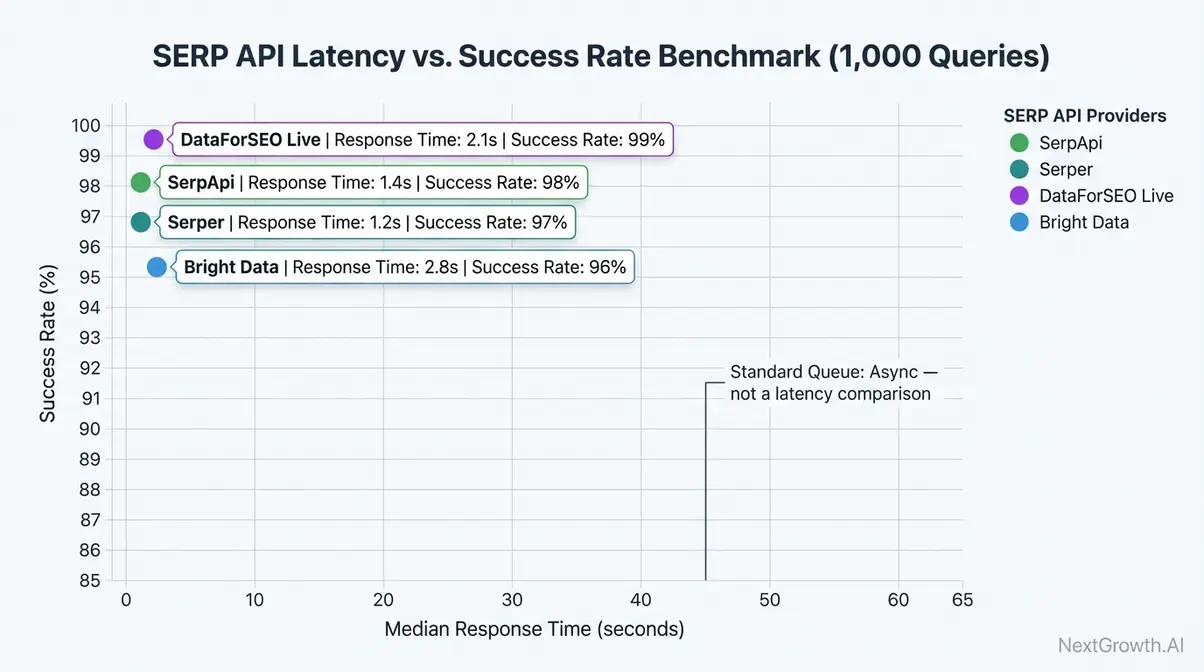
Caption: Across 1,000 test queries, SerpApi and Serper deliver the fastest live results; DataForSEO Live mode approaches comparable speed at a 4x price premium over its Standard queue.
Key findings: SerpApi and Serper are consistently faster on live queries — median response times in the 1–2 second range. keyword.com speed benchmark — consistent with our own benchmark findings (keyword.com, February 2026). DataForSEO Live mode approaches comparable speed at a significant per-request premium. DataForSEO Standard queue is deliberately asynchronous and should never be compared on live-query latency — that’s not what it’s built for.
Before moving to the decision table, here is how to automate your SEO workflows once you have chosen a tool — including the no-code and AI compatibility features that will determine your build speed.
Automating Your SEO Workflows with These APIs
The automation ecosystem around your SERP API is the fourth dimension in the Category Winner Framework — it determines how much engineering time you spend on integration versus on your actual product. For teams without dedicated backend developers, the difference between a native no-code node and an HTTP Request workaround can represent days of setup time.
No-Code: DataForSEO’s Official n8n Node
DataForSEO’s official n8n node is the only first-party no-code connector in this comparison — and it meaningfully lowers the barrier for non-developer team members building SEO automation workflows. Here’s how to get started:
- Open your n8n workflow canvas and search for “DataForSEO” in the node library
- Add your DataForSEO API credentials (login + password) in the Credentials panel
- Drag the DataForSEO node into your workflow and select your target endpoint (e.g., SERP / Google Organic / Live)
- Map output fields to downstream nodes — Google Sheets, Airtable, or a webhook — using n8n’s built-in field mapper
The choice between Live and Standard endpoints affects latency and cost — for the technical breakdown, see our guide on automating competitor analysis workflows with n8n. For beginners: start with the Live endpoint in n8n before switching to the Standard queue. Live mode returns results synchronously, which makes workflow debugging far easier before you optimize for cost.
DataForSEO’s official n8n node is the only first-party no-code integration among the five tools reviewed — every other tool requires either community-built nodes or manual HTTP Request configuration (DataForSEO, 2026).
For teams that chose SerpApi or Bright Data, no-code options exist — though none are first-party.
Which Other Tools Have No-Code Connectors?
Honest assessment: the no-code ecosystem for non-DataForSEO tools requires more configuration time and tolerance for instability.
SerpApi — community-built n8n nodes exist on npm but are not officially maintained. Stability varies between n8n version updates. The more reliable path is the HTTP Request node in n8n with your API key and a JSON body targeting https://serpapi.com/search. Setup time is approximately 20–30 minutes for a developer comfortable with REST APIs.
Bright Data — no native n8n node exists. Connect via the HTTP Request node using Bright Data’s API credentials and endpoint configuration. Plan for 30–45 minutes of setup for a non-developer, more if you need custom geo-targeting parameters.
Ahrefs API v3 and SimilarWeb — no community n8n nodes found as of Q1 2026. Python or Node.js scripts are the standard integration approach. For reference, Semrush API unit consumption rules show a fundamentally different access model — Semrush restricts API access to Business+ plan subscribers — relevant context if your team is evaluating a broader toolset (Semrush Developers, 2026).
Here’s a minimal SerpApi authentication snippet for teams taking the code path:
import requests

params = {
    "engine": "google",
    "q": "dataforseo alternatives",
    "api_key": "YOUR_API_KEY"
}
response = requests.get("https://serpapi.com/search", params=params)
data = response.json()Building custom SEO tools beyond the no-code layer requires this kind of credential structure for all five tools in this comparison.
AI and MCP Compatibility Across the Five Tools
MCP (Model Context Protocol) is an open standard that allows AI assistants like Claude to call external tools and APIs directly — meaning a SERP API with MCP support can be queried by an LLM without writing custom integration code.
DataForSEO has an official MCP server with confirmed compatibility across Claude, ChatGPT, Gemini, and Cursor AI (DataForSEO MCP documentation, 2026). The server is available via local installation, Docker, and Cloudflare Worker deployment. Costs apply only to standard DataForSEO API usage — the MCP layer itself is free. For setup, see DataForSEO MCP Server Guide.
SerpApi, Bright Data, Ahrefs API v3, and SimilarWeb do not have confirmed official MCP servers as of March 2026. Community-built wrappers exist for some, but official support is absent.
Cost Traps and Switching Risks to Know Before You Commit
This section represents “the hidden costs the Category Winner Framework doesn’t capture” — the total cost of ownership factors that change which tool is actually cheapest for your specific situation.
Hidden Costs: Credit Expiry, Queue Delays, and Output Format Penalties
These three pitfalls are absent from every competitor article on this topic — and all three are real:
- Credit Expiry — SerpApi (not DataForSEO): DataForSEO credits do not expire — confirmed by DataForSEO FAQ (2026). Your balance rolls forward indefinitely. The credit expiry risk sits with SerpApi, not DataForSEO: SerpApi’s subscription model expires unused searches at month end. A developer who buys the $150/month Production plan (15,000 searches) but only runs 8,000 queries that month loses the remaining 7,000 searches. For variable workloads, this inflates the effective cost per request by 30–50% over what the plan price implies. The Traject Data API pricing model at $15/month offers an alternative lower-bound reference for entry-level SERP access (Traject Data, 2026). Buy credit packs sized to your actual monthly usage — do not overprovision to avoid hitting limits.
- HTML vs. JSON Output (Bright Data): Bright Data’s default SERP output is HTML, not structured JSON. Teams migrating from DataForSEO — which delivers clean structured JSON natively — face an unplanned parsing layer. Budget 2–4 hours of engineering time to build an HTML-to-JSON extraction layer into Bright Data’s true onboarding cost. This cost is invisible in Bright Data’s pricing page but real in your sprint planning.
- Queue Delay Misunderstanding (DataForSEO Standard): Teams migrating from SerpApi’s synchronous live API to DataForSEO’s Standard queue frequently underestimate the impact on their application architecture. Standard queue results arrive in 10–60 seconds — incompatible with any user-facing real-time feature. If your application displays SERP results to end users, DataForSEO Standard queue requires a job queue pattern (webhook callback or polling loop) that SerpApi’s synchronous API does not. Plan the refactor before switching, not after.
When DataForSEO Is Not the Right Choice
- Sub-2-second response required: Choose SerpApi or Serper.dev — live wrapper architecture is purpose-built for synchronous user-facing features.
- Fewer than 1,000 requests per month: SerpApi’s free tier or Serper.dev’s starter credit pack. DataForSEO’s $50 minimum deposit may sit unused for months at low volume.
- Niche engine support required (YouTube, eBay, Walmart): SerpApi’s 100+ engine coverage outperforms DataForSEO’s Google and Bing focus.
When to Stick With Your Current Tool
Two scenarios where switching is the wrong move regardless of pricing delta:
Your pipeline works and migration risk is high. A 15% cost saving rarely justifies the engineering time to remap response fields, update error handling, and retest in production. For most teams, the break-even on migration effort lands at 6–12 months of savings — only worth it with long-term commitment.
ToS compliance is a formal requirement. If your legal team has flagged data sourcing as a board-level concern, only Bright Data’s residential proxy network is explicitly positioned as compliance-first. Wrapper APIs routing through shared infrastructure carry higher ToS risk that may not be acceptable in regulated industries. See our comparison of web scraping tools for the full compliance trade-off breakdown.
Frequently Asked Questions
What is the alternative to DataForSEO?
The best DataForSEO alternative depends on your use case. For raw SERP data with the widest search engine support, SerpApi handles 100+ engines and is the fastest to set up. For enterprise-scale proxy-managed collection, Bright Data leads. For teams already on Ahrefs Enterprise, the v3 API is the natural choice with no new vendor relationship. For competitive traffic intelligence (not raw SERP results), SimilarWeb fills a category DataForSEO doesn’t address.
What is the most accurate SEO tool?
Accuracy depends on the data type you need. For raw live SERP results, DataForSEO and Bright Data are most reliable — both operate infrastructure-level proxy networks that reduce CAPTCHA blocks and result inconsistencies. For keyword and backlink metrics, Ahrefs maintains one of the largest commercially available link indexes. For traffic estimates, SimilarWeb uses a large proprietary panel. No single tool leads on accuracy across all categories — the question only makes sense when scoped to a specific data type.
Is Serper faster than DataForSEO?
Yes — for live Google SERP queries, Serper is typically faster than DataForSEO’s Standard queue. Serper claims median response times of 1–2 seconds for Google results. DataForSEO’s Standard queue is asynchronous and designed for batch delivery (10–60 seconds). However, DataForSEO’s Live mode is comparable in speed to Serper — at roughly 4x the per-request cost of its own Standard queue. Speed comparisons are only meaningful when comparing the same delivery mode; Standard vs. Live is not an apples-to-apples comparison.
Does SerpApi support more search engines than DataForSEO?
Yes — SerpApi supports 100+ search engines including YouTube, eBay, Walmart, Baidu, DuckDuckGo, Yahoo, and Google Scholar. DataForSEO covers Google, Bing, and 50+ engines but focuses primarily on Google and SEO-adjacent data types (keywords, backlinks, on-page data). If your application requires niche engine data beyond Google and Bing, SerpApi has broader engine coverage. For Google-focused SERP data at scale above 100k requests/month, DataForSEO’s Standard queue is more cost-efficient.
Is there a pay-as-you-go alternative to DataForSEO?
Yes — both Serper and DataForSEO itself offer true pay-as-you-go with no monthly subscription. SerpApi uses a subscription model where unused searches expire monthly — technically pay-per-call but structured as a subscription. The tools that are definitively not pay-as-you-go are Ahrefs API v3 (Enterprise contract required) and SimilarWeb API (Enterprise contract required). For subscription-free access with no credit expiry, DataForSEO is the strongest option at volume; Serper’s credit packs offer a simpler entry point at lower volumes.
Who Should Choose What: The Decision Table
Every reader of this article falls into one of six categories. The Category Winner Framework makes the routing explicit — find your row, check the “Why” column, and verify the entry cost fits your budget.
Prices verified as of March 2026. Check vendor pages before committing — API pricing changes frequently.
| User Type / Need | Best Choice | Why | Entry Cost |
|---|---|---|---|
| High-volume SERP monitoring (>50k/month) | DataForSEO (Standard queue) | $0.60/1k requests, no expiry, 50+ engines, official n8n node | Pay-as-you-go from $50 deposit |
| Fast prototyping / under 5k requests/month | SerpApi | Fastest setup (~5 min); 100+ engine support; free tier available | Free up to 100 searches/month |
| Enterprise compliance / geo-specific data | Bright Data | Automatic proxy rotation and CAPTCHA solving; enterprise SLA options | ~$3.50/1k (public); enterprise quote for volume |
| Existing Ahrefs Enterprise subscriber | Ahrefs API v3 | No new vendor; direct programmatic access to Ahrefs backlink + keyword index | Included in Enterprise plan |
| Competitive traffic intelligence | SimilarWeb API | Only tool that returns traffic estimates and audience data — not SERP pages | Enterprise quote required |
| Non-developer team needing SEO dashboard | Semrush / SE Ranking | Full UI, no API required — different category entirely | From ~$99/month |
Before committing to a DataForSEO plan, test your exact use case for free in the DataForSEO Sandbox — the Sandbox environment mirrors production endpoints without consuming credits, allowing you to verify that the structured JSON output format matches your application’s requirements before depositing a single dollar.
Finding the right DataForSEO alternative means matching tool to use case, not chasing a single ranking. DataForSEO leads at volume on cost and breadth — $0.60/1k requests with no expiry and 50+ engines. SerpApi wins on simplicity and multi-engine coverage below 5k requests/month. Bright Data leads on proxy compliance for enterprise applications. Ahrefs API v3 is the path of least resistance for existing Enterprise subscribers, though its November 2025 deprecation of v2 changed the access calculus. SimilarWeb stands alone for traffic intelligence — a category none of the other four tools addresses.
The Category Winner Framework exists because forcing a single “best” recommendation misleads developers and wastes their time. Most comparison articles list Semrush as a DataForSEO alternative — that’s the wrong answer for any developer building with APIs. The five-tool comparison above, covering pricing at three tiers, data breadth, onboarding speed, no-code integrations, and AI/MCP compatibility, is designed to route you to the right tool in under five minutes.
Your concrete next steps: register for the DataForSEO Sandbox (free, no credit card required for Sandbox access) and run a sample SERP request against the /serp/google/organic/live endpoint to verify the JSON structure fits your build. Then run SerpApi’s free tier for 100 queries and compare the response object. Pick the tool whose output requires the least post-processing in your specific application stack — that’s the most reliable signal of long-term fit.